
At a fast-scaling tech organization, leaders noticed something striking: they did not have a successful mentorship program. What changed it all was a structured mentorship initiative to accelerate capability, confidence, and career momentum.
Today, that company reports stronger internal mobility, faster time-to-competency, and significantly improved engagement, all directly tied to its mentorship framework.
Mentorship bridges skill gaps and cultivates a culture where employees feel seen and supported.
In this article, we explore the five key factors that drive successful mentorship programs in enterprises.
According to a study by Gartner, employees who participate in mentoring programs are five times more likely to be promoted than those who do not.
However, not all mentoring programs yield the desired results. The key to a successful mentorship initiative lies in its design, execution, and adaptability.
For Talent Development Leaders overseeing teams of 5,000+ employees, the real challenge isn’t just setting up a mentorship program, it’s making sure it actually works. That makes for an effective mentorship program.
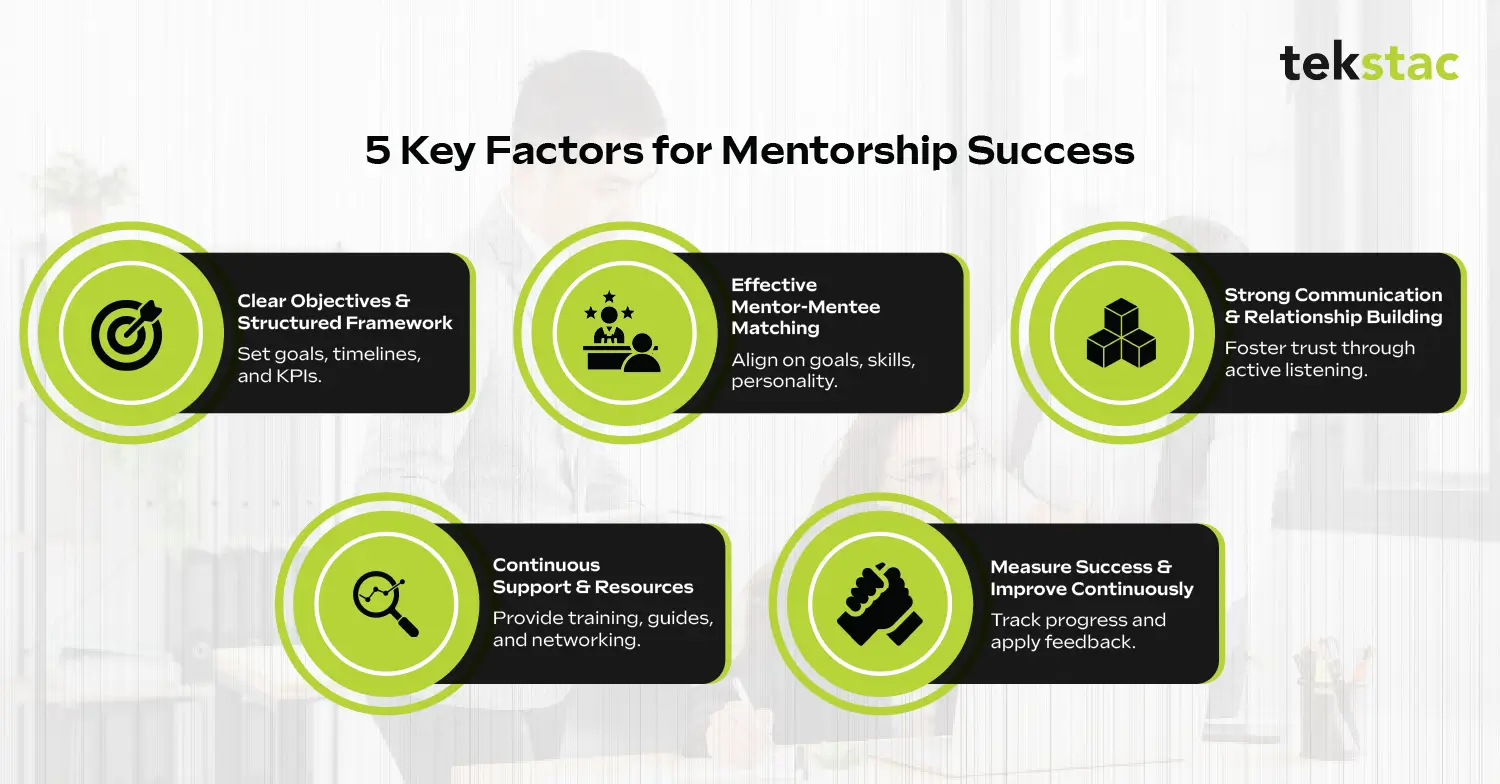
A mentorship program can only succeed when its purpose is clearly defined from the outset. Enterprises must outline measurable goals, whether the focus is accelerating career progression, building leadership pipelines, strengthening knowledge transfer, improving engagement, or advancing diversity initiatives.
However, one of the primary reasons mentorship programs fail is not the lack of intent, but the lack of structure. When expectations are unclear, mentors and mentees are left without guidance, resources, or leadership backing. Over time, participation drops and the initiative loses momentum.
Before launching mentoring programs, organizations need to answer a few hard-hitting questions:
A structured mentorship framework provides guidance for mentors and mentees. Essential elements include:
An effective mentorship program prioritizes compatibility between mentors and mentees. Poor pairings can lead to disengagement and lacklustre results.
A study by Harvard Business Review found that mentoring programs can increase retention rates by 72% for mentees and 69% for mentors. For companies, this directly boosts employee retention and builds a strong pipeline of future leaders .
Many organizations use AI-driven platforms for mentoring to facilitate mentorship matching based on preferences, career objectives, and behavioral assessments. This data-driven approach increases the likelihood of successful mentor-mentee relationships.
The heart of any mentorship program lies in strong communication and meaningful relationships. Without effective communication, mentorship programs lose their impact.
Equally important is building psychological safety. Mentors must practice active listening and create a non-judgmental space where mentees feel comfortable discussing challenges and ambitions.
Mentorship programs should not operate in isolation. Providing ongoing support and resources ensures mentors and mentees remain engaged and derive maximum value.
Even experienced professionals may not be natural mentors. Organizations should offer:
Mentees should have access to:
Studies show that 71% of Fortune 500 companies have formal mentorship programs, reinforcing the importance of structured mentorship in organizational success.
A successful mentorship program continuously evolves based on feedback and data-driven insights. Organizations must establish clear evaluation metrics to measure effectiveness.
A report by McKinsey found that companies with strong mentorship programs see a 24% increase in employee performance and engagement compared to those without.
Regularly reviewing feedback from mentors and mentees helps refine the program. Organizations should:
Successful mentorship programs require more than good intentions; they need clear goals, structure, communication, and sustained support. When executed well, they strengthen culture, build future leaders, and improve retention. The right mentorship strategy doesn’t just develop employees. It drives long-term organizational success.
So how well does your organization’s mentorship program align with these five key success factors? If you’re looking to strengthen, scale, or refine your approach, now is the time to act. The right mentorship strategy doesn’t just support employees. It transforms organizations.
1. What are the types of mentoring in the workplace?
The three main types of mentoring programs are corporate mentoring (focused on leadership development and talent retention), peer-to-peer mentoring (knowledge sharing among employees at similar levels), and professional mentoring (pairing early-career professionals with experienced leaders for career growth).
2. What makes a mentoring program successful?
A mentoring program succeeds when it is built around a clear, measurable strategic purpose and backed by strong executive sponsorship. It includes thoughtful program design, trained mentors, structured communication, quality mentor-mentee matching, ongoing data tracking, and consistently celebrating outcomes to demonstrate impact.
3. What are the top mentoring program benefits for organizations?
Mentoring programs increase employee loyalty and reduce turnover. They also strengthen skills, boost engagement through meaningful cross-functional connections, and reinforce company culture.
4. How do enterprises implement mentorship programs?
Enterprises implement mentorship programs by defining objectives, matching mentors and mentees, setting milestones, offering training, tracking progress, and scaling across diverse teams.