

Career Progression Plan: What It Is and How to Build One That Actually Works
June 25, 2025

Why Most Career Progression Plans Fail Your Best Employees
Your best engineer just left.
Again. Official reason?
“Looking for better growth opportunities.” But let’s be real, they just couldn’t see a future here.
Now the team’s left picking up the pieces, and you’re stuck trying to figure out promotions with half-baked feedback and gut calls. You’re hoping you’re getting it right, but deep down, you’re not sure.
And it’s not just about losing one person. It hits harder, and morale dips. Work slows down.
The problem?
Most career progression plans are just broken. Too much guesswork. Too much politics. Not enough clarity or fairness.
So yeah, it’s not just a one-off. It’s a pattern. And if nothing changes, the best people will continue to walk out the door.
What Is a Career Progression Plan?
A career progression plan is a structured roadmap that defines how an employee can grow within an organization mapping current skills, identifying capability gaps, and outlining the steps, milestones, and support needed to reach the next role or level of responsibility. It differs from a job description (which defines a current role) and an annual review (which evaluates past performance). According to Gartner, only 46% of employees feel supported in growing their careers at their organization, which means for most companies, career progression exists in name only. Done well, a career progression plan aligns individual ambition with business capability needs, reduces reliance on external hiring, and is one of the most measurable tools for improving long-term retention.
The Brutal Reality Behind Failed Career Systems
Here’s what’s happening in your organization under the guise of employee career development:
- The visibility trap: The ones who speak up the most often get noticed. They get promoted. Meanwhile, the quiet high-performers keep delivering real results but stay under the radar. Over time, that lack of recognition turns into quiet frustration. The potential is there, but it’s left untapped.
- The title inflation game: New senior titles keep getting created, but nothing changes in the work or responsibility. It just adds noise. Teams often get confused, and external candidates struggle to understand the actual meaning of these titles.
- The management bottleneck: Every promotion or role change depends on managers who are already overloaded. They are short on time and stretched to the limit. That leads to delays, inconsistent decisions, and people feeling stuck without a clear way forward.
- The skill speculation problem: People are being judged based on assumptions or how they perform in interviews rather than on real, proven work. This leads to mismatched roles, frustration, and a disconnect between potential and performance.
Gallup estimates that replacing an employee in a technical role cost around 80% of their annual salary, and that figure excludes the compounding costs: stalled projects, knowledge loss, and the morale hit the team left behind.
How to Build a Career Progression Plan That Actually Works
It’s time to treat career development like a well-engineered system—methodical, data-driven, and continuously evolving.
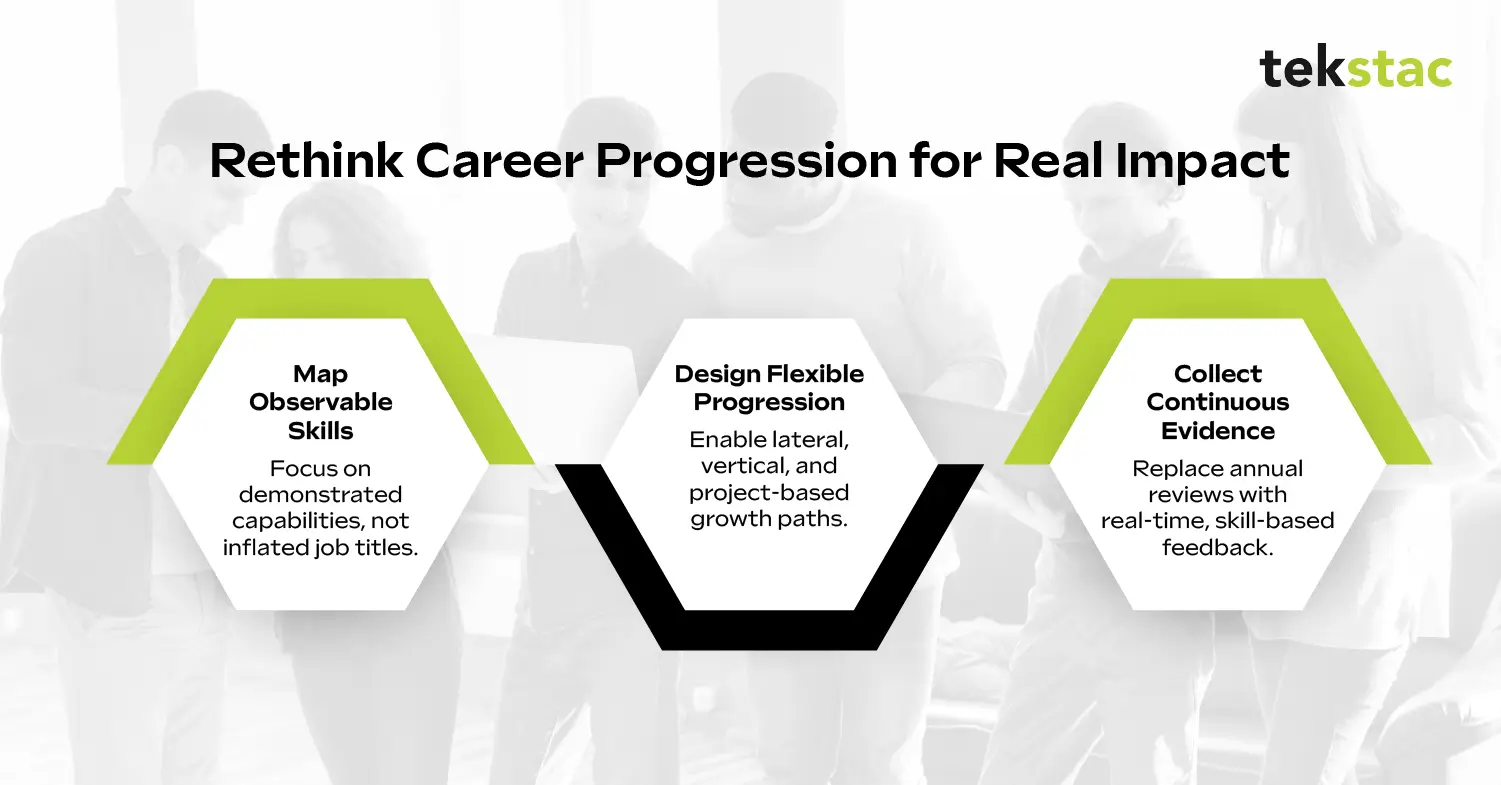
- Map Observable Skills, Not Fluffy Titles.
- Design Flexible Career Progression Plans, Not Ladders.
- Replace Annual Reviews with Continuous Evidence Collection.

1. Map Observable Skills, Not Fluffy Titles
Define what people can do—don’t rely on vague titles.
- Concrete capability clusters: For example, “designs and deploys scalable microservices capable of handling over ten thousand concurrent users with high uptime” provides leaders with clarity and engineers with purpose.
- Real-world problem complexity: Track someone’s ability to identify and resolve tricky production race conditions under pressure rather than just attendance or code volume.
- Context‑specific abilities: Recognize that excelling at legacy refactoring is different from greenfield architecture; both deserve acknowledgment, but they require clarity of context and measurement.
- Measurable depth indicators: Map progression from “needs guidance to implement” up through “independently leads and mentors peers on advanced patterns across projects.”
2. Design Flexible Career Progression Plans, Not Ladders
People don’t grow in straight vertical ladders—they flourish across diverse, evolving career pathways.
- Multiple advancement paths: Create distinct tracks, such as technical specialist, engineering lead, or systems architect, allowing engineers to grow based on impact rather than role or hierarchy.
- Lateral skill expansion: Enable transitions, QA engineers developing DevOps proficiency, backend developers learning security best practices, or data analysts moving into product analytics without penalizing them for sideways moves.
- Diagonal capability building: Encourage growth at the intersection where senior developers adopt product thinking or engineers begin to develop core business strategy acumen, bridging gaps across teams.
- Dynamic role evolution: Refresh and adjust tracks quarterly to reflect changing priorities, new tech stack investments, or emerging business needs, keeping growth aligned with the company’s direction.
3. Replace Annual Reviews with Continuous Evidence Collection
Why evaluate performance once annually when engineers are evolving daily?
- Project-based skill demonstration: Every code review, production deployment, and architecture session becomes a data point that evidences capability development and tangible impact on business outcomes.
- Peer validation mechanisms: Structure input from the teammates who work with someone every day. This gives a much clearer picture of how they collaborate and how much trust they’ve earned within their domain, compared to just relying on top-down reviews.
- Real-time capability dashboards: Make individual progress visible to engineers, managers, and leaders alike, highlighting strengths, areas for growth, and potential next steps at any time.
- Transparent progression criteria: Publicly share what’s required to advance to the next level, removing guesswork, bias, and inconsistency in promotions or recognition.
How to Align Career Progression with Business Goals
This is not a nice-to-have. It’s a competitive business advantage when engineers’ growth aligns with organizational growth goals.
- Align skills with business direction: Don’t invest in declining languages or tools. Focus on where your roadmap is headed, whether it’s AI platform development, full-stack expansion, or reliability engineering.
- Future‑focused capability building: If your strategy includes an AI-native architecture, build machine learning fluency across engineering teams, not just within one silo, through targeted learning paths and live projects.
- Platform transformation readiness: While migrating to cloud-native systems, fast-track engineers who have already demonstrated the ability to work with microservices architecture, container orchestration, and resilience patterns.
- Cross‑functional bridge building: Encourage engineers to speak product language, especially when customer experience becomes the competitive edge, improving communication, alignment, and solution quality.
Strategic workforce intelligence: Use real-time, anonymized skill data to answer critical questions: “Are we technically ready for our next 18-month roadmap? Who’s closest?“—without gut guessing.
Succession Planning: How to Identify and Develop Future Leaders
When leaders leave, don’t scramble. Plan ahead.
- Capability trajectory tracking: Spot the people who are growing in both technical depth and influence across the team. This helps you understand who might be ready for bigger roles before you’re forced to make urgent decisions.
- Experience gap bridging: Give engineers the kind of stretch opportunities that actually prepare them for what’s next. Let them lead cross-team architecture reviews or take on client-facing technical demos so they’re ready when the time comes.
- Leadership pipeline visibility: Make it easy for leaders to see where their teams stand. Show them who’s ready, who could step up next, and where the risks are so that they can plan with clarity and confidence.
How to Measure Career Progression: The Metrics That Matter
Ditch HR vanity metrics—track indicators reflecting real system health and strategic impact.
- Internal promotion rate: Measures what percentage of senior roles are filled from within versus external hires. A healthy benchmark is 30-40% internal fills for mid-to-senior roles. If your rate sits below 20%, your career progression plan is not producing promotable talent; it is producing people who leave when they’re ready to move up.
- Capability development velocity: Tracks how quickly employees acquire the skills your roadmap actually requires. The metric matters because most organizations invest in L&D without connecting it to strategic skill priorities. Companies that offer structured upskilling opportunities retain 58% more employees, according to the World Economic Forum. Making velocity a retention metric as much as a development one.
- Cross-team mobility success: Monitor whether staff are moving between domains to share knowledge or are trapped in silos with stagnant role paths.
- Retention correlation: Analyze whether professionals moving along defined, capability-based tracks stay longer than those in outdated, hierarchical systems.
Upskilling and Reskilling: Building Learning Into the Flow of Work
Forget generic courses—build learning into everyday work.
- Business needs-based skill development: Recommend learning content tied directly to upcoming project tasks and role requirements rather than generic catalogs.
- Work‑embedded practice: Integrate skill reflection into sprint retrospectives, design reviews, and daily standups, making learning part of engineering flow.
- Mentorship as a growth multiplier: Develop structured peer coaching where senior team members both coach and refine their leadership through active mentoring.
- Evidence‑based learning outcomes: Track which learning efforts (courses, projects, peer-teaching) correlate with actual performance improvements and promotion readiness.
The best engineers don’t just want a title; they want a Career Progression Plan that’s visible, practical, aligned to impact, and personally meaningful. Help them see the art, science, and movement of their career. Do that, and you’ll stop losing great people to uncertainty.
Build a Career Progression System That Retains Your Best People
Building a career progression plan that holds up at scale requires more than a spreadsheet and an annual review cycle. Tekstac is an AI-powered skills intelligence platform used by enterprise teams at IBM, PwC, and Capgemini to map role-aligned skill requirements, track capability development in real time, and connect learning investment to measurable business outcomes. If career progression at your organization is still running on gut calls and guesswork, Tekstac gives you the infrastructure to make it systematic. [Request a personalized demo →]
FAQs on Career Progression Plan
1. What should a career progression plan include?
A strong career progression plan includes: the employee’s current skill profile, the skills required for the next role or level, a clear gap analysis, defined milestones with timelines, the development resources available (training, mentoring, projects), and a review cadence. Plans without defined milestones and gap analysis are not progression plans they are intentions.
2. Why do most career progression plans fail?
Most career progression plans fail because they rely on visibility over performance (the loudest employees get promoted), annual reviews over continuous evidence, and manager judgment over structured data. Without a system to capture real skill development over time, progression becomes subjective, and subjective progression drives attrition.
3. How does a career progression plan improve employee retention?
Career progression plans improve retention by giving employees a visible, credible path forward. According to LinkedIn’s Workforce Learning Report, employees who make an internal move are 75% more likely to stay long-term compared to 56% for those who don’t. which means a functioning progression plan is one of the most cost-effective retention tools available.
4. What is the difference between a career ladder and a career progression plan?
A career ladder is a fixed, vertical hierarchy each rung represents a promotion to a higher title. A career progression plan is more flexible: it accommodates lateral moves, diagonal growth (e.g., a developer in building product thinking), and role evolution over time. Career ladders reward tenure; career progression plans reward capability.