
How many times have you gotten praise at work that didn’t quite hit right?
Like it was from someone who didn’t really see the effort you put in — or the struggles you faced. That’s the most common experience with traditional top-down recognition, which misses the mark because it’s distant, generic, or delayed.
This disconnect is exactly why peer-to-peer recognition is becoming essential in modern workplaces. Recognition carries more meaning when it comes from colleagues who work alongside you, understand the challenges, and witness the real impact of your effort.
In fact, a study by the Harvard Business Review found that 82% of senior leaders feel they don’t receive enough recognition. That says a lot about the culture collapse in organizations even today.
The traditional employee engagement strategies are ineffective today. Our way of recognizing employees is stuck in the past, being outdated and out of sync with how work actually gets done today. What we need is something real and immediate, coming from people who see the hard work and impact of work every single day. That something is peer-to-peer recognition.
Peer-to-peer recognition is when employees recognize each other’s work, contributions, and skills. They recognize publicly and directly, without waiting for a manager or a leader to do it. It’s that shout-out from the teammate who saw you stay late just to get that project done. Or a quick thanks from a coworker who knows exactly how much time you saved them.
Top-down praise has been the traditional way workplaces recognize achievements for decades. It flows from management down through the organizational hierarchy, and this model is currently showing its age. What once seemed like the natural order of workplace acknowledgement now feels increasingly disconnected from the real work happening on the ground.
Picture this: a manager who’s not involved in the daily grind gives praise based on a quarterly review or what they heard from someone else. The timing’s off. They don’t really get the full picture. So when the praise finally comes, it feels more like formality than real thanks.
This model can also result in a system where employees look up for approval rather than around for collaboration. If we look around, the modern workplace doesn’t operate in typical hierarchical lines anymore. Projects across departments, teams form and dissolve based on need, and some of the most valuable contributions happen in the spaces between job descriptions. Yet our recognition systems remain stuck in an organizational chart that doesn’t reflect how work actually flows.
Furthermore, managers have limited bandwidth, making recognition another item on an already crowded to-do list. What should be immediate and genuine becomes scheduled, hence organizations are now shifting towards peer-to-peer recognition.
The shift we’re seeing, from hierarchical praise to peer recognition, is not a trend; rather, it delivers measurable advantages that traditional top-down systems simply cannot match.
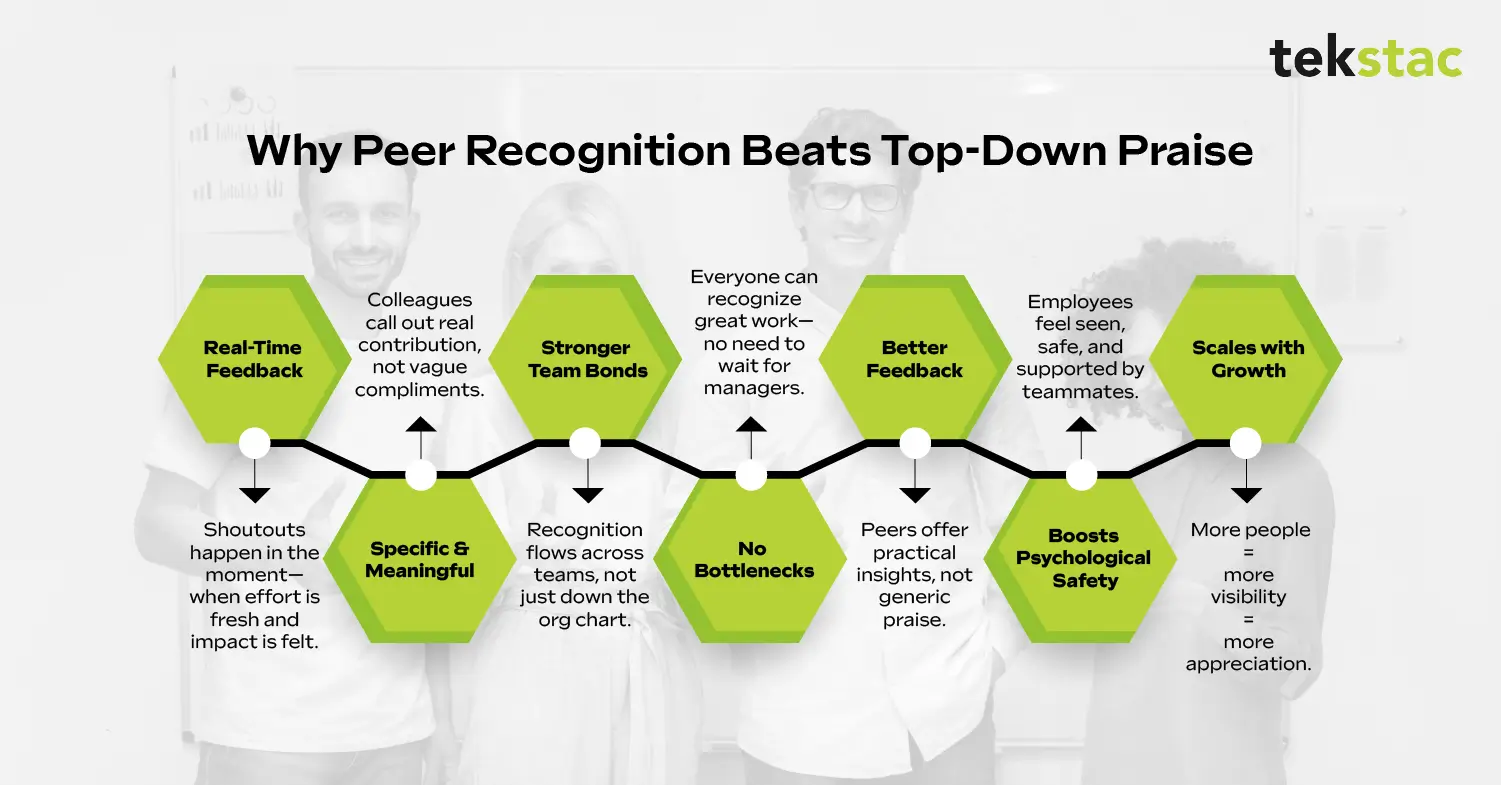
Peer recognition operates on the principle of proximity, as colleagues work alongside each other, see the real challenges, and witness the actual problem-solving process. Hence, peer to peer recognition naturally addresses specific contributions rather than broad performance categories. In contrast, top-down recognition often lacks the same level of detail because managers don’t always see day-to-day contributions.
Recognition loses power when it’s delayed. Acknowledgement hits hardest when it comes right after the win, while the effort is still fresh. That’s why peer-to-peer recognition works so well. They happen naturally, in the moment, not because some formal process says they have to. This immediacy also means that recognition can influence ongoing work, encouraging continued collaboration and excellence within the same project cycle.
Most companies focus on the relationships between managers and their teams. However, while this is important, it is only one way how people can connect at work. When colleagues recognize each other directly, it creates a different kind of connection, boosts employee morale and motivation and morale, rather than just formal mail.
Managers, despite good intentions, cannot always see every contribution, which can create recognition gaps when they are busy or unaware. Peer-to-peer recognition spreads this responsibility across the team, ensuring good work is noticed more often.
The best recognition goes beyond praise and offers insights that help people improve. Peer-to-peer recognition is effective because co-workers understand the work closely and can explain why a contribution mattered. This level of detail turns appreciation into continuous learning. In contrast, top-down praise often stays broad and lacks the specifics needed to repeat success.
Psychological safety at work is the confidence to speak up without fear of judgment, and peer recognition helps build it naturally. When teammates appreciate each other’s work, people feel safer sharing ideas and admitting mistakes. This support shifts focus from fear to improvement. Manager recognition is valuable, but it doesn’t always create the same level of comfort as peer-to-peer appreciation. Social recognition at work is equally important.
The quality and frequency of recognition often decline as team size increases. Peer-to-peer recognition scales more naturally when teams grow, with more people noticing and appreciating diverse contributions. It strengthens as teams expand or shift across projects. Unlike fixed top-down systems, it adapts easily to change.
Recognition should not stop at daily work. It also plays a powerful role in learning and upskilling cultures.
Peer-to-peer recognition itself is evolving and becoming more complex in 2026 as AI enters the workplace. A recent report shows that 67% of employees can still distinguish between human-written and AI-generated recognition messages. The real differentiator will be creating authentic, human-centered recognition cultures supported by technology.
Ready to see this in action? Discover how Tekstac enabled a fortune 500+ tech company to transform its culture by onboarding and upskilling 40,000+ fresh graduates, creating the visibility, accountability, and cross-team connections that make peer-to-peer recognition thrive.
1. Why is peer-to-peer recognition important?
Peer-to-peer recognition strengthens everyday work culture because appreciation increases visibility of contributions, builds psychological safety, and encourages continuous learning.
2. How do you structure peer-to-peer recognition in your company?
The most effective structures are simple, visible, and integrated into daily workflows. This can include digital recognition platforms, monthly shout-outs during team meetings, learning-achievement highlights, or internal community boards.
3. What types of rewards or recognition programs work best?
Not all recognition needs to be monetary. You can combine social recognition at work with experiential rewards such as course sponsorships, mentorship opportunities, or skill-building programs.