
Don't Miss Out: Tekstac & SHRM Research Report 2025 | |
In partnership with People Matters, this Round Table brought together leaders from across industries to explore how AI is revolutionizing the way organizations build future-ready talent. From AI-powered coaching simulations to predictive skill benchmarking and adaptive learning, participants shared real-world use cases of leveraging AI to drive personalized learning, workforce productivity, and measurable business outcomes.
September 12, 2024 | Chennai
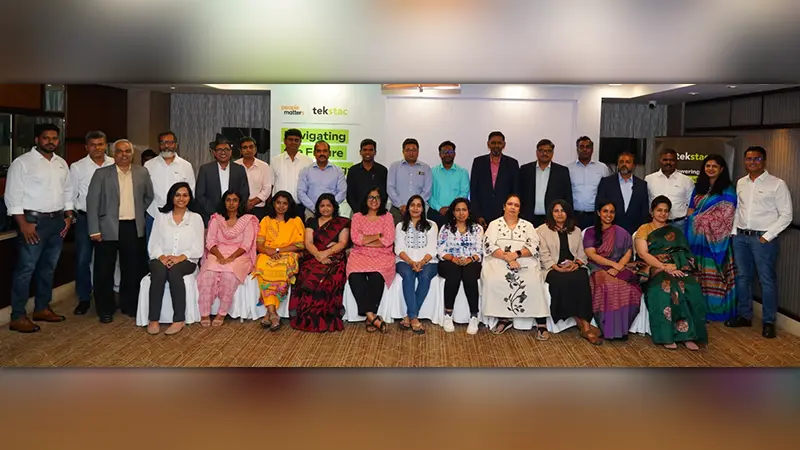
What made the discussion particularly compelling was the diversity of real-world applications shared by participants.
In healthcare, leaders spoke about how AI is already being used to support diagnostics, train interns through simulated environments, and leverage predictive analytics to better understand patient demographics and lifestyle patterns. These applications are not only improving accuracy but also enhancing the quality of training and decision-making.
Discussions also highlighted how AI is also being used to:
These use cases emphasised how AI is gradually becoming embedded into everyday learning workflows.
Another strong perspective that emerged was the need to rethink how learning success is measured.
Organisations are moving beyond completion rates and feedback scores, focusing instead on how learning translates into performance and business outcomes.
With the help of analytics, L&D teams can now proactively identify skill gaps, predict learning needs, and assess employee readiness for future roles.
As discussed during the session, the real value lies in linking learning outcomes to metrics such as productivity, efficiency, and time-to-deployment.
The conversation also acknowledged that while AI is promising, it is not without limitations.
Saransh Agrawal, Head of Learning at Cognizant, spoke about the current challenges in fully addressing complex L&D needs through AI alone. This highlighted an important point: AI must complement human expertise, not replace it.
Echoing this, Chhaya Ramani, Global Learning and Development Partner at AstraZeneca, emphasized the potential of AI in predicting learning needs, enabling organisations to design more targeted and personalised interventions.
Maya Rajaguru, Head of Learning and Development at Apollo Hospitals, added another dimension, highlighting how L&D functions can evolve into profit centres when learning initiatives are closely aligned with business objectives.
At the heart of the discussion was a shared focus on outcomes.
Krishnan Unni, Chief Business Officer at Tekstac highlighted Tekstac’s “Objective to Outcome” methodology, which centres on aligning every learning initiative with a clearly defined business goal. This approach ensures that learning is not just delivered but designed to create measurable impact.
Participants also explored the growing role of generative AI in assessments and adaptive learning systems, tools that can evolve with organisational needs and make learning more agile and responsive.
The roundtable concluded with a strong consensus; learning is no longer a support function; it is becoming a strategic driver of business growth.
With AI, analytics, and emerging technologies shaping the future, organisations have an opportunity to transform learning into a function that delivers measurable value.
For those willing to embrace this shift, the path is clear: move beyond training, focus on capability, and align learning with outcomes that truly matter.

Transforming tech upskilling with data-driven insights and holistic learning solutions
© 2026 Tekstac. Copyright and rights reserved.
Transforming tech upskilling with data-driven insights and holistic learning solutions
© 2024 Tekstac. Copyright and rights reserved.