

Learning outcomes define what learners should know, understand, or be able to demonstrate after completing a course, certification, or corporate training program. Unlike learning objectives, which focus on what instructors intend to teach, emphasize measurable learner achievements. They help organizations evaluate training effectiveness, identify skill gaps, improve employee performance, and demonstrate learning ROI. Whether you’re designing an employee training program or evaluating workforce readiness, clearly defined learning outcomes provide the foundation for measurable business success.
Learning outcomes are the specific skills, knowledge, attitudes, and competencies that a learner is expected to acquire as a result of a learning experience. Unlike learning objectives, which describe what the instructor aims to teach, learning outcomes describe what the learner can do after the training. These outcomes are measurable and actionable, making them essential for evaluating learning effectiveness.
Examples of learning outcomes include:
Although the terms learning outcomes and learning objectives are often used interchangeably, they serve different purposes in education and corporate training. Learning objectives describe what instructors intend to teach, while learning outcomes focus on what learners can demonstrate after completing the training. Understanding this distinction helps organizations design measurable training programs, assess learner performance, and align learning initiatives with business goals.
| Learning Objectives | Learning Outcomes |
|---|---|
| Instructor-focused | Learner-focused |
| Broad | Measurable |
| Course design | Performance evaluation |
| Teaching plan | Demonstrated skills |
Bloom’s Taxonomy is a widely recognized framework for creating measurable learning outcomes. It helps educators and L&D professionals use clear, action-oriented verbs to define what learners should know, understand, and demonstrate after training. By aligning learning outcomes with Bloom’s Taxonomy, organizations can design more effective assessments, accurately measure skill development, and connect training outcomes to business performance and ROI.
Organizations invest millions in learning and development each year. But without concrete measurement, these initiatives risk becoming superficial. Here are some key reasons why measuring learning outcomes is critical:
Measuring outcomes helps determine whether a training initiative led to improved skills or behavior change. This validation ensures that learning is meaningful, not just procedural.
Assessment of learning outcomes helps identify skill gaps, enabling personalized learning paths. For instance, if a learner struggles with a certain concept, targeted content or support can be introduced. Over time, this leads to continuous improvement in both learning content and learner performance.
When learning outcomes are tied to business objectives (like improved customer satisfaction, increased productivity, or reduced error rates), it creates alignment between individual development and organizational success.
In today’s data-driven world, L&D departments are increasingly accountable for delivering measurable results. Outcomes-based measurement offers transparency and builds credibility with stakeholders.
You can’t demonstrate ROI without data. Measuring learning outcomes provides the metrics needed to correlate learning interventions with business impact, making it possible to justify or even expand the L&D budget.
Traditional learning measurement methods, such as tracking attendance and course completion, are giving way to more sophisticated, data-rich approaches. Organizations now leverage data analytics to capture granular insights into learner performance, progression, and engagement.
This shift is fueled by the increasing availability of digital learning platforms and AI-driven tools that collect, process, and analyze learning behavior in real-time. Predictive analytics, adaptive assessments, and learning experience platforms (LXPs) are transforming how we measure success. By using data to continuously evaluate and refine learning interventions, organizations ensure that every learning dollar is spent strategically.
According to a Deloitte survey, 61% of high-performing organizations use data analytics to support learning strategy development- more than double the rate of their lower-performing peers.
The ultimate goal of measuring learning outcomes is to prove—and improve—return on investment (ROI). Here’s how outcomes data directly impacts ROI:
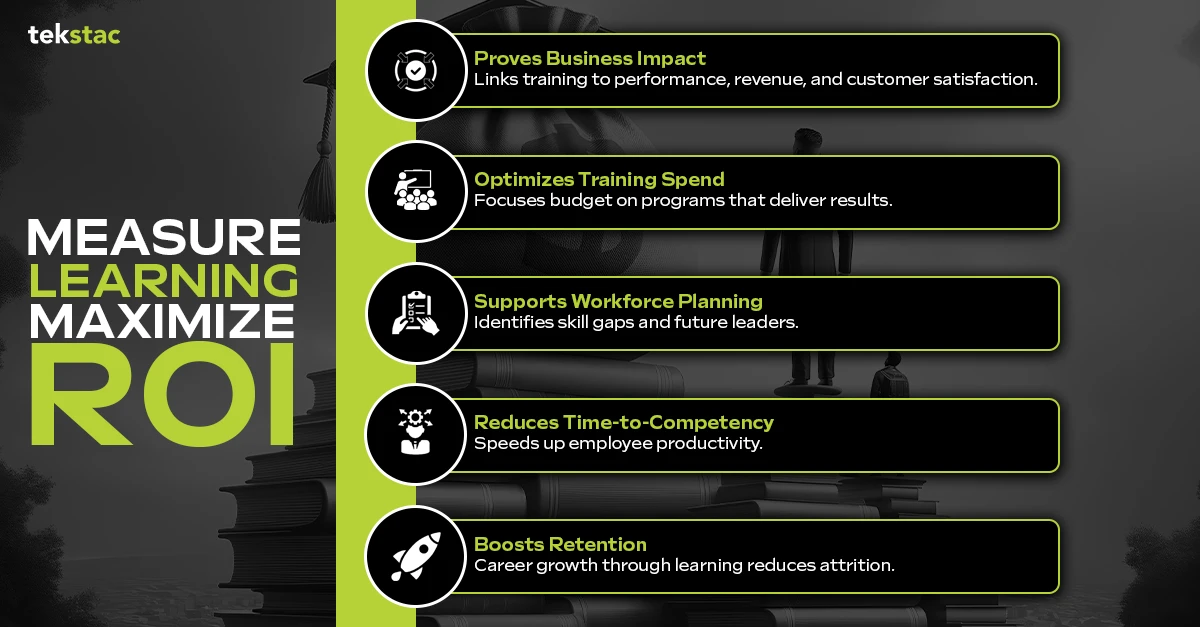
Clear outcomes link learning efforts to key business metrics such as employee performance, customer satisfaction, and innovation speed. For example, improved sales training outcomes can be measured against increased revenue or shorter sales cycles.
Outcome data helps identify high- and low-performing programs, enabling better budget allocation. By cutting ineffective initiatives and scaling successful ones, organizations maximize learning ROI.
By measuring outcomes, organizations can identify future leaders, skill shortages, and team strengths. This enables proactive talent management and succession planning.
Effective training backed by measurable outcomes shortens the time it takes for employees to reach full productivity, accelerating ROI.
Employees who see real career progression through skill development are more engaged and less likely to leave, significantly reducing attrition costs.
Many organizations still rely on traditional methods like attendance tracking, course completion rates, or post-training feedback forms. While useful for gauging engagement or satisfaction, these methods do not assess skill application or knowledge retention.
Modern approaches include:
When you have clear data on what works and what doesn’t, you can make better decisions about content, delivery methods, and resource allocation.
Learners who see a direct link between their efforts and career growth are more motivated. Measurable outcomes act as milestones that validate progress.
A McKinsey study reveals that only 40% of companies align learning strategies with business objectives, underscoring the need for clearer measurement frameworks that connect learning outcomes to performance and ROI.
A Harvard Business Review report shows that companies that effectively measure and act on learning data are 24% more profitable than their peers.
In a fast-changing market, the ability to rapidly upskill or reskill talent is a competitive advantage. Measuring learning outcomes helps build this agility.
According to a LinkedIn Learning report, 73% of L&D professionals say their leadership wants them to connect learning to business outcomes. Accurate measurement makes this possible.
Despite its importance, outcome-based measurement is not without challenges:
This is where intelligent learning platforms like Tekstac come into the picture.
Tekstac is a 360° skilling platform that integrates learning, assessments, and analytics to provide a holistic view of learner development. Unlike traditional LMS or LXPs, Tekstac is designed to focus on outcomes, not just activities. Its learning engine is built to simulate real-world scenarios and projects that mirror actual workplace challenges.
Tekstac assessments cover multiple formats, including auto-evaluated coding tasks, case-study evaluations, scenario-based MCQs, and AI-proctored video assessments. Each assessment is role-mapped, which ensures that learners are tested on job-relevant skills. This results in more precise measurement of learning outcomes and more actionable insights.
Tekstac’s assessment engine generates deep insights into skill proficiency, growth trajectory, and role readiness. For organizations, this means they can:
Ultimately, Tekstac doesn’t just help you assess what learners know- it helps you understand what they can do. And when learning outcomes are that clear, ROI follows naturally.
Turn learning outcomes into measurable business results with Tekstac. Discover how our AI-powered skills assessments, learning analytics, and role-based learning paths help organizations validate workforce capabilities and maximize training ROI. Book a demo to see how Tekstac can transform your learning and development strategy.
1. What is the purpose of measuring learning outcomes?
Measuring learning outcomes helps organizations evaluate training effectiveness, identify skill gaps, and link learning to business results and ROI.
2. What are the best platforms for tracking learning outcomes in online courses?
The best platforms for tracking learning outcomes in online courses include learning management systems (LMS), learning experience platforms (LXP), and skills assessment platforms such as Tekstac. These platforms provide assessments, analytics dashboards, progress tracking, and measurable insights into learner performance and skill development.
3. What is the difference between learning objectives and learning outcomes?
Learning objectives describe what training intends to teach; learning outcomes define what learners can actually do afterwards.
4. How do learning outcomes impact ROI?
They provide measurable evidence of performance improvement, enabling better budget allocation and business impact analysis.
5. Which companies offer software solutions to measure learning outcomes in corporate training?
Several companies offer software solutions to measure learning outcomes in corporate training, including Tekstac, Degreed, Cornerstone, Docebo, and other enterprise learning platforms. These tools combine assessments, analytics, skill tracking, and performance insights to help organizations evaluate training effectiveness and business impact.