
A skills assessment is a structured, data-driven process that measures employee capabilities against role requirements to identify skill gaps and guide targeted upskilling. Organizations that implement regular skills assessments reduce misaligned training spend, improve talent deployment, and build a workforce that adapts to change. This guide covers how to build a skills assessment process, conduct employee skill gap analysis, and choose the right tools.
Roles are frequently assigned based on resumes, past job titles, or assumed experience, not based on validated, current capabilities through a proper Skills Assessment. That’s where the inefficiencies start to creep in. Over time, these assumptions evolve into a quiet but dangerous problem: skill blindness. Our Skills Assessment Guide can help you break this cycle by identifying real skill gaps and aligning talent more effectively.
It is a structured and data-driven method that organizations use to understand the current skills of their employees and compare them with the skills required for their roles. Instead of relying on assumptions, job titles, or intuition, a Skills Assessment provides clear, measurable insights into workforce strengths, skill gaps, and development needs.
A typical Skills Assessment includes:
In simple terms, it removes guesswork and helps companies make smarter decisions about talent alignment, learning investment, and productivity improvement.
To turn this assessment data into meaningful action, organizations rely on skill insights to interpret workforce capabilities, identify patterns, and drive smarter talent decisions.
Without a structured skills assessment strategy in place, organizations end up guessing their way through talent deployment. That guesswork may hold up for a while, but eventually, it snowballs into misaligned responsibilities, inefficiencies, and burnout.
Take this example: A software development team consistently lags behind deadlines.
The assumption is they need more staff. So leadership hires aggressively. Yet the problem persists. The real issue? A misalignment between skill sets and project demands, not the headcount.
Without proper Employee skill gaps analysis, you risk:
This leads to:
Ultimately, you can’t optimize what you can’t measure. And measuring skills is the foundation for building an adaptable, competitive workforce.
According to Deloitte’s Global Human Capital Trends report, only 14% of business executives strongly agree their organization fully leverages workforce skills — a persistent gap that costs organizations in productivity, retention, and competitive readiness.
To eliminate these pitfalls, companies must adopt a structured, repeatable, and data-driven Skills Assessment framework.
A robust Skills Assessment strategy provides:
But it’s not about generic surveys or one-time testing. True Skills Assessments are ongoing, role-specific, and aligned with real-world performance.
Conducting a skills assessment without a structured process leads to the same problem it’s meant to solve — decisions based on assumptions rather than data. Organizations that follow a repeatable framework identify skill gaps 2x faster and allocate training budgets with measurably higher precision than those using ad-hoc evaluation methods. The five steps below form a proven sequence used by enterprise L&D teams to move from scattered intuition to a clear, actionable picture of workforce capability. Each step builds on the last — skipping ahead produces incomplete data and unreliable outputs.
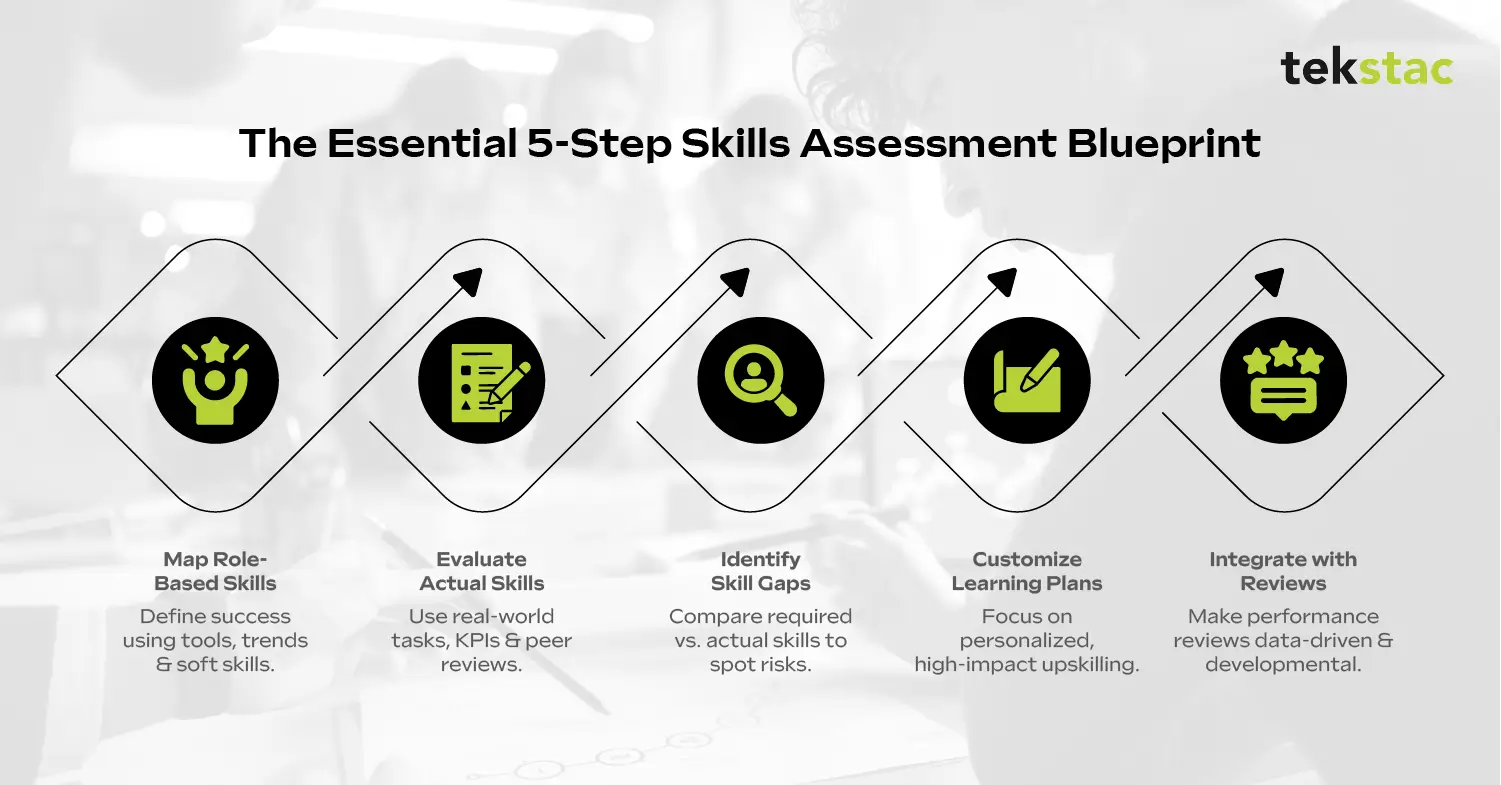
Start by defining what success looks like in each role.
Don’t just rely on generic job descriptions. Factor in:
Core technical competencies tied to business impact
Assessments should be performance-based, not theoretical. Combine:
This holistic view reveals not just what someone knows—but how they apply it.
Once both the “required” and “actual” skill levels are clear, it’s time to identify gaps.
Ask:
Tools like Tekstac offer actionable dashboards that visualize these gaps for informed planning. For organizations looking to improve engagement, modern employee assessment tools now include gamified simulations and interactive challenges. Explore our guide to gamified employee assessments to see how enterprises use game mechanics for skill evaluation.
Use the gap data to design interventions that are:
Avoid generic training modules. Go for high-impact courses, mentorship, job rotations, or AI-driven microlearning.
Instead of treating Employee performance reviews as standalone rituals, integrate updated Skills Assessment data.
This:
A structured employee skill profile gives managers a consolidated view of each individual’s verified competencies, learning progress, and skill gaps — making career path conversations evidence-based rather than subjective.
IBM implements continuous skill assessments across departments. This enables:
The result? A future-ready, agile workforce and improved employee retention.
Google integrates hands-on coding assessments with interviews. This dual approach:
Google’s model highlights how customized role-specific assessments lead to better hires.
Amazon uses data-driven, scalable skill assessments in both tech and non-tech roles. Their success lies in:
This has streamlined their high-volume recruitment while ensuring role alignment.
By now, it’s clear: building a Skills Assessment framework isn’t just about checking boxes, it’s about creating a high-performance learning culture.
The benefits include:
Effective Skills Assessment isn’t just about methodology—it’s about execution. For that, you need the right platform.
An ideal tool should offer:
One platform that delivers across these fronts is Tekstac.
Tekstac provides a comprehensive platform designed specifically for organizations aiming to execute a structured Skills Assessment strategy. Here’s how it maps directly to your needs:
Tekstac aligns its evaluation modules with specific job functions. This means:
This relevance ensures accurate insights, not guesswork.
For technical roles, Tekstac provides live coding environments that simulate real business challenges. This tests:
Using smart algorithms, Tekstac automates evaluations. No more manual checks. The platform also benchmarks individual performance against:
This lets you see exactly where your talent stands competitively.
One of the standout features of Tekstac is its data visualization engine. Leaders get:
Tekstac doesn’t replace your existing systems—it enhances them. It can plug into:
This ensures that Skills Assessment becomes part of your daily workflow, not an isolated event.
Even when leaders understand the value, adoption of a Skills Assessment system is often delayed due to concerns. Let’s tackle them head-on.
Reality: While the initial investment requires time and effort, the return is exponential.
Think of it as building a foundation for everything: learning, staffing, innovation.
Reality: If framed incorrectly, yes. But the key is intentional communication.
You’re building a feedback-rich culture, not a punitive one.
Reality: This is where tools like Tekstac excel.
Their assessment libraries can be updated regularly to reflect:
Additionally, since assessments are data-driven, you can adapt based on live skill evolution.
Reality: With modern APIs, platforms like Tekstac make integration nearly frictionless.
They offer plug-and-play compatibility with popular platforms, ensuring that:
Now that tools and objections are covered, here’s a practical execution roadmap to embed Skills Assessment into your culture.
Choose a single department (e.g., engineering or sales). Use Tekstac to:
Measure outcomes (project success, engagement scores, peer feedback) to validate the ROI.
Connect results directly to upskilling and reskilling strategies. Whether you use internal academies or external platforms, make sure the learning paths solve for actual, identified gaps.
Bring the Skills Assessment data into regular employee performance reviews.
After validating with one unit, roll out across departments.
Best practice: staggered implementation with champions from each team. This improves adoption and reduces pushback.
Once fully embedded, Skills Assessments become part of your company DNA. The long-term benefits include:
You also create a learning culture where development is tied to real business outcomes, not just hours logged in training portals.
In a business environment, the difference between surviving and thriving lies in your workforce adaptability. A structured Skills Assessment framework is not just a tool, it’s your organization’s compass for growth, relevance, and competitive edge.
It enables you to:
Tekstac offers a powerful, customizable engine to help you implement this vision, from employee skill gap analysis to role-specific learning. The time to move from assumptions to action is now.
1. What are the best employee skill assessment tools for enterprise?
The best employee skill assessment tools for enterprises are those that combine AI-driven assessments, real-time analytics, and personalized learning paths. Platforms like Tekstac stand out by offering auto-evaluated assessments, hands-on labs, and skill gap analysis in a single system. These tools help organizations assess capabilities at scale, track progress, and align training with business goals.
2. What is employee skill gap analysis and why does it matter?
Employee skill gap analysis is the process of comparing current employee capabilities with the skills required for their roles or future business needs. It helps organizations identify gaps and prioritize targeted training initiatives. This matters because it enables companies to move from assumptions to data-driven decisions and build a future-ready workforce through continuous upskilling.
3. How does skills benchmarking improve workforce planning?
Skills benchmarking improves workforce planning by providing a clear view of employee proficiency levels across roles, such as beginner, intermediate, or expert. This allows organizations to identify talent strengths, plan reskilling initiatives, and allocate resources effectively. By benchmarking skills, companies can make faster, evidence-based decisions about hiring, promotions, and internal mobility.
4. How is a skills assessment different from a performance review?
A skills assessment evaluates an employee’s actual capabilities through practical tests and real-world tasks, while a performance review focuses on past job performance, behavior, and overall contribution. Skills assessments provide objective, measurable insights into what employees can do, whereas performance reviews are often subjective and retrospective.



Great article! This step-by-step guide makes Skills Assessment really easy to understand.