

Last updated on January 30th, 2026
“For decades, corporate training topics have revolved around content.”
As leading industry analyst Josh Bersin points out, organizations have spent nearly 30 years refining how learning is delivered; shorter modules, mobile access, videos, microlearning, MOOCs. But we have rarely questioned whether the content itself truly works.
This has always been the core challenge of corporate training: content consumption does not equal capability creation.
As we step into 2026, the question for organizations is no longer what courses should we offer?
What capabilities must our workforce demonstrate, and how quickly can we build them?
This blog explores the trending corporate training topics for 2026, not from a content-first lens, but from a capability-first perspective.
Companies annually invest over $350 billion in corporate training. That’s quite an investment, but here’s the shocking reality: 70% of employees still feel they lack the skills to do their job well.
It only gets worse. For example, an ATD study reported that 62% of HR managers said their training programs did not meet the employee’s needs. Quite simply, most corporate training programs with good intentions and big budgets are off target.
To the leaders of L&D in tech, this is not a problem; it’s a challenge. Technology is always in development, and 2026 is going to be a sterner challenge in terms of keeping pace with the latest tech.
Staying relevant despite widespread changes in the corporate sphere is not about spending more on training; it’s about being smart about how you do it.
Are you focusing on the skills that matter most? Are you delivering training that future-proofs your workforce?
How do you ensure your team not just keeps pace but thrives in this ever-changing landscape?
The answer to these questions is prioritizing training topics that matter, beyond theory into real-world impact.
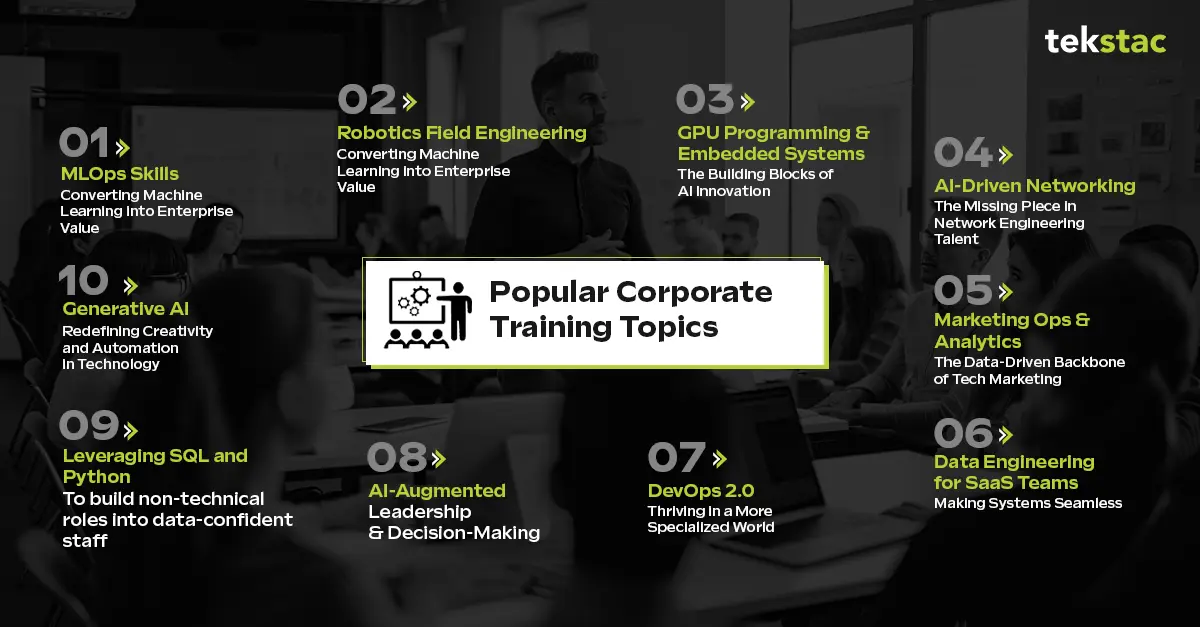
Let’s take a closer look at the top 10 corporate training topics your company should cover in 2026 to close the skills gap and truly empower your workforce.
L&D leaders in tech companies must prepare their workforce for the challenges of scaling machine learning models. This is where MLOps comes into the picture.
MLOps is a mix of machine learning, DevOps, and data engineering that helps businesses successfully deploy and manage AI solutions.
A perfect MLOps use case that shows how beneficial training your employees in these skills can be is that of Ocado.
Being one of the largest online supermarkets, Ocado needed robust yet scalable ML solutions for key challenges including fraud detection, supply chain optimization and personalized customer experiences.
Ocado successfully implemented MLOps to deploy and monitor ML models that improved fraud detection, reducing manual review times and securing transactions.
With the help of MLOps, Ocado created daily retraining pipelines for quick adaptability to changing data patterns.
They were also able to make accurate demand predictions, minimize food waste, and optimize delivery routes to ensure freshness while reducing fuel emissions.
Key Challenges this corporate training topic solves:
The industry-wide revolution in robotics will take place in healthcare, logistics, manufacturing, and beyond.
Training employees in robotics goes beyond mere programming; it is geared at nurturing all-around problem solvers capable of dealing with complicated machines and data.
Providing corporate training for employees in embedded systems programming, hardware maintenance, and troubleshooting can groom employees for career positions such as Robotics Operations Manager or Field Engineer and future-proof your organization.
Key challenges this corporate training topic solves:
GPU programming and embedded systems are the driving force behind today’s most advanced technologies, from AI to self-driving cars.
Training in these areas arms employees with what they need to push the needle and prepare for the next wave of AI and high-performance computing.
Proper training can equip your team with the skills needed to manage the robust technologies of the future and derive the best results for your organization in 2026 and beyond.
Key challenges this corporate training topic solves:
Networking is the silent binding force that holds all technology companies together. Everything from a simple flow of data to cloud services and remote teams runs on networking.
Here is where the problem lies: there are simply not enough good network engineers. Inevitably, this lack of people with such a crucial skill is beginning to make things a bit more difficult to manage for businesses as networks get increasingly complex, especially with cloud computing, IoT, and the modern work-from-anywhere approach.
This is a type of training topic for employees that companies should look to have resilient networks that run well, securely, and efficiently.
As the bulk of modern day business relies on technology, network infrastructure has become critical in daily operations and data security.
If you are an L&D leader, your key training focus for this area should be to train employees to use AI-powered network tools.
This will help them proactively identify and address issues before they disrupt operations.
Also, focus on cloud-based networking courses that can train your team to connect hybrid cloud systems with in-house networks for seamless connectivity.
Additionally, train your team to build zero-trust security models to protect sensitive information from leaking through various access points.
Key challenges this corporate training topic solves:
In many tech companies, marketing operations and analytics are unsung heroes. They work in the background, stitching together marketing and sales so that decisions can be data-driven rather than based on gut feeling. This is a very important but commonly overlooked role, especially in B2B tech companies where growing tech stacks and data complexity create chaos.
By training teams in marketing ops and analytics capabilities, technology companies can make informed, data-driven decisions that enhance performance by reducing inefficiencies and improve the alignment between marketing and sales efforts. This not only fosters current growth but positions companies for ongoing success.
Key challenges this corporate training topic solves:
Think of SaaS as the circulatory system of modern tech: data flows are its lifeblood. But when these streams hit blockages or inaccuracies, real-time decision-making goes out of the window, teams lose faith in their tools, and the user experience suffers. Better training will make your employees more self-reliant and confident with regard to handling data pipelines. For example, an operationally competent team of experts can create a custom dashboard themselves that saves them hours of manual reporting. This will increase efficiency by empowering the teams to make wiser decisions faster.
Key challenges this corporate training topic solves:
DevOps has evolved from the “jack-of-all-trades” engineer to a model that embraces specialization. Whereas early DevOps teams depended on one person handling everything from infrastructure through CI/CD pipelines, the complex tech ecosystems of today ask for experts in specific areas, such as Kubernetes or monitoring systems.
Training is of prime importance to help your team adapt to these changes while still collaborating effectively. Think of an application crashing in your tech company just because the underlying infrastructure was unable to support sudden surges in traffic. With the right DevOps training, your team can manage this issue and quickly create spin-ups of new servers using Kubernetes ensuring uptime without glitches. Specialization in key tools will not only avoid downtime but help your team improvise faster and work better.
Key challenges this corporate training topic solves:
AI-augmented leadership can sometimes sound like a futuristic concept, but in reality, it is already shaping how organizations operate today. Let’s imagine a scenario where the organization’s leadership team can access real-time skills insights from platforms like Tekstac. This gives them a measurable competitive edge while reducing guesswork and cognitive overload.
Key challenges this corporate training topic solves:
Data is the backbone of any tech company’s success, but just imagine a situation wherein both your marketing and operations teams don’t need to knock the doors of their data counterparts. By teaching basic skills in SQL and Python within non-technical positions, you make every team more agile, increasing the productivity of specialized manpower and creating an atmosphere where every team is self-sufficient and empowered.
For instance, a marketing professional who can write a simple SQL query to analyze campaign performance doesn’t just save time but contributes to faster, data-driven decisions.
Key challenges this corporate training topic solves:
While GenAI is the talk of the town with every company’s focus honed in on its potential, it’s a corporate training topic worth reiterating in this list. GenAI has become a cornerstone of innovation that allows technology companies to reimagine creativity, productivity, and automation. From content creation to the generation of synthetic data for testing, GenAI lets organizations reimagine workflows and build smarter, faster solutions.
Training teams to leverage GenAI means ensuring your business stays ahead in a rapidly evolving landscape, driving efficiency and innovation at every level. Automation through this technology is less about machines replacing humans; instead, it is more about empowering people, giving them the opportunity to get more done with much less sweat.
Key challenges this corporate training topic solves:
These corporate training topics are at the heart of true talent transformation—helping companies move beyond filling skill gaps to building future-ready teams that can adapt and thrive.
As you navigate through these trending corporate training topics to help your organization in 2026 and beyond, one challenge remains universal: how to ensure practical, on-the-job applicability of these skills? Additionally, how to ascertain that your employees are properly engaging in the training and are preparing ideally for the organizational goals you have in mind? This is where platforms like Tekstac are redefining corporate skilling.
Such platforms deliver real-world based training, assess employees for role-specific competencies, and help you analyze their progress using advanced data. The best part? You can scale your corporate learning programs across large teams without compromising on depth. If you are an L&D leader wanting to deliver result-oriented tech training across various verticals effectively and at scale, consider investing in a corporate training platform like Tekstac.
1. How do corporate training topics improve employee performance?
Corporate training topics boost performance by closing skill gaps, improving confidence, fostering adaptability, and aligning employee abilities with evolving business goals.
2. How to choose the right corporate training topics for my workforce?
Identify current skill gaps, align training with business objectives, consider future industry trends, and prioritize topics offering practical, measurable impact on performance.
3. Which corporate training topics are best for tech companies?
Tech companies benefit most from training in AI, MLOps, DevOps 2.0, data engineering, robotics, and generative AI for innovation, efficiency, and competitiveness.
4. What are the types of corporate training?
The main types of corporate training include onboarding, technical skills, soft skills, compliance, leadership development, product training, and diversity programs.