
For decades, organizations structured workforce strategies around jobs, and skill insights were rarely a priority. That model is now under pressure. According to research by Microsoft and LinkedIn, the skills employers require are expected to change by 50% by 2030 compared to 2016, with Generative AI potentially accelerating the shift to 68%.
Yet many organizations still struggle to answer a fundamental question: What skills actually exist within our workforce today? This visibility gap is pushing companies to rethink how they track and develop workforce capabilities, making skills intelligence a critical part of modern talent strategy. At the center of this shift is the concept of skill insights, which helps organizations make more informed, data-driven workforce decisions.
Skill Insights are comprehensive, analytics-driven evaluations of workforce capabilities. They combine multiple sources of data, such as assessments, certifications, project outcomes, and performance feedback, to create a dynamic understanding of employee skills.
Unlike traditional skills inventories that rely heavily on self-reported information, Skill Insights are continuously updated through workforce skills analytics and validated through learning activity and performance signals..
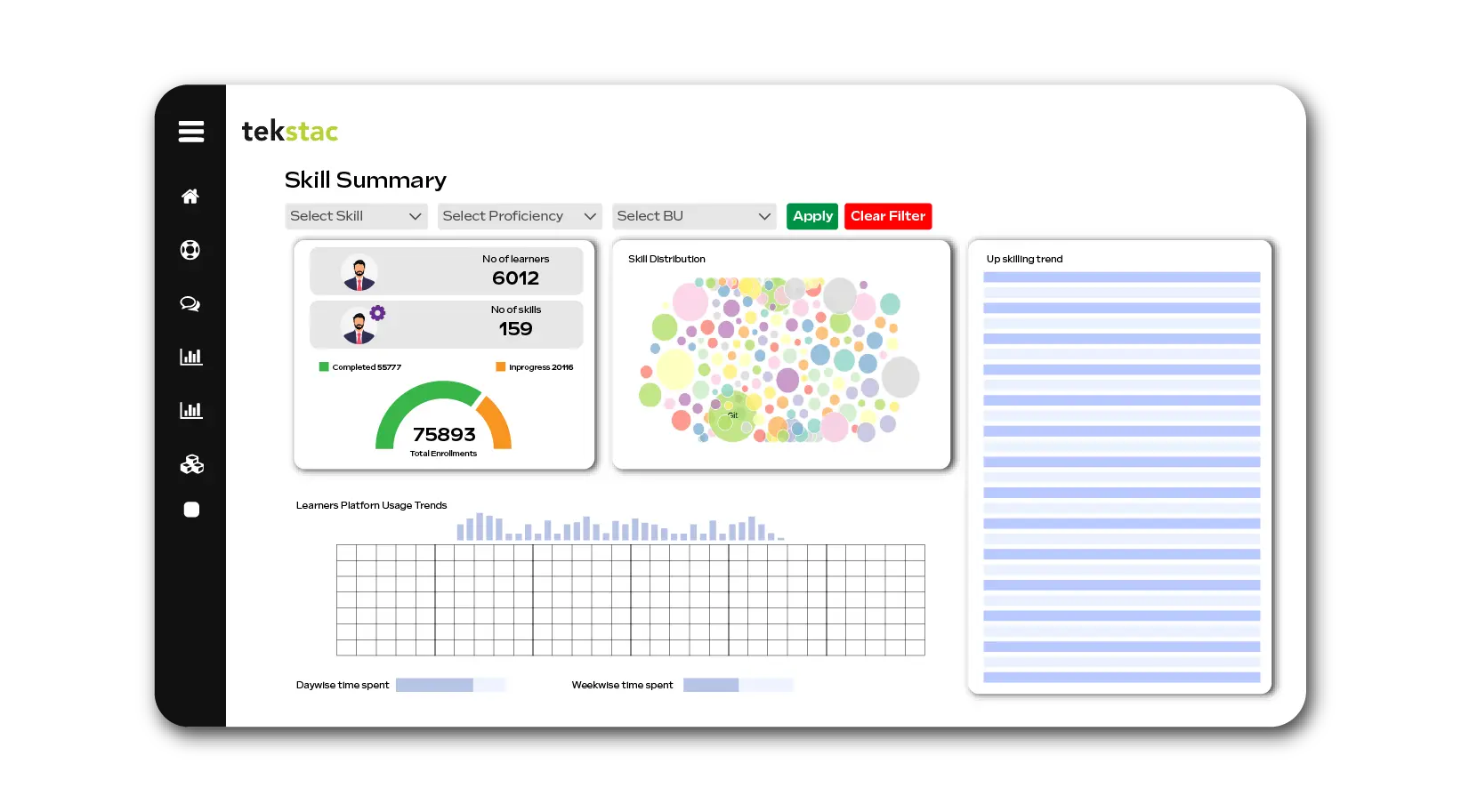
This approach enables organizations to move beyond tracking training participation and instead understand how capabilities evolve across teams and roles.
Through structured employee skills assessment, Skill Insights help organizations:
In practical terms, Skill Insights transform learning data into actionable talent analytics that inform workforce decisions.
47% of leaders list upskilling existing employees as a top workforce strategy for the next 12–18 months.
Organizations today face an unprecedented rate of capability change. Mere certifications will not suffice to prove we have skills- workforce. While IT certifications provide a strong foundation, organizations increasingly need hands-on labs to truly understand workforce capabilities.
According to the SHRM Talent Trends Report, 28% of organizations now require candidates to possess new skills for full-time roles, and 47% of those roles are existing positions that now demand updated capabilities.
This means that workforce transformation is not only about creating new roles; it’s also about redefining existing ones.
Meanwhile, the World Economic Forum’s Future of Jobs Report 2025 highlights another challenge: 63% of organizations cite skills gaps as the primary barrier to business transformation.
These trends are driving organizations toward skills-based workforce planning, where decisions about hiring, learning, and mobility are guided by skills data rather than static job titles.
When organizations lack visibility into workforce capabilities, strategic decisions become harder.
Skilling programs may target the wrong skills. Hiring strategies may overlook internal talent. Workforce planning may rely on assumptions rather than evidence.
The cost of this invisibility can be significant.
According to McKinsey research, 87% of organizations globally are already experiencing or expect to experience a skills gap within the next few years.
At the same time, the World Economic Forum estimates that nearly six out of ten workers will require substantial reskilling or upskilling by 2030 in order to keep pace with evolving job demands.
Without reliable workforce skill insights, organizations risk making workforce investments that fail to address the real capability gaps that affect performance and growth.
To generate meaningful Skill Insights, organizations typically build a structured workforce capability framework that integrates skills data, performance signals, and role requirements.
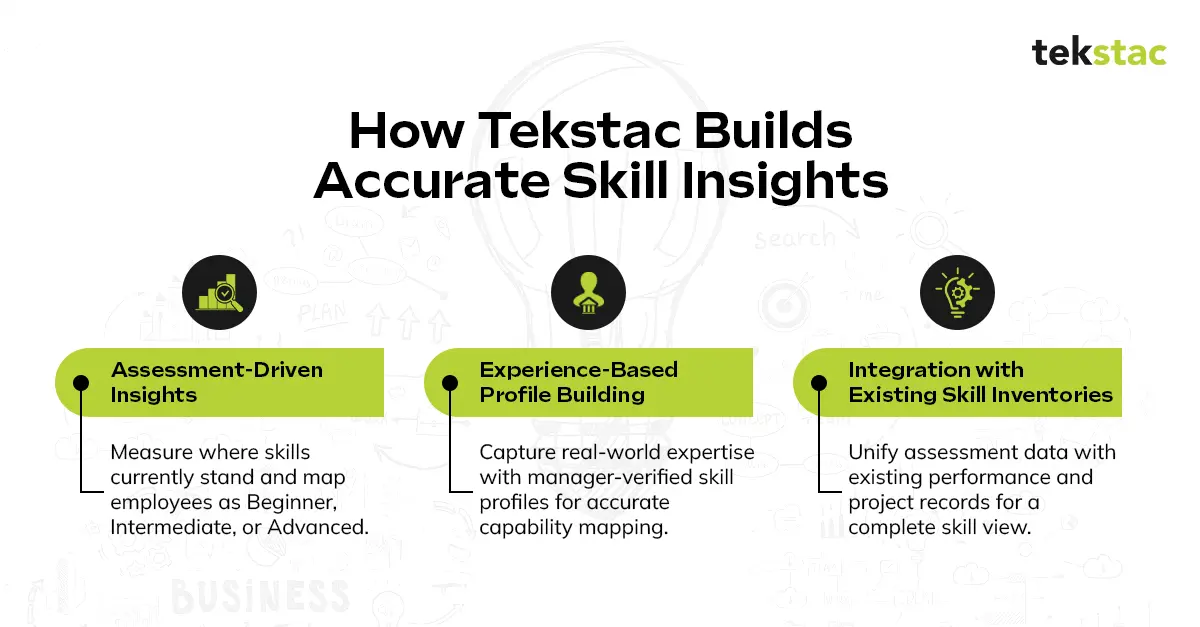
Skill Insights framework combines three powerful methods:
Assessment-Driven Insights
This allows employees to gauge their proficiency levels across specific skills. The results categorize individuals as beginner, intermediate, or advanced, providing a clear foundation for the organization’s skill inventory.
Experience-Based Profile Building
Not all expertise can be measured through assessments alone. For experienced professionals, we can enable the creation of skill profiles based on self-declared data, verified by managers, or cross-referenced with organizational records. This ensures that practical experience and institutional knowledge are accurately represented.
Integration with Existing Skill Inventories
Many organizations already maintain some level of skill tracking through performance reviews or project data. It can be integrated with insights from the pre-held assessments and learning modules.
Two key metrics often form the backbone of this framework.
The Skill Match Score evaluates how closely an employee’s current capabilities align with the requirements of their role.
This metric functions as a workforce “fitness indicator.” It shows whether employees possess the competencies necessary to perform their responsibilities effectively.
Beyond operational reporting, the skill match score can also support skills-based workforce planning. Employees with high match scores may be ready for expanded responsibilities, leadership roles, or more complex projects.
The Skill Gap Metric builds upon the skill match score by identifying capability deficiencies.
For example, if an employee’s match score falls below a defined threshold, the system flags this as a development need.
Aggregated across teams and roles, these insights allow organizations to conduct targeted skill gap analysis and design focused upskilling and reskilling strategies.
Our ultimate goal is to create a dynamic and evolving database of skill profiles, which we refer to as ‘SkillTag’. The idea behind SkillTag is to track and reflect the continuous development of skills over time, offering a comprehensive, real-time view of an individual’s expertise and growth.
Krishnan Unni, Chief Business Officer, Tekstac
Organizations rarely adopt Skill Insights all at once. Instead, they typically begin with one part of the talent lifecycle and gradually expand toward a more comprehensive skills-based model.
In our experience working with organizations embarking on this journey, they typically take one of three different approaches mentioned below.
Many organizations begin by redesigning L&D programs around skills rather than jobs.
One Fortune 500 Services Company, for example, began by shifting its skilling recommendations away from job-based training toward skills-based development pathways.
Courses were mapped to specific capabilities instead of job titles, allowing employees to develop targeted competencies aligned with business needs.
As the company expanded this approach to hiring and internal mobility initiatives, leaders realized that they needed a centralized workforce capability framework to support the transformation. This led to the development of an enterprise-wide skills hub that used skills as the core unit for managing workforce capabilities.
Other organizations start by creating the underlying infrastructure for skills management.
One of our IT clients began by developing a shared language for describing workforce capabilities that defined categories, proficiency levels, and relationships between skills.
This framework allowed the organization to map skills across roles and learning resources, identify high demand “hot skills,” and design more targeted development pathways.
Over time, the skills framework became the foundation for broader talent analytics, influencing recruitment, workforce planning, and compensation strategies.
A third approach focuses on the work itself rather than the structure of jobs, encouraging employees to demonstrate a willingness to learn at work. Some organizations are introducing internal talent marketplaces where projects and short-term assignments are matched to employees based on skills.
This allows employees to gain experience in new domains while organizations deploy talent more flexibly. Through structured skills insights, employees can assess their current capabilities, explore future roles, and develop plans to close skill gaps.
One of the biggest challenges in building a skills-based workforce is the portability of verified skills data. At the same time, structured skills development is increasingly becoming the foundation for sustainable career progression in modern organizations.
Some organizations are beginning to address this gap. For example, a defense organization introduced a platform that allows service members and veterans to record skills gained through training, education, and operational experience. By linking these records to a common framework, individuals can better understand how their capabilities translate to civilian roles and where further development is needed.
As organizations gain better visibility into workforce skills, career structures are evolving from traditional career ladders to more flexible career lattices, where employees build capabilities through cross-functional and cross-skilling opportunities. According to the ACCA Global Talent Trends Survey, 58% of employees expect their next career move to be outside their current organization, highlighting the importance of workforce skills analytics in supporting talent development and retention. These shifts are supported by workforce skills analytics, which help organizations identify adjacent skills and potential career transitions.
Skill Insights are increasingly shaping several core workforce strategies. Here are some of the ways in which they play a significant role.
By analyzing workforce capability insights, organizations can match employees to roles or projects based on their capabilities rather than their job titles.
This improves talent utilization while reducing reliance on external hiring.
Learning leaders use employee skills assessment data to design more targeted development programs.
Rather than delivering broad training programs, organizations can prioritize learning initiatives that address the most critical capability gaps.
Research from Gallup shows that 41% of employees say lack of time is their biggest obstacle to participating in training programs.
Skill Insights help organizations ensure that learning time is invested where it will deliver the greatest impact.
Skill Insights also support long-term workforce planning. Through structured skills intelligence, organizations can decide when to:
This decision model enables organizations to respond more effectively to evolving skill demands.
The impact of Skill Insights becomes clearer when organizations apply them to real workforce challenges.
Challenge:
The client, with a 300,000+ global workforce, wanted to accelerate workforce mobility and efficiency through lateral training programs. But they faced multiple hurdles: limited visibility into skill gaps, generic learning programs, and an inability to link training efforts with performance outcomes.
Our Solution:
Challenge:
Graduates were arriving with low Day-1 readiness, forcing extended onboarding programs that increased training costs and delayed time-to-billable deployment.
Our Solution:
Impact:
Objective:
Create a structured talent pipeline to identify, skill, and onboard large volumes of graduates efficiently across product development and niche technology roles.
Challenges:
Our Solution:
Implemented a three-stage skilling framework covering the entire talent lifecycle.
Impact:
The future of workforce strategy will increasingly be defined by skills rather than jobs. The employee development trends are shifting toward continuous learning, internal mobility, and skills-first talent strategies. That’s where skill insights come into the picture. In a world where skills change rapidly, the ability to understand and act on workforce capabilities will become one of the most important strategic advantages an organization can possess.
1. What is Skill Insights? Why are they important for the future of work?
Skill Insights are analytics-driven evaluations of workforce capabilities derived from assessments, learning activity, and performance signals. They allow organizations to adapt to rapidly evolving skill requirements and build effective upskilling and reskilling strategies.
2. What is the difference between Skill Insights, Skill Gap Analysis and Talent Analytics?
Workforce Skill Insights provide a comprehensive understanding of workforce capabilities through integrated skills data.
Skill Gap Analysis focuses specifically on identifying the difference between current skills and required capabilities.
Talent Analytics represents a broader category of HR analytics that includes workforce metrics related to hiring, engagement, and retention.
3. What are some of the skills gap analysis tools organizations can use?
Organizations today use a combination of skills intelligence platforms, talent analytics tools, and learning management systems to identify and address workforce skill gaps. Some commonly used skills gap analysis tools include Tekstac. These platforms perform skills gap analysis to provide organizations with deeper visibility into workforce capabilities.
4. How can workforce skill insights improve employee training programs?
Workforce skill insights help organizations design more effective employee training programs by identifying real skill gaps and aligning learning initiatives with business needs. With better visibility into workforce capabilities, organizations can: