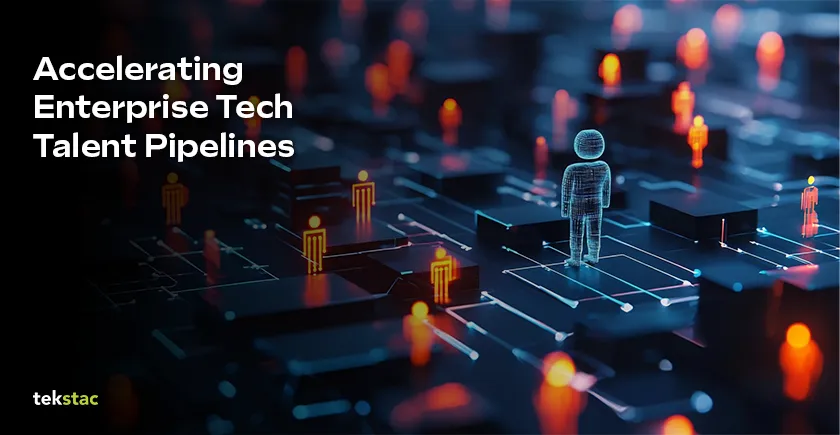
A tech talent pipeline is a structured, continuous system for building job-ready technical skills inside an organization — combining role-based learning, AI-driven skill-gap analysis, and measurable readiness tracking, instead of one-off training or reactive external hiring.
Here’s what happens without one: when a critical tech project came up, one of our client organizations was confident their team could deliver. The talent was experienced, the processes were in place, and the skills seemed sufficient. But when the project required newer AI, cloud, and data integration capabilities, performance dropped. The team needed immediate reskilling — and external hiring became the only short-term fix.
This is not an isolated story. It’s a reminder that tech capability doesn’t scale on its own. In reality, future-ready talent isn’t hired—it’s built through deliberate design. That design is what we call a tech talent pipeline.
In today’s fast-changing digital economy, continuous upskilling has become the backbone of enterprise competitiveness.
Technology evolves faster than job roles. A cloud migration project can demand new certifications within a single quarter; an AI integration initiative can make last year’s skill map obsolete before it’s finished. Without a structured system to build capabilities on an ongoing basis, even strong, experienced teams risk falling behind the tools their own projects require.
While most enterprises recognize this, many still rely on ad-hoc training. What’s needed instead is a data-driven, AI-enabled talent framework that continuously builds, tracks, and sustains skill readiness across functions and technologies.
At Tekstac, we’ve seen this gap firsthand. Traditional training programs can’t keep pace with new tech stacks, agile workflows, and the speed of AI adoption.
That’s where Tekstac’s AI-driven learning platform transforms how organizations develop tech capability—aligning skill development with measurable performance outcomes.
Tekstac’s learning ecosystem is built around one idea: Tech readiness should be business-aligned, continuous, and measurable.
Our platform helps enterprises operationalize tech talent pipelines that move beyond certifications and one-time bootcamps—into a system of lifelong learning and performance-linked growth.
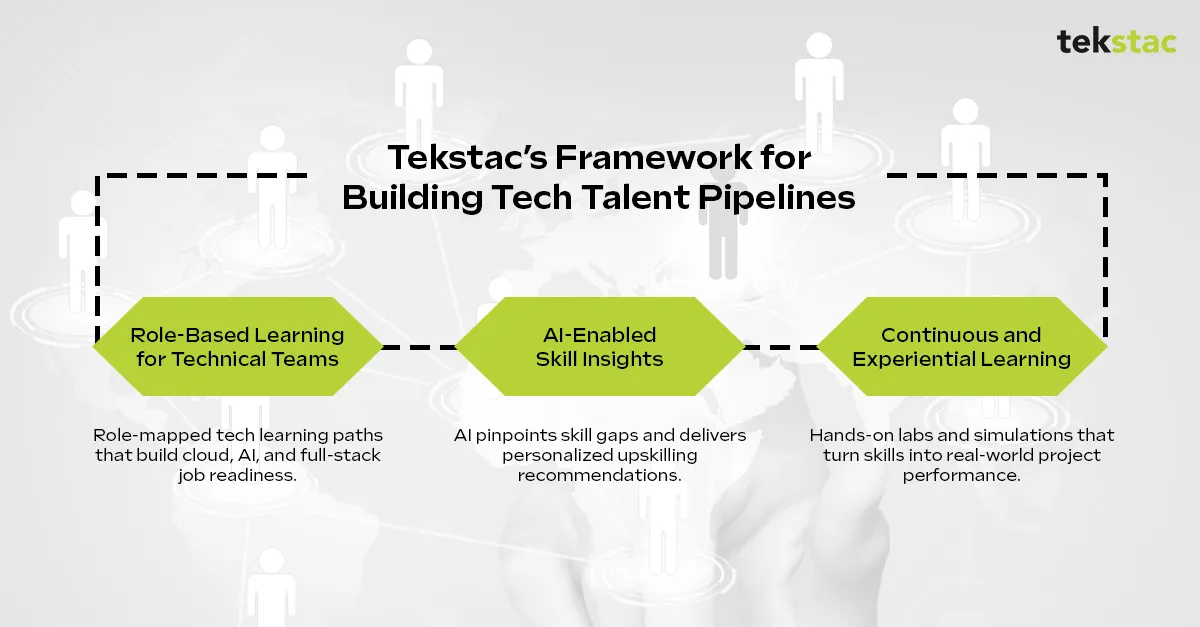
Here’s how it works:
Tekstac’s role-based learning structure maps every module to real-world project needs—whether that’s cloud migration, full-stack development, or AI implementation.
Each pathway blends course modules with hands-on coding labs, simulations, and project assessments, building real world application ready, deep technical mastery for each role.
AI in talent development is no longer a nice-to-have—it’s mission-critical.
Tekstac uses AI-powered analytics to identify skill gaps, benchmark capabilities, and recommend personalized learning paths.
This approach helps enterprises proactively develop internal talent—reducing dependency on external hiring and ensuring readiness for emerging technologies.
Technical skills evolve every quarter. Tekstac integrates experiential learning that helps teams apply what they learn immediately in the flow of work.
This gives L&D and business leaders data-backed visibility into skill progress, role readiness, and workforce ROI.
When new technology initiatives arise, organizations often default to hiring externally. But a recent Forbes research report shows that 58% of companies are now focused on building a culture of continuous learning, and 69% believe every employee needs technical upskilling opportunities.
External hires, meanwhile, often struggle with culture fit, take longer to reach peak productivity, and add real cost — from recruiter fees to the 3–6 months it typically takes a new technical hire to reach full output.
Building a tech talent pipeline helps organizations develop talent that already understands the systems, culture, and clients they serve.
At Tekstac, tech learning isn’t just course-driven—it’s experience-led. Each program simulates real-world engineering challenges.
Learners progress through interactive, structured modules, hands-on labs, and instant feedback for performance improvement.
Key platform highlights:
By the end of each program, learners earn a SkillTag—a verified record of competencies that reflects job readiness and tech mastery.
Tech skills now have shorter half-lives than ever before.
In the AI era, the future workforce must be capable of re-skilling, adapting, and integrating new technologies continuously.
Skill gaps don’t appear overnight—they grow silently when learning is reactive. A well-structured tech talent pipeline changes that narrative. It ensures readiness at every level, continuity in every transformation, and a workforce that grows as fast as technology does.
Tekstac’s Learning Platform helps organizations move from reactive hiring to proactive capability design—enabling HR and L&D leaders to build, measure, and sustain the tech talent their businesses need for the future.
Book a Tekstac demo today and start building your tech talent pipeline.
1. Why is tech hiring so bad right now?
Tech hiring is challenging because technology evolves faster than available skills. Employers increasingly need specialized AI, cloud, cybersecurity, and hybrid capabilities, creating skills mismatches and making qualified talent harder to find.
2. What is the current demand for tech talent?
Demand remains strong for specialized technology talent, particularly in AI, machine learning, cybersecurity, cloud, and platform engineering. In India, AI-related IT hiring increased 16% year over year in June 2026.
3. How does AI improve skill-gap identification?
AI analyzes employee skills, benchmarks capabilities against role requirements, identifies proficiency gaps, and recommends personalized learning paths. This gives organizations data-driven visibility into workforce readiness and supports proactive talent development.
4. What is a SkillTag?
A verified, Tekstac-issued record of the competencies a learner has demonstrated through hands-on labs and assessments — used as evidence of job readiness.