

Fewer than one in three corporate training programs directly improve business KPIs, according to the LearnOps Industry Report. L&D managers who want a seat at the leadership table need to measure training ROI, not just completions. That requires a clear skills gap analysis, SMART KPI frameworks, and technology that connects learning outcomes to workforce performance, which is exactly where an AI-powered upskilling platform like Tekstac is designed to help.
While most of them still measure the traditional surface-level metrics such as:
These numbers still don’t answer the most important question: Did skill development actually change performance?
Tekstac is an AI-first skill development and intelligence used by enterprise clients including IBM, PwC, Capgemini, Zensar and Cognizant. It connects training delivery to measurable business outcomes through real-time analytics, skills gap analysis, and role-aligned learning paths. With over 1 million professionals upskilled across 27 million+ learning hours, Tekstac is built for L&D teams that need to prove ROI to leadership.
Traditional L&D metrics, completion rates, attendance numbers, and assessment scores are easy to report but impossible to connect to business performance.
The core problem is activity tracking masquerading as impact measurement. A sales team can complete a negotiation program with 95% attendance and strong quiz scores. If quarterly revenue stays flat, the program delivered activity, not capability. The same logic applies to leadership development, onboarding, and compliance training.
Replacing surface-level metrics with skills gap analysis means mapping current team capabilities against the skills required to hit specific business goals, identifying the gaps, and building training interventions with a measurable success criterion, before launch not after.
It means mapping current skills to business goals, finding critical gaps, and creating focused upskilling programs to close them.
This shifts L&D from spotting problems to solving them, building the right skills, in the right people, at the right time.
L&D business KPIs help organizations move from measuring participation to measuring performance change. Remember to identify the right KPIs for your L&D.
The role of KPIs in L&D:
Did you know? According to the LearnOps Industry Report 33% of organizations don’t measure L&D success at all, leaving most training budgets unaccountable to leadership.
Listed below are some of the common challenges faced in tracking business KPIs
One of the biggest hurdles for L&D managers is convincing leadership, that training delivers value. Without robust data, learning is seen as a “nice-to-have” rather than a strategic growth driver.
Attendance numbers and retention rates are simple to report, but they don’t tell the full story. True measurement requires both quantitative data (scores, completions, proficiency levels) and qualitative insights (employee satisfaction, perceived value, behavioral change).
Overcoming these challenges requires the right employee performance KPIs, the right measurement approach, and the right technology.
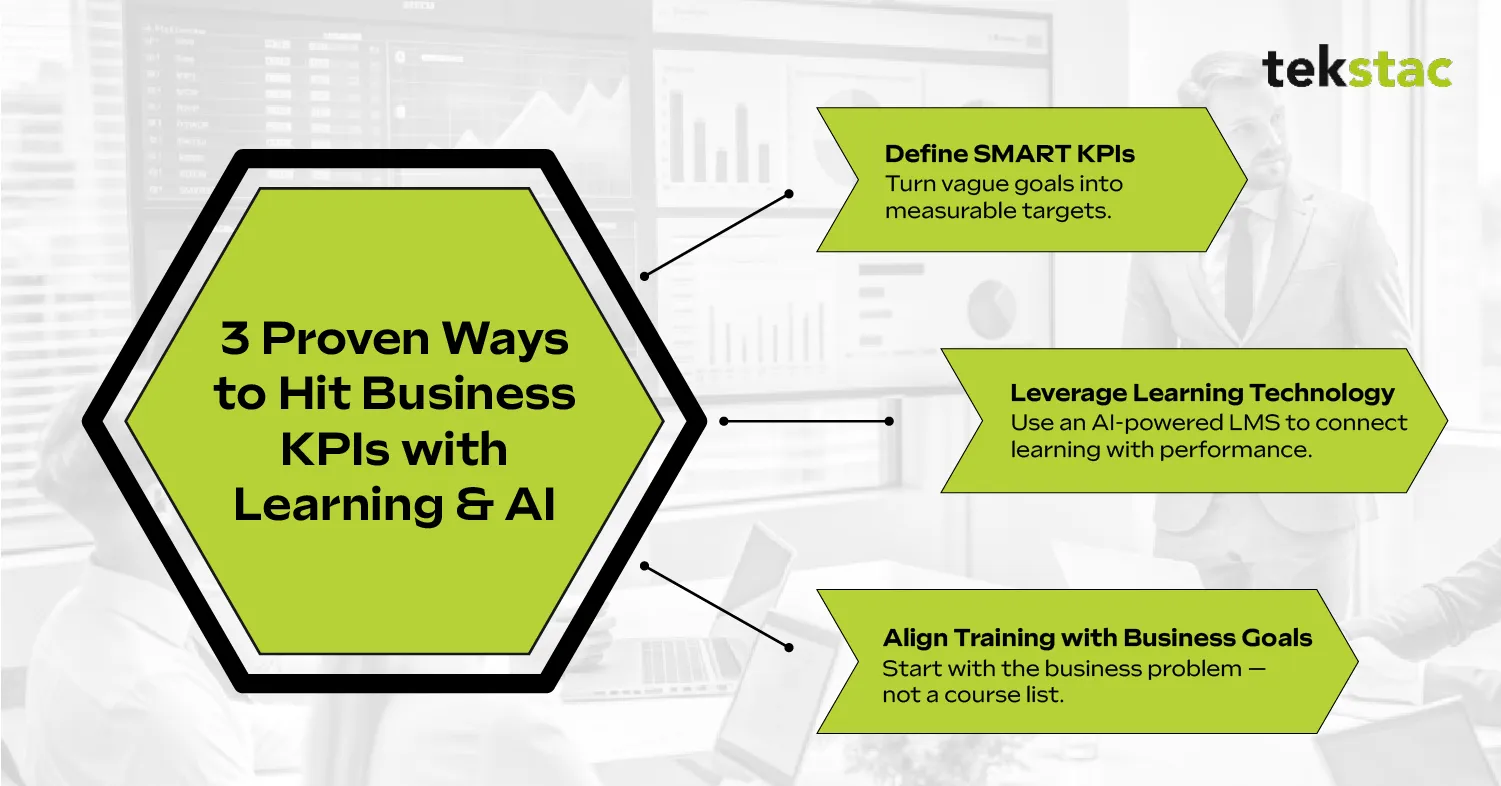
Instead of “Improve onboarding,” a SMART KPI would be “Reduce new hire ramp-up time by 20% within six months.”
To truly measure and maximize the impact of learning, organizations need more than just training delivery—they need visibility, precision, and scalability. This is where an AI-powered Learning Management System (LMS) makes the difference and tracks upskilling impact on KPIs.
A AI-powered LMS can:
This shifts L&D from being reactive to proactively shaping workforce performance.
Training should always start with a business problem, not a course catalog. Ask upfront:
When learning initiatives are designed with these questions in mind, they not only engage employees but also prove their impact to stakeholders.
Tekstac empowers L&D managers to link training directly to business performance through powerful learning analytics and management tools.
Skills gap analysis at scale
Tekstac maps each learner’s current proficiency against role-specific skill requirements, automatically surfacing gaps and assigning targeted content. L&D managers see a real-time dashboard of team capability, not just who completed what, but who is ready to perform.
Training ROI measurement built in
Unlike traditional LMS platforms that stop at completion of tracking, Tekstac links learning activity to business metrics. L&D leaders can show leadership in which programs improved time-to-competency, productivity benchmarks, or retention rates, in the same reporting interface.
Beyond L&D success measurement, Tekstac powers learning delivery with:
With 1 million+ professionals upskilled, 27 million+ learning hours, and enterprise clients like IBM, PwC, Capgemini, Zensar and Cognizant, Tekstac is proven at scale.
It’s time to stop tracking skill development for just the numbers. Instead of asking “Did employees finish the course?”, L&D managers must ask “What business KPI did this program improve?”
Track what matters and focus more on metrics stakeholders already value. Identify the employee performance KPIs before launching a program.
Need assistance with all this?
Tekstac transforms L&D from tracking hours and completions to driving measurable performance, stronger KPIs, and a future-ready workforce.
1. What is the most important L&D business KPIs to track?
The five most measurable L&D business KPIs are:
2. How do L&D teams prove training ROI to leadership?
Establish a measurable baseline before launch, define which business metric the training should move, then track that metric for 60–90 days post-training. An AI-powered LMS like Tekstac automates this linkage, connecting learning data to business performance dashboards in real time.
3. How does an AI-powered LMS improve L&D KPI tracking?
An AI-powered LMS improves L&D KPI tracking by automating skills gap analysis, personalizing learning paths, and providing real-time dashboards that connect training data to business performance indicators, removing the manual data work that prevents most L&D teams from building a credible ROI case.
4. What are the 4 pillars of KPI?
The four pillars of KPIs typically include strategic alignment, measurable metrics, accountability, and continuous monitoring. These pillars ensure that key performance indicators are clearly linked to business goals, can be tracked with data, have responsible owners, and are regularly reviewed to improve performance.