Reid Hoffman’s book ‘Superagency: What Could Possibly Go Right with Our AI Future’ asks a provocative question: what if AI expands human capability instead of replacing it? That question now defines the reality of AI in HR.
Across boardrooms in every corner of the world, AI is no longer experimental; it is operational. CHROs are not asking whether AI belongs in HR. They are asking how fast they can deploy it without losing control.
During HR roundtables we conducted across India in 2025, several CHROs shared that their organizations reduced hiring timelines by up to 47% after implementing AI-driven recruitment systems. That number isn’t incremental. It’s structural. This blog walks through the frameworks, implementation models, real-world impact metrics, and leadership decisions shaping that shift in 2026 so HR leaders can move from experimentation to enterprise transformation.
At its foundation, artificial intelligence in HR refers to the integration of machine learning, predictive analytics, generative AI, conversational systems, and intelligent automation into core HR processes.
This includes:
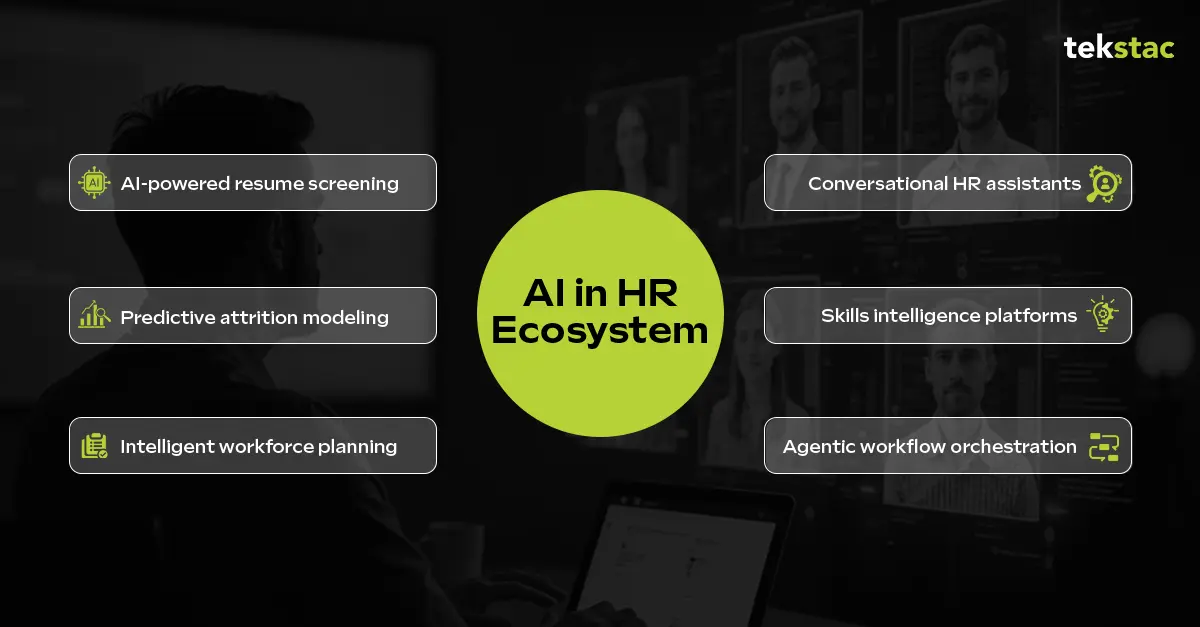
Unlike traditional HR automation, which focused on digitizing forms and workflows, AI introduces cognition into systems. It enables pattern recognition, forecasting, personalization, and adaptive decision-making.
This marks the shift from process digitization to digital HR transformation.
Instead of asking what happened last quarter, HR can now ask:
The urgency around AI adoption in HR is not theoretical. Let’s see some actual numbers.
According to McKinsey & Company – Global AI Survey, 65% of professionals report their organizations use AI in at least one business function. Yet within HR specifically, maturity remains uneven.
43% of organizations now use AI in HR, up from 26% in 2024. 45% of Indian organizations have already integrated Generative AI into HR, with 93% reporting increased efficiency.
And yet 93% of employees say AI is underutilized. 55% of HR leaders say their tech stack does not meet evolving needs. 60% of business leaders admit they lack a clear AI implementation vision.
This is the paradox of the current moment: High investment. Low clarity.
The organizations delaying implementation are not saving money. They are widening the capability gap.
The Future of Work with AI will not wait for organizations to feel ready. To remain competitive, organizations must focus on helping employees outskill AI, building capabilities that complement AI technologies rather than lag behind them.
Josh Bersin describes the current phase of AI in human resources as enthusiastic but immature. Many companies are experimenting, but few have identified high-impact, scalable use cases.
He emphasizes that AI deployment is not like ERP rollouts. It requires iteration, trust-building, and continuous governance, particularly in hiring and performance evaluation.
At the same time, one of the leading reports in 2026 projects that the global AI in HR market will grow from $4.3 billion to $25 billion by 2031.
Drivers of this growth include:
Much of this momentum is being shaped by emerging AI trends in L&D, as organizations rethink how skills are built, measured, and scaled across the enterprise.
The following case studies highlight how AI is transforming HR from an administrative function into a strategic growth engine.
A global retail enterprise deployed an AI-powered hiring assistant. Due to this, application completion rates increased from 50% to 85%. Hiring timelines reduced from 12 days to just 4.
Result? Efficiency improved and more importantly, candidate experience improved.
In another remarkable instance, Unilever implemented AI-driven assessments in early hiring stages and reported improved diversity in candidate pipelines while reducing time-to-hire. As former CHRO Leena Nair stated:
“Technology should remove bias and enable meritocracy, not reinforce existing patterns.”
On the contrary, AI in HR also had some negative results. Take, for instance, Amazon’s AI recruiting tool, which showed gender bias in training data that resulted in eradicating the tool itself.
These examples illustrate both the power and responsibility of AI and automation in HR.
Agentic AI represents a major leap beyond rule-based automation. HR adoption of Agentic AI currently sits at 15%, but Salesforce projects it will reach 64% within two years.
Unlike isolated tools, Agentic AI systems can plan, reason, and execute multi-step workflows across systems. At Advanced Micro Devices (AMD), an AI-powered HR service orchestration agent was deployed to handle high-volume employee support across systems like SAP SuccessFactors and Microsoft Teams. Instead of routing every request to a human helpdesk, the agent interprets employee intent, retrieves context from HR systems, initiates workflows, routes approvals, and escalates complex issues when needed. The result for AMD was an 80% reduction in time to resolve inquiries, 50% of requests handled via self-service.
The impact of AI in HR isn’t limited to automation. Its value unfolds across three powerful layers: operational efficiency, strategic intelligence, and employee experience.
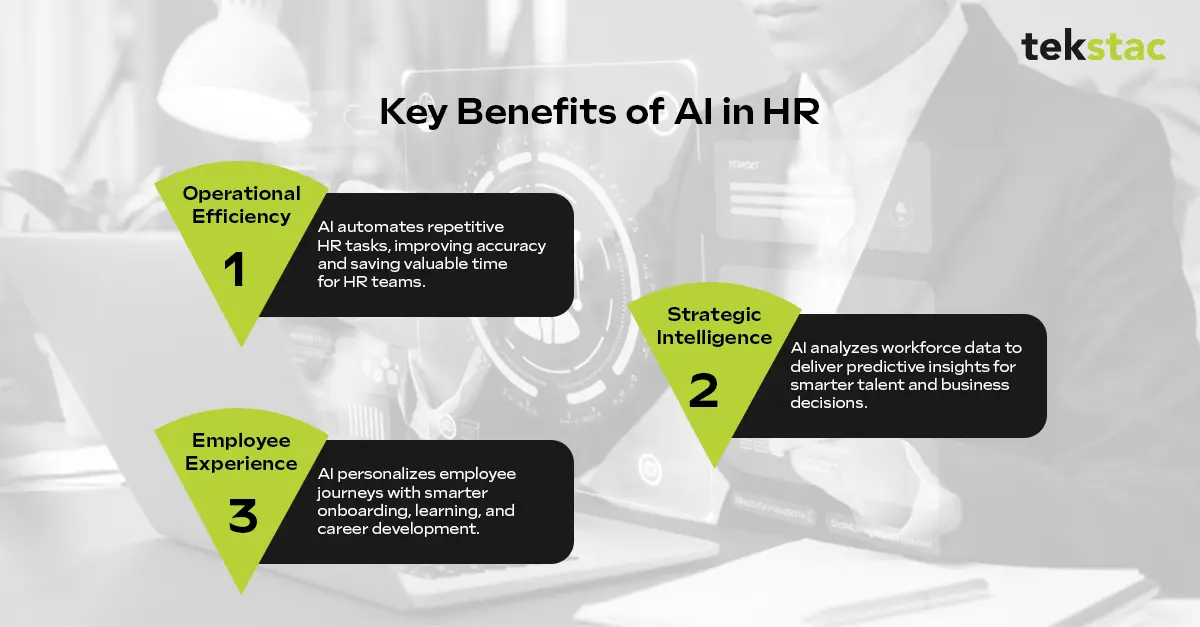
At the foundational level, AI streamlines everyday HR operations. From resume screening and interview scheduling to payroll validation and helpdesk queries, repetitive and time-intensive tasks can now be automated with precision.
In fact, as per ETHR, 68% of companies say AI improves job accuracy in HR processes, while 72% report enhanced productivity and time savings.
Beyond efficiency, AI elevates HR from administrative execution to predictive strategy. Machine learning models analyze workforce data to identify patterns and generate forward-looking insights.
Organizations are using AI for:
Instead of relying on reactive reports, HR leaders can anticipate risks, model future scenarios, and make data-backed talent decisions aligned with business goals.
AI also plays a critical role in personalizing the employee journey. It enables:
As organizations shift toward skills-first talent models, AI-powered workforce upskilling becomes essential. Today, 88% of organizations report active upskilling programs, and companies investing in reskilling are 2.5 times more likely to achieve positive business outcomes from AI initiatives.
AI is increasingly helping HR teams work smarter, not harder, by automating routine tasks, improving decision-making, and enhancing employee experiences. Here are five standout AI tools that are shaping the future of HR:
AI transformation is not an IT initiative. It is a people transformation.
More than 70% of enterprises are investing in AI, yet many struggle to extract value due to skill gaps and change resistance.
CHROs must lead in three critical areas:
As Prabir Jha, leading HR advocate in India, has consistently articulated in his writings and leadership conversations, digital transformation succeeds only when capability transformation precedes technology adoption.
The top HR leaders in India are already demonstrating what proactive AI leadership looks like, integrating technology with talent strategy.
AI’s greatest value emerges when strategy and talent are synchronized.
CHROs must build AI literacy, embed ethical guardrails, and champion cross-functional partnerships.
AI’s greatest value emerges when strategy and talent are synchronized.
CHROs must build AI literacy, embed ethical guardrails, and champion cross-functional partnerships.
The most effective HR leaders are not reacting to AI. They are orchestrating it.
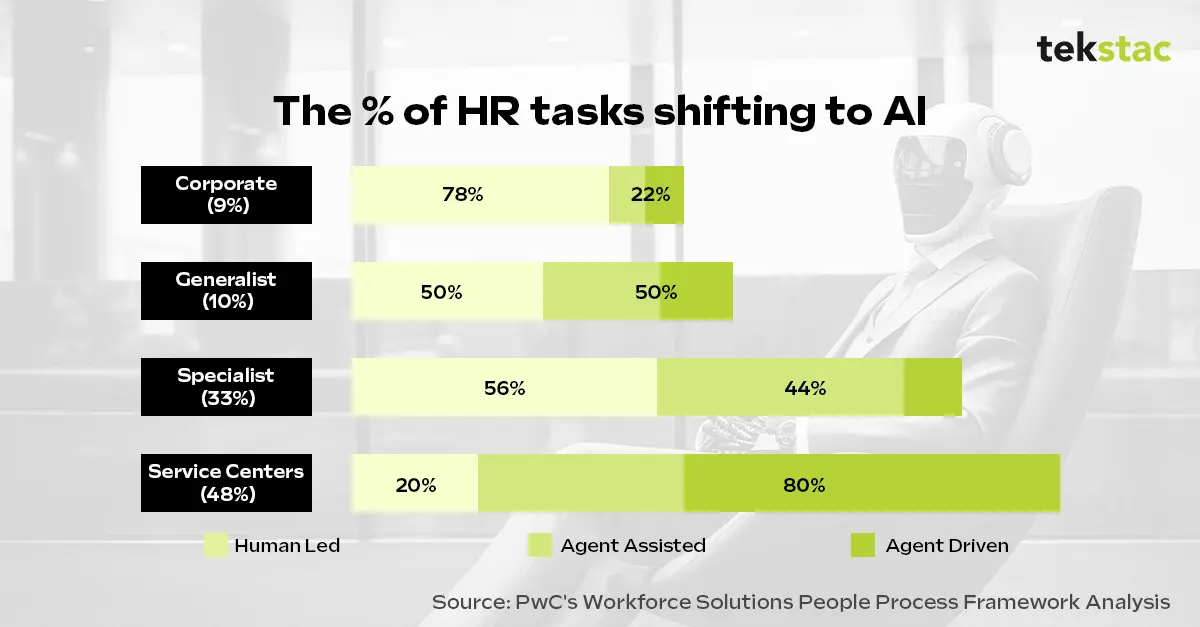
When discussing AI implementation in HR, Dave Ulrich, widely known as the Father of Modern HR has discussed recently about an analysis from PwC’s Workforce Transformation Team, which examined how AI is likely to reshape the four core elements of the HR operating model. The central idea is powerful. AI should not sit as a separate HR initiative.
It should be embedded into the HR operating model to increase stakeholder value.
AI implementation succeeds when it is structured, intentional, and aligned with business outcomes. While many organizations begin with isolated pilots, sustainable impact comes from a clear framework that connects technology, people, and processes.
Identify high-impact processes. Evaluate tech stack readiness. Assess data quality and governance models.
Many companies fail here by rushing implementation without clarity.
Start with high-volume workflows like recruitment or onboarding. Measure KPIs such as time-to-hire, cost-per-hire, and satisfaction.
68% of companies report improved job accuracy during AI pilots.
Scale gradually with governance, bias audits, and structured change management.
AI deployment must be iterative, not disruptive.
Disciplined scaling differentiates strategic transformation from fragmented tool adoption.
Despite rapid momentum, adoption is far from universal. 17% of organizations still have no plans to implement AI in HR, reflecting hesitation around risk, readiness, and ROI clarity. Even among adopters, concerns remain significant. This signals a critical leadership gap: technology is advancing faster than organizational capability.
For CHROs, the real challenge is not whether to use AI, but how to implement it responsibly at scale. AI systems influence hiring decisions, performance evaluations, compensation modeling, and employee monitoring. Without strong guardrails, the same systems designed to drive efficiency can amplify bias, compromise privacy, or erode employee trust.
This is why forward-looking HR leaders are prioritizing:
“AI will not replace humans — but humans who use AI will replace those who don’t.” — Sam Altman, CEO, OpenAI
The fear isn’t new. Every technological leap has sparked the same question: Will machines take over? The broader debate around AI stealing jobs often frames the future of work as a zero-sum game: humans versus machines. In HR, that anxiety feels personal. But here’s the reality: AI doesn’t replace HR. It reshapes it.
AI can screen thousands of resumes in seconds. It can flag skill gaps, predict attrition risk, and automate interview scheduling. What it cannot do is read nuance in a candidate’s life story, sense cultural alignment in a conversation, or coach a struggling employee through uncertainty. The future of HR is not “AI vs Humans.” It is AI-powered Humans. As Alim Dhanji, Chief People Officer at TD SYNNEX puts it, “AI is an enabler; it cannot replace the human element in HR. Judgment, empathy and understanding context are areas where AI falls short.”
One of the most searched queries around AI in HR is simple: “How do we measure ROI?” Because experimentation is exciting. But leadership cares about outcomes. According to IDC, 92% of organizations plan to increase their AI investments, with AI spending projected to grow at 1.7x the rate of overall digital technology spending in the next three years.
Organizations investing in AI and automation in HR are increasingly tracking impact across four dimensions:
A global enterprise reduced recruiter screening time by 42% after implementing AI-assisted shortlisting. That translated to thousands of hours saved annually.
AI-driven candidate matching improves role-skill alignment.
This directly impacts:
With strong talent analytics, organizations can now correlate hiring inputs with performance outcomes, something impossible at scale before.
AI-based skill mapping identifies who can move where.
Instead of external hiring, organizations now redeploy internal talent. That reduces hiring costs, onboarding time, and cultural friction.
This is where AI workforce planning becomes strategic, not administrative.
Companies adopting AI powered workforce upskilling report:
A product head from an enterprise client once said: “Earlier, we were guessing who might fit a future role. Now we can see it. Skills tell the story.”
That visibility is ROI.
While many organizations talk about implementing AI in HR, very few know where to begin.
This is where Tekstac’s GenAI Labs bridges the gap between experimentation and enterprise-ready execution. Instead of introducing AI as a standalone tool, Tekstac approaches HR automation as a structured capability-building journey.
Let’s take a closer look at how this works.
Inside Tekstac’s GenAI Lab, HR teams learn how to build AI-assisted resume shortlisting workflows that:
One of the overlooked areas of AI in HR is candidate communication. Generic outreach emails often result in low response rates and weaker employer branding.
Through our GenAI Lab, HR teams learn how to:
This dramatically improves candidate experience, a key metric in modern digital HR transformation.
Interview scheduling may seem operational, but at scale it becomes a coordination challenge across recruiters, hiring managers, and candidates often across time zones.
Inside Tekstac’s GenAI Labs, HR teams simulate AI-driven scheduling workflows that:
What makes this powerful is the simulation layer. This reduces risk during full-scale
The measurable impact typically includes:
The AI in HR market is projected to reach $25 billion by 2031. Agentic AI adoption will accelerate dramatically. The transformation is structural.
Organizations that approach AI with clarity, governance, and human-centered leadership will not just modernize HR, but they will redefine it.
The next wave of AI in HR will include:
AI in HR 2026 is not about tools. It is about redesigning how organizations hire, develop, engage, and scale talent. On one side are fragmented pilots and unclear governance. On the other hand, organizations are executing disciplined AI-driven workforce transformation with measurable ROI. The divide is widening. Artificial intelligence in HR will not define the future; how leaders implement it will.
If you’re looking to turn AI strategy into measurable outcomes, explore Tekstac’s platform demo.
1. What are the top AI in HR certifications for CHROs and HR leaders?
Here are some of the most recognized AI certifications suitable for senior HR leaders:
2. Is AI going to eliminate HR jobs or finally prove HR’s value?
This question often misses one critical point: AI isn’t just another HR tech tool. It’s built on machine learning, which means it improves over time. Many industry leaders anticipate a shift from partial automation to near-full workflow automation within the next 5 years. That doesn’t mean humans disappear. It means humans focus on approval, judgement, and complex decisions. HR teams will likely become leaner operationally, but stronger strategically.
3. How to implement AI responsibly in HR?
Responsible AI in HR means using AI in ways that are ethical, transparent, and aligned with organizational values. Before adopting any AI tool, CHROs should ensure it’s evaluated and approved, safeguarding security and compliance. AI use must respect privacy and data protection, with internal policies that prevent input of sensitive or confidential information. Organizations should be transparent about how AI is used, maintain clear documentation for traceability, and have oversight to catch errors, bias, or risk.