Upskilling and reskilling digital transformation is no longer an HR initiative — it is a business continuity strategy. As AI, cloud computing, and automation reshape every function, organizations that fail to build new capabilities in their existing workforce fall behind competitors who do. Companies must equip their teams with modern capabilities to stay competitive in the evolving digital economy.
Through digital transformation, businesses can minimize costs, achieve data-driven decision-making, increase revenue growth, and enable scalability. For example – Tech giant Amazon has revolutionized its business by using AI-driven robots in warehouses for better inventory management and offering personalized shopping experiences to clientele by incorporating machine learning into its recommendation engine.
Digital transformation is a continuous and long-term journey for organizations, which raises the question of how employees prepare for it. Upskilling and reskilling help navigate digital changes as they facilitate employee engagement and retention, meet industry regulations and compliance, and enhance workforce adaptability. They are also a great way to enhance an organization’s brand value and contribute to being a ‘best place to work’.
Suppose a renowned bank decides to adopt AI-based customer service tools like chatbots — In that case, it can upskill by teaching its customer service agents how to leverage chatbots for handling routine queries while solving the complex problems by themselves. The bank can reskill by shifting tellers and back-office staff into specialized roles that require managing digital financial products or customer relationship management.
Understanding the difference between upskilling and reskilling is key to building a future-ready team.
Both are strategic components of any digital upskilling training plan.
Upskilling and reskilling are invaluable in developing a sense of loyalty among employees, carving new paths, and increasing the chances of promotions and higher pay scales. They are also a great way to attract new talent, as prospective employees would appreciate a workplace that provides training facilities and helps them ease into their roles steadily.
Building a digital upskilling training program requires four steps: assess existing skill gaps using AI-powered tools, build personalised learning paths by role, supplement theory with hands-on project experience, and measure progress through completion rates and performance impact data.
Start your digital upskilling training journey by identifying digital skills gaps through tools like surveys, feedback loops, and AI-powered assessments. This forms the foundation for building personalized development roadmaps for upskilling employees and preparing them for future roles.
Based on the results, companies can create personalized training plans to help employees upskill by adopting new technologies like AI, IoT, or Cloud, improving their project management skills or customer service skills.
Practical experience creates a learning experience amalgamating real-world application, mentorship, and continuous feedback systems. This experience is invaluable in preparing an employee for a different job position. Thus, garnering practical experience is a great way to upskill and reskill.
Here are some ways for organizations to evaluate their employees on their newly acquired skills:
Internal projects are an excellent way to help employees test their understanding of concepts and skills in real-time projects and solve organizational-level problems. Hence, they help develop hands-on experience and boost employees’ confidence by putting theory into practice.
For example, A corporate communications specialist who earns certification in digital marketing can identify new platforms to run ad campaigns, offer creative ideas to social media teams, and generate new leads by collaborating with content marketing teams.
Cross-function roles enable employees to think from fresh perspectives, delivering creative and impactful solutions. They also help develop a holistic overview of how organizations function across teams and optimize resource use. As a result, employees participating in cross-collaboration roles have a broader picture of how technology supports overall business objectives.
For example, an HR team member undergoing reskilling for digital transformation can collaborate with IT to configure cloud-based HR systems—gaining technical know-how while improving workflow efficiency.
While preparing your team for digital transformation, investing in soft-skill training, such as written and verbal communication skills, leadership, Emotional Intelligence (EQ), and negotiation skills, is also important.
Organizations can conduct soft skill training to help with both upskilling and reskilling by partnering with external agencies for interactive workshops and running micro-learning modules. For example, while employees receive training on new technologies, they conduct short learning sessions focusing on specific soft skills like “communicating effectively for remote work” or “resolving conflicts in digital collaborations.”
To embrace digital transformation, organizations need to think differently, which involves encouraging teams to brainstorm, test new tools, and find unique approaches to work. Organizations can also run competitions and innovation-based challenges to offer solutions for issues arising during digital transformation. Follow up these with prototyping initiatives and pilot testing projects to develop hands-on experience and test the viability of innovative solutions through real-time application.
Celebrate your team members’ progression and achievements as they finish training and acquire new skills. Share their success stories and milestones in company newsletters, email campaigns, or company case studies to recognize their contribution to the organization’s digital transformation process.
Platforms like Tekstac’s Skills Insights give L&D teams a real-time view of each employee’s capability gaps, learning velocity, and role-readiness score — enabling truly personalized reskilling paths rather than cohort-based training that treats a cloud engineer and a customer success manager as interchangeable.
Organizations can integrate data analytics into their learning platforms to identify skills gaps, track progress, and forecast learning needs. Here are some ways through which analytics tools help:
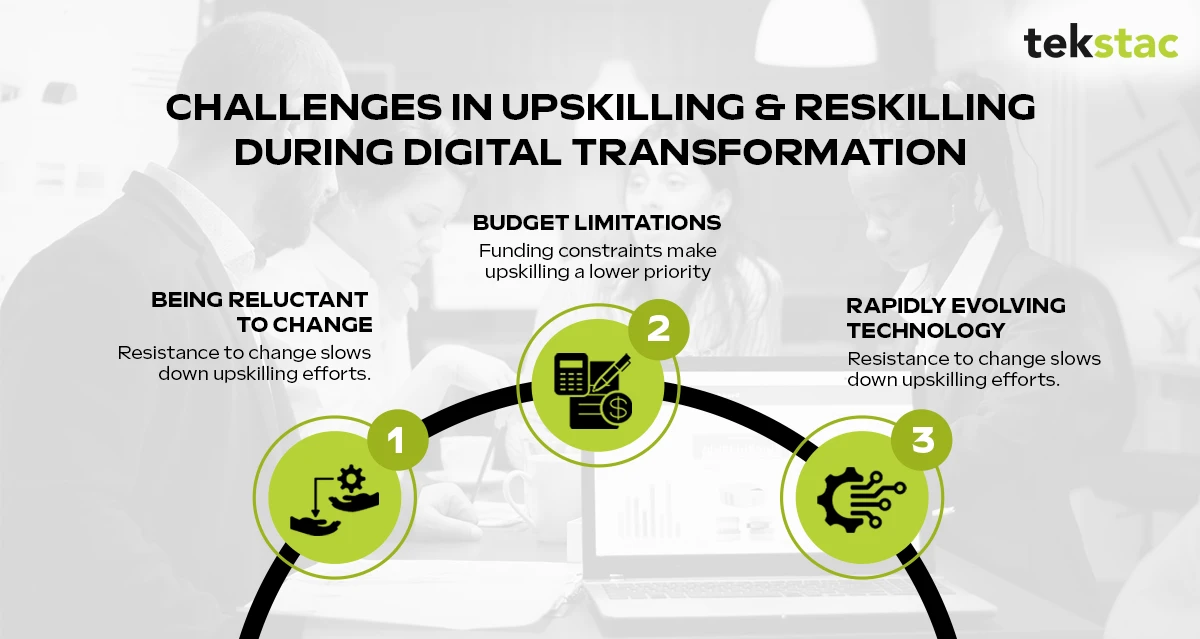
The three core challenges in reskilling employees for digital transformation are: resistance to change driven by fear of obsolescence, budget constraints competing with technology infrastructure spend, and the pace of AI and automation making programs outdated before they are completed. This could be due to several reasons, such as feeling complacent with their existing role and skill set, lack of time, especially while balancing existing workload with training, and a fear of failure.
When organizations undergo digital transformation, a significant portion of their budget is allotted to replacing legacy systems and digitizing operations. It leaves organizations, especially small and medium-sized enterprises, with strained budgets to allocate funds for upskilling and reskilling initiatives.
With the fast emergence of technologies like Artificial Intelligence (AI), Augmented Reality (AR), and cloud computing, employees find it difficult to keep up with the pace at which they must undergo training. Also, skills required for particular tools or technology become obsolete when newer versions are released. These constant changes may overwhelm employees as they try to balance their day-to-day roles and responsibilities with upskilling and reskilling training.
Are you an organization aiming to upskill and reskill to facilitate digital transformation? Here are some organizations that have made the successful transition and an insight into how did they do it:
IBM has since trained over 300,000 employees through its SkillsBuild program (2024), expanding beyond the original New-Collar initiative into generative AI and sustainability-focused roles. This initiative was a game-changer for those without a college degree, as they could still receive training to develop skills in new-age technologies.
They trained their workforce in software development, blockchain, cybersecurity, AI, Data science and analytics, and cloud computing. This was instrumental in creating a diverse and larger talent pool, minimizing the need for external hiring, and meeting the market’s demands.
They transitioned from a traditional sports shoe business to a digitally driven client-centric ecosystem. Nike invested in training its employees on data analytics, predictive analytics, and customer segmentation.
Based on this, the employees worked on user data from apps like Nike Training Club and Nike Run Club to run highly targeted marketing campaigns and offer personalized client experiences. Employees also underwent training in e-commerce platform management, inventory management, and digital payment systems to increase digital revenue.
Leaders were also reskilled in adopting new-age technologies like Augmented Reality (AR) and Blockchain to create digital-first strategies.
Global digital transformation spending reached $2.5 trillion in 2024 and is projected to exceed $3.9 trillion by 2027 (IDC, 2024). This is an excellent indicator for organizations to prepare their leaders to create a sound vision and strategy for digital transformation. The onus lies with the leadership establishing continuous learning that encourages employees to upskill and reskill. Since digital transformation marks a cultural shift in an organization, leaders must guide employees through regular meetings, offer constructive feedback, resolve their concerns, and promote its benefits.
Reskilling and Upskilling benefit employees and the organization, promoting increased job satisfaction, increasing brand reputation, and creating an agile and versatile workforce.
Take an initial step in your digital transformation journey by assessing your employee’s digital skills and empowering them to stand out in a constantly evolving digital landscape.
Ready to see how it works for your organization?
1. How do reskilling programs support digital transformation?
Reskilling programs support digital transformation by equipping employees with new capabilities — such as cloud computing, AI literacy, and data analytics — that are required for roles that did not previously exist. Rather than replacing staff, reskilling redirects existing talent into digital-first functions, reducing hiring costs while accelerating transformation timelines.
2. What is the difference between upskilling and reskilling in digital transformation?
Upskilling improves an employee’s existing skills to match evolving technology demands within their current role. Reskilling trains them in entirely new skills for a different role — typically triggered by automation, AI adoption, or major process change. Both are essential components of any enterprise digital transformation strategy.
3. What is digital upskilling and why does it matter?
Digital upskilling is the process of building modern technology competencies — including AI tools, cloud platforms, data literacy, and digital collaboration — in employees who currently lack them. It matters because digital transformation cannot succeed without a workforce capable of operating, adopting, and innovating with new technology.
4. What are the biggest challenges in reskilling employees for digital transformation?
The three primary challenges are: employee resistance to change, which stems from fear of obsolescence; budget constraints, particularly in mid-sized organizations allocating resources to technology infrastructure; and the pace of technology change, which makes it difficult to build programs that stay current with AI, automation, and cloud developments.
5. What are examples of successful upskilling and reskilling programs?
IBM’s New Collar Jobs initiative reskilled its workforce in AI, blockchain, and cloud computing without requiring traditional degrees — expanding its talent pool and reducing external hiring. Nike reskilled employees in data analytics and e-commerce operations as part of its shift to a digital-first customer model, enabling highly targeted marketing and increased digital revenue.