

Job architecture is a structured framework that organizes an organization’s roles into defined job families, levels, and career paths, creating a consistent, transparent system for titles, responsibilities, compensation, and progression. It answers three foundational workforce questions: what roles exist, how they relate to each other, and what it takes to advance from one to the next. Without it, organizations default to ad hoc hiring decisions, inconsistent pay structures, and career paths that exist only in managers’ heads.
According to Gartner, 86% of HR leaders believe career paths at their organizations are unclear for many employees; and a well-designed job architecture framework is the structural fix that makes career paths visible, credible, and consistent at scale.
Job architecture matters because the absence of it creates compounding, measurable problems. Without a standardized framework, compensation becomes inconsistent; similar roles get paid differently based on which manager hired them. Career paths become invisible; employees cannot see how to advance, so they look elsewhere.
Workforce planning becomes reactive — HR fills vacancies rather than building capability pipelines. Gartner research shows that 44% of companies do not provide career paths that encourage or compel employees, and 75% of those employees are actively looking at positions at other companies’ Training Orchestra. Job architecture directly addresses this: by defining job families, levels, and the skills required at each stage, it creates the visible career infrastructure that keeps employees engaged and gives HR the data to plan rather than react.
The need for a clear and equitable organizational structure. Leaders should practice real-time mapping toward career progression to promote such conversations. For potential employers, it streamlines hiring and performance management and salary benchmarking.
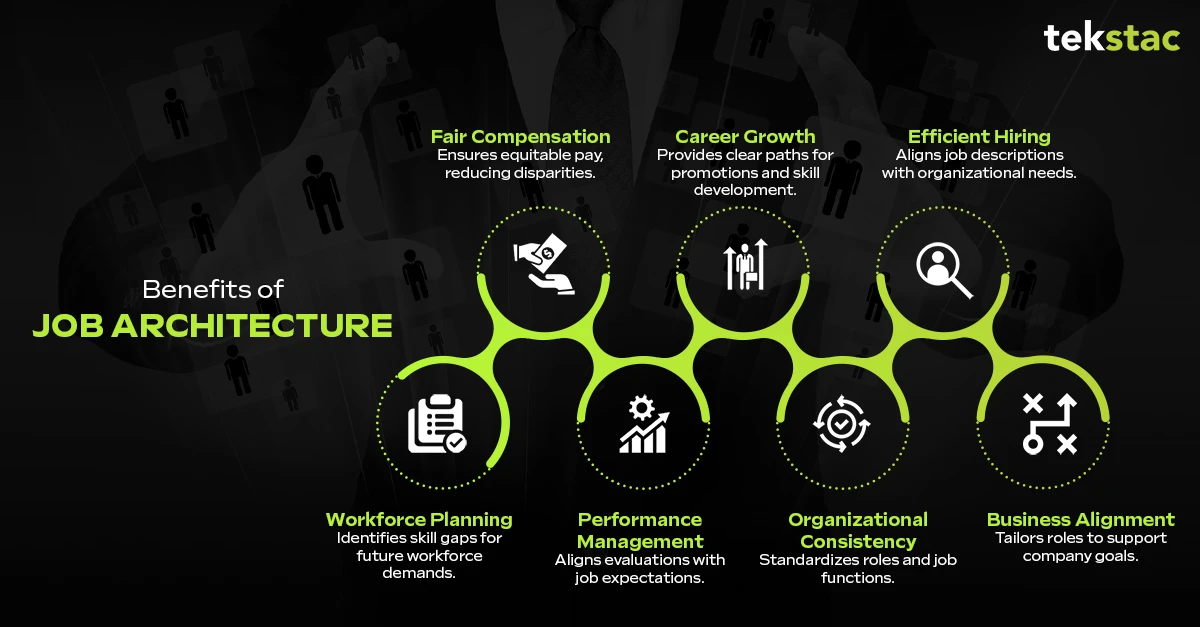
A job architecture framework is the complete operational structure built on top of job architecture principles ; it includes the job family taxonomy, the levelling criteria for each family, the skills and competency requirements at each level, the compensation bands mapped to each level, and the governance process for maintaining the framework as the organization evolves.
Where “job architecture” describes the concept, a “job architecture framework” describes the working system. A functional framework typically covers four layers: job families (broad groupings of related roles such as Engineering, Sales, or People Operations), job functions (sub-groupings within each family), job levels (individual contributor, senior, lead, principal, director and above), and career tracks (specialist vs. management paths within each function).
According to SHRM’s 2025 Talent Trends data, over the past three years the average job has seen 32% of its skills change; which means a job architecture framework without a regular review cycle becomes outdated faster than most organizations realize. Build in a quarterly review cadence as standard.
A good place to begin is by researching the company’s strategic position regarding its mission, vision, and scope of strategic objectives. This step is rather important because the job architecture should correspond to and also stimulate the organization’s direction.
For instance, when a company targets innovation, the jobs must generate positions responsible for research and creativity. Awareness of these goals helps ensure the framework can foster development, optimization, and overall compliance with major strategic objectives.
Take a comprehensive review of the organization’s existing roles, job descriptions, and reporting structures. Look for discrepancies among the levels, areas where responsibilities are closed or missing, and hierarchy gaps.
In some cases, there may be several job titles that are similar or critical roles that are not clearly defined. This assessment is an important part of reorganization and an effective way to avoid not including an important task.
Organize jobs with activities or tasks in clusters of their day-to-day activities, responsibilities or skills needed. For example, assigning customer assistance, sales, and marketing jobs can be placed categorically under a broader function.
This classification helps identify duplications of work and match positions with the company’s functional needs It also helps employees visualize their relationships to other positions within the company.
Explain the purpose and responsibilities, the requirements of the job, and the skills essential for the job. This stage ensures that the job descriptions prepared are well defined, accurate, and oriented toward achieving the firm’s objectives.
It will also involve tasks such as campaign planning, team leadership, performance evaluation, some degree of strategic thinking, and, last but not least, communication skills.
After finalizing the job architecture, release it to the organization. Describe the new framework’s impact, advantages, and goal. Provide training sessions to help managers understand how to implement it in their departments. For instance, they could require instructions on how to use job descriptions for promotions or performance assessments.
An effective job architecture is dynamic. Make sure the structure is still appropriate when the business expands or changes by reviewing it regularly. For instance, if a sector is reshaped by new technology, some jobs might need new skills or new positions would need to be created.
Maintaining the framework guarantees that it will continue to provide a solid basis for organizational success.
Job architecture is the foundation of a well-run, effective company. It promotes openness, equity, and alignment with corporate objectives by precisely outlining positions, duties, and career pathways. Employers may streamline operations, from workforce planning to recruitment, using this systematic method, improving employee engagement and retention.
A solid job architecture lays the foundation for long-term success by promoting staff retention and supporting effective organizational change. It also helps businesses find new opportunities with confidence. This approach creates a structured and goal-oriented work environment where motivation thrives and teams are empowered to drive sustainable growth.
1. What does a job architecture framework include?
A job architecture framework includes four core components: a job family taxonomy (broad groupings of related roles), job functions (sub-groupings within each family), job levels (from individual contributor through to executive), and career tracks (specialist vs. management paths). Each level has defined skills, responsibilities, and compensation bands attached to it.
2. How does job architecture support fair compensation?
Job architecture supports fair compensation by grouping similar roles into defined levels and attaching salary bands to each level. This removes the inconsistency of manager-by-manager negotiation and creates a defensible, auditable pay structure, reducing pay equity risk, and improving employee trust in how compensation decisions are made.
3. How often should job architecture be updated?
Job architecture frameworks should be reviewed at a minimum annually — and quarterly for organizations in fast-changing sectors. Role skill requirements are evolving rapidly: SHRM’s 2025 Talent Trends data shows the average job has seen 32% of its skills change over the past three years. A framework that is not regularly updated becomes a liability rather than an asset.
4. How does Tekstac support job architecture design and implementation?
Tekstac is an AI-powered LMS that helps HR and L&D teams centralize role data, map skills against job levels, and connect learning programmers to the specific competency requirements of each level in the job architecture framework. Enterprise organisations including IBM, PwC, Capgemini and Zensar use Tekstac to align workforce development with defined career paths at scale.