Increasingly rapid technology changes make it hard for businesses to keep up. It’s still imperative to increase revenue, foster employee engagement, and drive brand awareness—but now, there’s the added need to stay up to date with the latest technology advancements and find a way to use them to your business’s advantage. But how?
The key is leadership competence. With strong leaders at the helm, you’ll not only keep your business running in the digital age, but you’ll grow and thrive.
Here, we detail why leadership competence is so important in today’s digital environment and how your leaders can leverage change management, people leadership, vision, and technical savvy to lead the charge.
The stakes have never been higher. According to McKinsey’s 2025 workplace AI report, the single biggest barrier to successful AI adoption is not technology; it’s leadership. Meanwhile, Gallup’s State of the Global Workplace 2025 found that employee engagement has fallen to 21% globally, costing the economy an estimated $438 billion in lost productivity. The leaders who bridge this gap, technically literate, people-first, and strategically agile, will define which organizations thrive.
Leadership competence is a term that refers to one’s ability to lead effectively; this may include a combination of experience, knowledge, behaviors, skills and traits. Put simply, leadership competence is the difference between a strong leader and one that doesn’t live up to expectations.
Such competence is required from all leaders, but it’s even more important in the digital age. The continual advancements mean leaders must bring along the team and ensure they understand and adapt to changes. Plus, as digital changes lead to more opportunities for remote, distributed, and global workforces, they’ll need a strong leader to keep up morale and productivity. Finally, it’s important to keep up—remaining a competitive business requires staying on top of innovations and making your own.
Competent leaders don’t simply succeed in their roles. Instead, their impacts are broader, reaching and benefiting companies at large. There are several ways leadership competencies can positively impact an organization.
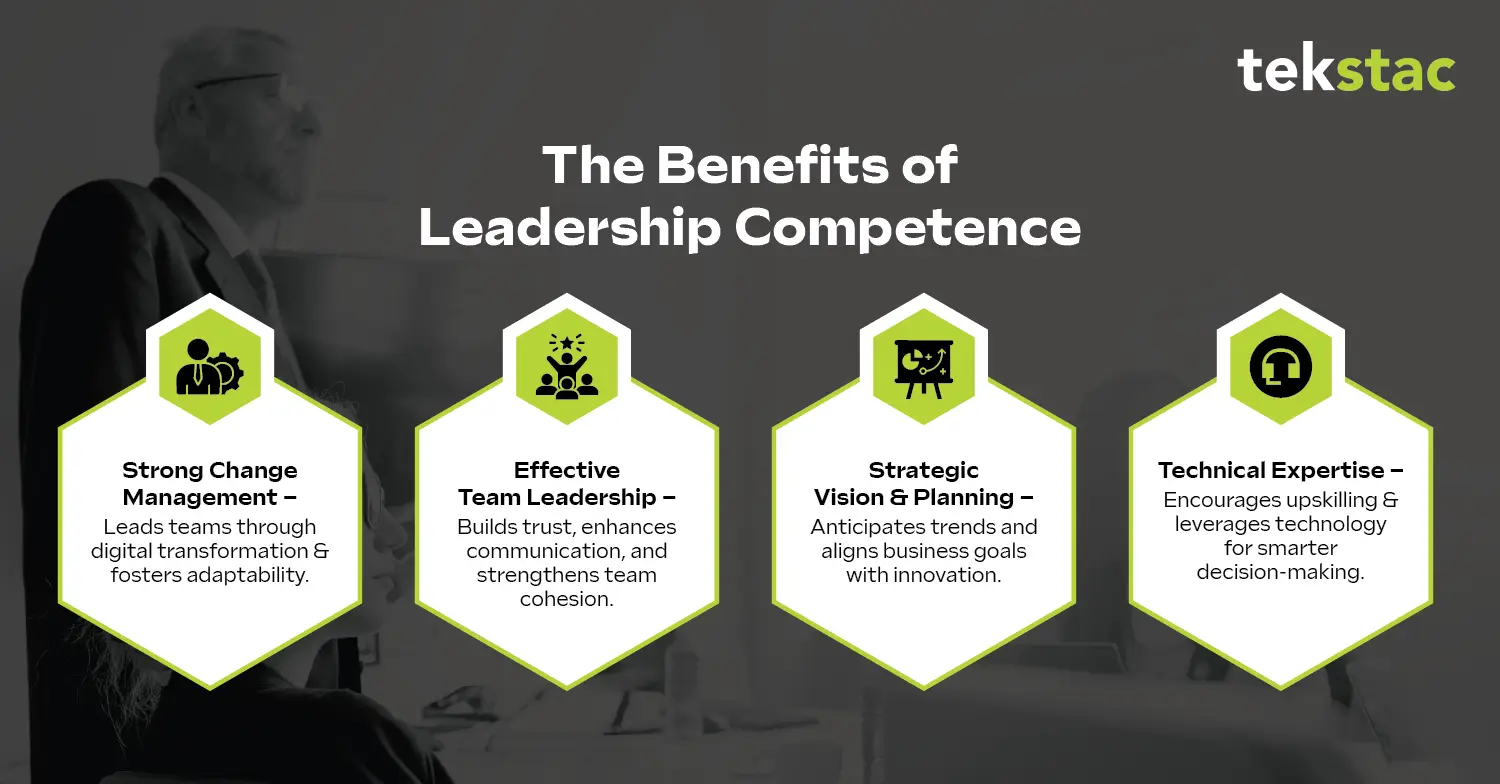
Rapid change is a major part of the digital age, but it can be difficult for employees to keep up. They may struggle to learn new tools or systems or feel anxious about the impact of AI and automation on their jobs. However, business leaders must bring along their staff and drive pivots as needed.
Consider how global consulting and professional services firms have integrated AI research and writing assistants into their analyst workflows. Rather than replacing junior analysts, forward-thinking leaders retrained them to prompt, validate, and apply human judgment on top of AI outputs, turning a potential threat into a productivity multiplier.
Practically, leaders can foster a culture of adaptability—and manage change among their teams—by encouraging teams to collaborate and cross-train, ultimately cultivating a strong growth mindset. In fact, a Harvard Business School survey found that 71% of respondents named adaptability the most important quality of a leader in the digital age.
While technology is a major part of workers’ daily lives, the human element is no less important. In fact, it may even be more important than ever. Strong leaders must show up with empathy and strong emotional intelligence and focus on clear communication with their teams.
Global engagement has dropped to 21%, the sharpest decline since COVID-19 lockdowns, driven largely by a 9-point drop in manager engagement since 2022.
This is especially important in a distributed or remote environment. Without employees working together from the same location, there’s more chance for miscommunication and a loss of team cohesion. To successfully manage this in the digital age, leaders can rely on digital tools like video conferencing, training platforms, and messaging systems.
A strong leader is always looking around the corner at what’s coming next and then determining the best path forward. The digital age makes this even more imperative. Leaders must set clear strategies and objectives that take into consideration the business’s needs, but also how the organization may need to change as technology does.
Without this type of strategic mindset, you could miss upcoming trends in your industry, finding yourself playing catchup rather than leading the charge to innovate.
At the same time, a strategic leader won’t simply jump to the latest trend without understanding its benefits and drawbacks. Rather than asking ‘what can AI replace?’, strategically competent leaders ask ‘where can AI amplify human strengths?.
Technical literacy is a must-have for competent leaders, but that doesn’t mean everyone must be an engineer. Instead, leaders should continually upskill and build their technical competence, then encourage their teams to do the same. According to McKinsey 2025 report, C-suite leaders estimate only 4% of employees use gen AI daily; the real figure is 13%. 63% of employees attribute leadership’s AI reluctance to “digital illiteracy”.
Currently, some of the major digital trends include generative AI, security, and big data, so those are a great place to start. As leaders become more fluent in today’s technological innovations, they can start using this understanding to make strategic decisions—or pivots, if needed.
Moreover, leaders should cultivate a culture of upskilling and training, investing in tools or programs that will help bolster their teams’ technical literacy and address employee skill gaps.
McKinsey’s 2025 research found that only 57% of employees say their company has an AI strategy, while 89% of C-suite leaders believe they do. Nearly half of employees report ‘lots of talk about AI but no action.’
Even with strong leadership, challenges abound in the digital workplace. Teams may resist AI adoption due to fears around job displacement, while others may independently adopt unauthorized AI tools without organizational oversight. This growing risk, known as “Shadow AI,” has become a major change management concern in 2025, with Zendesk’s CX Trends Report noting significant growth in unsanctioned AI usage across industries.
Leaders must balance change management with empathy by creating clear, safe, and governed AI adoption frameworks that help employees feel supported while encouraging responsible innovation. At the same time, with a rapidly evolving technology landscape, leaders must stay focused on business-critical priorities instead of getting overwhelmed by constant change and information overload.
It’s challenging for any company, regardless of digital advancements, to succeed without strong leaders. However, with the rise of new technologies and tools, competent leadership is even more imperative than ever.
Such leadership competencies include the ability to lead through change and foster adaptability, strong people management, a strategic mindset, and continued technological literacy—for both the leaders themselves and their teams. It takes intentional effort to focus on these areas, but it will pay off.
To further foster digital literacy and leadership, consider Tekstac. With over 500+ learning paths available, you can ensure your teams and leaders are trained and ready for whatever comes next.
1. Why do so many leadership competency models fail to get used?
Many leadership competency models fail because they are too generic, difficult to apply in real business situations, and disconnected from development or succession planning. Without validation or integration into day-to-day leadership decisions, organizations often struggle to use them consistently or confidently.
2. Do leadership competencies need to be customized for each organization?
Yes. Effective leadership competency frameworks should reflect an organization’s strategy, culture, business priorities, and leadership expectations. The strongest models balance research-backed structure with organization-specific relevance.
3. What are the four leadership competencies?
The four key leadership competencies are change management, people leadership, strategic vision, and technical literacy. Together, these skills empower leaders to guide organizations through transformation and thrive in today’s digital business environment.
4. How can leaders develop leadership competence?
Leaders can develop competence by continuous learning, upskilling in digital tools, practicing emotional intelligence, and seeking mentorship. Regular training programs and feedback loops also help strengthen leadership skills and adaptability.
5. How do leadership competencies connect to leadership development programs?
Leadership competencies define the skills and behaviors leaders need to demonstrate, while development programs help build those capabilities. Clear competencies make leadership development more focused, measurable, and aligned with real capability gaps and business goals.
6. How do you choose a leadership competency development vendor?
Organizations should look for vendors that combine research-backed frameworks, validation methods, customization capabilities, and measurable business alignment. Platforms like Tekstac help translate leadership competencies into practical development, assessment, and workforce strategies.