By 2027, six out of ten employees will need to upskill, yet less than half have access to adequate training, according to the World Economic Forum. This growing gap between evolving industry demands and workforce capabilities poses a serious challenge for businesses. In an era of rapid technological advancements, continuous learning is no longer just an HR initiative—it has become a strategic necessity for companies to stay competitive and future-ready.
Companies that treat learning as a core business function—integrating AI-driven development plans and tailored career paths based on current Learning and Development Trends—aren’t just keeping pace with change; they’re driving it. According to industry leaders, continuous learning is no longer a buzzword but a business imperative, essential for staying competitive in an evolving landscape.
They stress that staying ahead requires more than just offering training programs. It demands a strategic, AI-powered approach to skill development, strong leadership involvement, and a culture where learning is deeply embedded into everyday work. Today, the real question isn’t whether to invest in continuous learning—it’s whether businesses can afford not to.
Tata Technologies is prioritising continuous learning as a business-critical necessity, particularly in the rapidly evolving automotive and technology sectors. The company runs multiple learning programs for lateral hires but places equal emphasis on upskilling long-tenured employees who have been with the organization for decades.
Tracy Austina Zacreas, AVP – Global Head – Technical Learning and Development, highlights this focus, stating that Tata companies, including Tata Technologies and Tata Motors, have a legacy of long-serving employees—many working with the same skill sets for 35 to 40 years. “In most other organizations, a five-year tenure qualifies for a long-service award, but at Tata, employees build decades-long careers,” she explains.
However, as industries transform, the risk of these employees being left behind increases, making continuous learning essential. “This poses a challenge for the organization, making continuous learning a business-critical necessity,” says Zacreas. To bridge the gap, Tata Technologies is upskilling employees across operations, supply chain, and procurement, ensuring they are equipped to handle emerging technologies such as Gen AI, software-defined vehicles, and cybersecurity.
“From reading data sheets to negotiating with vendors for crucial components like motors, our goal is to ensure they stay relevant in a rapidly transforming landscape,” she adds. For Tata Technologies, continuous learning is not just a program—it is a strategic function. “Continuous learning ensures our experienced workforce does not miss the bus as industries embrace cutting-edge innovations,” Zacreas asserts.
Even the best AI platforms and learning management systems (LMS) won’t drive learning on their own. This is why learning journeys have been customized to cater to the specific needs of different employee segments at Infosys. Whether it’s tenured employees, team leaders, or those preparing for managerial roles, tailored interventions have been created for each group.
“For every segment, partnerships have been formed with leading platforms like Tekstac, LinkedIn Learning, and Udemy, offering specialized learning interventions to address unique needs. The Learning and Development (L&D) team oversees these interventions, ensuring they are focused and impactful for every employee,” Savio Freitas, Practice Lead HRD at Infosys, emphasizes.
This personalized, segment-based approach is how a continuous learning culture is fostered, ensuring that every employee has the support and resources they need to grow and succeed within the company.
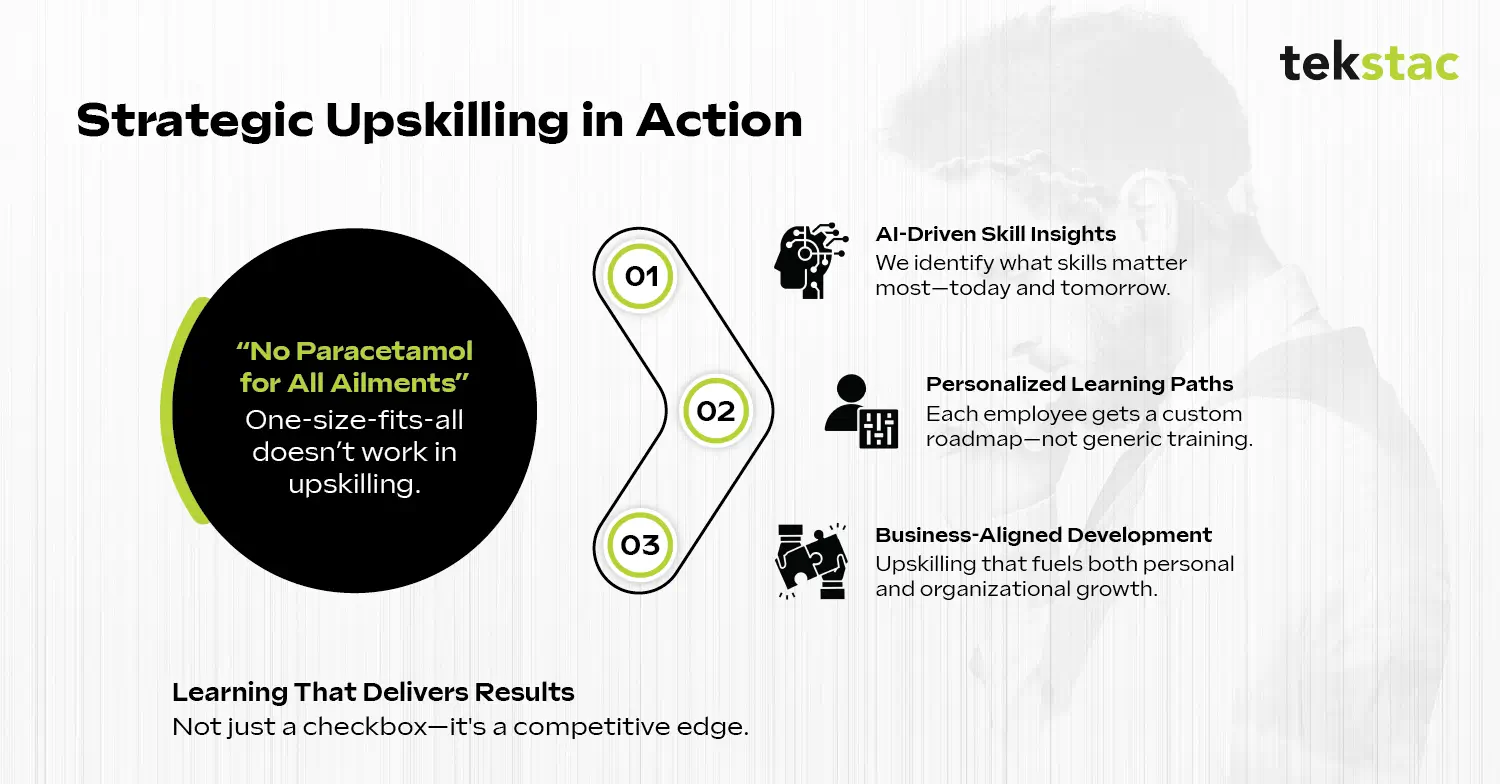
“We believe in a targeted approach to learning—there’s no ‘paracetamol for all ailments,’” says Manmohan Sharma, Talent Management at QX Global Group. And that’s why QX follows the Individual Development Plan (IDP) model, ensuring upskilling is precise and relevant. Sharma explains how they do it:
“This way, learning isn’t just a checkbox—it’s a tool for staying competitive,” he adds.
Want to accelerate your team’s growth?
Discover how effective upskilling strategies can drive your digital transformation and future-proof your organization.
At Amdocs, continuous upgradation in technology isn’t just an option—it’s a necessity. Simren Mehn, Practice Lead- OD & Senior Leadership Development-(Global) at Amdocs, emphasizes the importance of scaling to stay competitive. “If you’re not scaling yourself, you’re losing the game,” she says.
As a product-led service company, Amdocs creates core products that get customized for telecom organizations, requiring a mix of skills in both emerging technologies and legacy systems.
One of the company’s key initiatives involves conducting a deep skill analysis to identify:
“To support this, Amdocs is piloting an AI-based learning system that helps employees create skill profiles, self-assess, and receive targeted learning recommendations. Employees can rate themselves on a scale from basic to advanced, and managers can assess them as well. The system automatically identifies skill gaps and pushes relevant learning content,” explains Mehn.
However, Mehn emphasizes that merely implementing a system isn’t enough. “Driving learning through business units and leadership involvement is key,” she explains. L&D is no longer just an HR function—it’s a strategic business imperative.
Leaders at Amdocs understand that without continuous learning, they risk becoming obsolete. By embedding learning into the company culture, Amdocs ensures business relevance and long-term success.
The examples above highlight how companies are embedding continuous learning into their business strategies, ensuring employees remain relevant and competitive in a rapidly evolving world. But learning isn’t just about access—it’s about the right tools, the right interventions, and a culture that drives engagement.
Platforms like Tekstac play a crucial role in this transformation. By offering AI-driven insights, personalized learning journeys, and business-aligned skill development, these platforms enable organizations to provide targeted upskilling opportunities. Whether it’s reskilling long-tenured employees, ensuring managers are equipped for leadership, or closing critical skill gaps, leveraging the right learning ecosystem ensures that upskilling is not just a corporate checkbox but a strategic advantage.
The choice isn’t whether to upskill—it’s how quickly and effectively organizations can do it.
1. Why is continuous upskilling important for future-ready companies?
Continuous upskilling ensures that employees keep pace with emerging technologies, maintain productivity, and drive innovation. It prevents skill obsolescence and supports long-term business growth.
2. How can AI improve continuous upskilling?
AI personalizes learning paths, identifies skill gaps, and provides data-driven recommendations to accelerate employee growth and business outcomes.
3. Why is continuous learning and upskilling important?
Continuous learning and upskilling are essential to keep employees’ skills aligned with evolving technologies and business needs. They help individuals stay relevant, boost innovation, and enable organizations to remain competitive in a rapidly changing market.