
The top 7 learning and development trends for 2026, from AI-driven skill development to gamification and hyper-personalized learning. A practical guide for L&D leaders planning next-year strategies.
With growing dependencies on Gen AI, learning & development departments will continuously evolve in 2026. In order to stay relevant in the growing market, it’s imperative to follow the latest trends and be a part of a futuristic workplace.
So, what are the top Learning and Development Trends for 2026?
The leading L&D trends include AI-driven upskilling, hyper-personalized learning paths, microlearning, and data-driven learning strategies.
Read on to deep dive into what’s new in L&D and where it’s all headed.
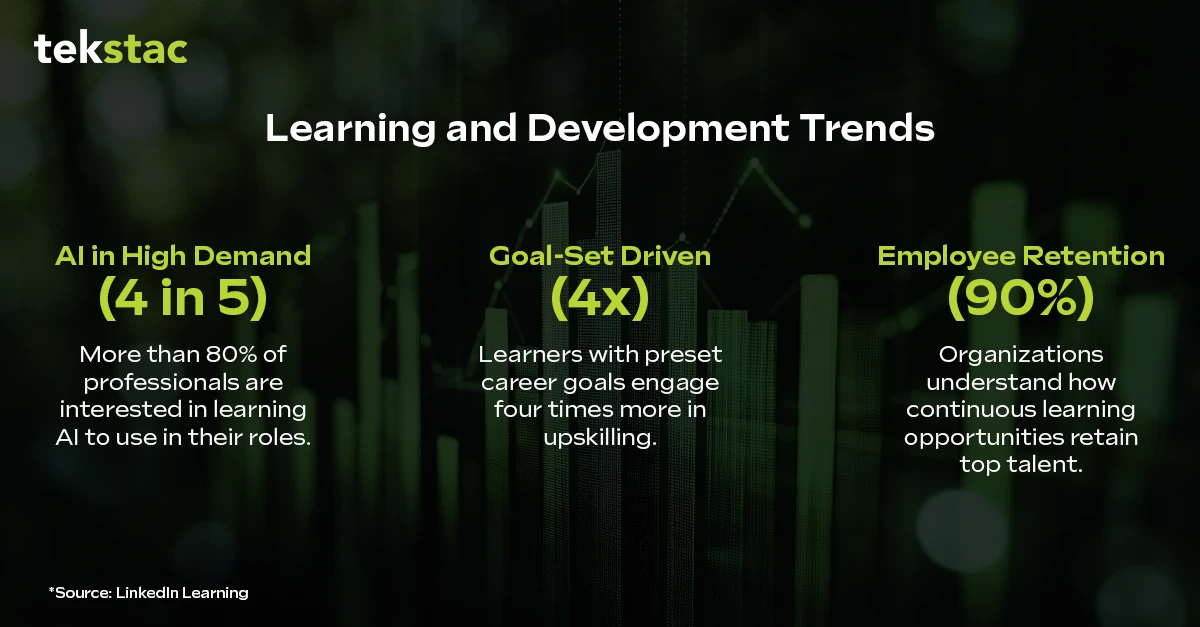
India’s workforce is undergoing rapid transformation, driven by AI adoption, digital skills demand, and evolving business needs. Multiple industry reports highlight both the scale of upskilling momentum, and the gaps organizations must address.
These insights highlight why organizations must rethink their learning strategies. Here are the key learning and development trends shaping the future of work.
Whether you’re looking to reskill, upskill, or future-proof your workforce, staying aligned with the latest L&D innovations is essential.
Let’s explore the top 7 corporate learning and development trends set to create growth waves in 2026.
AI is now the central driver of enterprise L&D strategy — not as a replacement for human learning, but as the infrastructure that makes personalized, continuous skill development scalable.
In 2026, the critical shift is from AI-assisted learning to responsible AI adoption: organizations must design Human+AI frameworks where AI handles adaptive content delivery, gap identification, and progress tracking, while human facilitators focus on mentorship, judgment, and collaboration skills that AI cannot teach.
Practically, this means L&D teams are deploying AI to map real-time skill gaps against business objectives, auto-generate personalized learning paths, and predict which skills their workforce will need 12–24 months ahead. Platforms like Tekstac combine skills intelligence with AI-driven recommendations — giving L&D leaders data to act on, not just data to review.
The corporate L&D Program has shifted towards personalized learning where content is customized based on each learner’s skill, responsibility, and goal in career.
In the coming years, companies will focus on specific skills for each person rather than on predefined roles. It leads to greater agility and fills the skill gaps more easily.
As professionals are becoming busier, on-demand upskilling has concise. Microlearning is going to dominate L&D strategies in the coming years. It involves bite-sized content to be learned in minutes, which makes it perfect for IT teams who manage tight schedules.
They can learn quickly and apply at any time level of experience. They are perfect for mobile learning and reinforce knowledge through repetition. Tekstac supports microlearning, allowing learners to get access to training modules anywhere, anytime.
2026, like this year, will equally advocate continuous learning culture with the power of immersive learning technologies. AR or Augmented Reality and VR or Virtual Reality will reign supreme in 2026 also.
With this, IT professionals can engage in the simulated environment to practice troubleshooting systems and coding and handling any complex projects without the risk of the real world.
With the great pressure of the ROI of training programs, the Learning and Development trends in 2026 have been data-driven. Data analytics is the core of any training these days to optimize and customize training programs based on performance metrics, skill gaps, and learning experiences.
For instance, at Tekstac, trainers collect and analyze information from different sources like learning management systems, performance assessments, and feedback surveys, to learn the areas of improvement. Later the insight is used to customize training content, and progress tracking, and to adjust strategies for real-time upskilling.
The future of corporate learning mostly relies on engagement metrics. The more engaging the training, the better results. Gamification is more than a buzzword. It’s a powerful tool for engaging employees, driving motivation, and fostering collaboration within teams. Gamified learning in 2026 will include AI, VR and AR in the learning environments, setting new benchmarks in immersive learning experiences.
Hybrid and remote working are the future, and it becomes necessary to create engaging L&D programs for remote teams through gamified eLearning. And who doesn’t enjoy a dynamic, game-based learning experience with a bit of healthy competition?
Social learning methodologies are transforming employee training and development in miraculous ways. Platforms like LinkedIn and internal social platforms within organizations are taking precedence for knowledge sharing and group discussions.
Not only that, incorporating interactive forums within LMS tools helps employees engage in real-time and share insights.
In 2026, Learning and Development will be shaped by AI, continuous learning, and deeper employee engagement. Organizations that invest in real-world skill development and data-driven learning strategies will be better positioned to adapt, innovate, and grow.
Platforms like Tekstac enable this shift by combining hands-on labs, continuous assessment, and analytics to deliver measurable skill outcomes at scale.
👉 Explore the Tekstac platform demo to see how you can build a future-ready, skills-first workforce.
1. Which companies offer AI-driven learning and development solutions for enterprises?
Several companies provide AI-driven L&D solutions for enterprises, including platforms like Tekstac, Degreed, and Coursera for Business. These platforms combine AI-powered learning, skill assessments, and analytics to help organizations upskill employees, track progress, and align learning with business outcomes at scale.
2. What are the top learning and development trends for modern workforces?
Key L&D trends include AI-powered personalized learning, continuous upskilling, skills-first workforce strategies, data-driven learning analytics, and immersive hands-on training. Organizations are also focusing on aligning learning programs with business goals and improving employee engagement through real-world, application-based learning experiences.
3. How do companies implement effective L&D programs?
Companies implement effective L&D programs by identifying skill gaps, aligning training with business objectives, and using scalable learning platforms. They integrate hands-on learning, continuous assessment, and analytics to track progress, while enabling personalized learning paths that improve engagement and ensure measurable outcomes across the workforce.
4. How is AI changing learning and development in enterprises?
AI is transforming L&D by enabling personalized learning paths, automating assessments, and providing real-time insights into skill development. It helps organizations predict skill gaps, recommend relevant content, measure learning impact, make training more efficient, scalable, and aligned with business performance goals.