
Companies are investing more than ever in employee training programs. Yet, for many HR and L&D teams, answering a basic question remains frustrating: ‘Is it working?
Despite billions of dollars invested in upskilling and workforce training each year, 61% of training leaders still do not measure the ROI of employee training programs, per a LearnUpon survey of training leaders. Even when training outcomes are evaluated, Even when training outcomes are evaluated, they’re often reduced to surface-level metrics, such as completion rates, smiley-face surveys, or test scores. While these are useful, they are neither sufficient nor adequate.
Many organizations cite lack of clear goals, insufficient resources, and uncertainty about where to start as the top challenges in measuring training ROI.
Let’s take a realistic approach and a practical step-by-step process that covers actual training costs, integration with business goals, and how to use the data you already have.
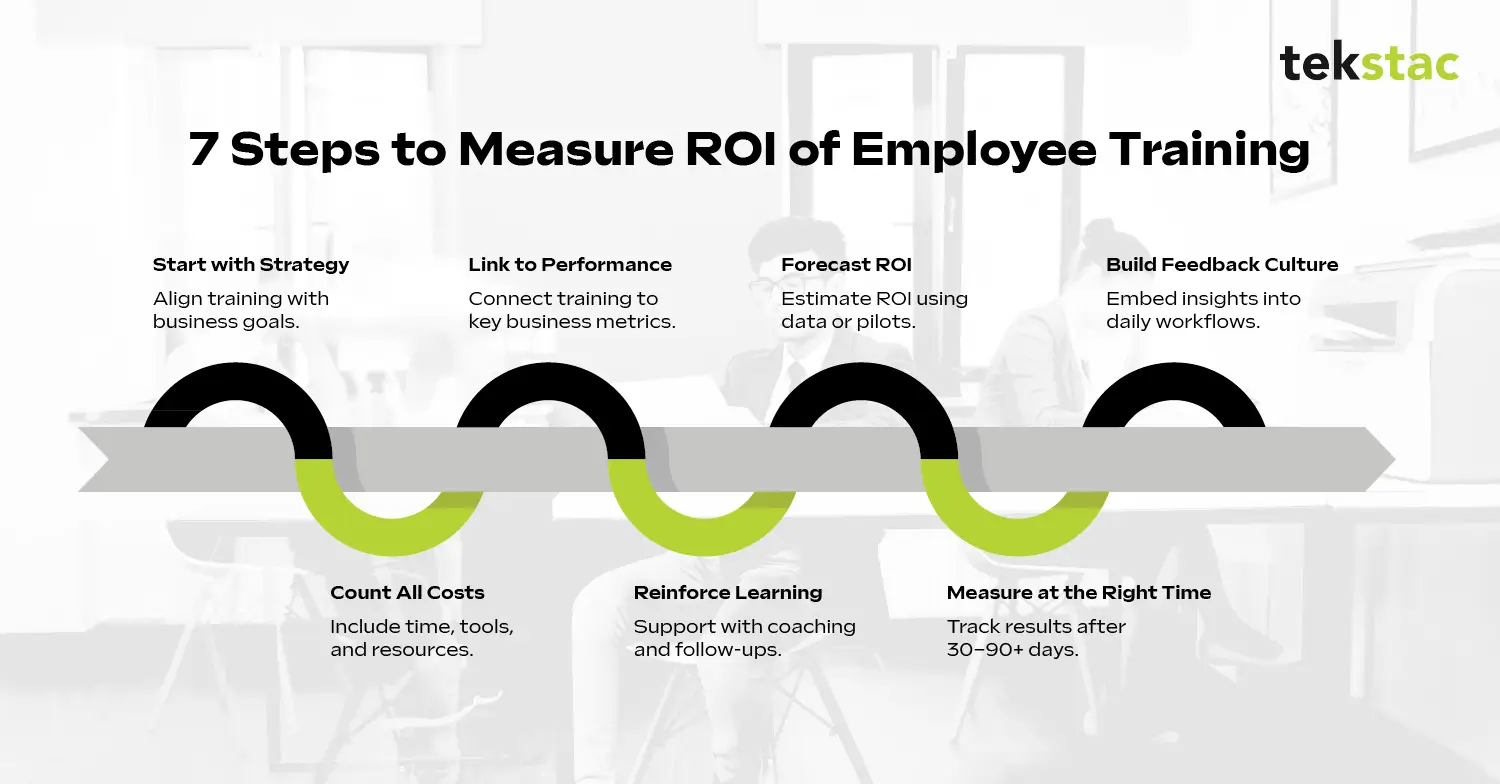
Most organizations begin their workplace training by identifying skill gaps, those missing competencies or technical skills employees lack. Focusing solely on skill gaps is a limited view that misses alignment with the company’s broader strategic goals and outcomes.
If L&D efforts fail to connect to what the business is trying to achieve, measuring learning impact becomes ineffective. Hence, without this strategic intent, most organizations fall prey to measuring ineffective ROI metrics like course completions or quiz scores but not outcomes such as increased revenue, improved customer satisfaction, faster product launches, etc.
To do this practically, begin every training program with a conversation beyond HR or L&D. Bring in stakeholders from business units, operations, sales, and leadership. Ask questions like:
From there, create learning objectives that tie directly to these priorities. This sets the foundation for meaningful ROI measurement. Determining learning success through business KPIs rather than just learning KPIs allows you to identify the right metrics upfront.
For example, instead of “improve negotiation skills,” a strategic intent might be to “reduce average sales cycle time by 15% through improved negotiation.”
Training budgets are generally calculated based on platform licenses, facilitator fees, or travel expenses. However, this approach does not capture the full cost of ownership of workplace training programs. Here’s how to ensure a more accurate cost baseline:
Employee time: Every hour spent in training is not spent on other productive work. This opportunity costs scales quickly across large cohorts.
Manager involvement: This includes conducting follow-ups, assigning pre-work, or leading on-the-job practice sessions, as they dedicate time and energy that needs to be accounted for.
Post-training reinforcement: Job aids, nudges, simulations, or coaching continues long after completing a course.
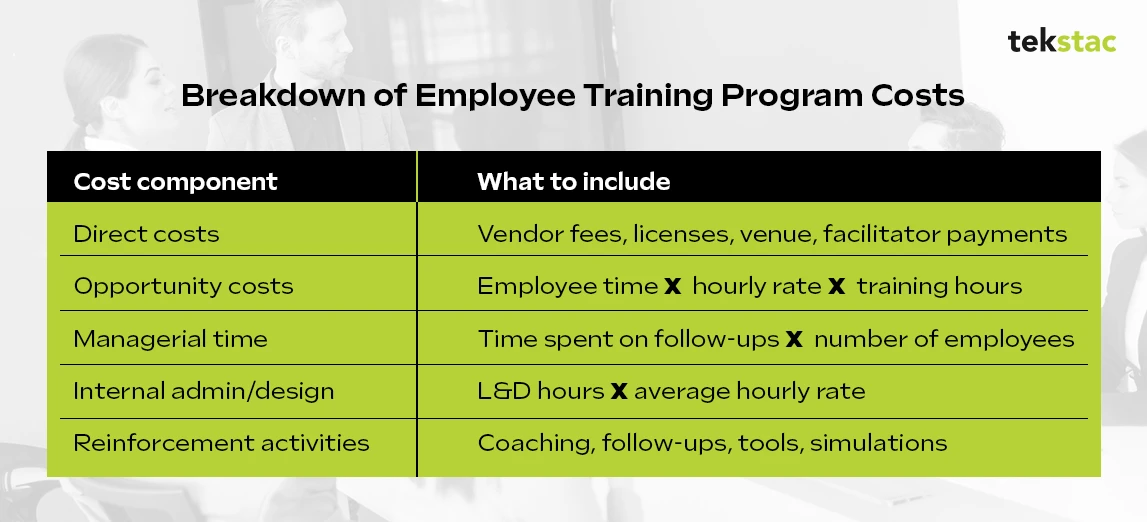
Many companies hesitate to investigate these costs out of fear they’ll seem too high, but being honest about the real cost of training actually strengthens credibility when showing impact, as leaders need an accurate number rather than a lower one.
Connect training outcomes with relevant performance data, sales figures, error reduction, customer satisfaction scores, or productivity rates. Start by identifying which business metrics your training will influence, then collaborate with data owners in departments like sales, customer success, or operations. They often track these metrics regularly and can provide historical data for comparison.
Now, create a simple data dashboard or report that overlays training participation data with these business KPIs over time. Look for patterns like improvements in key metrics following the training rollout—segment data by employee groups who took the training versus those who didn’t to isolate the impact.
For example, if average sales increase by 10% post-training in your trained group compared to untrained peers, that’s a clear signal of positive ROI. You can then translate that uplift into dollar values for your ROI formula.
Some employee training programs fail because of what happens after the session ends. Per Hermann Ebbinghaus’s Forgetting Curve research, as much as 90% of learning is forgotten within a month if not reinforced. As we observe, most L&D programs still operate on a “one-and-done” model.
Training is not a single event; it’s a process of behavioral change. Without reinforcement, there’s no lasting change, hence no real ROI. This means measuring training ROI must include structured reinforcement. Here’s what to include:
Tip: When planning your program, allocate at least 20-30% of your training budget or timeline to reinforcement.
A simple way to measure ROI with reinforcement in place would be to use this formula:
ROI of training programs (%) = (Total Benefit – Total Cost)/Total Cost x 100
Let’s break this down:
Total benefit = Business gains because of the training (e.g., time saved, revenue increased, increase in resolution times, etc.)
Total cost = Training costs + time + reinforcement tools or coaching
Predicting ROI upfront helps align expectations and secure stakeholder buy-in. Many organizations skip this step, making it harder to justify investments or set realistic goals. You can estimate the potential business impact your training can have based on historical data, benchmarks, or pilot programs. Forecast the costs involved so you have a clear picture of the investment
Predicted ROI (%) = (Expected Benefit – Cost)/Cost x 100
You can use smaller pilot groups to test training impact quickly before wider rollout and gather early performance signals, like knowledge application or behavior change, to adjust predictions. While predictive ROI isn’t perfect, it sets a proactive foundation for tracking and optimizing training success.
Measuring ROI too soon can be the biggest trap. True business impact from training often takes time to materialize. Behavior changes, productivity gains, or revenue improvements rarely appear overnight. It’s important to recognize that a training program might initially show a negative ROI or no measurable benefit—not because it failed, but because you haven’t yet reached the break-even point where benefits outweigh costs. To measure employee training ROI right:
If, after the appropriate measurement window, ROI remains negative, don’t see it as a failure but as a sign to dig deeper. It could mean the training wasn’t aligned with business priorities, the delivery method ineffective, or the benefits are harder to quantify. Use this insight to reassess training goals, refine the training content, improve reinforcement strategies, or adjust your metrics.
Training effectiveness depends heavily on how well it aligns with organizational culture, leadership support, and employee readiness to change. If the culture resists new behaviors or lacks reinforcement mechanisms, ROI will suffer despite great content or delivery. Factors like peer influence, manager involvement, and workplace norms shape whether learning turns into performance improvements.
Create channels to collect feedback not only immediately after training but throughout the learning journey. This includes:
The key here is to partner with managers to embed learning checkpoints into regular workflows, leverage technology platforms that allow real-time feedback and data integration, and communicating changes periodically.
Want practical strategies and future trends in employee development?
👉 Explore more in our full blog.
To actually measure training impact, the preparation work starts much earlier, with how you design your training ecosystem. There’s a need for a tool that not only delivers content but effectively tracks, connects, and analyzes every learning touchpoint against actual business KPIs.
Tekstac’s learning analytics and management modules help perfectly:
The platform also powers your learning experience with custom learning paths, mentor marketplace, virtual sessions, auto-evaluated practice labs, AI-proctored assessments, and many more. With over 1 million professionals upskilled, 24 million+ learning hours, and enterprise customers like IBM, PwC, Capgemini, and Cognizant, Tekstac is built for organizations that want to transform how they train and upskill. See Tekstac in action.
1. Why is ROI significant in training evaluation?
ROI is significant in training evaluation because it helps organizations determine whether training investments deliver measurable business value. By tracking outcomes such as productivity, performance, retention, and cost savings, companies can justify learning budgets, improve training effectiveness, and make more informed workforce development decisions.
2. How can we measure ROI from employee development programs beyond just satisfaction surveys?
Go beyond satisfaction surveys by tying training to measurable business KPIs — sales performance, error rates, productivity, or customer satisfaction — rather than completion rates. Segment performance data by who took the training versus who didn’t, then translate any uplift into dollar terms using the ROI formula: (Total Benefit – Total Cost) / Total Cost × 100.
3. What is the formula for calculating training ROI?
The standard formula is ROI (%) = (Total Benefit – Total Cost) / Total Cost × 100, where Total Benefit reflects business gains like time saved or revenue increased, and Total Cost includes delivery, employee time, and reinforcement. A Predicted ROI version — (Expected Benefit – Cost) / Cost × 100 — can be used before rolling out.
4. How do you measure employee training impact and ROI together?
Track leading indicators (knowledge retention, behavior change, engagement) soon after training, and lagging indicators (sales performance, error rates, customer satisfaction) over a longer 30–90 day window, then compare trained versus untrained groups to isolate the training’s actual effect.
5. What tools help measure training ROI?
Effective training ROI tools combine learning data with business KPIs in one view — look for custom dashboards with real-time progress tracking, predictive analytics to anticipate outcomes before rollout, and skill inventory monitoring, rather than tools that only report completion rates.





This blog gives a clear picture of how AI is changing jobs, not just taking them away. It shows the importance of learning new skills and working with AI to grow.