
Last updated on February 3rd, 2026
Outskilling AI isn’t a futuristic dream—it’s a present-day priority. AI could start replacing many jobs as early as 2026, according to Geoffrey Hinton, often referred to as the Godfather of AI. The real challenge isn’t the technology itself—it’s building a workforce that can evolve with it. That’s where AI skilling and forward-looking workplace learning strategies come in.
To outskill AI, organizations must focus on continuous skilling, real-world learning, and human capabilities that complement automation. In this guide, we’ll explore six hands-on tactics to help your organization outskill AI and turn change into competitive advantage.
Outskilling AI doesn’t mean competing with machines or trying to replace them. It means building human capabilities that AI can’t replicate on its own, such as critical thinking, judgment, creativity, and ethical decision-making. For L&D and business leaders, to outskill AI is enabling people to apply AI tools with intent and impact, not just teaching them how the technology works.
With AI reshaping roles at speed, the World Economic Forum estimates that 44% of core workplace skills will change by 2027—underscoring why organizations must actively outskill AI, not just adopt it.
Outskilling AI isn’t about learning more tools. It’s about asking better questions.
The following six questions help leaders think strategically about how humans stay ahead in an AI-enabled workplace.
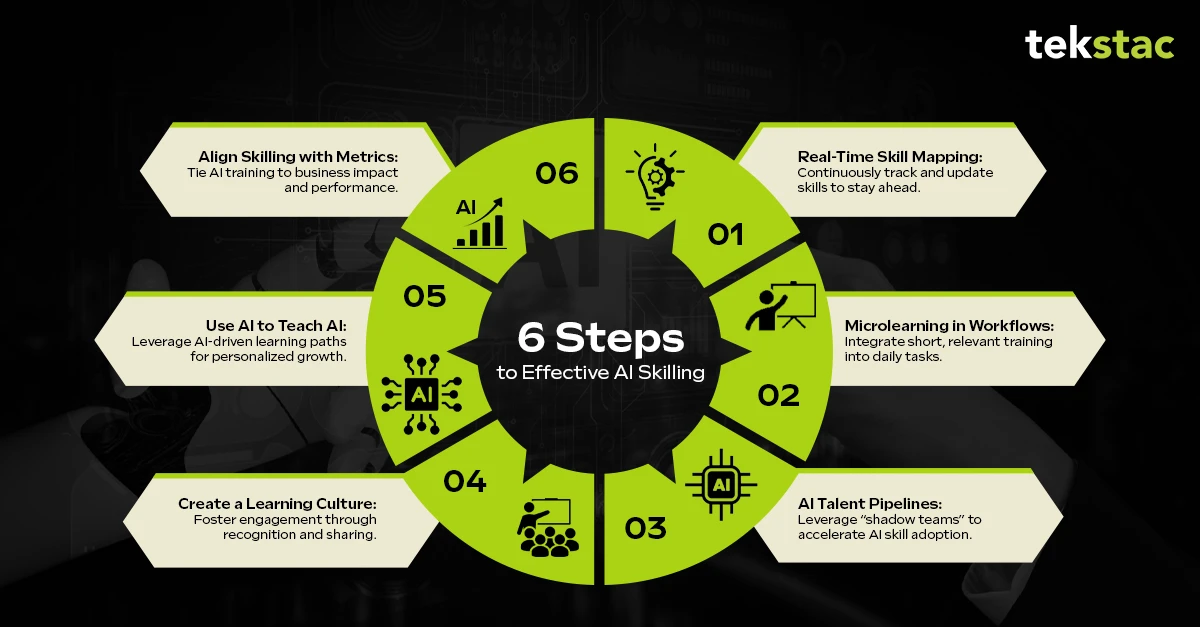
The first mistake many companies make is treating workforce planning like an annual project that gets updated once a year. By the time you identify a skill need, AI capabilities—and the market—have already shifted. A more effective approach is to make skill mapping continuous and data-driven. One organization did this by assigning a small AI readiness team to track new platform features, market trends, and emerging roles every quarter.
They used these insights to update a living skills matrix that guided hiring, training content, and internal mobility—no big reveals or annual panic meetings, just a steady cadence of updates that kept everyone on their toes.
No matter how powerful your training modules, they won’t stick if they feel like homework. To outskill AI, organizations need to embed learning directly into daily workflows, so employees build skills while doing real work.
One tech company put QR codes on production floors that linked to 2-minute how-to videos for new AI-driven machinery. The videos were relevant, concise, and directly tied to daily work—helping employees outskill AI by applying new capabilities in the flow of work rather than stepping away from it.
Most organizations have experts—whether in marketing, engineering, or customer service—who naturally pick up new systems faster than their peers. Instead of letting them operate in silos, organizations can form small “shadow teams” to pilot AI initiatives and share lessons learned with their core departments.
Think of it like a rotating fellowship: employees who show early aptitude for AI skills get the opportunity to experiment with emerging technologies, while their teams benefit from faster AI skill adoption. This approach not only accelerates workforce upskilling but also fosters a sense of ownership and engagement that keeps morale high.
If leadership sees training as a nice-to-have initiative rather than a growth driver, it’ll never get the attention and funding it deserves. The key is to tie skilling directly to metrics your organization already cares about. An AI upskilling sprint should be judged by outcomes: does it help teams outskill AI by accelerating speed to market, lifting customer satisfaction, or reducing costs? One consumer-goods manufacturer, for example, tracked how quickly new hires could start using AI-driven demand forecasting tools, then tied that ramp-up time to overall profit margins. The result? A data-backed case for investing even more in workforce development.
It might sound meta, but it works. Generative AI can predict not only future roles but also the specific competencies each job will require. Picture a scenario where you use an upskilling platform like Tekstac which uses AI to suggest personalized learning paths for each individual, based on the projects they’re working on and the goals they’re aiming for.
One global firm took it further by having AI flag emerging trends—like a new regulation or a novel customer channel—and automatically recommend relevant micro-courses to the employees who’d be most affected. The effect was like having a virtual coach that kept everyone just ahead of the curve.
There’s a difference between mandating training hours to outskill AI and instilling a genuine culture of learning. A 2026 Deloitte survey says that although workforce access to AI tools has grown by ~50% in a year, fewer than 60% of employees with access use those tools regularly in their work. The latter happens when employees see how AI skills make their work more impactful, more efficient, and sometimes even more creative. Celebrating wins—like a team that discovered a new product idea through AI-driven insights—goes a long way toward making skilling feel like an opportunity rather than an obligation.
Some organizations run internal “demo days” where teams showcase AI breakthroughs. Others encourage managers to dedicate time in weekly stand-ups for staff to share newly acquired skills or micro-certifications. Over time, these seemingly small rituals build a collective momentum that keeps upskilling front and center.
AI is moving faster than any technology and keeping up takes more than tools or intent. The organizations that win will be those that invest in people who can continuously learn, adapt, and outskill AI; not occasionally, but as part of everyday work.
1. What are the top skills needed to outskill AI in 2026?
To outskill AI in 2026, professionals need critical thinking, creativity, emotional intelligence, adaptability, and ethical judgment—skills that enable humans to guide, interpret, and enhance AI-driven outcomes.
2. What industries require workers to outskill AI the most?
Industries like finance, healthcare, manufacturing, and customer service require workers to outskill AI the most. These sectors rely on human judgment, ethical reasoning, and nuanced communication that AI can’t fully replicate.
3. What are the core components of an effective AI skilling strategy?
The core components of an effective AI skilling strategy include identifying skill gaps, offering role-specific training, blending technical and soft skills, and enabling continuous learning through hands-on projects and real-world applications.
4. How can AI skilling help businesses stay competitive?
AI skilling helps businesses stay competitive by empowering employees to work alongside AI tools, improve efficiency, innovate faster, and adapt to changing market demands with future-ready skills.