
In 2026, the pace of change has exploded. Emerging AI trends in L&D are redefining every aspect of workplace operations and learning. Yet, many organizations are still training like it’s 2010.
The world of Learning and Development (L&D) is at a turning point, as outdated systems clash with the urgent need for workplace upskilling with AI, and companies struggle to keep pace with the demands of digital transformation in L&D.
While AI promises hyper-personalization, real-time insights, and automation at scale, the uncomfortable truth is that most businesses are stuck delivering cookie-cutter training that satisfies no one.
The rise of AI trends in learning tech has made it clear: generic learning paths are obsolete. Workers demand training that reflects their roles, goals, and learning styles. Instead, they’re handed recycled slide decks and linear modules that neither engage nor empower.
AI Trends in L&D refer to the emerging ways artificial intelligence is transforming workplace learning. They include hyper-personalized learning paths, predictive analytics, adaptive content, skill intelligence, and AI-powered coaching that improve performance, retention, and training efficiency across the organization.
To understand how these trends fit into a broader workforce strategy, explore our AI in HR strategy and transformation.
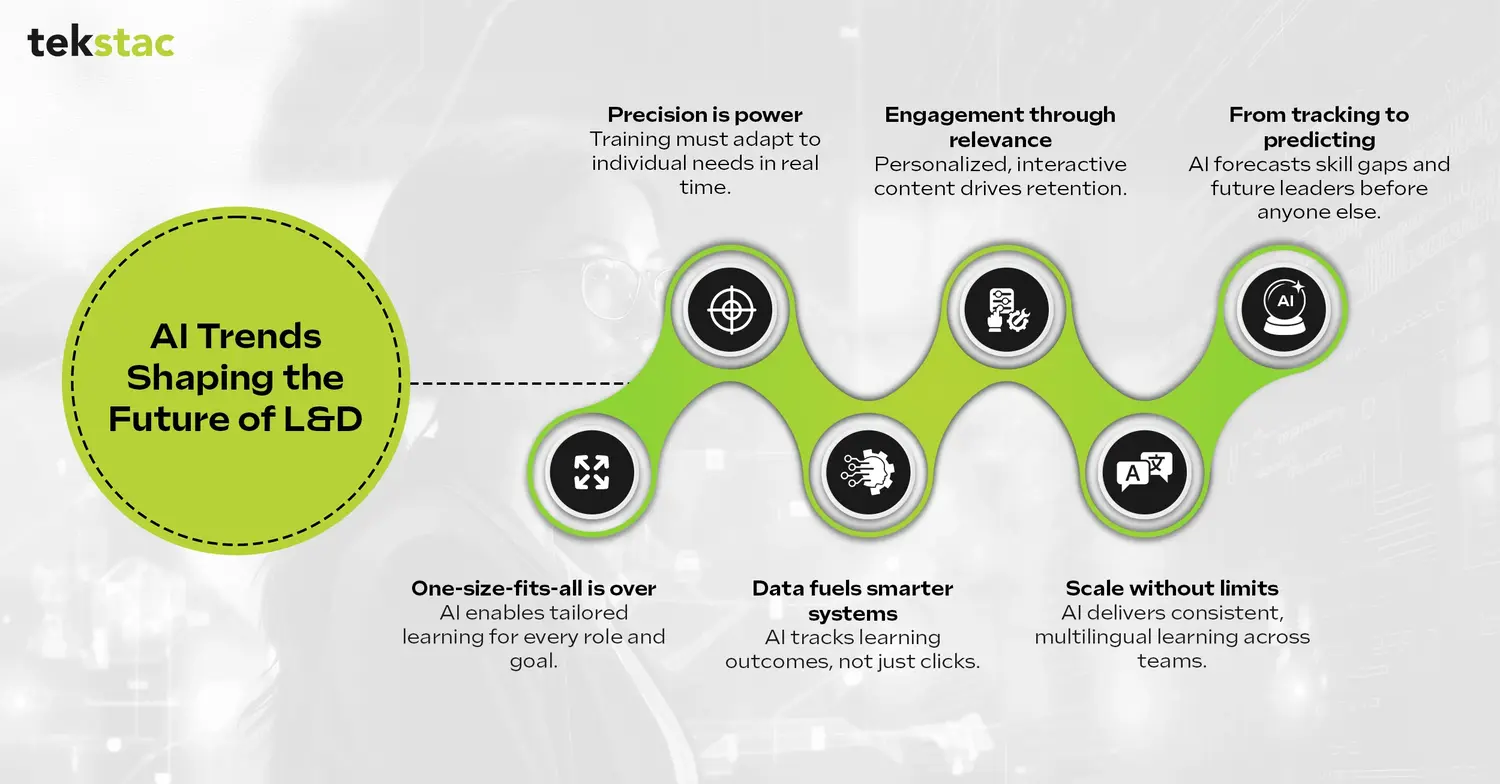
This article explains the six most important AI trends shaping corporate learning in 2026, backed by industry research and real-world insights. You’ll learn about:
Let’s start with the cold reality: most L&D systems are failing.
According to LinkedIn’s Workplace Learning Report, 71% of L&D professionals are exploring, experimenting with, or already integrating AI into their work — though turning that activity into measurable business outcomes remains the harder, less-solved part.
This hesitation has consequences. When 70% of training programs fail to deliver measurable outcomes, it’s not a user problem. It’s a system problem.
Current systems offer little more than completion data. They can tell you who clicked “Next,” but not who actually learned, retained, or applied anything.
Meanwhile, over half of learners abandon online courses midway, citing poor alignment with their roles. And with automation reshaping industries, job requirements evolve faster than most training teams can respond.
The result?
Disengaged employees, wasted budgets, and unmet business goals.
In a world moving at the speed of light, delivering personalized training isn’t just a “nice to have” anymore. It’s mandatory. L&D systems must know more than job titles.
They need to understand learning behaviors, career goals, and real-time performance data.
In companies that have embraced it, training time has dropped, skill application has soared, and employee retention has improved.
Organizations using AI in L&D commonly report measurable gains in both productivity and employee retention. At its core, this is transformation, not just tech.
Here’s what legacy systems don’t do: connect learning to business outcomes. AI-powered platforms, on the other hand, don’t just deliver content, they learn from it. They track not just engagement but impact.
Leveraging AI, modern systems can track how skills evolve over time, pinpoint where progress stalls, and identify who’s ready for a promotion—exactly what AI Trends in workplace learning are now shaping across forward-thinking organizations.
By year two of using these systems, organizations report smarter decision-making, less rework, and clearer succession planning.
By year three, AI-powered learning starts surfacing insights that no spreadsheet ever could: like which departments are overperforming, which skills correlate with project success, or where burnout is brewing.
This isn’t hypothetical.
This is happening now.
People don’t hate learning.
They hate irrelevant learning.
AI fixes this by making training feel personal, and customized for each individual so they feel it’s relevant for them but not forced.
It gives instant feedback, transforms lessons into interactive stories, and builds safe simulations where employees can practice without fear of failure.
Platforms like Tekstac are already using this approach.
With adaptive learning paths, localized content, and role-based recommendations, learners don’t just consume content, they experience it.
Learners increasingly favor AI-assisted training formats over traditional ones, and engagement data backs this up.
Traditional L&D hits a ceiling fast. More people means more facilitators, more costs, more logistics. But with AI, scaling is seamless.
Whether you’re training 10 or 10,000, the experience remains consistent and high-quality.
Companies using AI for training report meaningfully lower delivery costs while simultaneously increasing reach and effectiveness.
Multilingual support, auto-translation, and real-time content adaptation mean global teams can access the same content, tailored to their needs and context.
This levels the playing field and ensures inclusivity, a critical but often neglected component of enterprise learning strategies.
It’s no longer enough to ask whether someone completed a course.
The real question is: did it make a difference?
With AI, you no longer have to guess. You can see skill proficiency rising, time-to-productivity falling, and internal promotions accelerating.
Industry research from groups like Brandon Hall Group consistently links AI-based learning to higher retention and faster skill acquisition.
In forward-thinking companies, L&D leaders don’t chase KPIs, they shape them.
Predictive dashboards now alert managers to emerging leaders, identify team-level skill gaps, and recommend training before performance dips. The next step beyond prediction is action — agentic AI takes it further by autonomously assigning the right learning path or escalating a skill gap to a manager, without anyone first having to ask it to.
It marks a shift from learning to strategic talent development.
AI Trends in L&D are not just about better tools — they are redefining how organizations measure productivity, skill growth, and talent readiness.
At the center of this transformation is Tekstac.
It’s not just another learning platform, it’s a complete AI-driven learning intelligence system.
Built for scale, flexibility, and performance, Tekstac integrates content creation, real-time analytics, and adaptive delivery into one seamless experience.
From SHRM-aligned learning paths to auto-generated content and knowledge checks, Tekstac personalized every aspect of training.
It identifies where each learner stands, maps growth paths, and shows HR and leadership where the talent pipeline is headed. It connects every learning act to a real business outcome, be it faster onboarding, increased internal mobility, or improved customer results.
And the impact is measurable. Companies using Tekstac report up to 48% reduction in learning cycle time and 65% improvement in content relevance for high-skill roles like software development.
Whether you’re a tech giant, a healthcare provider, or a logistics firm, Tekstac adapts to your needs, your teams, and your goals.
The companies winning in 2026 are those who stopped viewing training as a checkbox and started seeing it as a growth engine.
They moved from one-size-fits-all to one-path-for-each. From passive completion to active transformation. And from static dashboards to living, predictive maps of workforce capability.
So here’s the truth: if your training platform can’t personalize, can’t scale, and can’t connect to business outcomes, it’s not slowing you down, it’s keeping you behind.
The shift to AI-powered learning isn’t just smart.
It’s inevitable.
Make the move to a platform that sees your people not just as learners, but as your competitive edge.
A platform that doesn’t just keep up with the future, but creates it.
Tekstac isn’t the next step. It’s the leap forward.
Want to adopt AI Trends in your L&D strategy? See a live demo of Tekstac’s AI-driven learning platform in action.
1. How is AI improving workplace learning outcomes?
AI boosts learning outcomes through hyper-personalized learning paths, adaptive content, and real-time feedback. Employees learn faster and retain more because training aligns with their roles and skill gaps.
2. What’s the next big AI trend in learning and development?
Skill intelligence platforms — systems that map role-based skills, predict future gaps, and auto-recommend upskilling paths. They shift L&D from delivering content to building workforce readiness.
3. What is the ROI for adopting AI in corporate training?
Organizations see higher retention, faster onboarding, and reduced training costs. AI turns L&D into a measurable business growth driver by improving productivity and workforce performance.
4. Which industries benefit from AI-driven L&D?
Industries with fast-changing skills need — tech, BFSI, healthcare, logistics, manufacturing, telecom, and retail. Any sector requiring rapid onboarding or upskilling gains from AI learning.
5. What are the latest AI trends in learning and development?
The leading AI trends in L&D right now are hyper-personalized learning paths, predictive analytics for skill and performance gaps, adaptive content delivery, AI-powered coaching and feedback, and skill intelligence platforms that map role-based skills to future business needs.
6. What are the most effective corporate AI talent development strategies?
The most effective strategies connect AI-driven learning directly to business outcomes — using predictive analytics to anticipate skill needs before rollout, tracking skill proficiency rather than just course completion, and tying training data to real metrics like time-to-productivity and internal mobility.