A talent mobility framework and a career pathing strategy are the two primary approaches organizations use to develop internal talent; but they solve different problems, suit different cultures, and require different infrastructure to run well.
A Gartner survey of 3,375 employees found that one in three feel they could have a bigger impact on a different role within their own organization; yet fewer than one in five organizations can effectively move talent to where it is needed. That gap is what both frameworks are designed to close. This guide explains what each approach is, how they compare, and how to decide which one or which combination is right for your organization.
Here’s an insight into what Talent Mobility Frameworks and Career Pathing are and how they can help your organization.
| Dimension | Talent Mobility Framework | Career Pathing Strategy |
|---|---|---|
| Primary goal | Move talent across roles, teams, and projects | Define structured advancement within a function |
| Movement type | Lateral, diagonal, cross-functional | Vertical (ladder) or flexible (lattice) |
| Best for | Agile, fast-changing organizations | Structured, hierarchical organizations |
| Key tool | Internal talent marketplace, skills database | Individual Development Plans (IDPs), role maps |
| Timeframe | Short-to-medium term, project-based | Long-term, milestone-based |
| Risk | Talent hoarding by managers | Rigidity, limits non-linear growth |
| Outcome | Workforce agility, skills diversification | Retention, structured promotion pipelines |
A talent mobility framework is a strategic approach organizations take to help employees move across departments, roles, and projects in line with their career aspirations and meet business objectives.
By maintaining a talent mobility frameworks, organizations offer employees tools, resources, and processes that aid them in skill development, succession planning, and career progression. It encompasses internal transfers, cross-functional training, upskilling and reskilling, and internal transfers.
For example, Google offers an internal job board called “Google Jobs,” which showcases all the company’s open positions to its employees. It also provides career coaching and leadership development programs to facilitate employee transition into new roles. They also have a “gTwo” program that gives employees the opportunity to work in a different department or location.
An internal mobility framework is the operational execution layer of a broader talent mobility strategy; defining the processes, eligibility criteria, and infrastructure that enable employees to move into new roles internally. For a full breakdown of how to build one, see our complete guide to Internal Mobility Framework.
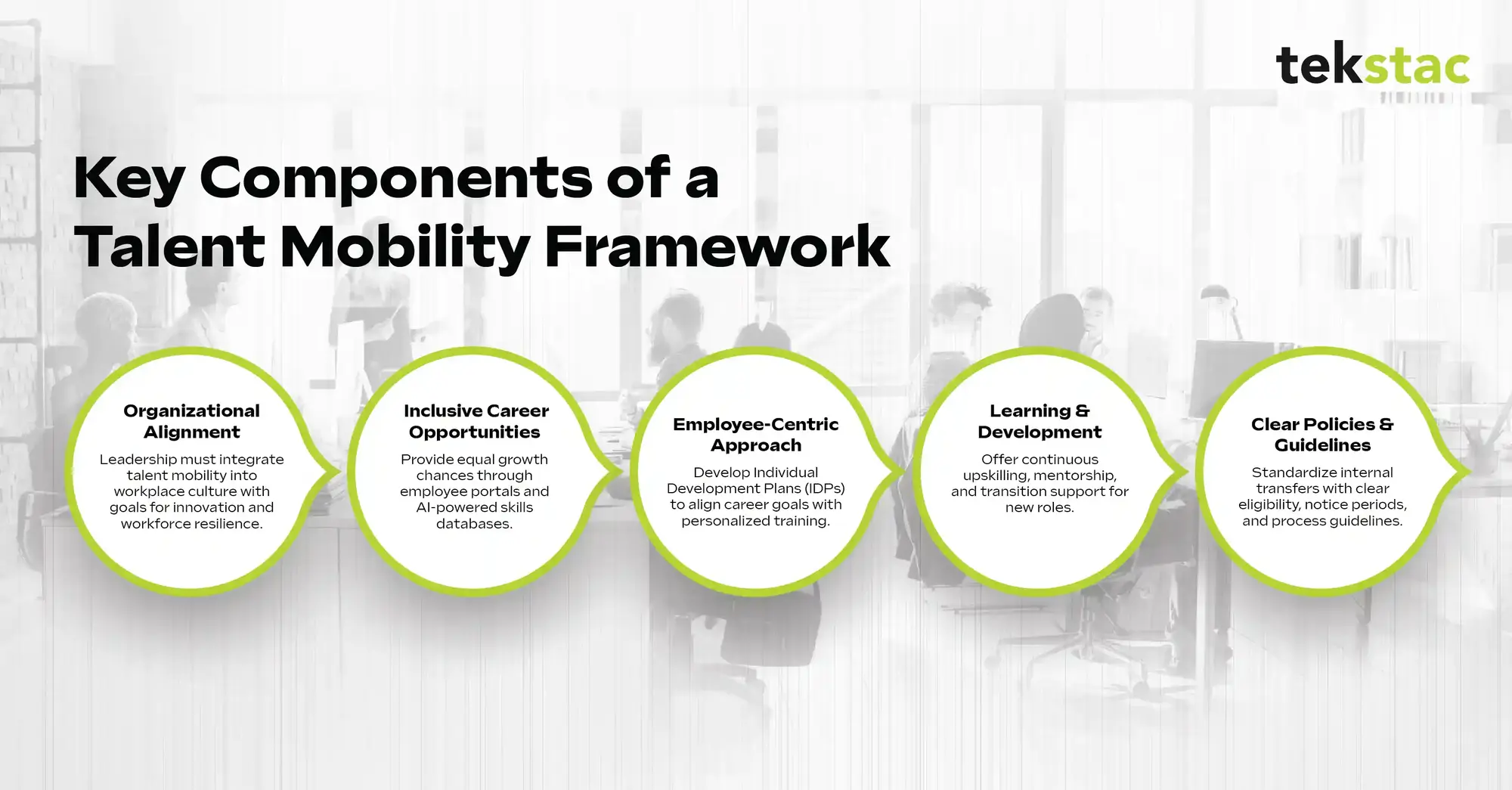
Leadership must prioritize and integrate a Talent Mobility Frameworks into the work culture. This framework should also have an end goal to be met regarding innovation, workforce resilience, and scalability.
Organizations should offer employees equal chances to grow and facilitate this through internal systems like employee portals, where new posts, vacancies, and projects are posted. An AI-powered skills database also helps map employees’ roles in sync with their competencies and career goals.
HR must take steps to create Individual Development Plans (IDPs) to chart career plans with short-and long-term goals, identify skills or roles that the employee seeks, and offer training programs accordingly.
Through continuous learning and development, organizations must offer upskilling programs and mentorship to help employees transition into new roles and develop new competencies.
Establishing clear guidelines and standardizing processes (eligibility criteria, notice periods, etc) helps smooth internal transfers and project assignments.
Through a talent mobility frameworks, organizations can:
Career pathing is a way for employees to fulfill their career aspirations by following a structured path, participating in developmental initiatives, reskilling or upskilling from time to time and meeting goals set by the organization.
Organizations can adapt career pathing to offer personalized learning, identify skills and competencies that support employees’ growth, and track their progress.
The two essential approaches to career pathing are:
For example, Nestlé has a Nestlé Academy program that offers personalized career development programs featuring job rotations and skill training. Through this program, employees can set clear career goals tracked through regular check-ins. Nestle also offers leadership development programs that help meet employee career aspirations and align with organizational growth strategy.
Organizations must first understand their business requirements, growth trajectory and identify leadership and business-critical positions.
Working in sync with employees helps organizations set short-and long-term goals that match their aspirations and meet organizational objectives.
Companies should set up 1:1 meetings to discuss their employees’ ambitions, interests, and values. Then, walk them through the skills and experience levels required to reach their career goals.
It is important to create strategies for acquiring skills, which include training sessions, upskilling and reskilling, shadow sessions, assignments, and mentoring.
Organizations must establish metrics to determine employee performance and hold one-on-one discussions to assess the initiatives’ effectiveness. To boost employee morale, organizations must reward significant progress or milestones with bonuses, salary hikes, or promotions.
Through career pathing, organizations can:
Both approaches are invaluable for an organization’s employee development and retention efforts. Choosing the right approach depends on your company’s culture, business requirements, and goals.
Talent Mobility Frameworks favor organizations focused on cross-functional learning, flexibility, and agility. If your main aim is to encourage employees to obtain diverse experiences and build versatile skills, moving across different departments, internal transfers, this approach would help immensely.
Career Pathing is more suitable for organizations that prefer structured and clear career progression. It is easier to implement in large or mid-sized companies with numerous hierarchical levels, which means moving to higher-level roles and retaining top-performing talent.
Organizations can also take a blended approach, ensuring flexible and structured growth. For example, employees can acquire diverse skill sets through cross-functional roles or lateral moves while working towards defined career goals.
For example – To get the best of both worlds, an organization can create a platform that offers internal job rotations, offshore assignments and short-term projects alongside well-defined career paths with specific milestones and development programs. This dual approach empowers employees with flexibility, helps them achieve long-term goals and create an agile workforce.
Whichever approach you choose, organizations can emerge as forward-thinking and keep reinventing themselves to stay relevant in a dynamic landscape.
Choosing between a talent mobility framework and a career pathing strategy, or building both, requires infrastructure that connects skills data, learning pathways, and performance outcomes in one place. Tekstac is an AI-powered LXP used by enterprise organizations including IBM, PwC, and Capgemini to build role-aligned learning paths, map skills gaps across teams, and track upskilling impact on internal mobility and career progression goals. Whether your organization needs the structured clarity of career pathing or the cross-functional agility of a talent mobility framework, Tekstac gives HR and L&D leaders the data infrastructure to make either approach work. 👉 Request a personalized demo now
1. How do Talent Mobility Frameworks benefit employee retention?
Talent mobility frameworks improve retention by giving employees a visible, credible path to grow without leaving. LinkedIn’s Global Talent Trends Report finds that companies with strong internal mobility programs see twice the employee retention rate. The mechanism is straightforward: when employees can see opportunities inside the organisation, the pull of external roles weakens.
2. Can organizations implement both Career Pathing and Talent Mobility together?
Yes, and for most mid-to-large organizations, a blended approach is the most effective model. Career pathing provides the vertical structure employees need to see a future; talent mobility provides the lateral flexibility to build skills that make them more valuable in that future. The two frameworks reinforce each other when both are supported by a shared skills data infrastructure.
3. What is the difference between a career ladder and career lattice?
A career ladder is a fixed, vertical hierarchy where progression means moving to a higher title within the same function. A career lattice is a more flexible model that supports lateral, diagonal, and vertical movement; allowing employees to grow across functions and build broader capability before moving up. Most modern talent mobility frameworks are built on a lattice model, as it better reflects how organizations need talent to move.
4. How does Career Pathing enhance employee engagement?
Career Pathing provides employees with a transparent growth roadmap, personalized development plans, and regular feedback, which boosts motivation and aligns individual aspirations with business objectives.