Today, leadership is in crisis. Workers are losing faith in leaders because many just aren’t measuring up.
DDI Global Leadership Forecast 2025 states that the trust in management fell from 46% in 2022 to as low as 29% in 2024, an enormous plunge. It shows how much everybody distrusts their leaders now.
While so much of the world is changing at the speed of light due to technology and remote work, leaders are still blamed for lacking rudimentary human competencies such as empathy and clear communication, which are one of the best leadership skills.
If you examine legendary leaders throughout history, you will see that they possessed these competencies in abundance. Today, far too many leaders lack these competencies.
Then, what do today’s professionals need to learn to keep up with today’s requirements and thrive amidst all this change? This blog will discuss the top 10 leadership skills required in 2026 and how to develop them.
In India and Southeast Asia, the best leadership skills combine emotional intelligence, digital and AI literacy, adaptability, inclusive communication, and change leadership. India’s GCC sector — employing over 1.66 million professionals (NASSCOM, 2024) — demands leaders who can manage large, diverse, hybrid workforces while scaling talent development and business performance across global teams. These skills enable leaders to manage large, diverse, hybrid workforces while scaling talent development and business performance effectively.
The 10 best leadership skills for 2026 span two categories: timeless human competencies that no technology can replace — emotional intelligence, communication, coaching — and emerging capabilities that AI-driven workplaces now demand, including technology literacy, adaptive leadership, and data-driven strategic thinking. Here is what each skill means and how to build it.
But the world keeps evolving at this fast pace, and with it, the kind of skills leaders need. For example, computer literacy was not as critical previously as it is today. Today, the skill of coping with AI and technology is what any leader needs. With new opportunities and challenges by 2026, leaders will have to change and evolve.
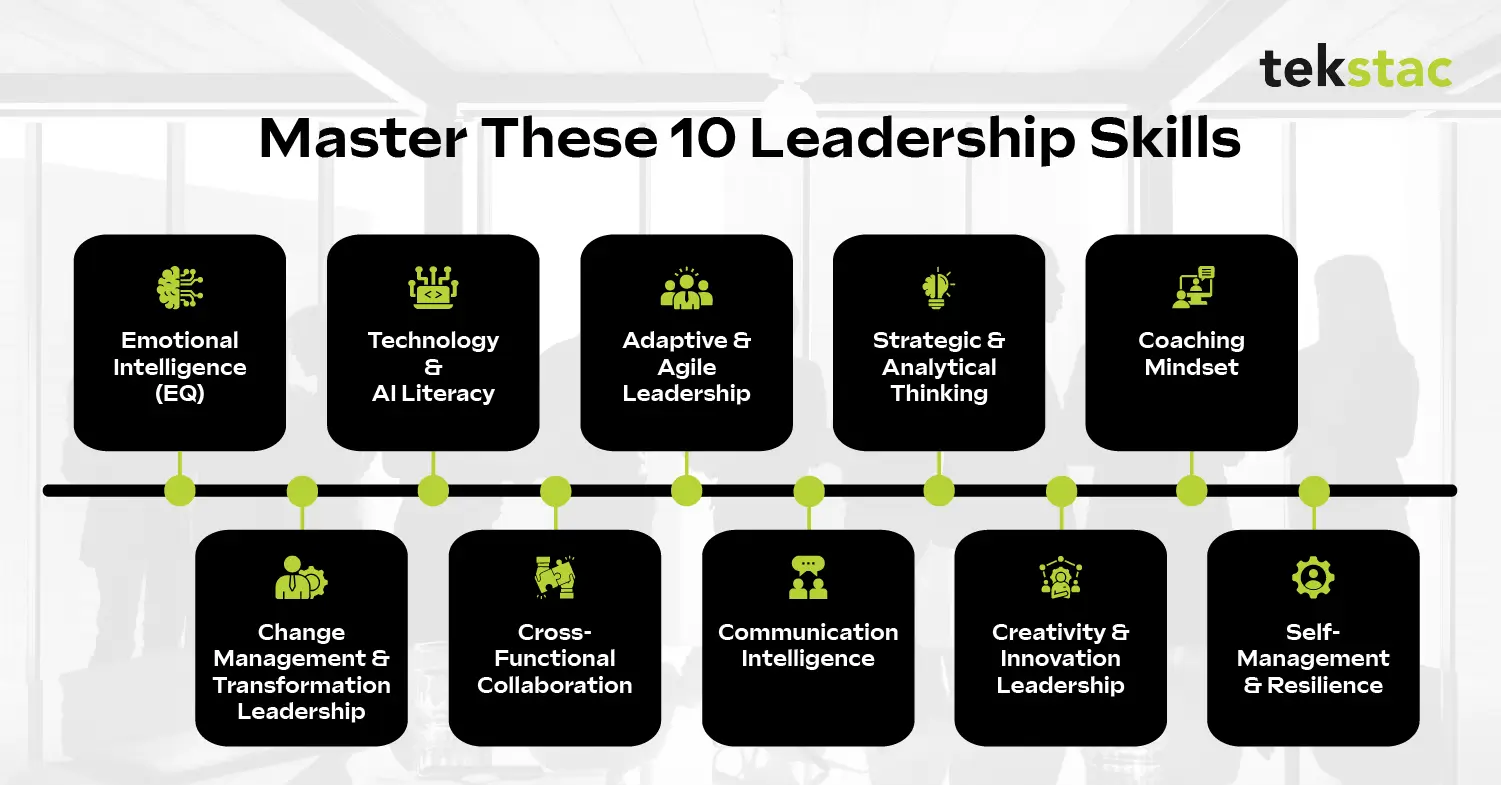
What if it is possible to be a good leader through emotional understanding? Emotional Intelligence (EQ) has already passed from being a soft skill to being the basis of fearless leadership. EQ is about paying attention to your feelings and others’, managing your reactions, and establishing genuine relationships.
In the age of AI dominance, we cannot live without trust and empathy. EQ leaders create psychologically safe environments, with collaboration and innovation thriving even when teams are separated by geography across continents. For instance, the most incredible testimony to Satya Nadella’s Microsoft transformation is where he created the learning and empathy culture and re-stoked the growth and morale of the company.
How to build it: Practice vulnerability by opening up your problems. Always consider your emotions, and ask your colleagues for straightforward opinions to become sensitive to forming relationships. Practice empathy daily.
Talent in 2026 will need to ride the wave of AI. 71% of CEOs in Korn Ferry’s 2025 Global Workforce Survey are confident that AI will add value to their worth within three years. Leaders today must have first-hand experience with AI and new technology. Organizations building this capability at scale are investing in structured workforce upskilling solutions that move beyond awareness training to hands-on AI literacy programs embedded in daily workflows. This skill enables them to identify improvements in efficiency, anticipate risk, shape responsible use of AI, and increase the agility and creativity of decision-making.
This leads to more effective decision-making and facilitated groups of de-drudged work. Amazon’s early implementation of AI to maximize logistics set industry standards and pushed hyper-growth revenue, demonstrating tech know-how pays.
How to build it: Get AI and digital literacy skills training, engage with tech forums, and collaborate with internal experts to stay competitive.
Most leaders are playing catch-up on talent as though it were 2010, and their leadership is outdated. John Maxwell’s book, Leadershift, is about leaders shifting their style so they can keep up with the pace of a changing world. Adaptive leaders create a culture where teams learn fast, turn fast, and embrace failure as a stepping stone.
For example, Netflix’s transition from DVD rentals to streaming is a quintessential example of agile leadership, making an early bet on video streaming revolutionized the company and kept it ahead of the curve.
How to build it: Condition yourself to be agile in mind by exposing yourself to something new and getting a great many different ideas every day.
Strategic thinking is seeing the big picture, connecting the dots, and making well-thought-out decisions driven by long-term organizational goals. This is reinforced by analytical thinking, which assists leaders in filtering information, identifying trends, and projecting possible risks or opportunities. With increasingly dynamic markets and data being the default norm, leaders possessing such skills create lasting competitive advantages.
As Jim Collins notes in Good to Great, disciplined strategic thinking is a defining trait of companies that outperform others over the long term. Among the best leadership skills, this capability helps leaders move beyond short-term fixes and set goals based on objective analysis. It enables cost-effective resource allocation, clear prioritization, and confident decision-making amid uncertainty.
How: Work actively with information, encourage shared goal-setting, and test assumptions regularly. Acquiring skills in applying decision-making templates and thinking about alternative perspectives requires applying those skills to build them.
Leaders’ actions are shifting from commanding and controlling to empowering and constructing. The coaching method can be implemented through good questions, listening, and nudging others to their solutions. Jacob Morgan outlines in his book The Future Leader that this shift is a necessity as workplaces become more complicated and growing talent is priority number one.
By 2026, coaching will play a critical role in employee training by building trust, boosting motivation, and accelerating learning across teams—especially in distributed or hybrid organizations. This approach enables leaders to develop autonomy, encouraging employees to innovate, take initiative, and apply new skills effectively on the job.
Organizations like Google have demonstrated the impact of performance enhancement with coaching in projects like Project Oxygen, which found that managers’ coaching styles strongly impact team performance.
How to develop: It can be achieved through regular growth conversations, emphasis on development and strengths areas, and a culture of continuous learning.
Change is inevitable, but outstanding leaders can make change an imperceptible evolution and not an interruption. For enterprise organizations navigating large-scale transformation, understanding how leadership transformation in GCC is being redesigned offers a practical model for applying change management at the organizational level — not just the team level. It is especially important in the aftermath of AI, hybrid workplaces, and digital shifts that are redefining companies.
By 2026, open-speaking leaders who can speak to their teams in advance and establish psychological safety will facilitate more adoption and maintain productivity amid change. This leadership skill also reduces fear and increases resilience in organizations.
Taking Microsoft as an example, its transformation under Satya Nadella as a change leadership story of a software giant becoming a cloud giant could be an example of the best type of change leadership. Nadella’s open communication and guidance pushed employees toward acquiring alternative thinking and operational outlooks.
How to construct: Leaders learn good change management by observing best practice models, constructing empathic conversations and involving stakeholders at all change levels.
Inclusive decision-making involves seeking alternative perspectives to enhance thinking and avoid blind spots. Cross-functional teamwork breaks down silos, speeds up execution, and puts teams on purpose. Korn Ferry discovered that 43% of senior leaders experience impostor syndrome, which inhibits full participation, rendering inclusivity even more important to unlock collective leadership potential.
Leaders who practice inclusive leadership skills by creating space for employees to be heard foster innovation and accelerate business outcomes. Salesforce is a strong example, where a focus on diversity and inclusion has strengthened culture while delivering sustained financial performance.
How to build: Daily collaboration habits, constructing psychological safety, and learning decision-making approach to create inclusive input.
Clear, open, and emotionally smart communication is the foundation of great leadership. Companies are only just beginning to figure out how to work hybrid and run at speed, and communication intelligence keeps people on track, engaged, and energized. It’s not about communicating, but communicating in such a way as to speak to people’s emotions and build trust.
Netflix’s communication culture and reward culture is a classic example of communication contributing to innovation and accountability.
How to create: Embed frequent feedback loops, role-playing narratives, and sensitivity to body language even in virtual environments.
No matter how much participation is augmented by AI, human ingenuity remains the best equalizer in leadership. Creativity is all about generating fresh ideas, while innovation is the way one converts those ideas into feasible products, services, or processes. Structured or disciplined creativity is what Jim Collins calls the answer to the Great to Good companies.
Among the most important leadership skills is the ability to create environments where experimentation is encouraged, failure becomes a source of learning, and diverse viewpoints are valued. This approach drives teams to develop innovative solutions and deliver more compelling customer experiences. Apple’s culture of innovation demonstrates how creativity-driven leadership enables companies to remain industry leaders year after year.
How to build: Provide room for brainstorming, enable cross-functional collaboration, and freely reward creative efforts.
Self-management, emotional, mental, and physical is the recipe for long-term success. Self-management requires emotional control, stress control, and keeping your focus in the midst of trouble. Resilient leaders need to practice the behavior they want their teams to embody.
How to construct: To construct this capability, one needs to develop reflective habits, practice intentionally, and establish sharp boundaries between play and work.
Developing the best leadership skills starts with an honest self-assessment: identify the specific competencies where you are weakest relative to your current or target role, then build a deliberate practice plan. Leadership is not a personality type — it is a skill set built through structured feedback, applied practice, and continuous learning.
Leadership does not happen naturally. Leadership is a skill set, a checklist of habits, and attitudes that you learn with time. Begin by asking for counsel from your teammates or colleagues. Listen to how you are handling challenges. Are you listening too little? Are you responding quickly enough? Making space for other people’s voices and ideas? Then, learn something new every day. Whether it is reading, mentoring, learning online courses, or simply observing good leaders ahead of you, every one counts. And as you grow, take your people with you. Great leaders do not raise themselves alone, they raise people alongside them.
Hence, leadership competence, which is anchored in the best leadership skills, is what differentiates a bad leader from a great one. It is the set of attitudes, behavior, experience, and competences that enables you to lead with influence, particularly in a digital-first world.
Tekstac helps enterprise L&D teams build the best leadership skills across their workforce — through AI-powered capability assessments, personalized development paths mapped to role requirements, and skills intelligence dashboards that make leadership growth measurable rather than aspirational.
1. What are examples of leadership skills at work?
Leadership skills at work include: emotional intelligence in managing team conflict, AI and technology literacy for data-driven decisions, coaching mindset for employee development conversations, change management for guiding teams through restructuring, and cross-functional collaboration for breaking down silos. For L&D leaders, these skills map directly to the capabilities that distinguish high-performing managers from functional executors.
2. What is the difference between leadership skills and leadership qualities?
Leadership skills are learned, practiced capabilities — communication, strategic thinking, coaching — that can be deliberately developed through training and experience. Leadership qualities are inherent or deeply cultivated character traits — integrity, empathy, resilience — that underpin how a leader applies those skills. Great leaders develop both: the qualities define who they are as a leader, and the skills determine how effectively they act on those values.
3. What are the 5 qualities of good leaders?
The five core qualities of good leaders are emotional intelligence, adaptability, strategic thinking, effective communication, and integrity. These qualities are foundational across leadership styles and industries — and unlike technical skills that evolve with technology, these qualities remain consistently predictive of long-term leadership effectiveness. For L&D teams, developing these qualities alongside role-specific skills builds leaders who perform across multiple contexts.
4. What is the most important leadership skill in 2026?
Emotional intelligence is the most important leadership skill in 2026. As AI handles more analytical and process-driven tasks, the distinctively human capabilities — empathy, self-awareness, the ability to build trust and psychological safety — become the primary differentiators of leadership effectiveness. Research confirms it: DDI’s Global Leadership Forecast 2025 found trust in management fell from 46% in 2022 to 29% in 2024, and the primary driver was leaders failing at interpersonal, not technical, competence.
5. How can organizations develop the best leadership skills through training?
Organizations develop the best leadership skills through structured programs that combine self-awareness tools (360-degree feedback, assessments), applied practice (coaching conversations, simulation-based decisions), and continuous reinforcement (microlearning, peer learning, manager accountability). AI-powered platforms like Tekstac make leadership skills training scalable — delivering personalized development paths based on individual capability gaps, role requirements, and career trajectory rather than generic cohort-based programs.