
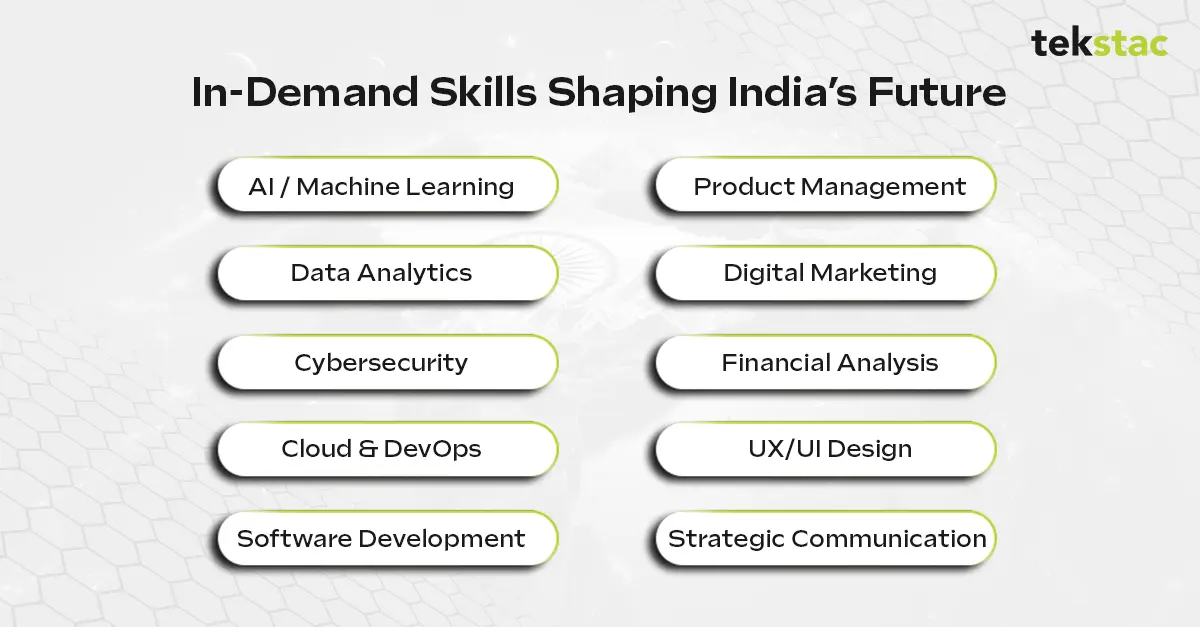
The top high demand skills for the next 10 years in India are AI/ML, Data Analytics, Cybersecurity, Cloud/DevOps, Software Development, Product Management, Digital Marketing, Financial Analysis, UX/UI Design, and Strategic Communication. Together, these 10 capabilities define who gets hired, promoted, and paid more through 2035, regardless of degree or seniority.
Roles like AI prompt engineer, MLOps specialist, and cloud security architect barely existed five years ago. They are now among India’s fastest-growing job titles, according to LinkedIn’s 2025 Jobs on the Rise report. At the same time, NASSCOM data shows entry-level IT roles declining by 18% as automation absorbs repetitive tasks. The skills for the next 10 years determine which side of that shift you land on.
According to the World Economic Forum’s Future of Jobs Report 2025, nearly 44% of workers’ core skills will need to change by 2030. McKinsey’s Global Institute echoes this, projecting that up to 12 million occupational transitions may occur in India alone this decade. Organizations have responded by shifting their hiring filter from academic credentials to demonstrated capability. They are prioritizing outcomes, portfolios, and proof of work.
As per Gartner’s 2025 HR Technology Survey found that skills-based hiring adoption grew by 39% year-over-year among enterprise technology firms. NASSCOM’s State of the Tech Talent Report estimates India faces a deficit of 800,000 qualified professionals in AI, cloud, and cybersecurity roles, despite producing 1.5 million engineering graduates annually.
In simple terms, the market rewards capability over credentials.
India’s labor market is undergoing a transformation driven by AI, automation, and digital infrastructure.
The World Economic Forum predicts 170 million new jobs by 2030. For India specifically, the WEF projects a net gain of approximately 11 million jobs by 2030, concentrated in technology, green energy, and care economy sectors, but only for workers who have already transitioned their skills.
Deloitte’s 2025 Global Human Capital Trends report found that organizations which invested in structured upskilling saw 2.4x higher internal mobility rates; meaning skilled employees are also more likely to grow within a company, not just get hired.
This is why skills for the future workforce are becoming the most valuable career currency.
| Skill | Demand Level | Typical Salary Growth Potential |
|---|---|---|
| AI / Machine Learning | Very High | Very High |
| Data Analytics | Very High | High |
| Cybersecurity | High | High |
| Cloud / DevOps | High | High |
| Software Development | Very High | High |
| Product Management | High | Very High |
| Digital Marketing | Medium to High | Medium to High |
| Financial Analysis | Medium to High | High |
| UX/UI Design | Medium to High | High |
| Strategic Communication | Universal | Career Multiplier |
A. TECH SKILLS
Why This Matters Now
AI is no longer a niche skill; it’s becoming as fundamental as internet literacy once was. From recommendation engines to fraud detection and generative AI tools, AI is embedded into how businesses operate. According to LinkedIn’s 2025 Emerging Jobs Report, AI and generative AI-related job postings in India grew 3.1x year-over-year, making it one of the fastest-scaling emerging skills in India.
Current Market Reality
What You’ll Actually Earn
What You Need to Learn
Why This Matters Now
If AI is the engine, data is the fuel. Every organization today generates vast amounts of data, but very few can translate it into meaningful insights. This is why data analytics continues to rank among the most valuable in-demand skills.
A 2025 Nasscom-Zinnov report found that only 23% of Indian organizations have a data analytics function that directly influences C-suite decisions. Unlike some specialized technical roles, data analytics is relevant across industries; from finance and healthcare to retail and logistics. What has changed, however, is expectation. Companies are no longer looking for professionals who can only analyze data; they want individuals who can connect data insights to business outcomes. This shift has elevated the role from a support function to a strategic one.
Current Market Reality
What You’ll Actually Earn
What You Need to Learn
Why This Matters Now
As organizations become more digital, their exposure to cyber threats increases. Cybersecurity is no longer a backend function—it is central to business continuity. This makes it one of the most essential skills required for future jobs.
The nature of cyber threats is also evolving. With the rise of AI-driven attacks and increasingly sophisticated hacking techniques, companies need professionals who can anticipate and mitigate risks proactively. India, in particular, faces a significant shortage of cybersecurity talent, creating strong opportunities for those entering this field. What makes this skill unique is its long-term relevance—security will remain a priority as long as digital systems exist.
Current Market Reality
What You’ll Actually Earn
What You Need to Learn
Why This Matters Now
Cloud computing has become the backbone of modern business infrastructure. Every application, platform, and digital service relies on cloud systems to function efficiently. This makes cloud expertise one of the most critical digital skills in demand today. The demand for cloud professionals continues to outpace supply, particularly in India, where digital transformation is accelerating across industries. For professionals, this translates into strong career growth and global opportunities.
Current Market Reality
What You’ll Actually Earn
What You Need to Learn
Why This Matters Now
Software development is one of the most important next generation skills. The demand for full-stack developers, in particular, reflects the industry’s need for versatility. At the same time, the integration of AI tools into development workflows is reshaping how software is built, making continuous learning essential for professionals in this field.
Current Market Reality
What You’ll Actually Earn
What You Need to Learn
B. DIGITAL & BUSINESS SKILLS
Why This Matters Now
India has seen a 52% increase in product manager job postings between 2022 and 2025, driven by the rise of SaaS companies, fintech platforms, and consumer super-apps. Unlike most tech roles, PM salaries jump steeply with experience; a 3-year PM at a funded startup typically earns more than a 7-year software engineer at a service company. What makes this role unique is its emphasis on decision-making. Product managers are responsible for identifying market needs, defining product strategies, and ensuring successful execution.
Current Market Reality
What You’ll Actually Earn
What You Need to Learn
Why This Matters Now
The shift toward digital platforms has transformed how businesses reach their audiences. Marketing is no longer limited to traditional channels; it is driven by data, algorithms, and user behavior. This makes digital marketing one of the most practical digital skills in demand.
Current Market Reality
What You’ll Actually Earn
What You Need to Learn
Why This Matters Now
India processed over 14.3 billion UPI transactions in January 2025 alone, making it the world’s most active real-time payments market. This volume has created a structural need for financial analysts and is now one of the high paying skills.
Current Market Reality
What You’ll Actually Earn
What You Need to Learn
Why This Matters Now
India’s EdTech sector saw 22 million new users in 2024, all of whom interact with products designed in English but used in Hindi, Tamil, or Bengali. UX designers who can research and prototype for multilingual, low-bandwidth users are commanding a growing premium that English-first markets simply don’t create. This has elevated UX/UI design from a supporting role to a core business function. It is now one of the most essential skills for the future workforce.
Current Market Reality
The Taggd report highlights rising demand due to:
What You’ll Actually Earn
What You Need to Learn
C. HUMAN & COGNITIVE SKILLS
Why This Matters Now
The most underpaid insight in India’s upskilling conversation is that communication and problem-solving skills amplify every other skill on this list. A data analyst who presents insights clearly earns 25–35% more than one who cannot, according to LinkedIn Salary benchmarking data. This is why communication skills continue to rank among the most important future skills in India.
Current Market Reality
What You’ll Actually Earn
Not a direct salary skill, but a career multiplier
What You Need to Learn
India’s workforce is at an advantage that other large economies don’t have: a young, English-fluent, tech-curious population that is already in the middle of this transition. The 10 skills in this article are not predictions; they are current hiring realities. The gap between who gets hired and who doesn’t is narrowing to a single question: have you built the evidence to prove what you can do?
Platforms like Tekstac are designed for exactly this; structured, role-aligned skill insights with assessments that create the kind of verifiable proof employers now require. If you’re mapping out your upskilling path, it’s worth starting there.
1. Is foundational skill like Microsoft Excel still in demand today in the age of AI?
Yes, Microsoft Excel continues to be one of the most widely used tools across industries, especially for data analysis, reporting, and operational tracking. When combined with analytics or business intelligence tools, Excel becomes a strong foundational component of broader digital skills in demand, improving both efficiency and decision-making capability.
2. Why do skills matter more than degrees today?
The shift toward skills-based hiring is driven by the need for immediate, measurable impact. While degrees provide foundational knowledge, they do not always reflect a candidate’s ability to perform in real-world scenarios.
3. What are the most important future skills in India?
Technical skills such as AI, data analytics, cybersecurity, and cloud computing are driving demand across industries. At the same time, organizations are placing increasing value on communication, problem-solving, and adaptability. The combination of these capabilities reflects the broader shift toward a skill-based economy, where both technical expertise and human judgment play a critical role.
4. Why is adaptability considered a high-demand skill?
Adaptability is a high-demand skill because workplaces today are constantly changing with new technologies, roles, and expectations. People who can quickly learn, adjust, and handle change are more likely to stay relevant and perform well. It also helps them take on new challenges, work across different situations, and grow in their careers, making them valuable to any organization.
Reference Links: