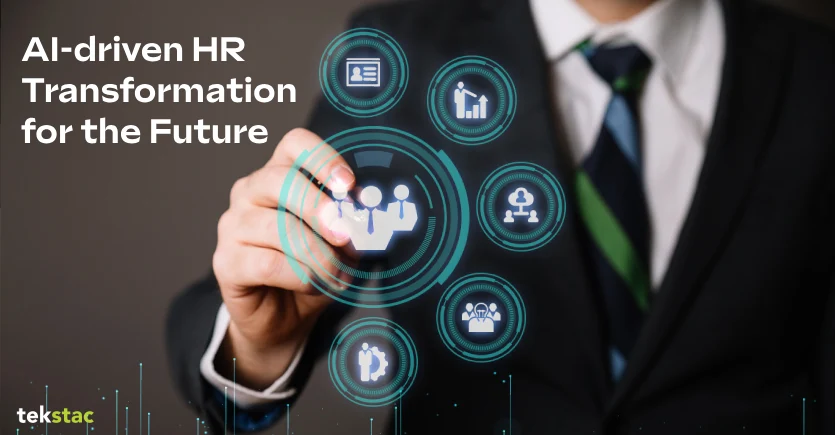
According to SHRM 76% of HR leaders agree that they risk falling behind in the next two years without AI.
As Generative AI (GenAI) and workforce digitization sweep across industries, HR transformation has become a critical priority. From digital HR strategy to next-gen workforce management, these technologies are reshaping traditional HR functions—adding both complexity and opportunity.
For organizations ready to adapt, the benefits of AI and automation in HR transformation are boundless: faster hiring, smarter decisions, and personalized employee growth. But for those who resist, the gap will only widen, making it essential to embrace these innovations today.
This article explores 6 HR transformation strategies powered by AI and automation, highlighting how organizations can modernize HR operations, improve employee experiences, and build a future-ready workforce.
HR transformation is the process of modernizing HR strategies, processes, technology, and workforce practices to better support business goals. It can include AI-powered automation, digital HR systems, workforce analytics, skills-based talent management, and personalized employee development.
It matters because modern HR teams need to respond faster to changing workforce needs, improve employee experiences, close skills gaps, and make data-driven decisions. By combining AI, automation, and human expertise, organizations can build more agile and future-ready HR functions.
According to SHRM, about 1 in 4 organizations are currently using AI to support HR tasks. Nearly half of HR professionals said using AI to support HR has become a priority over the last year.
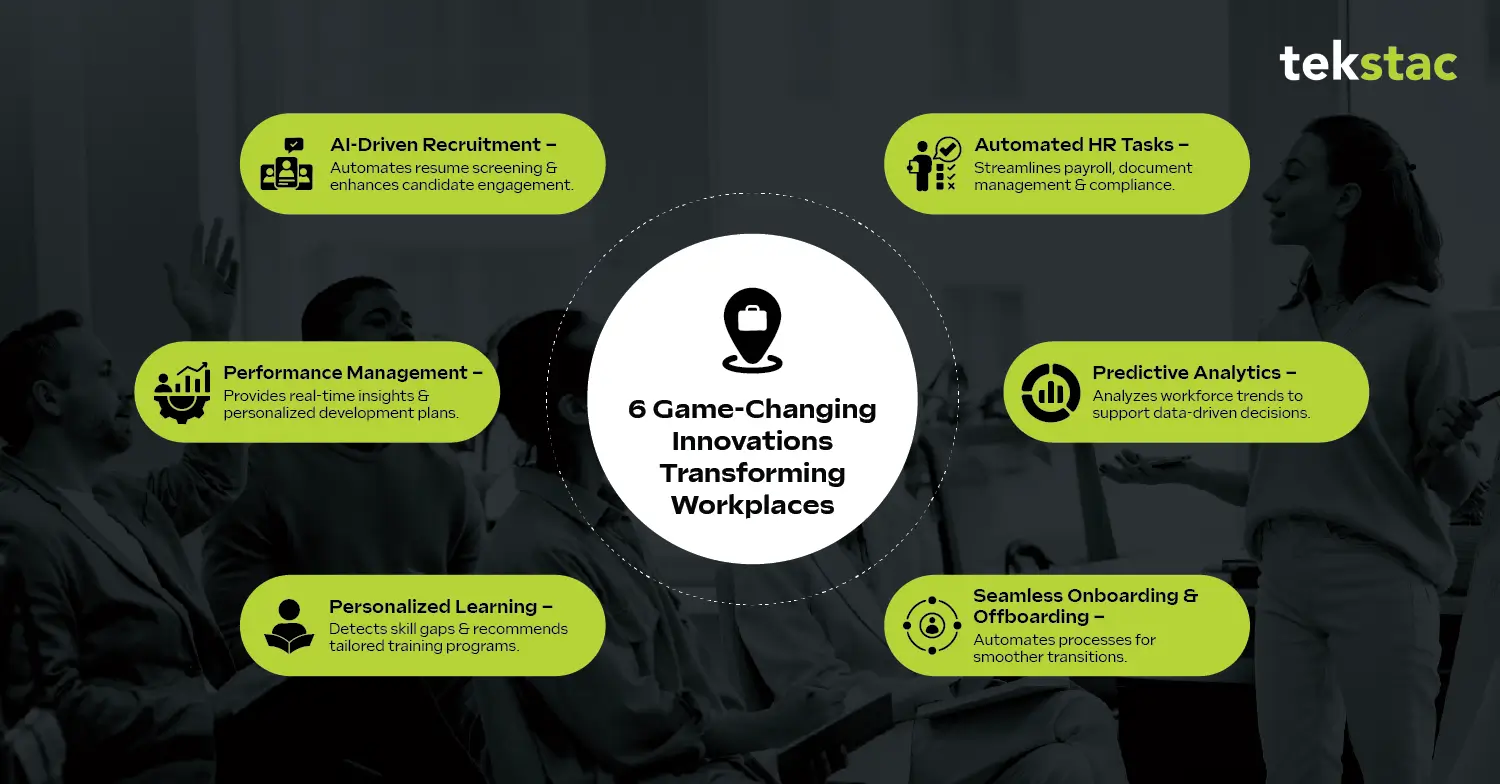
Here are six ways AI is transforming HR:
Recruitment comes with inefficiencies for HR as they must review countless resumes while keeping candidates engaged throughout the hiring process. AI-powered applicant tracking systems (ATS) and talent intelligence platforms can now handle resume screening, ensuring that only the right fit reaches HR’s desk. This form of AI-powered talent management accelerates workforce planning and supports a digital-first HR transformation strategy.
Predictive analytics identify top talent faster, while AI chatbots maintain communication with candidates, keeping them engaged. Generative AI platforms also create personalized job descriptions and postings, tailored to each role.
Traditional performance reviews and management are prone to bias and subjectivity, sometimes failing to reflect an employee’s work. AI now brings objectivity by analyzing employee performance in real-time. Machine learning algorithms identify performance patterns and suggest development plans for each employee. Repetitive tasks such as data collection are also automated, ensuring managers focus on employee career growth and meaningful conversations.
With the rise of AI, HR can now customize learning journeys and track individual performance metrics to recommend training modules or upskilling initiatives. Any skills gaps are detected to provide targeted growth plans, ensuring employees grow in ways that benefit themselves and the organization. In the near future, AI has the potential to become a personal mentor for employees, providing invaluable career guidance.
HR teams are burdened by repetitive tasks like payroll processing, data management, and document management, leaving little time to interact with employees. AI-driven solutions automate these processes while being highly accurate and saving countless hours. For instance, payroll systems calculate and disburse salaries accurately, while document workflows ensure compliance without human intervention.
AI can process and analyze data via predictive analytics, even presenting trends in areas like employee satisfaction, turnover rates, and diversity metrics. This empowers HR to anticipate challenges before they become devastating, and with seamless reporting features, HR can inform leaders to make data-driven decisions on workforce planning and management, thereby driving significant organizational change.
Onboarding can feel like finding your way through a maze of forms, policies, and processes, while offboarding has its challenges in compliance and security. AI simplifies both.
AI tailors workflows for each new hire during onboarding, automates benefits enrollment, and provides required training resources. It can also act as a virtual assistant, guiding end to end in onboarding . For offboarding, AI protects company data by managing automated equipment retrieval and ensuring smooth transitions with personalized communication.
Here’s how automation streamlines and transforms HR processes:
HR automation has transformed recruitment processes, enabling posting job ads across platforms in seconds, tracking applications in real-time, and even screening resumes effectively. Tasks like candidate ranking and interview scheduling are automated, enabling HR teams to focus on candidate experiences and finding the perfect fit.
From generating e-signed forms to granting access to essential tools and devices, automation creates a seamless journey for new hires. Automated workflows ensure nothing is missed—whether IT setups or mandatory training sessions—setting employees up for success from day one.
Submitting expenses is universally dreaded, and 1 in 5 manual expense reports are incorrect. Automation and AI-powered systems allow employees to snap a photo of their receipts, automatically extracting the necessary details like amount, date, and vendor. Approval workflows are initiated instantly, saving hours of back-and-forth emails. With countless hours of processing time saved, and errors practically eliminated, companies gain real-time expense visibility.
Manually managing payroll is prone to human errors, but automation brings accuracy and transparency to the forefront. It calculates from work hours to deductions and taxes, automating the entire payroll system to ensure that every paycheck is accurate and compliant. Not only does this save time, but it also builds trust among employees.
Forget tedious spreadsheets and inconsistent performance reviews. Automated systems now track employee performance metrics, offering real-time insights that empower managers to make informed decisions. Automation ensures unbiased evaluations, clear goal-setting, and actionable feedback loops.
As organizations embrace automation across HR processes, the need for more personalized solutions will arise—especially in learning and development.
The future of L&D lies in data-driven approaches that adapt to individual needs while driving organizational growth. AI-powered learning platforms like Tekstac offer game-changing features that help organizations evaluate and track skills effectively to empower employee growth.
With features like customizable assessments, dashboards with real-time analytics, and data-driven insights, these platforms simplify tracking skills progression and development plans. For instance, Tekstac provides:
Ready to accelerate your HR transformation? Book a Tekstac demo to discover how AI-powered learning can build a future-ready workforce.
1. How is HR transformation different from HR digital transformation?
HR transformation focuses on redesigning HR strategy, processes, and workforce practices, while HR digital transformation specifically uses digital technologies such as AI, automation, analytics, and cloud platforms to modernize HR operations.
2. What is the Dave Ulrich HR transformation model?
The Dave Ulrich HR transformation model emphasizes aligning HR with business strategy through strategic HR roles, efficient processes, and employee-focused services, helping organizations shift HR from an administrative function to a strategic business partner.
3. How does HR transformation improve employee experience?
HR transformation enhances employee experience by enabling personalized learning, streamlined onboarding, faster services, and data-driven decisions that build engagement, productivity, and long-term retention.
4. What role does learning and development play in HR transformation?
Learning and development fuels HR transformation by closing skills gaps, creating personalized growth paths, and aligning workforce capabilities with organizational goals for sustainable success.
5. What’s a realistic HR transformation roadmap or timeline?
A realistic HR transformation roadmap typically takes 12–24 months, depending on organizational size and complexity. It usually involves assessing current capabilities, defining priorities, implementing technology, developing skills, and continuously measuring outcomes.