

Most L&D leaders don’t suffer from a lack of data. They suffer from too much fragmented data, too little trust in it, and no clear way to translate it into better business decisions.
The default metrics such as completion rates, satisfaction scores, and average quiz marks feel precise. They’re easy to pull from an LMS and easy to put in a report. But they almost never answer the question a CFO or COO is actually asking: Is our team capable? What’s our learning ROI?
This is where the conversation in L&D needs to change — from data-driven to data-informed decision making. Without this shift, L&D will continue to struggle to demonstrate learning ROI to the C-suite.
Organizations collect vast amounts of L&D data, but converting that information into meaningful business decisions is often challenging. Without the right context and insights, learning metrics can create confusion instead of driving action.
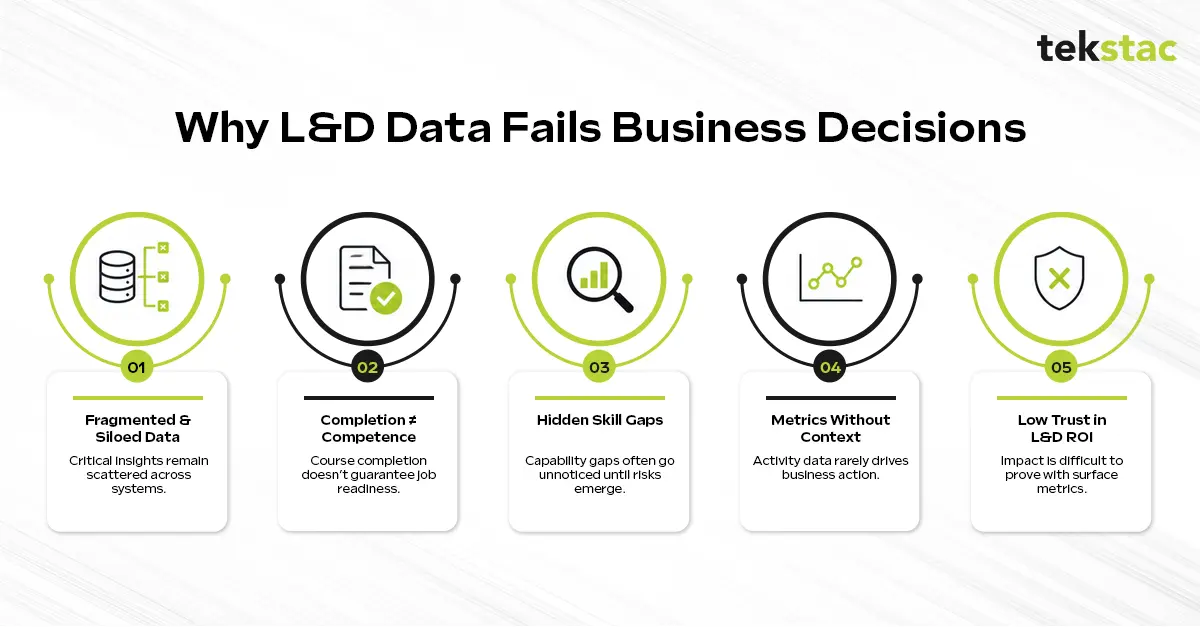
Ask any L&D leader where their data comes from, and the answers are familiar: LMS reports, post-training surveys, assessment scores, manager feedback, HR systems. And yet the most common complaint remains: “We don’t have enough data.”
In reality, the problem is almost never data availability. It’s that data lives in silos, owned by different functions, in different systems, with different access controls. Performance data sits in HR. System usage data sits in IT. Customer interaction data sits in operations. Each island holds a piece of the puzzle, but no one is assembling the picture.
If LMS completion data is your primary evidence base, you’re operating within very narrow boundaries, and every business decision you inform is built on an incomplete foundation.
In L&D, too many teams are operating on autopilot, following the waggle dance of LMS reports and quiz scores without asking what those numbers actually mean, or what they’re failing to surface. A learner can score 90% on a cloud security assessment and still fail to stop a live breach. Completion is not competence. Passing is not performance.
The hard truth: An LMS tells you who completed what and when. It cannot tell you who is actually job-ready, where capability gaps are quietly growing, or whether training reduced a single point of business risk.
According to the World Economic Forum (WEF), 50% of the global workforce completed formal training in 2025, but many L&D teams still face challenges in translating learning activity into measurable business decisions.
Beyond the silo problem, there’s a more fundamental limitation: your LMS can only ever reflect the environment you designed. It surfaces insights you thought to look for. It will never show you what you didn’t think to measure.
The shift we need is from treating data as a dictator; something that tells us what to do, to treating it as one critical input in a larger business decision-making process.
As Jerry Z. Muller argues in The Tyranny of Metrics, chasing numbers can cause organizations to miss their real objectives entirely. Completion rates, satisfaction scores, and quiz averages feel precise, but without context, they can actively mislead. They reward compliance, not competence. They measure what was easy to measure, not what actually matters.
The most effective fix is not better dashboards. It’s a declared, documented, pre-agreed methodology for how your function engages with data; one that ties training effectiveness directly to workforce capability and business outcomes.
”The goal of analytics isn’t to report on the past. It’s to separate the signal from the noise so we can predict the future.”
— David Green, Global Leader in People Analytics
L&D often struggles to earn trust, not because of a lack of capability, but because of a lack of documented methodology. When a business leader asks “Why did you choose a workshop over e-learning?” or “How do you know this is a training problem and not a management problem?”, the answer is too often “we judged it based on experience.”
Experience is valuable. But it’s not auditable. And in an environment where every function is being asked to justify its budget in outcome terms, “we felt it was the right call” is not a defensible position.
Without a clear methodology tying learning activity to workforce capability and business outcomes, L&D insights will always feel subjective, even when the underlying data is sound.
Tekstac is a skills intelligence platform built to close the gap between learning activity and real workforce capability, giving organizations the data intelligence needed to make confident business decisions.
Tekstac doesn’t start with reports. It starts with the questions business leaders actually need answered:
Each of these capabilities shifts the conversation from “Did training happen?” to “Can the team perform?”
At the core of this platform is role–skill fitment. Rather than treating learners as course completers, it maps individuals against required role skills and proficiency levels. This gives L&D teams, managers, and leaders a shared, objective view of where the workforce stands and ultimately translates into better business decisions.
The platform replaces passive quizzes with auto-evaluated hands-on labs. When a developer works inside the platform’s sandbox, the platform doesn’t simply record whether they got the right answer; it tracks their logic, their error-correction speed, and their technical accuracy under realistic conditions. The result is a proficiency heatmap: not “100 people passed” but “40 people are ready for senior DevOps work; 60 need targeted support with deployment automation.”
Using AI-driven, multi-dimensional talent matching, it identifies employees who are closest to role-readiness. For large organizations hiring or redeploying at scale, this directly reduces time to productivity, training costs, and project risk. In one consultancy case study, targeted micro-lab interventions identified from Tekstac data reduced time-to-competency by 20%, moving staff to billable projects weeks ahead of schedule.
Data-informed decision making in L&D means using learning data such as proficiency scores, skill gap analysis, role-fitment assessments as one input alongside business context. Unlike purely data-driven approaches where numbers dictate action, data-informed teams use analytics to ask better questions and validate decisions, not replace human thinking.
The future of L&D is not about collecting more data; it’s about turning the right signals into smarter business decisions. Completion rates and quiz scores may show activity, but they rarely reveal whether teams are truly capable, deployable, or ready for change.
In a business environment where speed, adaptability, and capability define competitive advantage, L&D can no longer afford to operate on assumptions. That’s where Tekstac changes the conversation. By combining role–skill fitment, hands-on assessments, and AI-driven skill intelligence, it helps organizations move beyond reporting metrics to making informed business decisions.
👉 Book a Tekstac demo and see your workforce capability data in action
1. What is decision-making in business?
Business decision-making is the process of analyzing information, evaluating risks and opportunities, and choosing the best course of action to achieve organizational goals. Effective decision-making combines data, business context, experience, and strategic priorities to drive better outcomes across operations, people, finance, and growth.
2. What is the difference between data-driven and data-informed L&D?
Data-driven means the numbers dictate the action. Data-informed means data is one critical input alongside professional judgment, qualitative signals, and business context. The latter produces better decisions because it accounts for what data can’t capture: the messiness of real work, shifting organizational context, and the knowledge held by experienced practitioners that never makes it into a dashboard.
3. How do you measure L&D impact beyond completion rates?
Track proficiency improvement over time using pre/post assessments, speed to competency (how fast capability develops, not just whether a course was finished), role–skill fitment scores that show readiness against actual job requirements, and downstream business metrics such as QA scores, deployment speed, error rates, and time-to-productivity. Tekstac connects practice behavior in hands-on labs directly to on-the-job performance, creating a defensible link between learning activity and business outcome.
4. How should L&D present impact data to the C-suite?
Lead with outcomes, not activity. Structure the narrative as: the problem → the signal → the action → the result. Executives don’t need a dashboard; they need a decision. Make the business outcome the hero of the story, not the L&D team or the platform.
5. How do we stop being ‘order takers’ and become strategic partners?
Stop saying yes to every course request. If the data shows no meaningful skill gap exists, the problem is likely a process issue, a management issue, or a confidence issue, none of which a training course will fix. Having a documented methodology for how you diagnose problems and communicate that clearly to the business.