
L&D workplace challenges show up the same way in every organization: employees finish training, but their behavior at work doesn’t change. Sarah from marketing completed 12 training modules last quarter. However, she still struggles with the same workplace challenges she faced six months ago.
This happens everywhere. Employees complete training, yet nothing changes in their daily work. They finish courses on time management, but still miss deadlines. They take leadership workshops but avoid difficult conversations. They learn presentation skills but freeze up during client meetings.
Workplace challenges persist. Teams still struggle with communication breakdowns. Managers still micromanage instead of delegating effectively. Projects still fail due to poor planning and execution. The skills people need to succeed at work remain underdeveloped, despite all the training investment. Why?
Remember the last time employees sat through mandatory training? That glazed-over feeling when the instructor asked if there were any questions and the room went dead silent?
One of the main workplace challenges in L&D is not that employees are resistant to growth, but that most companies do not yet treat skills like abilities that need practice. Here are a few reasons why workplace challenges persist despite employee development efforts:
1. Learning is not treated like a process: Most companies offer workshops or courses and consider the job done. But skills take repetition and real-world practice to develop, not just a single chunky session or video. Innovative strategies like microlearning can address these issues.
2. Learning content doesn’t address specific job problems: Employees often face specific challenges, like handling conflict, managing deadlines, or delegating tasks. But the training they receive is too generic and doesn’t help solve those real issues.
3. There are no clear goals tied to learning: Employees complete training, but they do not understand what’s expected to change in their work afterward. Hence, without specific goals, it’s hard to apply what was learned.
4. Managers don’t support ongoing development: After training, most employees are left on their own. If managers don’t follow up or create space to apply new skills, the learning may be quickly forgotten.
5. L&D is not a long-term plan: Learning programs are often launched only after problems show up. There’s no proactive strategy to build skills ahead of time — which means the same challenges keep repeating.
While most organizations focus heavily on delivering learning, very few take the next step to define what employee development should look like in practice. Without clear outcomes tied to learning, employees walk away from training unsure of what’s expected to change. This also means, when managers fail to reinforce those expectations, even well-designed programs can lose their value and impact.
Goal setting helps fix these workplace challenges, bringing structure and accountability into the development process. For example, a leadership goal might be:
These become signals of whether someone is actually developing the skill. With goals like these, employees can track progress, apply what they learn, and get targeted feedback from their managers. Some other major reasons why goal-setting helps:
1. It turns learning into action: Goal-setting strategies in L&D bridge the gap between knowing and doing, giving employees a clear target to apply what they have learned in real work situations.
2. It adds structure to development: Without goals, employee development can feel incomplete. Employees need specific, time-bound outcomes that guide their growth step by step.
3. It makes progress visible: Learning without visible milestones can make employees feel stuck. Goals give employees and managers a clear way to track movement in regard to skill change.
4. It personalizes the learning journey: Setting individual developmental goals helps employees focus on what they need, along with what the company rolls out.
5. It creates accountability and momentum: When goals are clear, ownership becomes easier. Employees stay engaged while managers know how to support them, review progress, and celebrate development wins.
Most companies use SMART goals or OKRs during performance reviews. These work fine for tracking quarterly targets or project milestones. But they fall short when applied to skill development.
Traditional goal frameworks ignore this messiness. They assume you can learn delegation skills the same way you’d complete a sales quota – with clear milestones and predictable timelines. But developing capabilities means breaking old patterns, which takes time and repeated practice. Real skill development looks different. Someone learning to give feedback might nail it with friendly colleagues but struggle with difficult personalities. Someone building presentation skills might excel at internal meetings but panic during client calls. These aren’t failures – they’re normal parts of learning and workplace challenges that goal-setting must account for.
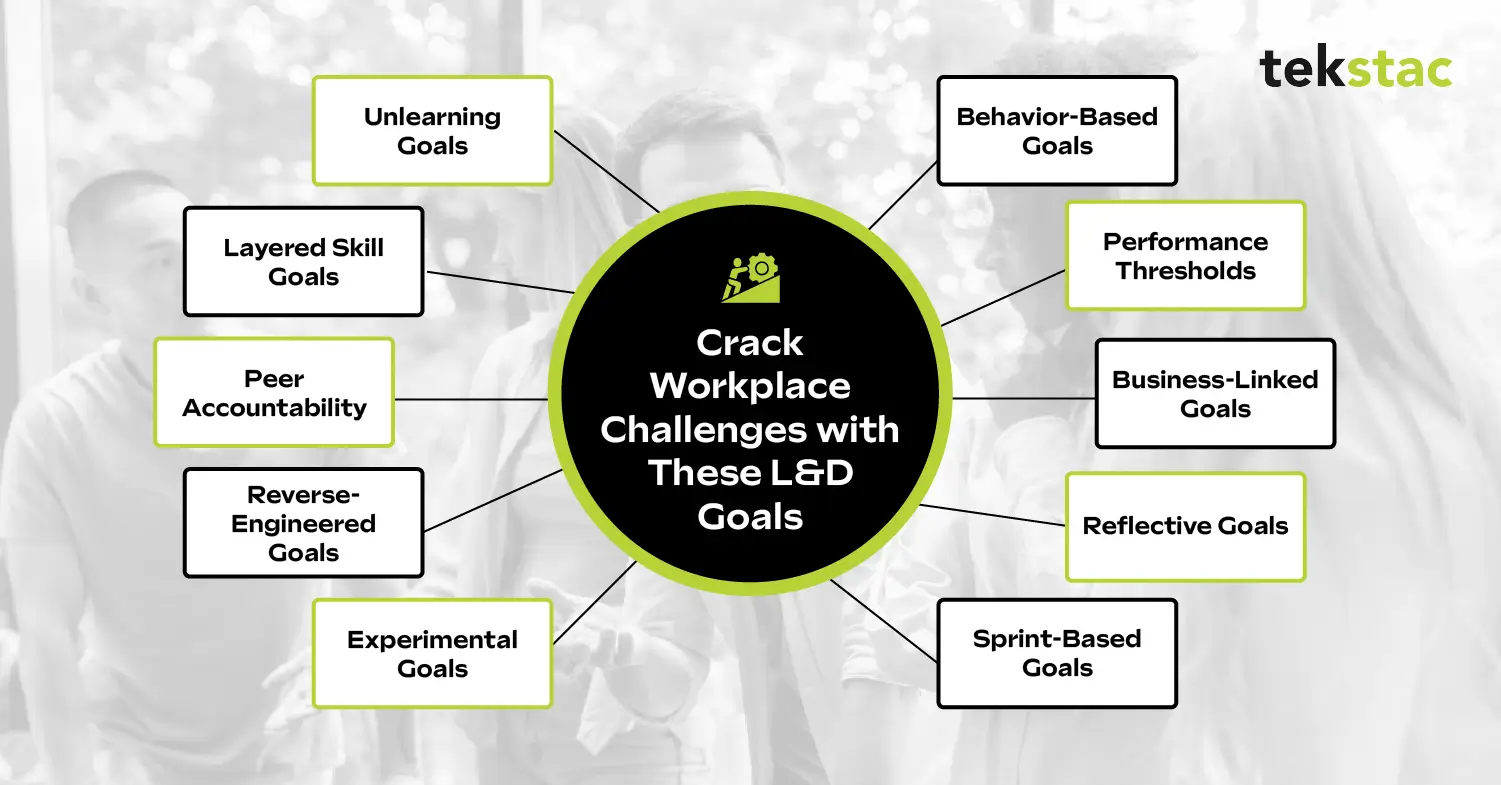
The strategies below recognize this reality. They work with the natural ups and downs of skill development instead of fighting against them.
One of the biggest gaps in L&D is assuming learning equals doing. High performing organizations take it further and define success as an observable behavior. For example, an objective like “complete negotiation training” can look like “negotiate three client contracts without senior support” as an outcome. This changes the focus from input (the training) to output (the behavior change). To implement this, organizations must align every learning intervention with a concrete, on-the-job action they expect to see post-training, and review it in one-on-ones. Strategies like gamification can change how organizations build skills for practical outcomes.
Most goals are set around finishing something, be it attending sessions or completing a module. These don’t always translate to real-world application, especially when workplace challenges come into play. Top L&D leaders set thresholds, minimum performance standards that indicate readiness. For instance, a presentation skills program might require the employee to lead two internal briefings rated at least 4 out of 5 by peers. This measures if an employee performed at an acceptable level, and this works best when you link learning goals to clear evaluation rubrics or feedback criteria.
Instead of setting goals in isolation, tie them to upcoming business shifts, be it a new product launch, market expansion, or process change. This makes learning feels urgent, relevant, and visible too, helping stakeholders buy in as the goal supports actual business movement.
One underrated strategy is making self-assessment part of the goal. This promotes self-awareness and helps employees internalize learning before rushing into execution. Organizations can implement this via reflection logs, post-training prompts, or weekly development check-ins.
Borrowed from agile methodology, this involves setting short, focused development goals over 2-4 week sprints, with check-ins baked in. The key is the midpoint checkpoint to provide course correction. Sprint-based goals create urgency without overwhelming employees, while allowing for real-time coaching. These sprints employ strategies that help bridge the gap between classroom training and real-world workplace challenges with workplace training, ensuring skills improve through practical application.
Leaders stress that development is not merely about acquiring skills, it’s also about unlearning ineffective habits. If someone’s been micromanaging for years, a good goal must allow them to delegate with only one follow-up per week and allow autonomous decisions. For this to work, goals should explicitly call out what needs to stop.
Rather than isolate a skill in one goal, layer goals across exposure, practice, and mastery. Each layer deepens the skill and reinforces it through repetition. To apply this, structure L&D goals into progressive levels that build on one another over time, similar to scaffolding in instructional design. This approach aligns with Deloitte’s findings that organizations with skills-based strategies are 57% more likely to anticipate and respond effectively to change, enabling them to build a more agile and future-ready workforce.
Peer support builds consistently. One effective approach is to pair employees with a peer following a similar development path and set shared learning goals. This fosters collaboration, strengthens accountability, and creates informal coaching opportunities. Organizations can scale this through buddy systems or learning cohorts.
According to LinkedIn’s Workplace Learning Report, 94% of employees say they would stay longer at a company that invests in their career development. Peer learning and collaborative development initiatives can reinforce that investment by creating a culture of continuous growth and shared success.
Instead of asking, “What should they learn?” ask, “What impact do we want to see?” Then set development goals that target those inputs. This approach ensures that learning is directly linked to measurable outcomes rather than assumptions. When goals become skill-based, companies are 63% more likely to achieve results, thereby creating a direct link between employee development and workplace challenges.
Growth is rarely linear, and we must acknowledge this by framing goals as hypotheses rather than certainties. For example: “Test running team check-ins without a formal agenda to increase engagement over one month.” This lowers the fear of failure and encourages employees to try new behaviors, assess the results, and refine. Implementing this requires managers to be coached on setting short-term experimental goals to debrief outcomes without judgment.
Effective employee development is uncomfortable and requires commitment from everyone involved, but it’s also the only approach that actually works. Here, the right platform makes all the difference. Organizations that successfully implement these goal-setting strategies for L&D workplace challenges, they need systems that support focused, measurable development. Platforms like Tekstac bridge this gap by combining structured learning paths with hands-on practice environments and real-time progress tracking.
When employees can practice skills in immersive labs, receive AI-powered assessments that identify specific improvement areas, and follow customized learning journeys aligning with their career development plan, goal setting turns into measurable progress. Additionally, comprehensive dashboards and analytics help managers track whether the goal is actually translating into improve stakeholder relationships and business outcomes.
Over 1 million+ professionals have already experienced this focused approach to development, with organizations reporting 100% retention rate when learning is tied to clear, achievable goals. Your employees too are waiting for you to give them a real path forward, one that’s measurable, practical, and directly connected to their daily work. Explore Tekstac today!
1. What are the most common workplace challenges in L&D?
Common L&D workplace challenges include skill gaps, low learner engagement, limited budget, difficulty measuring training ROI, rapidly changing business needs, and aligning learning programs with organizational goals. Addressing these challenges requires a strategic, skills-based approach to workforce development.
2. What are the best practices for solving workplace challenges in L&D?
Successful L&D teams align learning with business objectives, conduct regular skills assessments, personalize learning paths, encourage continuous feedback, and use learning analytics to measure outcomes. These practices improve engagement, close skill gaps, and deliver measurable business impact.
3. What software tools can track learning program ROI and impact?
Learning Experience Platforms (LXPs), Learning Management Systems (LMS), skills intelligence platforms, and learning analytics tools help track learner progress, skill development, assessment results, and business KPIs to measure the ROI and effectiveness of training programs.
4. How can digital learning platforms help overcome L&D challenges at work?
Digital learning platforms help L&D teams deliver personalized learning, automate skills assessments, track learner progress, provide real-time analytics, and scale training efficiently. These capabilities improve engagement, reduce skill gaps, and support continuous workforce development.