Executives are worried, and the worry has a number attached to it. As the gap between the skills organizations have and the skills they need keeps widening, Skills Intelligence has moved from a nice-to-have capability to a boardroom concern. For nearly two decades, the Learning Management System (LMS) has been the backbone of corporate learning.
But the LMS was built to manage learning, not to understand it. AI has exposed that limitation, and as AI reshapes how people learn and how organizations operate, learning technology is undergoing a fundamental shift: from systems of record to systems of intelligence, what’s increasingly being called Skills Intelligence.
At its simplest, Skills Intelligence is the ability to continuously identify, measure, and act on the skills an organization has, the skills it needs, and the gap between the two. It isn’t a feature bolted onto an LMS. It’s a different architectural starting point: a Learning Intelligence Layer that reads real signals from the business and responds to them, rather than waiting to be told what to deliver.
| Traditional LMS | Skills Intelligence Platform |
|---|---|
| Delivers assigned courses | Continuously identifies skill and capability needs |
| Tracks learning activity and completion | Reads signals from learners, teams, roles, and business priorities |
| Requires manual updates and interventions | Recommends personalized learning and next-best actions automatically |
| Measures past learning performance | Continuously adapts to changing workforce and business needs |
WEF’s Future of Jobs Report found that 63% of employers now cite skills gaps as the top barrier to business transformation, a scale of change that legacy LMS infrastructure was never designed to address. Even a well-executed skill gap analysis tends to hit a wall somewhere between “we identified the problem” and “we did something about it.” That wall isn’t analytical, which means better dashboards won’t fix it.
The gap analysis usually sits inside a workforce analytics or skills intelligence tool. Learning content lives in the LMS. Gap data is organized around skills and roles, while learning content is organized around courses and topics, making it difficult to deliver personalized learning at scale. The two structures don’t naturally talk to each other. Someone has to build that bridge manually, usually someone who already has a full-time job, which is why the translation either doesn’t happen or happens once and fails to scale.
A gap analysis report tells you where the problem is. It can’t tell you what to assign, to whom, by when, or what happens if nobody engages. A dashboard creates awareness, but without a workflow attached to it, awareness rarely turns into movement. It’s a map of the gap, not a route out of it.
HR owns the skills data. L&D owns the learning programs. Managers own development conversations. But who owns the connection between an identified gap and a specific intervention, assigned to a specific person, on a specific timeline? In most organizations, the honest answer is nobody, and that accountability gap is exactly where momentum disappears. It’s a structural design flaw, not a personal one, which also means it’s fixable.
LinkedIn’s Workplace Learning Report puts the pace of this change in sharper relief: the skills required for jobs have already shifted by roughly 25% since 2015, and that rate is projected to accelerate to 40–70% by 2030. The move from LMS to Intelligence Layer isn’t only a technology decision. It changes how L&D leaders think about their own role. In an LMS world, L&D’s primary job is content production and program management: building courses, running workshops, managing enrollments, reporting completions. Valuable work, but increasingly automatable, and increasingly disconnected from the outcomes leadership actually cares about.
In an Intelligence Layer world, that job changes. L&D’s primary work becomes defining what capability the organization needs to build, setting the conditions for continuous development, and interpreting the signals the system surfaces. Coordination is handled by agents; strategy is handled by people. That’s a more durable position for the function, and it’s the foundation of the kind of skills-first leadership that CHROs are increasingly expected to model at the top.
A Skills Intelligence platform like Tekstac can enhance recruitment, support skills development, and improve talent management. For organizations, Skills Intelligence supports strategic workforce planning by giving leaders a comprehensive view of skills data aligned to future business needs. It improves talent acquisition by identifying gaps and helping recruit the right people into them. It optimizes L&D by designing targeted programs around actual gap data rather than assumption. Together, these are the building blocks of Skills-Based Organizations.
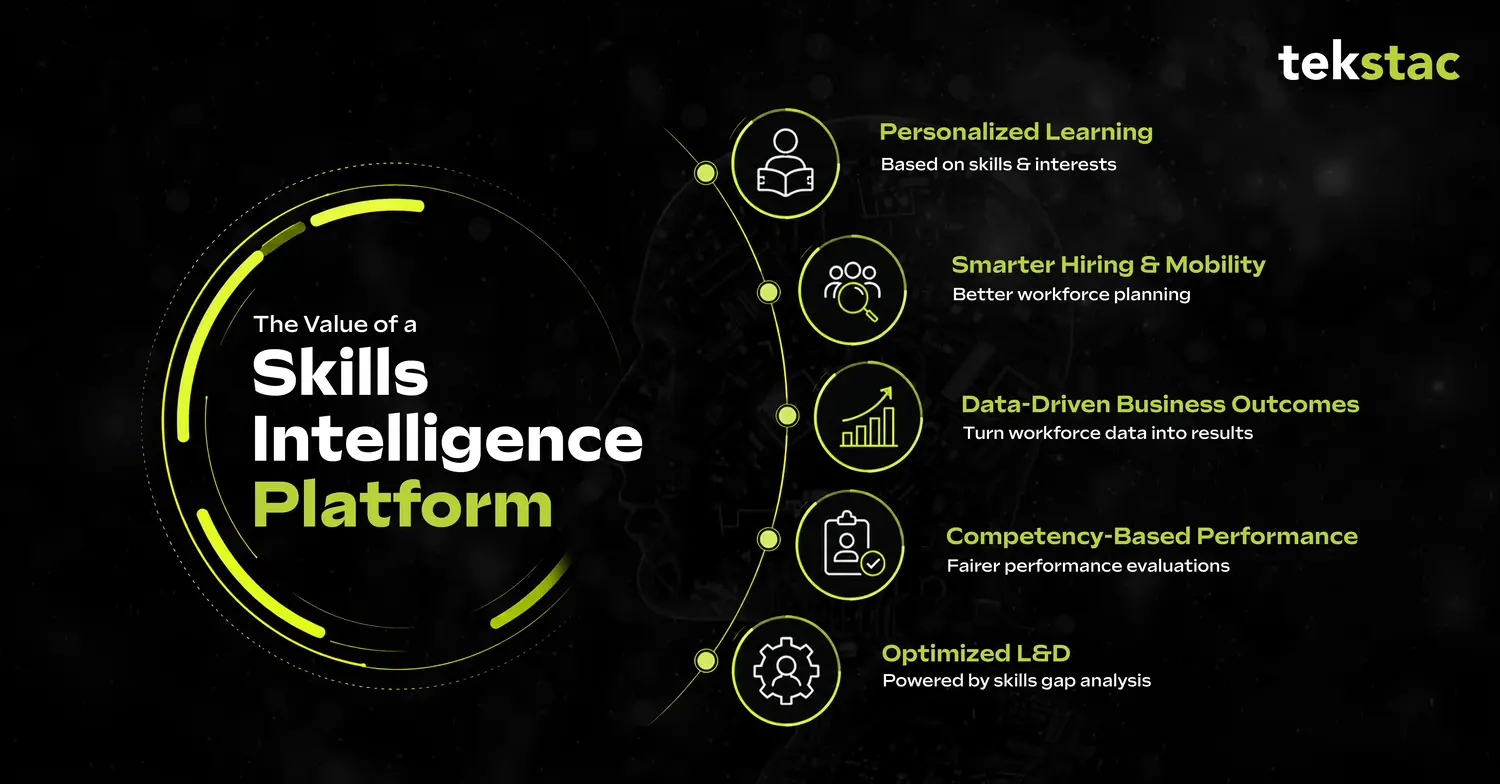
Closing the gap between skills data and skill-building action is precisely the problem Tekstac’s Skills Intelligence approach is built around. The platform has the Skill Insights hub that connects skill gap analysis directly to role-based learning pathways, so identification happens easily. For L&D leaders and CHROs evaluating whether their current LMS can carry this weight, that connective layer, not another course library, is usually the missing piece.
The LMS remains the foundation of enterprise learning, but its role is expanding beyond content delivery into an intelligent system of action. The organizations that recognize this earliest will build workforces that are faster, more capable, and more adaptable. That is the essence of Skills Intelligence: not another dashboard, but an operating model for continuous capability building.
Ready to see what a Skills Intelligence layer would look like on top of your existing LMS?
Talk to the Tekstac team about mapping your organization’s skills gaps to real deployable skill profiles.
1. How do Skills Intelligence platforms differ from traditional HR tools?
Skills intelligence platforms go much further by continuously identifying, validating, and analyzing workforce skills in real time. Instead of simply tracking completed courses or certifications, they map skills to roles, business goals, and future capability needs, helping organizations make better decisions about hiring, upskilling, internal mobility, and workforce planning.
2. What is the impact of AI on skills intelligence?
AI transforms Skills Intelligence by automating skill discovery, identifying capability gaps, and recommending personalized learning paths at scale. It continuously analyzes data from learning activities, projects, assessments, and job roles to create an accurate picture of workforce capabilities. This enables organizations to predict future skill requirements, accelerate reskilling initiatives, and make faster, data-driven talent decisions.
3. What are the challenges in deploying Skills Intelligence platforms?
Successful deployment requires more than implementing new technology. Organizations often face challenges such as fragmented skills data, inconsistent skill frameworks, poor integration with existing HR and learning systems, and low employee participation. To maximize value, businesses need a clearly defined skills taxonomy, reliable assessment methods, executive sponsorship, and a culture that encourages continuous learning and skills validation.
4. How do you know if your LMS is failing?
An LMS may be falling short if it measures learning activity instead of workforce capability. Common signs include high course completion rates with little improvement in on-the-job performance, limited visibility into actual skill gaps, generic learning recommendations, and difficulty linking learning outcomes to business goals. If your LMS cannot identify these, it may be time to move beyond traditional learning management toward a skills intelligence platform.