Agentic AI is rapidly moving from experimentation to enterprise adoption, and corporate learning is emerging as one of its most promising applications. From personalized learning journeys to real-time mentoring, agentic AI use cases are redefining how organizations build, validate, and deploy workforce capabilities. As enterprises look to close skill gaps faster and prepare employees for an AI-driven future, a new set of trends is beginning to shape the future of corporate learning.
Unlike a chatbot that waits for a prompt, an agentic AI system observes, decides, and acts; assessing a learner’s skill level, flagging a capability gap, recommending the next module, and adjusting the path the moment performance data changes.
An agentic AI system is distinguished by four traits:
Explore our in-depth AI in HR guide to understand how AI is transforming every stage of the employee lifecycle, from hiring and onboarding to learning, talent management, and workforce planning.
Gartner projects that 40% of enterprise applications will embed task-specific AI agents by the end of 2026, up from less than 5% in 2025; one of the fastest technology adoption curves the enterprise software market has seen. If you lead Learning & Development, Talent Management, Workforce Transformation, or Enterprise Skilling initiatives, these are 10 Agentic AI use cases worth knowing.
| Use Case | L&D Function | Reported Impact |
|---|---|---|
| Onboarding Agents | Role-based training assignment | Less manual HR effort |
| Compliance Training | Certification tracking & audit prep | Weeks of coordination saved/quarter |
| Adaptive Learning Journeys | Personalized content pathing | Higher completion rate |
| Skills Mapping & Gap Analysis | Live capability visibility | Better workforce readiness |
| Real-Time Analytics & Intervention | Disengagement detection | Increase in completions |
| Feedback Loops & Optimization | Sentiment-driven content fixes | Weeks-to-hours analysis time |
| Document-to-Course Generation | Automated content authoring | Faster development |
| Contextual Microlearning | In-flow, just-in-time delivery | Higher participation |
| Reinforcement Learning | Spaced retention prompts | Better retention scores |
| Automated ROI Measurement | Cross-system impact correlation | Faster ROI analysis |
AI tools are transforming HRTech in many ways. Employee onboarding is usually the first place agentic systems get deployed. These agents assign personalized learning paths, surface resources at the right moment, answer routine questions via AI chat, and track completion automatically, learning from every interaction to refine the next hire’s journey.
Compliance is repetitive by design, making it an ideal candidate for agentic ownership. Instead of relying on L&D coordinators to manually track certification expiries in spreadsheets, AI-driven employee training systems continuously monitor compliance, auto-assign refresher modules, generate audit-ready dashboards.
This is arguably the most cited of all agentic AI use cases, and for good reason; generic learning paths fail the moment a workforce has mixed experience levels. An AI agent continuously reads learner behavior, performance, and feedback, then adjusts content difficulty, skips mastered topics, and recommends the next-best module in real time.
Static skill matrices go stale the moment they’re published. Agentic AI in HR continuously integrates data from HR systems, performance reviews, and learning activity to maintain a live view of workforce skills and organizational capability.
Traditional L&D analytics report on what has already happened. Agentic systems intervene while it’s still happening. It reads engagement signals, quiz performance, and participation to detect a disengaging learner and automatically deploying a nudge before that learner drops off entirely.
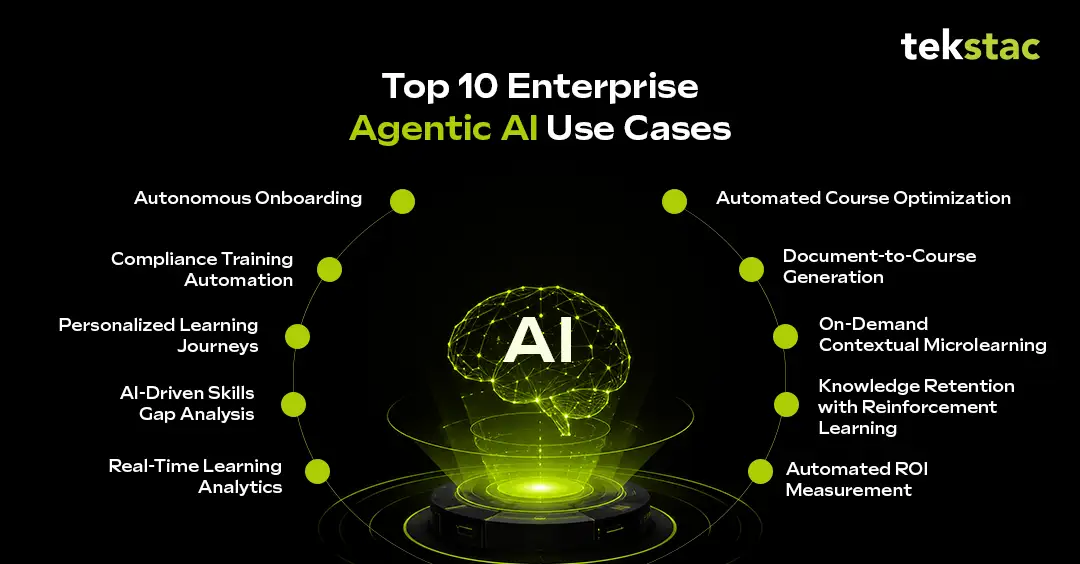
Post-training feedback is usually collected, then ignored for months. Agents surface what’s failing inside a no-code dashboard, and let L&D teams adjust content, pacing, or delivery style immediately.
Course creation is one of L&D’s most expensive bottlenecks; turning SOPs, manuals, and technical documents into structured learning content can take weeks per program. AI-driven employee training addresses this challenge by enabling intelligent content builders to read source documents, extract learning objectives, and automatically generate structured learning modules that L&D teams can review and refine.
Agentic systems deliver a short, relevant lesson at the exact moment it’s useful; a leadership tip before a 1:1, a compliance refresher before an audit, directly inside the tools people already use, like Slack or Teams.
The forgetting curve is L&D’s oldest problem, and agentic reinforcement is one of the more durable fixes. After a course ends, the agent schedules follow-up micro-quizzes, sends spaced summaries, and prompts scenario-based challenges to keep key concepts active in memory rather than letting them decay.
Proving L&D’s business impact has historically required manually correlating training records with performance data. Agentic dashboards now pull from the LMS, HRIS, CRM, and project tools simultaneously, correlating learning activity with productivity, engagement, or sales metrics in a continuously updating view. A telecom enterprise using this approach cut analysis time by 90% while giving leadership a far more transparent picture of training ROI.
SAP’s Value of AI Report 2026 projects that Indian enterprises will increase Agentic AI investment fivefold over the next two years. As organizations accelerate adoption, the challenge is no longer access to AI technology; it’s building the workforce capabilities required to use it effectively.
That challenge became evident for one of the world’s top five IT consulting and services organizations. Despite significant investments in AI learning programs, very few engineers had hands-on experience building and deploying multi-agent systems in production environments.
To bridge that gap, the organization partnered with Tekstac in January 2026 to launch a 1,200-engineer Agentic AI Project Accelerator. Designed around a project-first approach, the four-week program required engineers to build and deploy live multi-agent applications using CrewAI and LangGraph on real AWS and Azure environments. Every stage of the development process was automatically evaluated, scored, and supported with instant feedback.
The results are measured the way the thesis demands. In the first batch of 340 engineers, 40% have already built and shipped production Agentic AI applications, with 100% of project delivery auto-evaluated against capability rather than attendance.
AI fluency at work is already a thing, and the enterprise adoption curve is accelerating. And the most impactful agentic AI use cases are already moving beyond pilots into real-world workforce transformation initiatives.
For L&D and talent leaders, the opportunity is not simply to automate existing processes, but to rethink how skills are developed, measured, and applied at scale. Organizations that act now will be better positioned to build the workforce agility required in an AI-driven future.
Ready to accelerate your enterprise’s Agentic AI journey?
Book a demo to see how Tekstac can help your teams build production-ready Agentic AI capabilities.
1. What do you mean by Agentic AI use cases in corporate skilling?
Agentic AI use cases in corporate skilling refer to applications where AI agents can autonomously assess, decide, and take actions to support workforce development. Common agentic AI use cases include personalized learning journeys, skills gap analysis, onboarding automation, compliance management, learning analytics, coaching assistants, content generation, and workforce readiness tracking.
2. What type of AI agents are used in corporate upskilling initiatives?
Corporate upskilling initiatives typically use a combination of specialized AI agents rather than a single AI assistant.
Some of the most common types include:
3. What are some popular Agentic AI certifications and learning programs?
Popular options include certifications and programs focused on AI agents, multi-agent systems, LLM orchestration, autonomous workflows, and AI application development. To address this need, Tekstac offers specialized Agentic AI capability-building programs for enterprises.
Some commonly pursued learning paths offered by Tekstac:
4. How does Agentic AI improve enterprise learning and workforce upskilling?
Agentic AI improves enterprise learning by moving beyond static training programs to deliver personalized, adaptive, and outcome-driven learning experiences. Unlike traditional AI tools that simply respond to prompts, AI agents can autonomously assess employee skill levels, identify capability gaps, recommend tailored learning pathways, provide real-time coaching, and continuously adapt learning based on performance and business needs.