A talent development strategy is the system that closes the gap between the skills your business needs and the capabilities your people currently have. Without one, organizations train reactively spending on programs that don’t connect to business priorities, losing talent that sees no growth path, and falling behind competitors who treat capability building as a strategic function.
49% of learning and talent leaders admit their executives are worried employees cannot deliver on business strategy. The problem is not ambition, it is architecture.
The most innovative companies are doing more than upskilling and reskilling. They’re building internal ecosystems for growth, including coaching, leadership training, internal mobility, etc.
These “career development champions,” organizations that are pulling ahead on profitability, retention, and AI readiness through employee development, are 42% more likely to be Generative AI frontrunners, as per LinkedIn’s Workplace report.
And yet, only 36% of organizations qualify as champions. This means 64% of companies haven’t even started. There is no roadmap, no commitment—just scattered programs.
Let’s be honest—many organizations are still in the early stages of developing a strong talent development strategy. They don’t know what it looks like. This is exactly where we begin.
A talent development strategy fails when it is designed around content rather than business outcomes. The organizations that close the gap between training investment and measurable performance treat development as a strategic function, not an HR program connecting every learning initiative to a specific business priority, role requirement, or succession need. A true talent development strategy starts with a business problem, and ends with measurable impact. Career development champions connect employee development strategy to outcomes that actually matter:
Now, here’s what the champions are doing differently:
These organizations don’t train for its own sake. The strategy builds AI fluency if the business is shifting to AI-powered tools. If a growth market opens, they groom internal talent to lead that charge.
Career development should never be a one-time conversation. It’s designed into jobs, into culture, into how managers lead. Champions make growth visible, expected, and tracked. To truly grow employees, career development must be built into your performance management processes. That means development goals are set alongside business goals. Managers talk about growth in regular 1:1s. People know what skills they’re expected to build, and how that ties into the next role or project.
Employees need more than a new title; they need new challenges as well. The best organizations move talent laterally, vertically, and even across geographies. It’s less about hierarchy and more about exposure and stretch.
Budgets are focused on critical roles, high-potential employees, and future skills. These companies treat talent development like product R&D.
The biggest secret isn’t more content—it’s better managers. Champions are more likely to provide their managers with training to support career development because if they aren’t on board, your strategy won’t land.
Most companies miss the mark by treating employee training and development as a series of disconnected programs instead of a cohesive strategy. They focus on content, assuming more training equals better performance, without aligning learning to business goals. This step-by-step process helps avoid this:
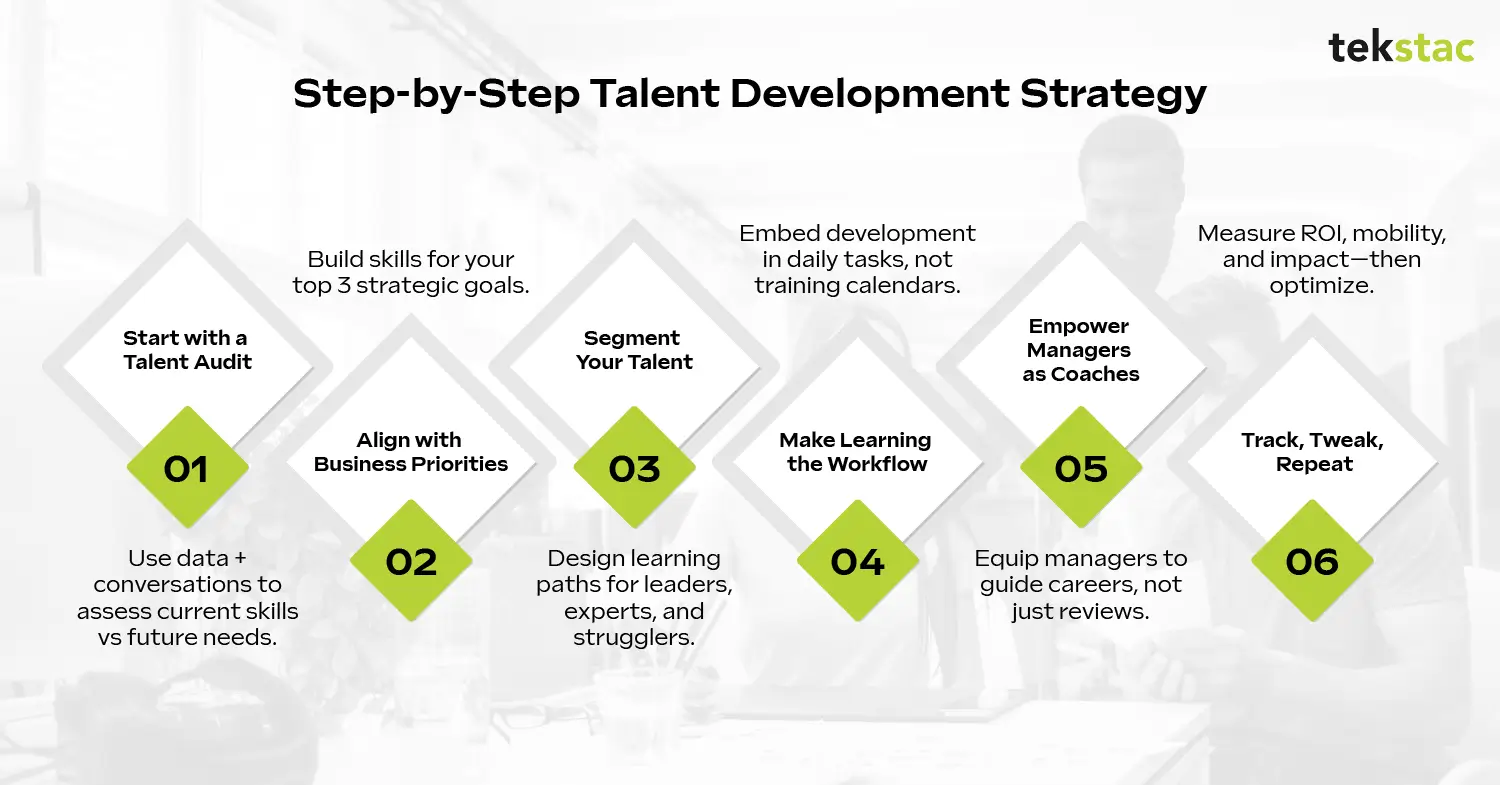
A talent audit is the mandatory first step in any talent development strategy because without it, every subsequent investment is guesswork. It assesses current employee skills, identifies capability gaps versus business requirements, and reveals which roles are most at risk from attrition, AI disruption, or market change, giving L&D teams a prioritized, evidence-based starting point rather than a training calendar.
Before jumping into upskilling, take stock of what you actually have. Conduct a talent audit to assess employees’ current skills, roles, and potential or your workforce against where the business is headed.
Tools like Tekstac’s skills insights give L&D teams a real-time view of capability gaps across roles, departments, and levels — replacing pulse surveys and spreadsheet audits with continuous, AI-driven skills intelligence.
Start by asking:
Pull in hard data (performance, exits, skill gaps), but don’t stop at dashboards. Run pulse conversations, interview managers, and look at internal mobility patterns. These don’t just help diagnose skill gaps but also in predicting future failure points.
Champions are 49% more likely to use internal data to identify skill gaps and 48% more likely to build career paths with aligned skills and courses. Most organizations are flying blind. Don’t be one of them.
Anchoring talent development to business priorities means translating your organization’s top strategic bets directly into capability requirements. If the business is shifting to AI-powered workflows, the development strategy builds AI fluency. If a new market is opening, it grooms internal talent to lead that expansion. The strategy reads like a GTM plan — not a policy document.
Then, think of the capabilities that these bets would demand. Build talent around these moves, be it expanding into new markets, implementing new tech, or overhauling operations. Your talent development strategy must read like a GTM plan rather than a policy document. That’s what gets executive buy-in as well.
Your employees are not one audience. They’re high potentials, legacy SMEs, restless Gen Zs, and mid-level managers stuck in the middle. So why offer them the same workshops?
Prioritize your development paths:
Champions offer 33% more tactics than non-champions: internal job postings, cross-functional gigs, career plans, gig-based work, and peer learning—all tailored.
Most organizations still treat learning like a perk. But in top companies, learning is the workflow. They embed it to create a continuous learning culture through:
Building this kind of infrastructure requires more than content — it requires AI-powered workforce upskilling solutions that adapt to each employee’s role, pace, and capability level in real time.
For instance, instead of sending new team leads to a generic leadership training, you could create a shadowing sprint where new leads spend their first month observing senior leaders in action, paired with weekly feedback reviews. This leads to faster ramp-up and fewer early missteps.
Champions are 88% more likely to offer career-enhancing project work, and 32% more likely to deploy AI training.
Managers make or break development. Yet only 15% of employees say their manager helped them build a career plan in the last six months. This is because managers are underequipped. They’re drowning in operations and rarely trained to discuss growth.
What you can do:
No company would leave a marketing campaign untracked, so why treat employee development like a static initiative? Make sure to track:
This helps ensure if your talent development strategy is growing fast enough to match market shifts and if people are moving into critical roles, or out of the company.
Workforce development plans shouldn’t depend on annual budgets or which HRBP’s leading the charge this year. If it does, your development plan is already fragile and may be forgotten by Q3.
Career development champions build infrastructure—systems that outlast people, roles, and restructures. Here’s how:
Career development plans should be company-wide mandates. Executives define the bets, HR turns them into critical capabilities, and managers translate them into meaningful conversations about growth.
Internal mobility starts with visibility. Employees must see what’s possible across teams, roles, and business units. Then comes normalization, where you reward managers who let talent move instead of hoarding it. Finally, automation and AI can match people’s skills with real opportunities.
When asking employees to grow, organizations must clearly define what growth means.
If you build talent development strategies on spreadsheets, siloed platforms, and scattered learning content:
Organizations need a comprehensive talent development platform, like Tekstac, built for companies serious about capability building. It’s a full-stack skills development program trusted by IBM, PwC, Cognizant, Accenture, and many more to build a competent, future-ready workforce.
It directly plugs into your organizational infrastructure:
A development initiative on its own won’t solve the bigger problem. Without a solid system in place, processes will inevitably fall apart. An infrastructure, or system, ensures every initiative is connected, repeatable, and scalable. And that’s precisely how Tekstac integrates learning into your broader business strategy.
Ready to change how your team learns, grows, and performs? [Request a Tekstac Demo]
1. Why is Talent Development Important in 2026?
Talent development is important in 2026 because AI and automation are reshaping the majority of roles faster than traditional hiring can compensate. A 2024 AI-Enabled ICT Workforce Consortium report found 91.5% of ICT jobs face high or moderate AI-driven transformation. Organizations that build continuous development infrastructure retain institutional knowledge, reduce external hiring costs, and adapt to market shifts without restructuring — giving them a measurable competitive advantage over those that treat development as a periodic initiative.
2. What is the difference between HR strategy and talent strategy?
An HR strategy manages people operations — payroll, policies, compliance, and workforce planning. A talent strategy goes further: it connects skill development, succession planning, and internal mobility directly to business goals and future growth requirements. HR strategy asks ‘do we have the right number of people?’. Talent strategy asks: ‘Do our people have the capabilities our business strategy demands — and are we building those capabilities faster than the market changes?’.
3. How to develop a talent acquisition strategy?
Start by defining your ideal talent profile, then align recruitment with your long-term skill needs. Use data, employer branding, and talent pipelines to attract, evaluate, and retain high-performing employees.
4. What does a talent development plan guide include?
A talent development plan guide includes six components: a talent audit identifying current skill gaps and future capability requirements; business-aligned development priorities mapped to strategic goals; segmented learning paths differentiated by employee role, potential, and career stage; embedded learning mechanisms integrated into daily workflows rather than offsite programs; manager enablement tools and coaching frameworks; and measurement systems tracking skill progression, internal mobility, and leadership pipeline readiness against business KPIs.
5. What is an effective talent assessment strategy?
An effective talent assessment strategy combines quantitative data (performance metrics, skill gap scores, exit patterns) with qualitative input (manager interviews, pulse conversations, internal mobility patterns) to build a complete picture of workforce capability versus business requirements. Champions are 49% more likely to use internal data to identify skill gaps and 48% more likely to build career paths with aligned skills and courses. The output is a skills map that identifies critical role gaps, high-potential employees, and development investment priorities.