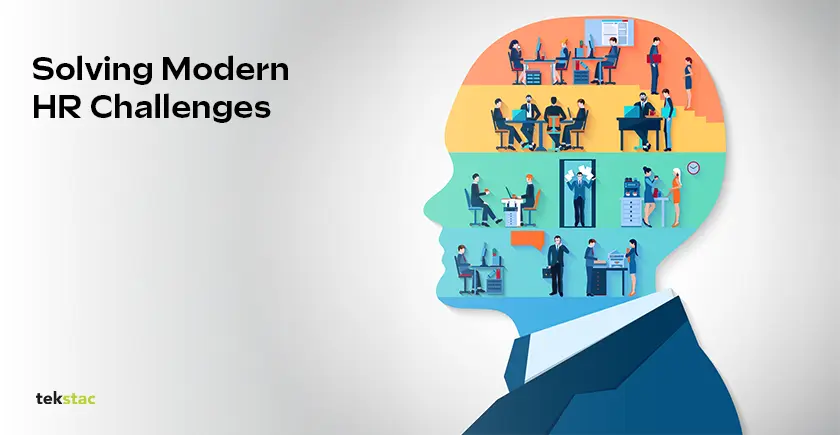
HR challenges include hiring qualified candidates, retaining talent, ensuring employee engagement, and complying with labor laws, among many others. In 2026, HR challenges are becoming more complex as the function sits at the intersection of workforce transformation, AI adoption, productivity, employee expectations, and rapid skill disruption.
However, one of the biggest challenges is the lack of clear visibility into workforce skills. Most organizations still don’t have reliable, role-level data on what their workforce can actually do, making it difficult to plan hiring, reskilling, internal mobility, and future workforce strategies effectively. The data tells a stark story. According to the WEF’s Future of Jobs Report 2025, 63% of employers globally identify skills gaps as the single biggest barrier to business transformation.
That gap between conviction and infrastructure is where organizations stall. Before looking at what modern skills intelligence platforms can solve, it’s worth being precise about what’s actually broken.
The WEF projects that 39% of workers’ current skill sets will be outdated or require transformation by 2030, and 59 out of every 100 workers will need reskilling or upskilling before then. More than 120 million workers globally are at medium-term risk of redundancy if that training doesn’t happen.
But the deeper problem isn’t the size of the gap. It’s the invisibility of it. Despite 98% of business executives agreeing that skills are becoming central to how organizations define work and value people (Deloitte), only 8% of those same organizations have reliable skills data to act on (Gartner, 2025). Training budgets get spent on generic programs, reskilling initiatives target the wrong gaps, and the skills drain caused by attrition goes unmeasured until critical project stalls.
As Jason Desentz, CHRO of Toshiba, noted at UNLEASH America 2026: “By 2030, successful organizations will be defined not by generational differences, but by a shared set of human skills that enable employees and managers to thrive alongside AI. These are no longer ‘nice to haves’ — they are the non-negotiable capabilities that HR leaders must intentionally cultivate.”
Hiring has grown more competitive and more expensive, but not more predictive. McKinsey data shows that 20–30% of key roles in many organizations are not filled by the most suitable people don’t exist, but because evaluation still relies on proxies: degrees, job titles, years of experience.
Strategic workforce planning is the second-highest HR priority globally, yet it ranks only 15th in current organizational capability, according to BCG’s “Creating People Advantage 2026.” What’s missing is a living, continuously updated picture of organizational skills; one that can inform decisions about internal mobility, succession, and whether to build, buy, borrow, or automate specific capabilities.
Patricia Frost, CHRO of Seagate, captures the challenge clearly: “Middle managers are really the powerhouse of any company. How well do they understand their teams and the skills within their teams, and understand also what people are passionate about?”
LinkedIn’s 2025 Workplace Learning Report reveals that 88% of organizations are concerned about employee retention and that providing learning opportunities is the top retention strategy. Yet most L&D and HR teams cannot demonstrate the business impact of development investment in terms that CFOs or boards respond to.
The gap between spend and provable outcome is a budget risk with compounding consequences. When HR ROI measurement can’t be quantified, training budgets become vulnerable at precisely the moment the skills crisis demands more investment.
As Mark Whittle, VP of Advisory in the Gartner HR practice, put it: “CHROs should take an enterprise-wide view of AI’s impact on work, the impact of change on leaders and employees, and how to evolve organizational culture to support performance expectations.”
Despite increased investment in internal mobility programs, mobility rates have remained flat. Only 24% of organizations have structured programs in place.
The barrier is rarely culture alone; it’s data. Without visibility into verified employee skills profiles, matching internal talent to new roles relies on manager networks and informal knowledge, which introduces bias. The result is a pattern that costs organizations on both ends: external hiring for those roles existing talent could fill, while tenured employees leave because they see no pathway forward.
Stacia Garr, Co-Founder of Redthread Research, captures the stakes at UNLEASH America 2026: “AI transformation will only deliver tangible results when HR, IT and the organization jointly own it — aligning on clear ROI, intentionally redesigning work, and preserving culture and connection as core differentiators.”
The most consequential shift in enterprise HR technology over the past two years has been the move toward skills intelligence platforms. As AI in HR continues to reshape workforce planning and talent decision-making, these platforms are becoming critical for organizations looking to build data-driven talent strategies. Skills gap analytics from these platforms allow HR leaders to prioritize development investments at the role, team, or organizational level.
Modern HR platform evaluation increasingly centers on predictive capability. By combining internal skills data with role demand signals, skills intelligence platforms help HR leaders anticipate which capability gaps will become critical in the next 6–18 months.
Skills data becomes significantly more actionable when it links directly to development content. Platforms that integrate skills gap analytics with curated learning pathways allow organizations to move from “we have a gap in data engineering” to “here are 14 engineers who are 60% of the way there, and here’s the 90-day pathway to close it.” This is the mechanism that transforms HR ROI measurement from an aspiration into a reportable business metric.
Tekstac is built as an enterprise skills intelligence platform that makes skills data the connective tissue between talent acquisition, development, and strategic workforce planning.
The platform gives organizations a validated, role-specific view of where their workforce stands against industry benchmarks. Rather than relying on self-assessments or anecdotal input, the platform runs structured auto evaluations that produce skills gap analytics at the individual, team, and organizational level. This enables the HR leaders identify which roles carry the highest capability risk and which internal talent is ready to step up.
For enterprises managing high-volume hiring or large-scale internal skills audits, The assessment engine combines adaptive, scenario-based questions with AI proctoring for enterprises. This ensures that the skills data entering your workforce planning decisions is accurate and trustworthy.
One of the clearest ways Tekstac supports HR ROI measurement is by connecting pre- and post-development skills data. When an organization runs an upskilling cohort, Tekstac shows how capability scores shifted, which roles are now better covered, and what the business impact looks like. This transforms the learning investment conversation from cost to measurable return.
The HR challenges of 2026 share a single root cause: organizations are making consequential decisions about their people without the skills infrastructure to make those decisions well.
Carrie Rasmussen, CHRO at Dayforce, frames the imperative plainly: “The old ways of deploying new technology will not suffice. CIOs and CHROs must move together. AI demands a unified mission.”
For HR leaders, the message is clear. The future of workforce transformation will depend on how effectively organizations can identify skills, close capability gaps, and align talent strategies with business goals. Explore how Tekstac can help your teams stay future-ready in an evolving world of work.
1. What are the current HR trends & challenges?
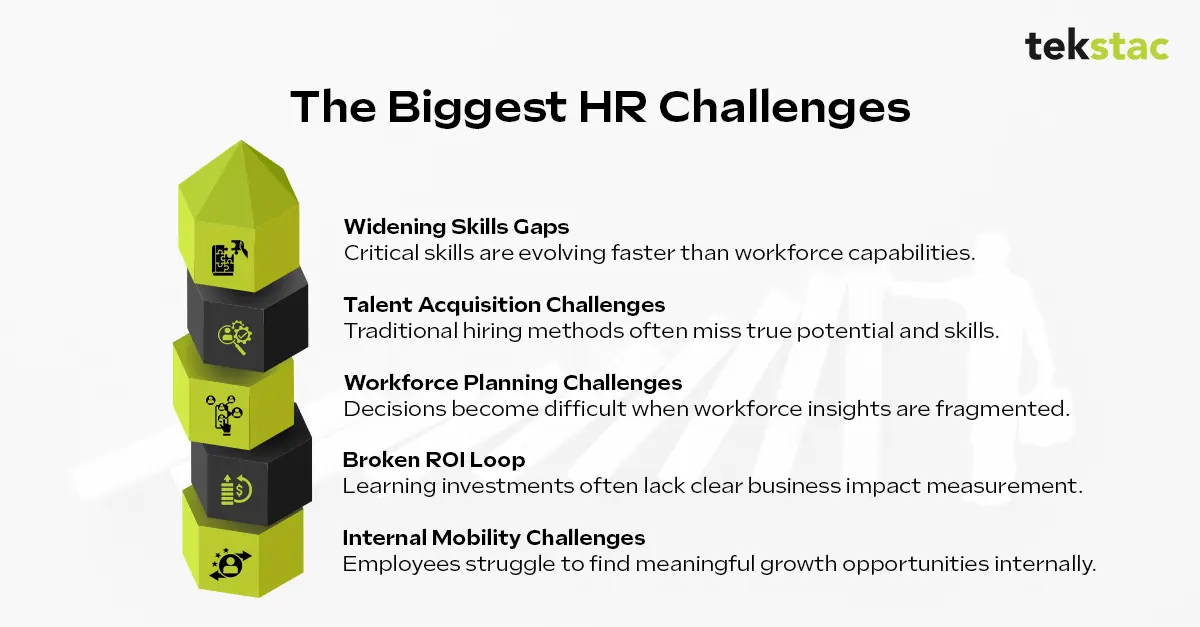
In 2026, HR leaders are navigating 5 challenges. Skills gaps are widening faster than hiring pipelines can fill them. Talent acquisition is shifting toward skills-based hiring, but most organizations lack the assessment infrastructure to operationalize it. Workforce planning remains largely reactive, with only 12% of companies having plans that extend beyond a single year (McKinsey). Employee retention is under pressure. And internal mobility, despite being a stated priority, stays flat because organizations don’t have reliable visibility into what skills their existing workforce actually holds.
2. How are HR leaders addressing the AI skills gap in 2026?
First, they’re building visibility using skills intelligence platforms like Tekstac to run structured assessments that reveal exactly where AI-related capability gaps exist at the team and role level. Second, they’re connecting that data directly to targeted learning pathways, so reskilling efforts are precise rather than broad. What’s changed in 2026 is the recognition that AI literacy isn’t a single skill; it spans prompt engineering, AI governance, human-AI collaboration, and role-specific application.
3. Why do most HR teams struggle to turn reskilling initiatives into measurable business outcomes?
Organizations invest in training but can’t connect it to performance, retention, or revenue. The answer naturally leads into why skills data infrastructure (assessments, benchmarking, pre/post tracking) is the missing link, which is exactly what Tekstac solves.
4. What are the top 5 HR priorities for 2026?
HR leaders are prioritizing closing skill gaps through upskilling and reskilling, integrating AI into HR and learning processes, and using skills intelligence platforms to gain better visibility into workforce capabilities. Improving employee retention and internal mobility has also become critical as organizations compete for skilled talent. At the same time, HR teams are expected to align talent and learning strategies more closely with business growth, productivity, and long-term workforce readiness.