Last updated on February 4th, 2026
When hiring, retaining, and managing top talent, the bar is being raised higher for organizations.
This is a part of turning into a skills-based organization, where employers move away from traditional job titles and rigid roles. Instead, they focus on the actual skills employees bring to the table.
With the new technology tools sprouting and the increasing nature of remote work, businesses focus on people who could immediately add value with applicable, practical skills, aside from background or previous experiences.
To find and retain such talent, organizations must transform into skills-based organizations poised to dominate in 2026 and beyond.
A skills-based organization is one that prioritizes the skills employees possess over traditional job titles or fixed roles. It structures teams and projects around the competencies required to drive business results. This allows employees to contribute based on their strengths and expertise.
Beyond hiring, a skills-based organization focuses on career development, promotions, or project management. Employees are assessed and advanced based on their skills and contributions rather than seniority.
For example, consider a company with defined roles, such as “Marketing Manager” or “Sales Representative.” Promotions are based on seniority, and employees are expected to stay in their roles for many years before moving up the ladder. For instance, a Marketing Associate role can only get promoted to Marketing Manager if the person has worked at the company for at least 5 years, regardless of whether they have mastered new marketing techniques or additional skills.
In contrast, a skills-based organization would recognize the value of new skills over years of experience or education. If the person possesses the right skills and knowledge, they would be promoted to leadership after demonstrating results with their abilities.
The transition to a skills-based model is a foundational shift that aligns with the evolving future of work, where agility, adaptability, and innovation drive success. Organizations must rethink traditional approaches to hiring, training, and talent development to stay competitive.
Becoming a skills-based organization requires businesses to adopt a mindset emphasizing the importance of employees’ abilities and talents rather than background or experience. This helps focus on continuous learning and skill development to build high-performing teams.
Here are the top 7 factors that will drive organizations to turn into skills-based organizations in 2026:
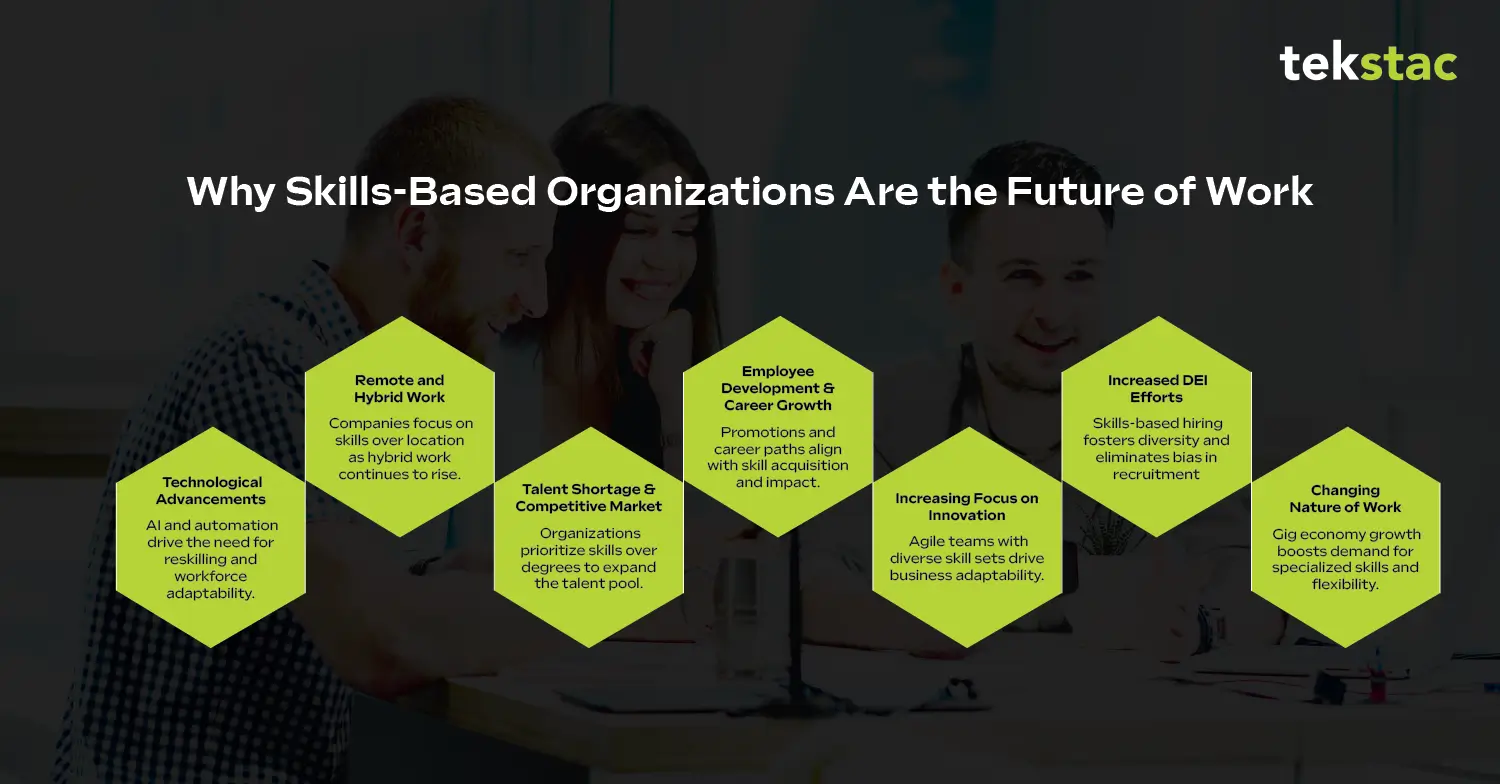
Technology is rapidly changing industries, with businesses integrating automation, AI, and other digital tools into their operations. An IBM report found that India will be the biggest adopter of AI in 2024, with 59% of large IT organizations deploying AI and 27% exploring this technology. 74% of this group is actively using AI in the following areas:
With AI handling repetitive tasks, humans are needed for creativity and problem-solving. This has shifted the focus to specific skills employees need to work alongside these emerging technologies. Also, organizations increasingly use these technologies for reskilling and development, ensuring the workforce has the required skills and is ready for the tech-driven future.
AI is also being embedded into employee training programs, helping tailor learning experiences and provide real-time feedback, thereby accelerating the learning curve for both new hires and existing talent.
Since the pandemic, flexible work arrangements have become mainstream, with hybrid and remote roles continuing to expand across industries. In India, about 12.7% of full-time employees currently work fully from home, while 28.2% are in hybrid work models, reflecting a significant shift toward flexible work preferences. Almost 41% of the workforce now embraces hybrid or remote arrangements, showing how work location flexibility has become a structural part of modern employment. Additionally, nearly 20% of job postings in India now explicitly offer remote or hybrid opportunities, up sharply from less than 1% in 2020, highlighting the sustained growth in flexible job openings.
As people work from different locations, companies focus on the specific skills employees bring to the table, regardless of where they are.
As per a Manpower report, nearly 4 in 5 employers in India found difficulty in finding the right talent in 2024. As observed, a growing demand for skilled workers makes recruitment highly competitive. To attract and retain talent, organizations must drop formal educational requirements and leave behind factors like location, background, race, and so on to hire talent that aligns with organizational needs. This mindset will help tap into a broader talent pool and retain skilled employees.
A skills-based organization’s approach also promotes talent mobility by allowing employees to move laterally across departments or take on cross-functional roles based on their skills, not just tenure. This increases engagement and retention while unlocking hidden potential within the workforce.
With 55% implementing new technologies to reskill and support workforce development, the emphasis is moving away from career growth based on skills employees acquire and their ability to drive value. This means promotions, appraisals, and career paths will be tailored to individual skill sets and their impact on the organization.
With the changing nature of work, companies now require teams that can adapt quickly to new needs. The need for agility and innovation has grown in response to market disruptions, such as global pandemics, economic shifts, and technological advancements. To quickly innovate, organizations must create flexible teams of employees with diverse and evolving skill sets to adapt to this fast environment.
A 2025 industry report found that 78% of employees consider diversity and inclusion important for job satisfaction, while 56% say they would leave an employer with weak DEI efforts, highlighting strong employee demand for inclusive workplaces. Additionally, 61% of organizations report higher employee engagement from DEI initiatives, and 81% of hiring managers say DEI influences how they source and evaluate talent.
Focusing on skills rather than background, a core principle of skills-based organizations helps broaden hiring criteria, reduce bias, and ensure decisions are driven by capability and potential rather than demographic or educational factors.
During the festive season, India witnessed a 23% increase in gig employment opportunities compared to 2023. With work changing, more project-based, freelance, or contract roles will require specialized skills. With talent shortages and competition, companies may shift to gig employment to leverage talent for specific skills. This also allows for more flexible work arrangements and quicker scaling of specialized teams.
As businesses continue to transform at a higher pace, adopting a skills-based organization is emerging as an essential factor for organizational adaptability and innovation in 2026 and beyond. This forward-thinking approach will allow companies to prioritize employee capabilities, even in the face of technological disruptions and workforce expectations.
Traditional models that still rely on rigid hierarchies, predefined job titles, and tenure-based career paths will continue to witness challenges in DEI, utilization of talent, work-life balance, skill development, and career growth.
Organizations must implement efficient systems to evaluate and track skills effectively to adopt and maintain a skills-based culture. This requires skills-based assessments that focus on:
To support this shift, organizations must refine their L&D strategy, making it more agile, data-driven, and aligned with evolving business needs.
This is where Tekstac can step in for organizations, whether pre-hiring assessments, upskilling and reskilling, or career development for IT professionals. It offers a comprehensive curriculum that can be fully personalized to meet organizational needs, ensuring employees acquire the skills necessary to succeed. Its solutions go beyond theoretical training by providing the following:
They lay the foundation for building and scaling a skills-based organization.
1. How is a skills-based organization different from a job-based model?
Traditional models focus on fixed roles and qualifications, while skills-based organizations focus on skills, potential, and continuous development. This allows employees to move across roles and projects based on evolving business demands.
2. Why are skills-based organizations important for the future of work?
They help organizations adapt faster to change, close skill gaps efficiently, and support hybrid work models. By focusing on skills, companies stay resilient amid rapid technological and market shifts.
3. What are the key benefits of a skills-based organization?
Key benefits include improved workforce agility, better internal mobility, reduced hiring bias, stronger employee engagement, and clearer alignment between learning initiatives and business outcomes.
4. What role does L&D play in a skills-based organization?
L&D enables skills-based organizations by identifying skill gaps, delivering targeted learning, tracking progress, and connecting skill development directly to performance, mobility, and business impact.