

The modern workplace is more diverse than ever, and that diversity is a competitive advantage. Different perspectives lead to better ideas, stronger collaboration, and smarter decisions. But to unlock this potential, organizations need inclusive learning environments.
Inclusive learning isn’t just about access; it’s about creating space where every individual feels valued and empowered to contribute. With studies showing that inclusive teams make decisions faster and more effectively, building inclusive learning experiences has become essential for driving both people and business outcomes.
A diverse workforce brings together people with different backgrounds, experiences, and perspectives within an organization. It’s more than just demographics. It’s about creating an environment where unique talents and viewpoints are valued and empowered.
Diversity means embracing individual differences to drive innovation, creativity, and collective success. It’s about recognizing that each person brings something unique to the team, helping organizations become more adaptable, dynamic, and competitive.
Personalized learning paths can further enhance workforce diversity by content to individual learning needs and strengths.
When paired with an inclusive learning environment, diverse workforces lead to exponential improvements in employee satisfaction, knowledge retention, and long-term business agility.
An inclusive learning environment is where every employee feels heard, respected, and empowered to learn. It goes beyond simply accommodating differences; it actively values and leverages them. This matters now more than ever, as McKinsey research shows that more than 8 in 10 organizations continue to prioritize DEI learning initiatives despite external pressures, reflecting a sustained commitment to inclusion.
Characteristics of such environments include:
When inclusivity is prioritized, employees absorb knowledge and feel more confident sharing their perspectives, driving innovation across the board.
A good, inclusive learning environment supports a diverse workforce in engaging employees, improving collaboration, and lowering the risk of biases in the workplace.
According to an Achievers Workforce Institute report, 83% of millennials are more engaged in inclusive workplaces. Organizations that prioritize diversity and inclusion in training consistently see higher productivity and morale.
An inclusive learning environment fosters a sense of belonging. When employees see that their unique contributions matter, they feel valued, which directly impacts their engagement levels. Engaged employees are more productive, innovative, and committed to their roles.
It’s the difference between an employee simply clocking in and one who’s genuinely invested in the company’s success.
That difference of thought is the key to diffusing problem-solving. Think of it like a recipe: the more ingredients you have, the richer the flavor. In an inclusive setting, teams are more likely to explore creative solutions or take calculated risks, which results in some groundbreaking solutions.
For instance, like the ones discussed, internal mobility strategies can boost employees in moving to positions where their inherent strengths outnumber their deficiencies.
Bias in the workplace, intentional or not, can create barriers to collaboration. Inclusive learning environments actively work to break down these biases. Employees learn to appreciate each other’s differences by focusing on empathy and understanding.
This reduces interpersonal conflicts and encourages harmonious relationships, benefiting the organization as a whole.
It is essential to equip trainers to support diverse learners through open communication, learning accessibility in the workplace, and flexible learning formats. These efforts align with modern workplace learning strategies that prioritize inclusivity, adaptability, and accessibility.
To supplement this, there’s leadership support and regular different training. If organizations implement these strategies, they will be able to create a conducive environment where every employee is valued and empowered to excel.
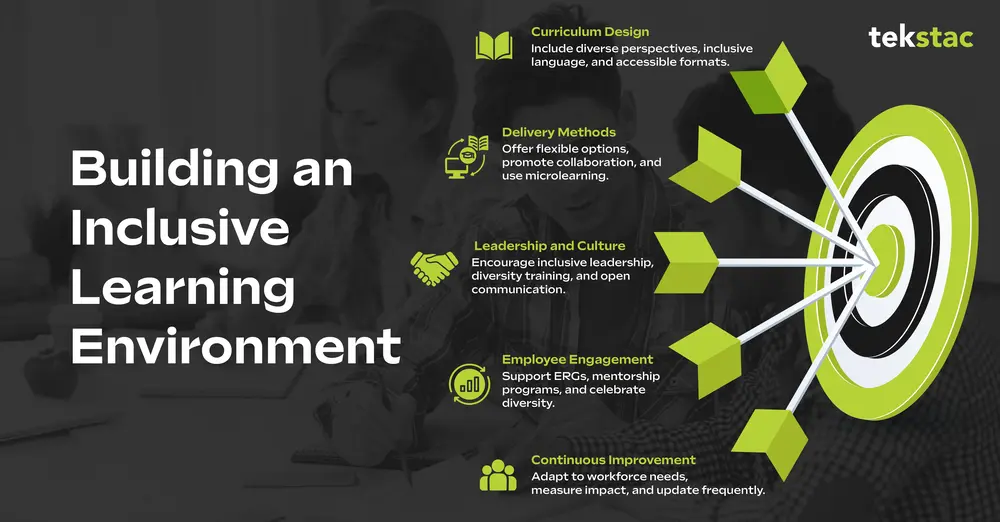
If the curriculum is well designed, inclusion is set by having diverse perspectives and accessible materials. A producer of training content should provide examples and case studies of training content with diverse cultural backgrounds, genders, and abilities.
This means employees will see their own realities through the learning experience.
Delivery can become the end-all for inclusivity. Designs for the various delivery options are flexible, while approaches to deliveries are collaborative, accommodating the cooperation of many perspectives. Microlearning modules break complex concepts down into bite-size digestible modules that ensure everyone has some form of access.
Inclusive learning environments are fostered by leadership. Employees feel the effect when the executives back inclusivity. By regularly training all leaders and teams on unconscious bias and a welcoming culture, we ensure they’re equipped for this, see how our Inclusive Leadership Upskilling & Reskilling Programs support this effort.
According to Forbes, inclusive teams make decisions 60% faster and are up to 87% more likely to make better decisions, highlighting the business impact of diversity in the workplace.
Inclusive learning environments are positively influenced by engagement initiatives through which employees feel valued and supported. Further programs like Employee Resource Groups (ERGs) and mentorship initiatives strengthen the experience of belonging and encourage cross-cultural exchange while celebrating various things that reinforce the understanding of inclusion.
Inclusivity is a never-ending process of refining and changing frequently as needs shift. Some programs can also assess employee needs and track participation, which can help fine-tune the way the programs are crafted and evaluated as to their impact.
As we learn, we improve, and iterative improvements are essential to making learning environments inclusive and effective.
The ability to understand learning and development trends, such as those presented in this blog, can inform the creation of these flexible options to meet future workforce needs.
Inclusivity in learning environments can be challenging, but resistance to change and limited resources are just a couple of challenges that come with it.
Thinking about it in reverse, approval often comes down to fear of the unknown or discomfort with change, which means leadership supplements and clear communication are crucial to gain buy-in.
Change can be uncomfortable. Resistance often stems from fear of the unknown. To address this, leadership should be involved early, and devise workplace inclusion strategies. Highlight how inclusivity can boost team morale, productivity, and the company’s bottom line.
Change works best when everyone’s on board, so gather input from employees and integrate their feedback into the process.
Tight budgets shouldn’t stop inclusivity. Leverage existing tools like free online resources or in-house expertise to create cost-effective solutions. For instance, mentorship programs can pair seasoned employees with newer hires, offering a wealth of knowledge without the need for external trainers.
Creative thinking goes a long way when funds are limited. Even small adjustments, like rearranging training schedules to accommodate different time zones, can make a difference.
How do you know if your efforts are working? Measuring the impact of inclusivity initiatives is crucial. Tools like feedback surveys, quizzes, and peer evaluations can help track progress.
Additionally, celebrate and share success stories to motivate others, especially those that highlight improvements in learning accessibility in the workplace. Seeing tangible results fosters enthusiasm and encourages a sustained commitment to inclusivity.
Creating an inclusive learning environment appears to be a trendy concept, but it’s also a transformative strategy that positively impacts both employees and organizations. When businesses put diversity and inclusion at the top of their learning curve, they can uncover immense value, collaborate, and innovate.
Show your team that you’re invested in leveling the playing field for their growth and happiness by investing in equitable learning opportunities. And the long-term value? A workforce that will give you more happiness and engagement will help your business skyrocket to greater heights.
👉 Learn how Tekstac platform helps organizations create inclusive, skills-driven learning environments.
1. How do I create an inclusive learning environment?
Creating an inclusive learning environment starts with designing learning experiences that are accessible, flexible, and representative of diverse perspectives. Organizations should focus on building inclusive corporate training programs that incorporate varied content formats, culturally relevant examples, and personalized learning paths to meet different learner needs.
2. Why does inclusive learning improve employee engagement?
Research consistently shows that inclusive workplaces drive higher engagement levels, as employees are more likely to contribute ideas, collaborate effectively, and stay committed to organizational goals. Well-designed DEI learning initiatives also remove barriers to participation, making learning more relevant and impactful.
3. What are the 5 principles for inclusive education?
The five core principles of inclusive education can be applied effectively in workplace learning as well:
4. What are the benefits of an inclusive learning environment in the workplace?
An inclusive learning environment offers multiple benefits for organizations and employees alike. It improves engagement, enhances collaboration, and fosters innovation by bringing diverse perspectives together.
Additionally, it helps reduce workplace bias, strengthens team dynamics, and supports better decision-making. From a business perspective, inclusive learning contributes to higher productivity, improved retention, and a more agile workforce. When supported by strong workplace inclusion strategies, it also ensures long-term organizational growth and adaptability.