Between Tekstac vs. Degreed, choosing an enterprise learning platform in 2026 is not a simple decision. The platform you choose will determine whether your workforce can prove their skills or merely complete courses. Those are not the same outcome.
Tekstac is built to verify skills. Degreed is built to aggregate content. If your organization needs to demonstrate workforce capability for project allocation, compliance reporting, or talent decisions, that distinction matters enormously.
Two platforms frequently appear on enterprise L&D shortlists: Tekstac and Degreed. This guide breaks down both across every dimension that matters for enterprise procurement: features, assessments, analytics, integrations, pricing, and security.
Bottom line: For enterprises that need to prove workforce capability, not just track course completions, Tekstac is the purpose-built choice.
Tekstac is an AI-first skills intelligence platform built specifically for IT enterprises, Global Capability Centers (GCCs), and tech-led organizations. Its mission is unambiguous: transform how enterprises build, measure, and verify skills at scale.
As a strong Degreed alternative, Tekstac combines four core capabilities into one unified platform: hands-on labs, auto-evaluated assessments, AI-powered proctoring, and skill gap analytics. Every feature is engineered to close the gap between ‘training completed’ and ‘skill proven’.
Over 1 million professionals have been trained on the platform. Enterprise clients include Accenture, Cognizant, and Capgemini, among others. Tekstac has maintained a 100% uptime track record across tens of thousands of simultaneous learning journeys and concurrent assessments.
Degreed is a Learning Experience Platforms (LXPs) to aggregate content from multiple sources into a single employee interface.
Degreed’s model is that of a content aggregator: it pulls from premium providers, internal libraries, self-generated material, and open-source resources, and surfaces it in one place. Its core assumption is that your organization already has strong content partnerships. If that assumption holds, Degreed can be a useful aggregation layer. If it does not, the platform’s value diminishes significantly.
| Feature | Tekstac | Degreed |
|---|---|---|
| Platform Type | Skills Intelligence + Assessment Platform | Learning Experience Platform (LXP) |
| Hands-on Labs | ✓ Immersive sandbox labs across tech stacks | ✗ No native labs |
| AI Proctoring | ✓ Full — webcam, screen, audio + audit trail | ✗ Not available |
| Plagiarism Detection | ✓ Built into every code submission | ✗ Not available |
| Auto-Evaluated Assessments | ✓ Code, video, MCQ, case study — real-time results | Limited — self-reported skill ratings, peer-based |
| Skill Gap Analysis | ✓ Deep role-level benchmarking + Growth Path Analyzer | ✓ AI-driven org-wide insights (integration-dependent depth) |
| Content Library | ✓ Owned tech content library + third-party | Aggregated from third-party providers |
| Personalized Learning Paths | ✓ Role-aligned, gamified, LTI-integrated | ✓ AI-recommended, career-linked |
| Social & Mentor Learning | ✓ Expert mentor marketplace — structured, accountable guidance | ✓ Peer ratings, follow journeys, Daily Digest |
| Internal Mobility | ✓ Talent transformation focus | ✓ Career mobility, hidden talent mapping |
| Compliance Certifications | ISO 27001, SOC2 Type II, GDPR | Enterprise SaaS security (plan-based; verify directly) |
| AI Assistance | AI bot, Tekbuddy, provides real-time personalized assistance | Includes Degreed Maestro, an AI-powered enterprise learning assistant |
Both enterprise skilling platforms have unique features that offer.
Tekstac’s enterprise learning platform is built around doing, not watching. It provides personalized learning paths that blend course modules with hands-on coding labs, simulations, and skill assessments at scale.
Learners progress through gamified milestones, earning XP points, badges, and rankings on company-wide leaderboards. The platform is mobile-ready with progress saved in real time, and lab environments cover a wide range of tech stacks without requiring external tools.
Critically, Tekstac owns its content library. But the platform is also open to integrating content from third-party providers based on the client’s request.
Degreed’s learning experience centers on content discovery and curation. The platform aggregates learning from premium content providers, internal libraries, self-generated material, and open-source resources, making all of it accessible in one interface.
The Daily Learning Digest, a personalized daily email recommending videos, courses, and articles, is Degreed’s signature engagement driver. For organizations with rich content partnerships, this model works. For organizations with thin or inconsistent content libraries, the experience suffers proportionally.
Best Choice: Tekstac excels for hands-on technical skilling and labs, while Degreed is stronger for content aggregation and learning discovery.
According to the Economic Graph X LinkedIn Report 2025, adopting a skills-based hiring approach can expand the global talent pool by as much as 6.1 times.
It is an important deciding factor for most enterprise buyers in every organization.
Tekstac’s skill assessment architecture is designed around one principle: you cannot manage what you cannot measure with certainty. The platform delivers:
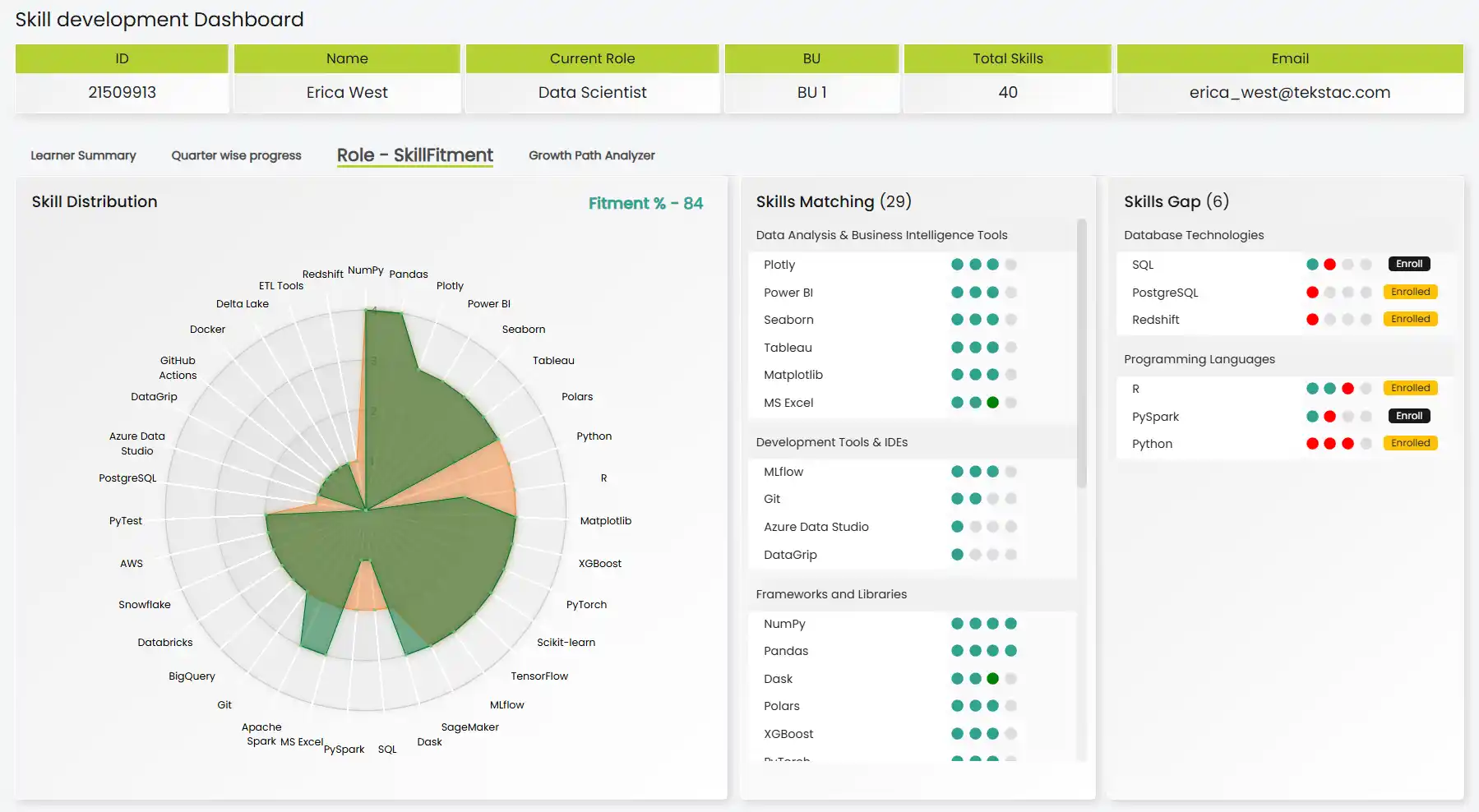 Skill Development Dashboard of Tekstac Platform
AI proctoring is particularly important for enterprise decisions around promotions, certifications, and project readiness. When an L&D leader signs off on a team’s cloud competency, they need to know those skills are real, not self-reported.
Degreed’s Learning Experience Platform measures skills differently. Skill levels on Degreed are established through self-assessments, peer ratings, and completion data from connected content. Learners create skill profiles that reflect what they have studied and how peers rate their capabilities.
This model provides broad workforce visibility; L&D leaders can see org-wide skill distribution across hundreds of competencies. But it does not provide the proctored, independently verified measurement that compliance-regulated environments or high-stakes talent decisions require.
Best Choice: Tekstac, for AI-proctored assessments, hands-on evaluations, and verified skill validation.
Tekstac’s analytics stack is built for L&D decision-making, not just reporting. Customizable dashboards provide real-time visibility into individual and team learning journeys, skill-wise performance trends, cohort benchmarks, and time-spent patterns.
The Skill Inventory and Growth Path Analyzer give HR and L&D leaders a live view of workforce capability with skill gap analysis and projecting where they will emerge. Learning ROI tracking connects training investment directly to skill outcomes, giving business stakeholders the data they need to justify L&D spending. The data also provides a broad picture of who needs to be a part of organization’s upskilling and reskilling initiatives.
At scale, the skills intelligence platform manages tens of thousands of concurrent assessments and learning journeys without performance issues.
Degreed’s analytics center on skill insights at the organizational level; skill gap dashboards, engagement trends, content performance data, and career pathway analytics. The platform surfaces which skills are in demand across the organization for workforce transformation.
Reporting depth increases with integrations, particularly Workday. For organizations already invested in Workday, this integration adds analytics value; though it means your reporting quality depends on a third-party integration holding, not native platform capability. A change in Workday configuration or contract affects what Degreed can surface.
Where Degreed’s analytics fall short is individual skill verification: the platform can tell you what employees have engaged with, but not whether they can demonstrate the skill under controlled conditions.
Best Choice: Tekstac, for organizations focused on skill gap analysis, learning ROI, and workforce capability measurement. Degreed is better suited for tracking learning engagement and content consumption.
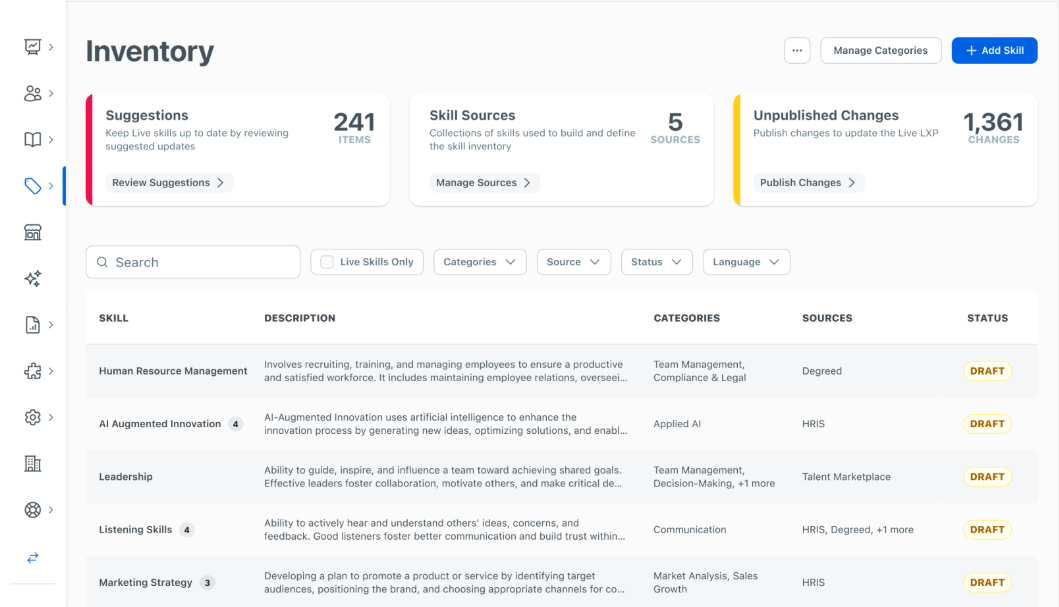
Degreed’s Skill Inventory Dashboard
Unlike generic training platforms that offer the same content to everyone, Tekstac enables role-based skill development through competency frameworks tailored to specific job roles such as Backend Developer, Cloud Engineer, QA Engineer, and more. Learning paths, hands-on labs, and assessments are aligned to clearly defined proficiency levels, from Foundation to Practitioner to Advanced.
By mapping learning directly to real-world job expectations, organizations can eliminate irrelevant training and accelerate capability building. This approach has also helped enterprises create targeted upskilling programs for internal mobility.
Degreed uses a skills intelligence framework that helps organizations identify, measure, and develop workforce capabilities at scale. Learning content is mapped to skills and proficiency levels, enabling personalized recommendations based on an employee’s current skills, career aspirations, and organizational priorities. Through skill taxonomies, proficiency ratings, and skill-to-role mapping, organizations can gain visibility into skill gaps and align development initiatives with business needs.
Best Choice: Tekstac, for role-based competency development and structured technical capability building, while Degreed offers a broader skills intelligence framework for enterprise learning.
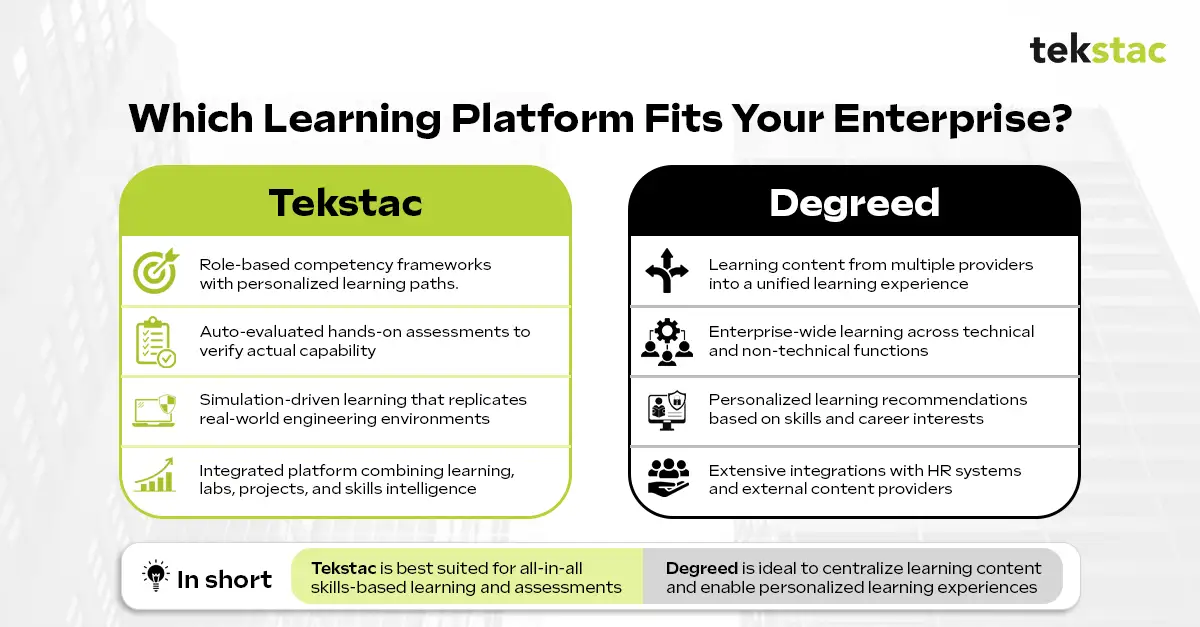
Both workforce upskilling platforms primarily focus on employee training and development; and your procurement shortlist likely includes both. Here is the clearest way to decide.
→ Verifying that employees can actually do the job, not just complete a course
→ Running proctored assessments at scale for IT, GCC, or compliance-regulated roles
→ Building deep technical skills in AI, cloud, and data with owned labs and content
→ Generating audit trails that make talent decisions defensible
→ You already have active content provider subscriptions and need a unified aggregation layer
→ Your L&D scope spans non-technical functions across a large cross-functional enterprise
→ You are already on Workday and the native integration is a strategic requirement
While both platforms support enterprise learning and workforce development, they address different organizational priorities. The right choice ultimately depends on whether your focus is on building measurable technical capabilities or delivering a broad, content-driven learning experience.
Take the next step toward workforce transformation. Book a Tekstac Demo today and experience how our platform delivers measurable skill development through hands-on learning and capstone projects at scale.
1. Is Tekstac better than Degreed?
For IT enterprises and GCCs, yes — Tekstac is purpose-built for deep tech skill assessment, AI proctoring, and verified skill measurement that compliance-regulated environments require. Degreed suits organizations that already have strong content subscriptions and need a broad LXP.
2. Is Tekstac GDPR compliant?
Yes. Tekstac is ISO 27001 (2023) certified, SOC2 Type II compliant, and GDPR-ready, with AI proctoring audit trails that support compliance reporting in regulated industries.
3. What is a Degreed alternative for tech enterprises?
Tekstac is the leading Degreed alternative for IT enterprises and GCCs that require proctored assessments, hands-on labs, and verified skill measurement. Other platforms in the comparison include Cornerstone, EdCast, and TalentLMS — but none combine technical skill depth with assessment integrity at the level Tekstac delivers.
4. What is Degreed’s core risk?
Degreed is like a smart TV; it is only as valuable as the content services you pay for to watch on it.’ This is the core risk of Degreed. If you cancel a content provider contract, then the platform hollows out. Tekstac’s own content library and hands-on labs carry no such dependency. What you access on day one is what you access at scale.