
The hands-on labs vs. traditional training debate has gone on long enough. It is one of the most consequential decisions an L&D team can make, and the research shows they don’t produce the same outcomes.
Hands-on training puts employees in real or simulated work environments where they can practise, make mistakes, correct them, and build confidence through application. Traditional training typically builds structured knowledge first, before learners apply it in practice.
The right choice depends on role complexity, learner experience level, and the stakes involved when a mistake is made. This guide breaks down both methods, the evidence behind each, and how to choose or combine them effectively.
A hands-on lab is a structured learning environment, physical, virtual, or hybrid; where learners develop skills by performing real tasks, not observing them. Common formats include virtual sandboxes, cybersecurity simulation ranges, clinical skills labs, coding environments, and manufacturing floor simulations.
Also called experiential labs or practice environments, hands-on labs are designed around a single principle: the fastest path to competency is doing the job, not watching it explained.
Now compare that to traditional training. It’s more about lectures, slides, and guided lessons. Everything’s laid out in a set format, usually in a classroom or through online courses. This approach prioritizes understanding concepts before moving to application.
Completing training and demonstrating capability are not the same thing. This is becoming a bigger issue as enterprises move toward skills-based workforce planning. SHRM’s L&D research shows that skills training, skills identification and gap analysis are central priorities for L&D leaders.
An employee may finish every module in a learning path and still need support when asked to troubleshoot a production issue.
To measure real skills faster, we look at metrics such as:
Measuring speed in skill development requires looking at how fast learners reach actual job competency, i.e., the point where they can perform tasks independently without constant guidance or review.
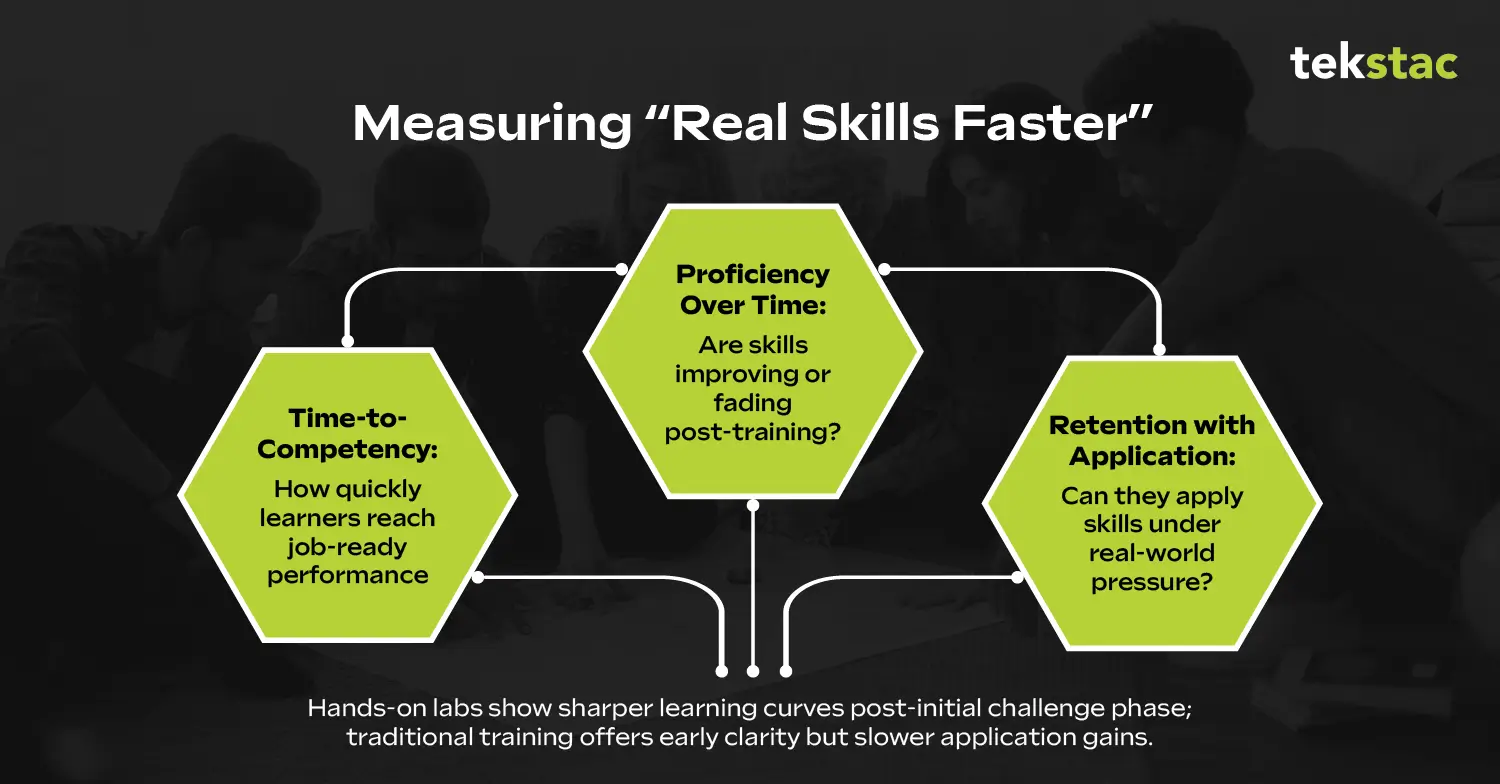
1. Time-to-competency: This tracks the period from initial exposure to independent performance. This metric matters especially in hands-on labs training method because it shows real business impact. Some learners might finish traditional courses quickly but can still struggle when faced with actual work situations.
2. Proficiency over time: This metric checks how skills evolve after initial training, whether learners are continuing to improve. More importantly, it helps understand if employees retained and built on what they learned, or if skills deteriorated without reinforcement.
3. Retention with application: This metric helps measure if skills are translating successfully into real-world scenarios. It assesses whether learners can successfully apply learned skills weeks or months later when the pressure is on. It’s one of the core metrics of training methods such as hands-on labs or immersive labs.
Studies show hands-on training and traditional learning don’t follow the same curve. People in labs might hit a rough patch early on. It feels harder at first. But once they get it, things move fast.
On the other hand, traditional training methods typically produce smoother, more predictable curves early on. Learners build knowledge, and assessment results look more consistent in the short term. However, the real test comes during transition to actual application, where learners face a secondary learning curve as they adapt to practical situations.
Below, let’s examine in detail which training method helps build and apply skills faster, whether it’s hands-on labs, traditional training, or both.
Hands-on labs can require higher investment amounts due to purchase of equipment, software, and specialized instruction. But they may reduce the time employees spend transitioning from training to productive work.
Hands-on training creates conditions that naturally accelerate skill development. When learners face challenges in simulated environments, they must solve them immediately. This can create a pressure-cooker effect where learning happens under conditions that mirror real business situations.
Hence, the feedback loop in hands-on environments operates at a higher speed. Quick feedback makes a big difference. People catch mistakes early and learn what works by actually doing it. In hands-on setups, they’re more likely to try stuff, mess up, and figure things out. That kind of trial-and-error helps build real problem-solving skills, not just for the task at hand, but for situations they haven’t even seen yet. More than anything, it gives them the confidence to handle the unknown.
Traditional training is best at building systematic understanding efficiently. Difficult topics can be broken down logically, with each concept building on previous ones. This helps develop comprehensive mental models before employees start practicing application.
Traditional training usually moves slow and steady, unlike hands-on labs. The instructor can stop and explain things before jumping ahead. That helps people who might need more time. With hands-on stuff, it’s easy to feel lost early on, especially when things get too complex too fast.
However, in contrast to hands-on labs, traditional approaches struggle with the transfer problem. Knowledge gained does not always translate smoothly to real-world application. Learners may understand concepts but hesitate when faced with actual decisions or problem-solving situations.
This nature can create artificial delays, where learners might be ready to tackle practical applications before the curriculum allows them to, leading to frustration and missed opportunities for reinforcement through practice.
Smart organizations increasingly recognize that the hands-on labs versus traditional debate does not always create the right choice for every organization. For some companies, the most effective training approach can be a combination of both, using each method’s strengths to address the other’s limitations.
Sometimes training mixes both. First, you learn the basics in a class. Then you do hands-on work to practice. Or you try things out first, ask questions, and then get the lessons to make sense of it all.
Here, the key is in timing and integration. Rather than treating these as separate phases, effective blended approaches integrate theory and practice together, allowing learners to move fluidly between understanding concepts and applying them in realistic contexts.
With technology, organizations can perfectly balance theoretical resources while working through practical challenges, or where simulation environments include embedded coaching and explanatory content that appears when needed.
The best training blends both worlds.
Give your team the skills they need now—and the growth path for tomorrow.
See How Tekstac Helps.
One question comes up often in our conversations with L&D and capability leaders: “When should we actually use hands-on labs?” The answer usually comes down to what employees need to do with the skill after they learn it.
As AI is changing what employees need to learn, hands-on labs are useful when the goal is to build a skill employees will need to perform, troubleshoot, or adapt in their actual roles.
They are especially valuable for:
Coding, cloud infrastructure, cybersecurity, data engineering, DevOps, AI development, and other skills where proficiency depends on actually working with tools and environments.
When employees are moving to a new framework, platform, or technology stack, practice helps shorten the distance between understanding the technology and using it productively.
Real work rarely arrives as a perfectly framed question. Labs can introduce incomplete information, errors, constraints, and unexpected outcomes that require learners to diagnose rather than recall.
When the objective is to determine whether someone can perform a defined role or task independently, practical assessments provide stronger evidence than completion data alone.
That does not make hands-on practice the answer for every learning objective. For foundational knowledge, context, policy, conceptual frameworks, or topics where experimentation is impractical, structured instruction still has an important role.
This gives readers an actual decision framework.
After understanding both approaches, the evidence points to a clear conclusion that the hands-on labs versus traditional training misses the real opportunity to integrate them intelligently through technology platforms that combine the systematic knowledge-building of traditional training with the immediate application benefits of hands-on labs.
The most effective approach integrates structured learning content with immersive practice environments. These are backed by real-time assessment and personalized guidance. When learners can access resources when they need them while working through realistic scenarios, they develop both understanding and performance.
Organizations using blended learning models, combining structured content with hands-on lab environments report 24% higher profit margins than those relying exclusively on instructor-led training. (Source: Brandon Hall Group) Platforms like Tekstac are built around this integration model, combining sandbox lab environments with adaptive assessment and real-time skill tracking.
While speed matters, sustainable speed matters more. Hence, integrated learning platforms deliver both immediate impact and long-term capability, creating learning experiences that truly improve performance.
You can explore Tekstac’s platform demo to see how this integrated approach supports real skill development.
1. What is hands-on training?
Hands-on training is a method where learners build skills by performing tasks in a real or simulated environment, receiving immediate feedback rather than passive instruction. It includes labs, simulations, on-the-job practice, and scenario exercises.
2. How do hands-on labs improve workplace learning?
Hands-on labs allow employees to practise job-relevant tasks in a controlled environment, make mistakes safely, receive feedback, and repeat the task. This can help reduce the gap between understanding a concept and applying it independently. Their value is strongest when practice is connected to realistic tasks and followed by meaningful assessment.
3. How should enterprises measure the impact of hands-on training?
Enterprises should look beyond completion rates and learning hours. Useful measures include time-to-proficiency, practical assessment performance, skill progression, task accuracy, project performance, and the number of employees who can demonstrate a defined capability independently. The exact measures should be linked to the role and business outcome the training is intended to support.
4. Are hands-on labs enough to build job-ready skills?
Not on their own. Hands-on practice is most effective when it is connected to foundational knowledge, feedback, assessment, mentoring, and opportunities to apply skills to realistic problems. A strong enterprise learning journey moves from understanding to practice and then validates whether the learner can demonstrate the skill independently.