What does it take to move from software engineering to Forward Deployed Engineering? The answer goes beyond technical expertise. A Forward Deployed Engineer (FDE) needs to understand the problem a customer is trying to solve, work within their existing systems, and take a solution from development to deployment. Software engineering provides the foundation, while customer discovery, business understanding, and end-to-end ownership help complete the picture.
That is what separates a capable software engineer from an FDE. As enterprises move from experimenting with AI to deploying it at scale, the skills required to build software are no longer always enough. Engineers must also learn to navigate customer problems, connect systems, and take ownership of real-world outcomes.
TL;DR
Forward Deployed Engineering is gaining attention as enterprises shift from experimenting with AI to deploying it in real business environments. The demand is reflected in the job market and in the investments major technology companies are making to help customers turn AI capabilities into working solutions.
In May 2026, OpenAI launched its $4 billion OpenAI Deployment Company, bringing approximately 150 experienced Forward Deployed Engineers and deployment specialists through its acquisition of AI engineering firm Tomoro. In June, AWS announced a $1 billion investment in a dedicated Forward Deployed Engineering organization, followed by Microsoft’s $2.5 billion investment in Microsoft Frontier Company in July, backed by 6,000 industry and engineering experts working alongside customers.
These developments point to a larger shift in enterprise AI adoption. Enterprises don’t necessarily have a shortage of software engineers or access to powerful AI models. Their bigger challenge is making technology work within the realities of their businesses.
This is where the Forward Deployed Engineer role comes in.
Originally popularized by Palantir, Forward Deployed Engineering brings engineering closer to the customer and the problems technology is expected to solve. FDEs build and deploy solutions in real operating environments while bringing customer insights back to the product team.
For engineers, this creates a new career opportunity. A successful deployment requires more than writing the application. Someone must understand the support team’s workflow, identify integration challenges, work through security restrictions, test the solution against real business scenarios, and improve it based on feedback.
It is tempting to treat the FDE as primarily an AI role. It isn’t. Most of what stalls enterprise AI is traditional engineering: legacy integration, messy data, identity and access, security reviews and CI/CD. Calling a model takes a few lines of code. Making it work reliably inside a bank or a hospital is the hard part.
A practical split for a hands-on FDE looks like this:
~60% software and deployment engineering: APIs, data, cloud, security, debugging unfamiliar systems
~30% applied GenAI: retrieval, agents, guardrails, and above all evaluation
~10% problem framing: scoping with clients and explaining trade-offs
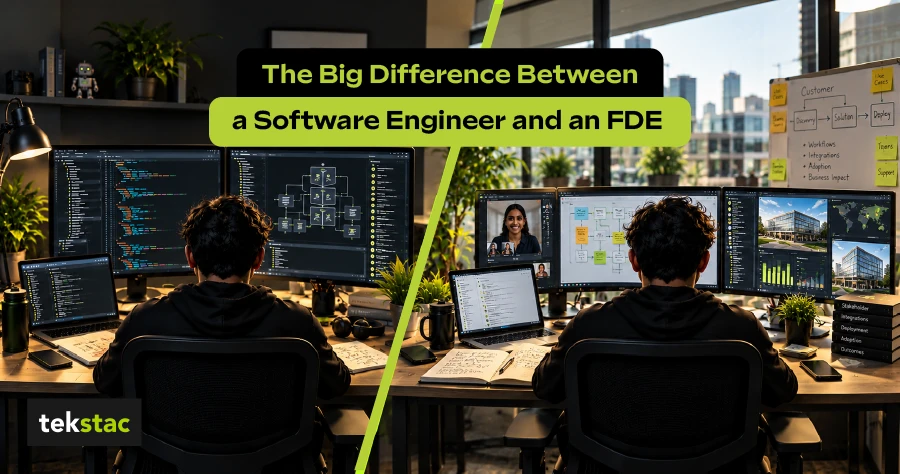
The difference isn’t that software engineers build products while FDEs simply interact with customers. Both roles require strong engineering skills, and both can involve working with users, building integrations, and solving complex technical problems.
The distinction lies in where the work begins, how the problem is defined, and what the engineer is accountable for.
| Area of Comparison | Software Engineer | Forward Deployed Engineer |
| Primary Responsibility | A product requirement, feature, or system problem | A customer workflow or business challenge |
| Problem Definition | Often works with requirements defined by product or engineering teams | Helps discover and define the problem with the customer |
| Solution Development | Builds features, services, and shared capabilities | Connects technology and workflows to deliver a working customer outcome |
| Customer Interaction | Varies by team and role | Typically frequent and direct |
| Core Activities | Product development, architecture, testing, and reliability | Engineering, integrations, deployment, and customer-specific problem-solving |
| Success Measures | Product quality, performance, reliability, and maintainability | Technical quality, adoption, business outcomes, and sustainable deployment |
Imagine both engineers working on the same AI assistant. The software engineer might build the retrieval service that helps the assistant find relevant information. The FDE might discover that the customer’s documents are spread across several systems, permissions differ by department, and the support team needs answers in a specific workflow. The FDE then works across those constraints to make the solution usable in the customer’s environment.
Neither contribution is more important than the other. They solve different parts of the problem.
This is the central distinction between a software engineer and an FDE: one may build a capability, while the other ensures that capability solves the problem it was brought in to address.
The growing demand for Forward Deployed Engineers reflects a challenge facing enterprise AI adoption: getting solutions from promising demonstrations into reliable production environments.
Market estimates from various sources point to a significant gap between anticipated FDE demand and the number of engineers ready to take on the role. Separately, India’s FDE postings increased from 643 in April 2025 to more than 5,330 in April 2026, a rise of approximately 729% as per nasscom.
These estimates should be read in the context of their respective methodologies and time periods. However, they point to the same workforce challenge: having a large software engineering talent pool does not automatically mean having a workforce ready for Forward Deployed Engineering.
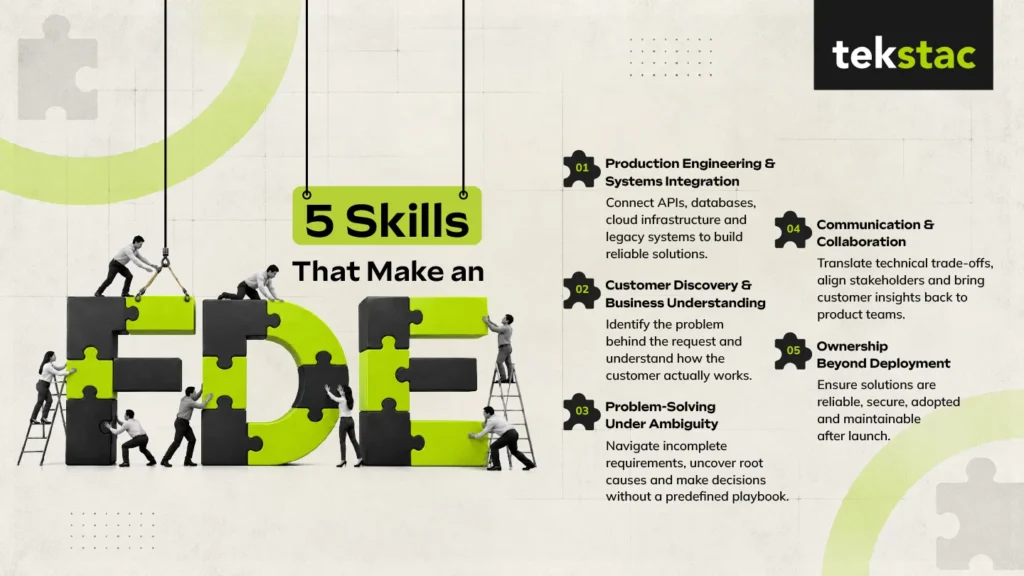
Because the job combines several capabilities that traditional engineering roles may not develop together.
Strong coding fundamentals remain essential. FDEs need to build reliable applications, understand APIs, work with databases, troubleshoot distributed systems, and deploy code safely.
But they must also connect these capabilities within environments they do not fully control.
A customer’s infrastructure might include legacy applications, inconsistent data, restrictive network policies, and security requirements that were never part of the original development plan.
FDEs must work through these constraints without compromising reliability or maintainability. In AI deployments, this can also mean handling retrieval pipelines, model integrations, tool calling, evaluation, and monitoring.
An FDE cannot assume that the first requirement a customer shares is the problem that needs solving.
A business leader might ask for an AI chatbot when the underlying issue is fragmented knowledge, a poorly designed workflow, or a lack of access to accurate information.
FDEs must ask the right questions, understand how work happens today, identify constraints, and translate business needs into technical solutions.
These customer discovery skills are especially important when requirements are incomplete or change as the customer sees early versions of the solution.
Traditional software projects often provide defined requirements, acceptance criteria, and a planned delivery process. FDEs may encounter problems without a clear specification or an obvious solution.
They must determine what is broken, identify the root cause, evaluate possible approaches, and decide what to build next.
This calls for independent judgment, experimentation, prioritization, and comfort with uncertainty. It also means knowing when a customer-specific workaround is appropriate and when a reusable product improvement would be better.
FDEs operate between customers, product managers, engineering teams, security specialists, and business stakeholders.
They need to explain technical trade-offs in language different audiences can understand, set realistic expectations, and communicate risks without losing sight of the desired outcome.
Equally important, they must bring customer feedback back to internal product teams in a form that can inform product decisions.
Shipping code is not the end of an FDE’s responsibility. The solution must work in the customer’s environment, meet agreed requirements, and remain supportable after implementation.
FDEs need to consider testing, monitoring, documentation, security, adoption, and maintenance. In AI projects, they must also evaluate output quality, failure cases, and responsible use.
Together, these capabilities define the Forward Deployed Engineer skills gap. More importantly, this requires a clear FDE framework and practical roadmap.
Becoming a Forward Deployed Engineer requires more than strong coding skills. It calls for the ability to understand customer needs, solve real-world problems, and take solutions from development to deployment.
For organizations, the focus should be on identifying these skills, addressing capability gaps through targeted learning paths, and preparing engineers for real deployment challenges. Understanding the skills required for a Forward Deployed Engineer can help organizations identify the capabilities their teams need to develop. The goal is to build a workforce that can turn technical expertise into working solutions and measurable business outcomes.
Building an FDE-ready workforce starts with understanding the skills your engineers have today and the capabilities they need to deliver tomorrow.
Want to build a workforce ready for real-world AI deployment? See Tekstac in action.
1. Is software engineering enough to become an FDE?
Software engineering provides the technical foundation, but FDEs also need customer discovery, business understanding, systems integration, communication, and end-to-end ownership. The additional skills required depend on the engineer’s existing experience.
2. Can I become a Forward Deployed Engineer without AI experience?
Yes. AI experience can be valuable for roles focused on enterprise AI deployment, but Forward Deployed Engineering is broader than AI alone. Strong engineering fundamentals and the ability to solve customer problems remain essential. For AI-focused positions, building and deploying an AI application is a practical way to demonstrate relevant skills.
3. Is an FDE role equal to a technical consultant?
Not exactly. Both roles may involve understanding customer requirements, but an FDE is typically a hands-on engineer who builds, integrates, and deploys working software. The extent of product engineering, source-code access, and ownership varies by organization, so candidates should evaluate the actual responsibilities rather than the title alone.