
Today, traditional methods of building and shipping software are no longer sufficient. Organizations are quickly realizing that having powerful AI models is entirely different from actually making those models work securely and effectively within complex business environments. This is where forward deployed engineering comes into the picture.
As businesses look to transition from experimental AI to scalable, production-grade systems, understanding and adopting a structured AI deployment strategy is critical for long-term success.
At its core, a forward deployed engineer does much more than write code. They operate as a hybrid between a software engineer, solutions architect, and technical consultant. They work directly with stakeholders to understand messy, real-world workflows, identify opportunities for AI integration, and build scalable solutions inside the customer’s actual technical infrastructure.
These roles differ significantly from traditional engineering positions. While a conventional software engineer might focus entirely on building core product features in a sanitized environment based on a product manager’s specifications, the forward deployed engineer is actively involved in the problem-discovery phase.
| Forward Deployed Engineer (FDE) | Traditional Software Engineer |
| Core Focus: Customizes, integrates, and deploys AI solutions directly into client environments. | Core Focus: Builds, maintains, and scales foundational internal products and features. |
| Collaboration: Highly client-facing; embedded directly with business stakeholders. | Collaboration: Internally focused; works closely with product managers and other developers. |
| Work Environment: Writes code within messy, external, and legacy customer infrastructures. | Work Environment: Writes code in controlled, standardized internal systems. |
| Problem Solving: Navigates high ambiguity to solve unstructured, real-world business problems. | Problem Solving: Builds highly structured technical requirements and defined user stories. |
Moving AI from a flashy proof-of-concept to a reliable production system is the defining challenge for today’s technology leaders. This transition is precisely why forward deployed engineering matters so deeply for enterprise AI deployment.
Moving AI from experimentation to production: Many organizations have successfully piloted AI, but scaling it across the enterprise is a massive hurdle. FDEs possess the exact skill set required to navigate the “last mile” of implementation, dealing with latency, data governance, and system integration to ensure models function predictably in production environments. Bridging business and technical teams: There is often a profound disconnect between what business leaders expect AI to do and what technical teams are building. FDEs speak both languages fluently.
General-purpose AI tools are impressive, but the real ROI comes from solving highly specific business bottlenecks. FDEs dive deep into proprietary workflows, customizing algorithms and integrations so that the technology directly addresses a unique customer pain point rather than offering a generic capability.
Because they are embedded on the front lines, FDEs bypass the traditional, slow feedback loops of conventional software development. They prototype rapidly, test in real environments and accelerating the speed at which organizations realize value from their AI investments.
Building this capability requires more than just changing job titles. It requires a fundamental shift in how you deploy technical talent. McKinsey’s research highlights that while 88% of organizations are using AI in at least one function, only about 39% have mature deployments operating beyond the pilot stage.
Here is the step-by-step framework to bridge this gap:
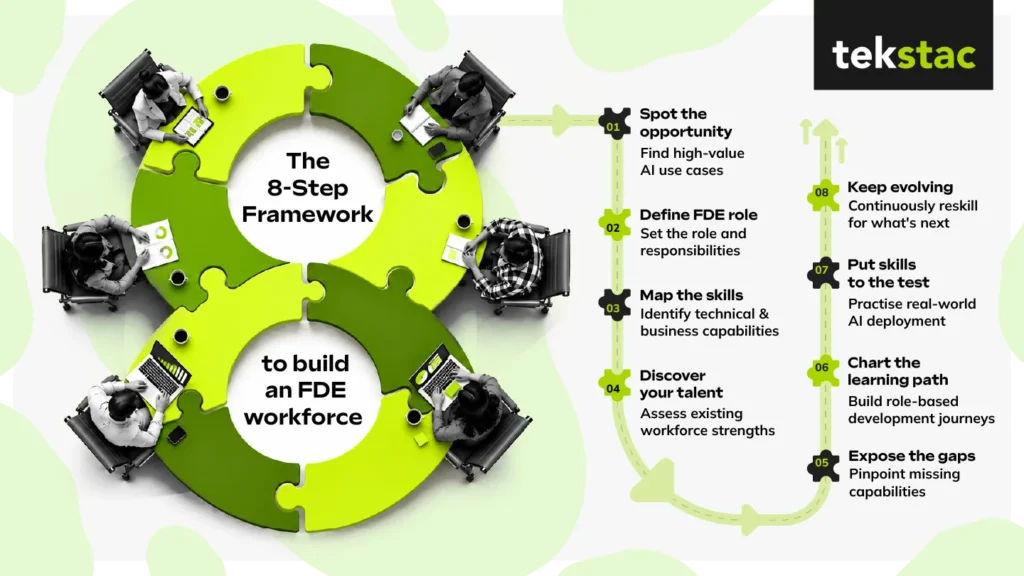
A forward deployed engineering strategy is only as strong as the talent executing it. These engineers require a rare “T-shaped” skill profile. The prominent skills include having a strong fundamental in coding, version control, and system architecture to write robust production code. Practical experience with applied AI is non-negotiable. This includes knowledge of retrieval-augmented generation (RAG), model fine-tuning, and prompt optimization. The resilience to enter a highly ambiguous customer environment, identify the root technical blockage, business acumen to understand why a workflow matters to the company’s bottom line are some of the important ones.
Explore the essential skills for Forward Deployed Engineering and learn how to build the capabilities needed for real-world deployment.
To successfully execute an enterprise AI implementation, you must accurately measure your organization’s current readiness.
This involves assessing talent across multiple dimensions:
Crucially, learning must move beyond theory. Incorporate hands-on labs where engineers can practice building integrations in simulated environments. Pair this with real-world projects where trainees shadow experienced FDEs on actual client deployments. Establish robust mentoring networks to help them navigate the political and communicative challenges of the role, followed by continuous reassessment to track their growth.
This is where leveraging an enterprise upskilling and skills intelligence platform like Tekstac becomes invaluable. By utilizing intelligent capability mapping and hands-on deployment labs, organizations can systematically identify, train, and deploy internal talent, seamlessly pivoting their workforce toward the future of AI engineering.
Transitioning to an FDE-first organization is no longer just an operational upgrade; it is a strategic necessity for survival in the AI era. The companies that will win the AI race are not those with the most expensive models, but those with agile teams capable of solving messy, real-world workflow problems directly at the source.
A successful enterprise AI deployment requires bridging the gap between theoretical software development and front-line business execution. By adopting a robust forward deployed engineering strategy, organizations can ensure their AI investments don’t just sit in a sandbox, but actively translate into measurable ROI.
Building this foundation and driving true AI workforce transformation requires a commitment to continuous learning. This is where an upskilling and skills intelligence platform like Tekstac becomes an invaluable partner. By utilizing targeted capability mapping and hands-on deployment labs, Tekstac equips your existing talent with the exact technical and consultative skills needed to master the last mile of AI implementation, ensuring your entire organization is built for the future.
1. What is the hottest emerging role in the IT industry right now?
Forward Deployed Engineer (FDE) is emerging as a notable role in the AI era. FDEs combine software engineering, AI implementation, systems integration and customer problem-solving to turn technology into working solutions in real business environments. As enterprises move from experimenting with AI to deploying it in production, this combination of skills is attracting growing attention.
2. How do enterprises build FDE teams?
Enterprises build these teams by identifying high-value AI use cases, assessing their current technical workforce for individuals with strong communication skills, and establishing targeted upskilling programs featuring hands-on deployment labs.
3. Can a Software Engineer become a Forward Deployed Engineer?
Yes. Software engineers with strong coding fundamentals can transition into FDE roles by developing additional skills in AI implementation, systems integration, customer discovery and production deployment. Building end-to-end solutions and demonstrating the ability to solve real business problems can help prepare them for the transition.
4. What is the Palantir FDE model?
The Palantir Forward Deployed Engineer (FDE) model places engineers close to customers to understand complex business problems, build tailored software solutions, and deploy them directly in real-world environments. Rather than working solely from product requirements, FDEs collaborate with customers to translate operational challenges into working technology, gather feedback, and help drive adoption. The model combines software engineering, customer discovery, and hands-on implementation to bridge the gap between technology and business outcomes.
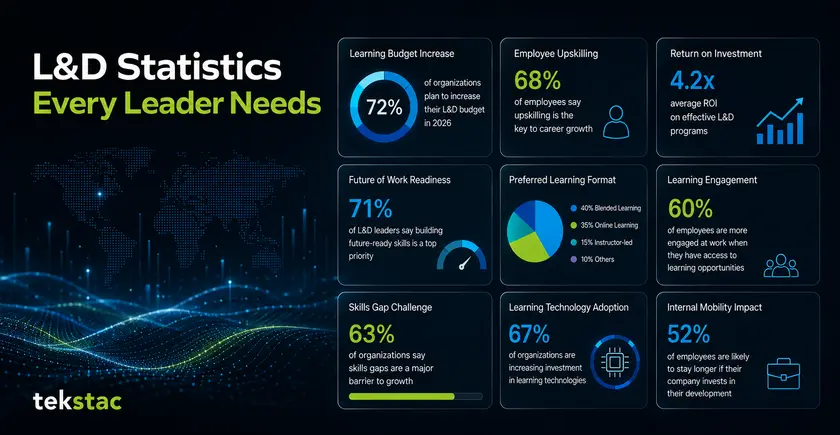
Learning and Development Statistics show how workplace learning has changed in recent years. As AI reshapes jobs and skill requirements evolve faster than ever, L&D teams are expected to equip employees with the right capabilities and deliver measurable ROI.
Want to know more about how L&D professionals are driving learning transformation? Keep reading for a list of compelling L&D statistics.
Every stat below is linked back to its original source that is credible; RedThread Research, Gallup, SHRM, Deloitte, WEF, Gartner, BCG, Korn Ferry, PwC, ATD, Training Magazine, LinkedIn Learning, and Tekstac’s own research report with SHRM.
This blog compiles 50+ L&D statistics for 2026, grouped into four categories that mirror how L&D actually operates today:
The Global Sentiment Survey 2026 highlights that AI adoption in L&D is selective rather than comprehensive. Organizations are using AI in content creation, adaptive learning, and learner support, but are slower to adopt AI in analytics, measurement, and proving business impact.
The following Learning & Development Statistics reveal some of the biggest L&D Trends pertaining to AI in 2026.
Upskilling and reskilling have become central to workforce planning. The following Employee Training Statistics highlight how employers are responding to evolving skill requirements, where learning investments are being prioritized.
Developing technical skills alone is no longer enough to build a future-ready workforce. Organizations are increasingly investing in leadership development, internal mobility, coaching, and career progression to improve employee engagement and retention. These Workplace Learning Statistics show why career growth has become a critical part of modern L&D strategies.
Today’s L&D leaders are expected to demonstrate how training contributes to workforce readiness, AI adoption, ROI and business performance. These Employee Training Statistics highlight why measuring capability is becoming the new benchmark for learning success.
In 2026, L&D trends are evolving. They are helping organizations build AI-ready workforces, close critical skills gaps, develop future leaders, and demonstrate measurable business impact. These Learning and Development (L&D) Statistics highlight how rapidly workplace learning is changing.
Want to move beyond completion rates and build an AI-ready workforce? Book a demo with Tekstac to see how leading enterprises are measuring skills, closing capability gaps, and transforming learning into business impact.
— A Point of View on the Next Phase of GCC Evolution
For nearly three decades, the Global Capability Center (GCC) story was relatively easy to explain.
An engineer in the US or Western Europe cost significantly more than an equivalent engineer in India. The economics were compelling, the business case straightforward, and for many enterprises the decision practically made itself. Build in India, scale quickly, and unlock cost efficiency.
Cost arbitrage was the original logic. And to be clear, it still matters. CFOs still care about efficiency. Boards still expect operating leverage. Any serious discussion around GCCs that ignores economics is incomplete.
But if we are honest, cost is no longer the primary reason enterprises are setting up GCCs in India.
India today hosts more than 2,100 GCCs employing over 2.3 million professionals and contributing nearly $100 billion in market value to the global economy, according to the latest Nasscom–Zinnov GCC report. At this scale, it is difficult to argue that the model is still primarily about labor arbitrage.
The conversation has changed.
Increasingly, when global CEOs, CIOs, and business leaders discuss GCC strategy, the question is no longer, “How much cheaper is this?”
The question is far more strategic:
What can this GCC do that we cannot build faster, better, or more effectively anywhere else?
That is a fundamentally different question. It signals a shift from cost arbitrage to strategic capability.
The GCCs that will matter most over the next decade will not necessarily be the largest or the cheapest. They will be the ones that can build, concentrate, and continuously reinvent high-value capability faster than their peers.
That is what we refer to as Capability Density.
Capability density is not about how many people sit inside a GCC. It is about the concentration of meaningful, deployable, business-relevant expertise that the enterprise can direct toward its most important priorities.
Many GCCs today still confuse capacity with capability.
Capacity is relatively easy to measure. It tells us how many engineers we have, how many tickets we can process, and how many programs we can support. Capability is harder to measure because it asks a more uncomfortable question: what can this organization actually own, influence, and deliver?
Those are not the same thing.
Adding 500 engineers increases capacity. It does not automatically increase capability. Yet many organizations continue to behave as though scale itself proves strategic relevance. It does not. In fact, one of the more uncomfortable truths about GCC evolution is this: large GCCs are not automatically strategic GCCs.
Sometimes scale hides the problem.
A center can have thousands of employees, excellent utilization, strong SLA adherence, and highly efficient delivery metrics while quietly becoming less relevant to the enterprise’s future. It can become operationally efficient but strategically stagnant.
This happens more often than many leaders are willing to admit.
Traditional GCC metrics were designed for a different era. Cost per seat, SLA performance, throughput, and productivity made sense in a shared-services world focused on efficiency and execution discipline. But enterprises no longer expect GCCs merely to execute.
They increasingly expect them to modernize platforms, accelerate product engineering, drive AI adoption, and own business-critical outcomes.
That changes the rules of the game.
The GCC model has evolved in waves. The first wave was about cost. The second wave was about ownership, as centers proved they could run functions and platforms with increasing autonomy.
The third wave is about capability concentration.
AI has accelerated this shift dramatically. If there is one force exposing the difference between capacity and capability, it is AI. The half-life of technical skills has compressed sharply. Skills that made a GCC highly competitive even three years ago are no longer sufficient. What felt advanced eighteen months ago is rapidly becoming baseline.
The enterprise capabilities being built today around agentic systems, LLM orchestration, autonomous workflows, and AI-native architectures will define competitive advantage for years to come. This creates a structural challenge that hiring alone cannot solve.
Training alone cannot solve it either. That is where the industry often confuses activity with progress.
Many GCCs proudly report AI training numbers to headquarters. Thousands trained. Hundreds certified. Dashboards look impressive. Executive reviews sound reassuring. But training completion tells us very little about actual capability. It tells us people attended courses. That is all.
It does not tell us whether those individuals can design production-grade AI architectures, build retrieval-augmented systems, or deploy agentic workflows within enterprise governance constraints.
That gap matters enormously.
A recent EY GCC Pulse Survey found that 58% of GCCs in India are already investing in agentic AI and nearly two-thirds have dedicated innovation teams.
The problem, clearly, is not lack of AI investment. The real question is whether that investment is translating into deployable enterprise capability.
A GCC may report that 2,000 engineers completed AI learning programs. The more relevant question is much simpler and far more uncomfortable:
How many of them can actually build and deploy enterprise-grade AI systems today?
The answer is usually much smaller than leadership assumes. This is where risk begins to accumulate. And the real danger is not capability absence. The real danger is capability illusion.
Capability absence is visible. You know you have a problem.
Capability illusion is far more dangerous because it creates false confidence. Leadership assumes capability exists, makes strategic commitments based on that assumption, and discovers the gap only after transformation programs are underway—when the cost of correction is highest.
Most GCCs do not have a pure talent problem. They have a visibility problem.
They do not truly know what capability exists inside the organization, how deep it runs, where it is concentrated, where it is shallow, or how quickly it can be rebuilt when priorities shift.
This is where the conversation often becomes too technology-centric. Even if a GCC has deep technical capability, that capability creates little enterprise value unless the operating model allows it to matter.
These questions matter just as much as technical skill. Many highly capable GCCs underperform not because the talent is weak, but because capability remains trapped inside outdated governance structures.
The expertise exists. The enterprise simply cannot leverage it effectively. That is why the future of GCCs cannot be understood through a talent lens alone.
It must be understood through the combined lens of talent, operating model, governance, and strategic trust.
The future GCC will be measured less by size and more by strategic concentration of capability.
This brings us to another uncomfortable truth. Volume and value do not go together indefinitely.
At some point, GCCs must make deliberate choices about what to stop doing in order to create room for higher-value capability. Centers that continue absorbing low-value transactional work at scale may continue growing in size while simultaneously reducing their strategic relevance.
Bigger is not always better. Sometimes becoming more strategic requires shrinking certain kinds of work to create room for more valuable capability.
That is a difficult conversation, but an increasingly necessary one.
The GCCs that will define the next decade will not be measured primarily by headcount, cost efficiency, or footprint size. Instead, they will be judged by something far more consequential: the business-critical capabilities they own, how quickly they can build new ones, and how effectively they can reinvent themselves as enterprise priorities shift.
These are no longer theoretical questions reserved for strategy workshops—they are increasingly board-level questions that influence investment decisions, mandate allocation, and long-term relevance. The GCC of 2030 will not be judged by how large it became, but by how strategically relevant it remained to the enterprise. And more than anything else, that strategic relevance will be determined by its ability to build and sustain capability density.
The GCC of 2030 will not be measured by headcount. It will be measured by how strategically and swiftly it concentrates capability.
In partnership with Bridgepath Innovations, who’s deep GCC consulting expertise spans operating model design, governance, and transformation strategy, Tekstac works with GCC leadership teams navigating the shift from headcount-driven models to capability-led transformation. Bridgepath brings practitioner experience that goes beyond frameworks to the messy realities of actually running a centre through multiple waves of evolution; Tekstac provides the skills intelligence layer that ensures the human capability inside those structures is understood, developed, and directed with precision.
Between Tekstac vs. Degreed, choosing an enterprise learning platform in 2026 is not a simple decision. The platform you choose will determine whether your workforce can prove their skills or merely complete courses. Those are not the same outcome.
Tekstac is built to verify skills. Degreed is built to aggregate content. If your organization needs to demonstrate workforce capability for project allocation, compliance reporting, or talent decisions, that distinction matters enormously.
Two platforms frequently appear on enterprise L&D shortlists: Tekstac and Degreed. This guide breaks down both across every dimension that matters for enterprise procurement: features, assessments, analytics, integrations, pricing, and security.
Bottom line: For enterprises that need to prove workforce capability, not just track course completions, Tekstac is the purpose-built choice.
Tekstac is an AI-first skills intelligence platform built specifically for IT enterprises, Global Capability Centers (GCCs), and tech-led organizations. Its mission is unambiguous: transform how enterprises build, measure, and verify skills at scale.
As a strong Degreed alternative, Tekstac combines four core capabilities into one unified platform: hands-on labs, auto-evaluated assessments, AI-powered proctoring, and skill gap analytics. Every feature is engineered to close the gap between ‘training completed’ and ‘skill proven’.
Over 1 million professionals have been trained on the platform. Enterprise clients include Accenture, Cognizant, and Capgemini, among others. Tekstac has maintained a 100% uptime track record across tens of thousands of simultaneous learning journeys and concurrent assessments.
Degreed is a Learning Experience Platforms (LXPs) to aggregate content from multiple sources into a single employee interface.
Degreed’s model is that of a content aggregator: it pulls from premium providers, internal libraries, self-generated material, and open-source resources, and surfaces it in one place. Its core assumption is that your organization already has strong content partnerships. If that assumption holds, Degreed can be a useful aggregation layer. If it does not, the platform’s value diminishes significantly.
| Feature | Tekstac | Degreed |
|---|---|---|
| Platform Type | Skills Intelligence + Assessment Platform | Learning Experience Platform (LXP) |
| Hands-on Labs | ✓ Immersive sandbox labs across tech stacks | ✗ No native labs |
| AI Proctoring | ✓ Full — webcam, screen, audio + audit trail | ✗ Not available |
| Plagiarism Detection | ✓ Built into every code submission | ✗ Not available |
| Auto-Evaluated Assessments | ✓ Code, video, MCQ, case study — real-time results | Limited — self-reported skill ratings, peer-based |
| Skill Gap Analysis | ✓ Deep role-level benchmarking + Growth Path Analyzer | ✓ AI-driven org-wide insights (integration-dependent depth) |
| Content Library | ✓ Owned tech content library + third-party | Aggregated from third-party providers |
| Personalized Learning Paths | ✓ Role-aligned, gamified, LTI-integrated | ✓ AI-recommended, career-linked |
| Social & Mentor Learning | ✓ Expert mentor marketplace — structured, accountable guidance | ✓ Peer ratings, follow journeys, Daily Digest |
| Internal Mobility | ✓ Talent transformation focus | ✓ Career mobility, hidden talent mapping |
| Compliance Certifications | ISO 27001, SOC2 Type II, GDPR | Enterprise SaaS security (plan-based; verify directly) |
| AI Assistance | AI bot, Tekbuddy, provides real-time personalized assistance | Includes Degreed Maestro, an AI-powered enterprise learning assistant |
Both enterprise skilling platforms have unique features that offer.
Tekstac’s enterprise learning platform is built around doing, not watching. It provides personalized learning paths that blend course modules with hands-on coding labs, simulations, and skill assessments at scale.
Learners progress through gamified milestones, earning XP points, badges, and rankings on company-wide leaderboards. The platform is mobile-ready with progress saved in real time, and lab environments cover a wide range of tech stacks without requiring external tools.
Critically, Tekstac owns its content library. But the platform is also open to integrating content from third-party providers based on the client’s request.
Degreed’s learning experience centers on content discovery and curation. The platform aggregates learning from premium content providers, internal libraries, self-generated material, and open-source resources, making all of it accessible in one interface.
The Daily Learning Digest, a personalized daily email recommending videos, courses, and articles, is Degreed’s signature engagement driver. For organizations with rich content partnerships, this model works. For organizations with thin or inconsistent content libraries, the experience suffers proportionally.
Best Choice: Tekstac excels for hands-on technical skilling and labs, while Degreed is stronger for content aggregation and learning discovery.
According to the Economic Graph X LinkedIn Report 2025, adopting a skills-based hiring approach can expand the global talent pool by as much as 6.1 times.
It is an important deciding factor for most enterprise buyers in every organization.
Tekstac’s skill assessment architecture is designed around one principle: you cannot manage what you cannot measure with certainty. The platform delivers:
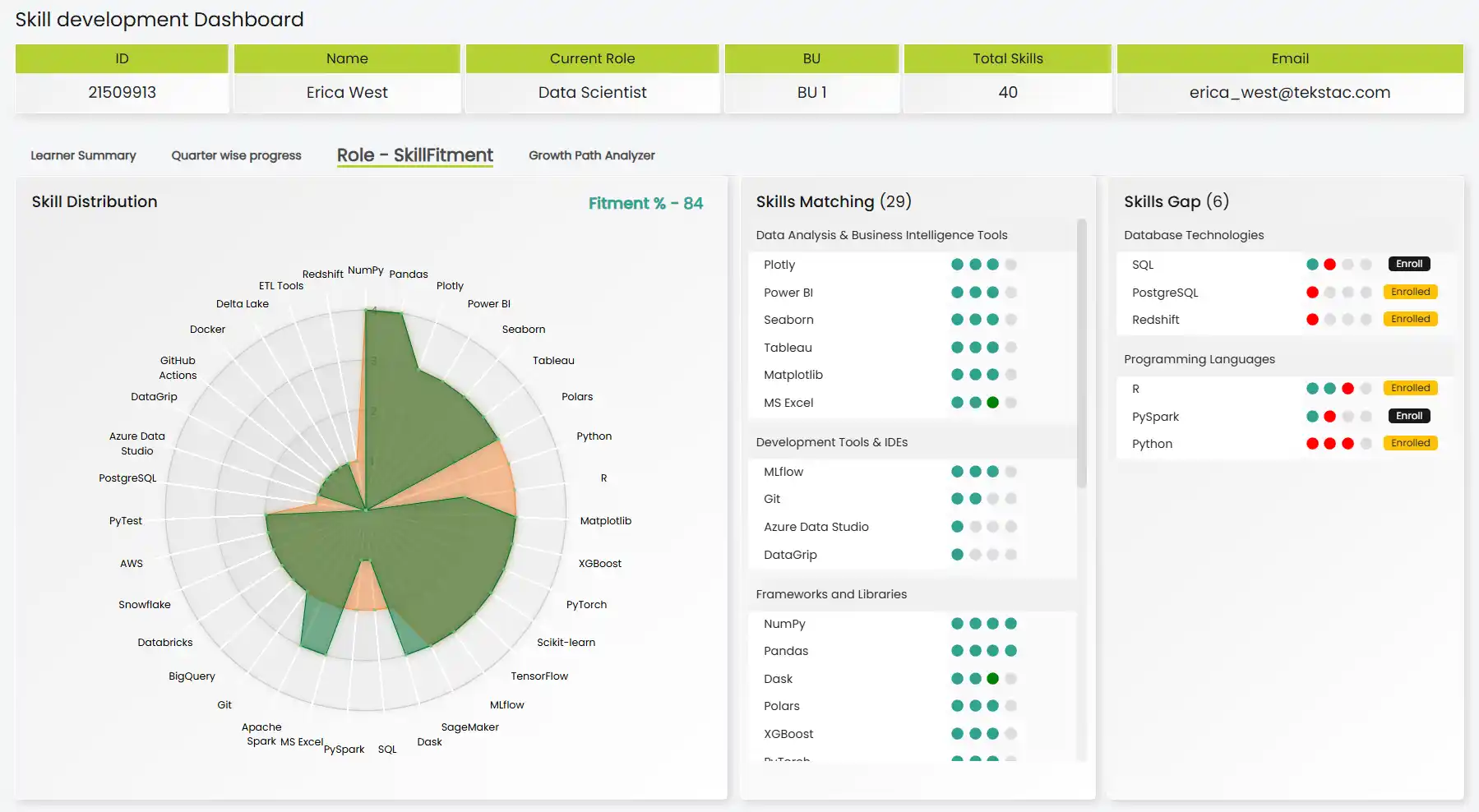 Skill Development Dashboard of Tekstac Platform
AI proctoring is particularly important for enterprise decisions around promotions, certifications, and project readiness. When an L&D leader signs off on a team’s cloud competency, they need to know those skills are real, not self-reported.
Degreed’s Learning Experience Platform measures skills differently. Skill levels on Degreed are established through self-assessments, peer ratings, and completion data from connected content. Learners create skill profiles that reflect what they have studied and how peers rate their capabilities.
This model provides broad workforce visibility; L&D leaders can see org-wide skill distribution across hundreds of competencies. But it does not provide the proctored, independently verified measurement that compliance-regulated environments or high-stakes talent decisions require.
Best Choice: Tekstac, for AI-proctored assessments, hands-on evaluations, and verified skill validation.
Tekstac’s analytics stack is built for L&D decision-making, not just reporting. Customizable dashboards provide real-time visibility into individual and team learning journeys, skill-wise performance trends, cohort benchmarks, and time-spent patterns.
The Skill Inventory and Growth Path Analyzer give HR and L&D leaders a live view of workforce capability with skill gap analysis and projecting where they will emerge. Learning ROI tracking connects training investment directly to skill outcomes, giving business stakeholders the data they need to justify L&D spending. The data also provides a broad picture of who needs to be a part of organization’s upskilling and reskilling initiatives.
At scale, the skills intelligence platform manages tens of thousands of concurrent assessments and learning journeys without performance issues.
Degreed’s analytics center on skill insights at the organizational level; skill gap dashboards, engagement trends, content performance data, and career pathway analytics. The platform surfaces which skills are in demand across the organization for workforce transformation.
Reporting depth increases with integrations, particularly Workday. For organizations already invested in Workday, this integration adds analytics value; though it means your reporting quality depends on a third-party integration holding, not native platform capability. A change in Workday configuration or contract affects what Degreed can surface.
Where Degreed’s analytics fall short is individual skill verification: the platform can tell you what employees have engaged with, but not whether they can demonstrate the skill under controlled conditions.
Best Choice: Tekstac, for organizations focused on skill gap analysis, learning ROI, and workforce capability measurement. Degreed is better suited for tracking learning engagement and content consumption.
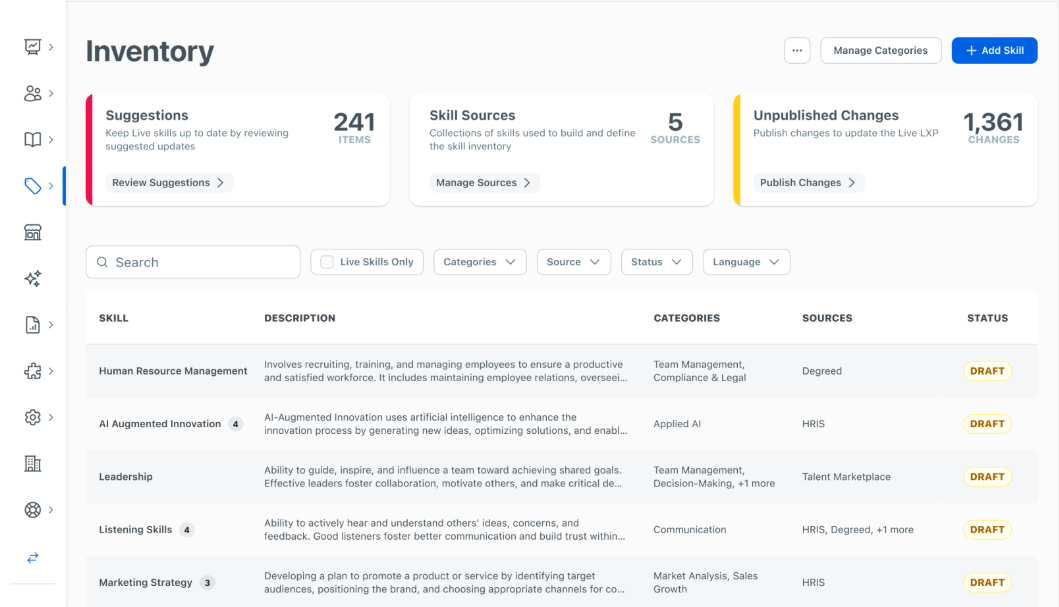
Degreed’s Skill Inventory Dashboard
Unlike generic training platforms that offer the same content to everyone, Tekstac enables role-based skill development through competency frameworks tailored to specific job roles such as Backend Developer, Cloud Engineer, QA Engineer, and more. Learning paths, hands-on labs, and assessments are aligned to clearly defined proficiency levels, from Foundation to Practitioner to Advanced.
By mapping learning directly to real-world job expectations, organizations can eliminate irrelevant training and accelerate capability building. This approach has also helped enterprises create targeted upskilling programs for internal mobility.
Degreed uses a skills intelligence framework that helps organizations identify, measure, and develop workforce capabilities at scale. Learning content is mapped to skills and proficiency levels, enabling personalized recommendations based on an employee’s current skills, career aspirations, and organizational priorities. Through skill taxonomies, proficiency ratings, and skill-to-role mapping, organizations can gain visibility into skill gaps and align development initiatives with business needs.
Best Choice: Tekstac, for role-based competency development and structured technical capability building, while Degreed offers a broader skills intelligence framework for enterprise learning.
Both workforce upskilling platforms primarily focus on employee training and development; and your procurement shortlist likely includes both. Here is the clearest way to decide.
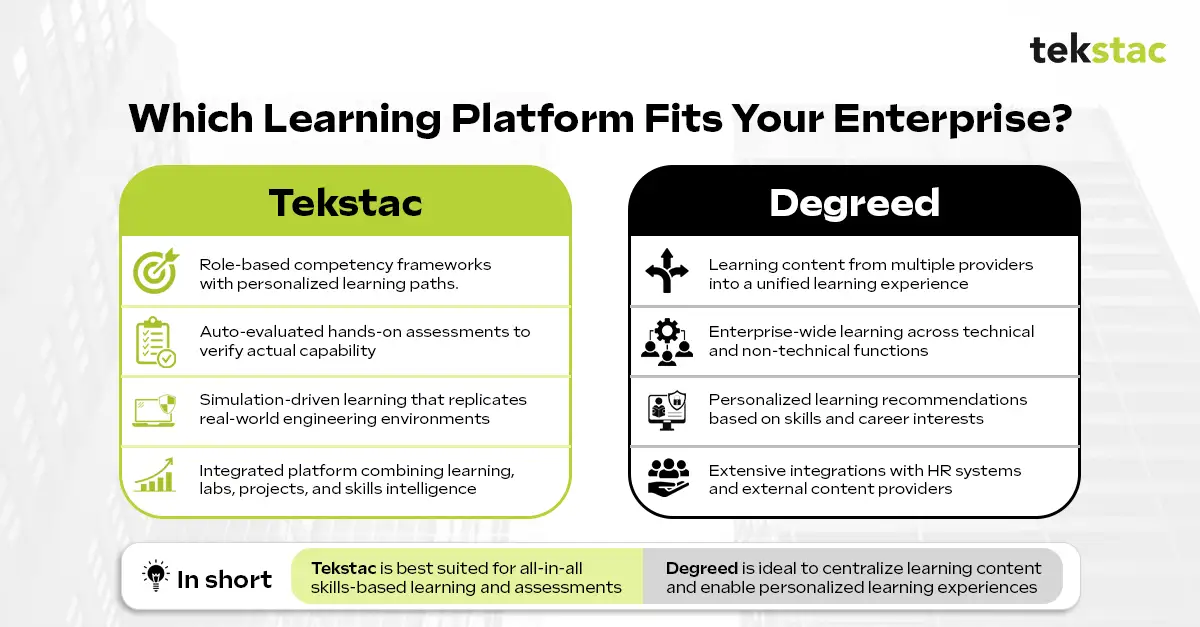
→ Verifying that employees can actually do the job, not just complete a course
→ Running proctored assessments at scale for IT, GCC, or compliance-regulated roles
→ Building deep technical skills in AI, cloud, and data with owned labs and content
→ Generating audit trails that make talent decisions defensible
→ You already have active content provider subscriptions and need a unified aggregation layer
→ Your L&D scope spans non-technical functions across a large cross-functional enterprise
→ You are already on Workday and the native integration is a strategic requirement
While both platforms support enterprise learning and workforce development, they address different organizational priorities. The right choice ultimately depends on whether your focus is on building measurable technical capabilities or delivering a broad, content-driven learning experience.
Take the next step toward workforce transformation. Book a Tekstac Demo today and experience how our platform delivers measurable skill development through hands-on learning and capstone projects at scale.
1. Is Tekstac better than Degreed?
For IT enterprises and GCCs, yes — Tekstac is purpose-built for deep tech skill assessment, AI proctoring, and verified skill measurement that compliance-regulated environments require. Degreed suits organizations that already have strong content subscriptions and need a broad LXP.
2. Is Tekstac GDPR compliant?
Yes. Tekstac is ISO 27001 (2023) certified, SOC2 Type II compliant, and GDPR-ready, with AI proctoring audit trails that support compliance reporting in regulated industries.
3. What is a Degreed alternative for tech enterprises?
Tekstac is the leading Degreed alternative for IT enterprises and GCCs that require proctored assessments, hands-on labs, and verified skill measurement. Other platforms in the comparison include Cornerstone, EdCast, and TalentLMS — but none combine technical skill depth with assessment integrity at the level Tekstac delivers.
4. What is Degreed’s core risk?
Degreed is like a smart TV; it is only as valuable as the content services you pay for to watch on it.’ This is the core risk of Degreed. If you cancel a content provider contract, then the platform hollows out. Tekstac’s own content library and hands-on labs carry no such dependency. What you access on day one is what you access at scale.
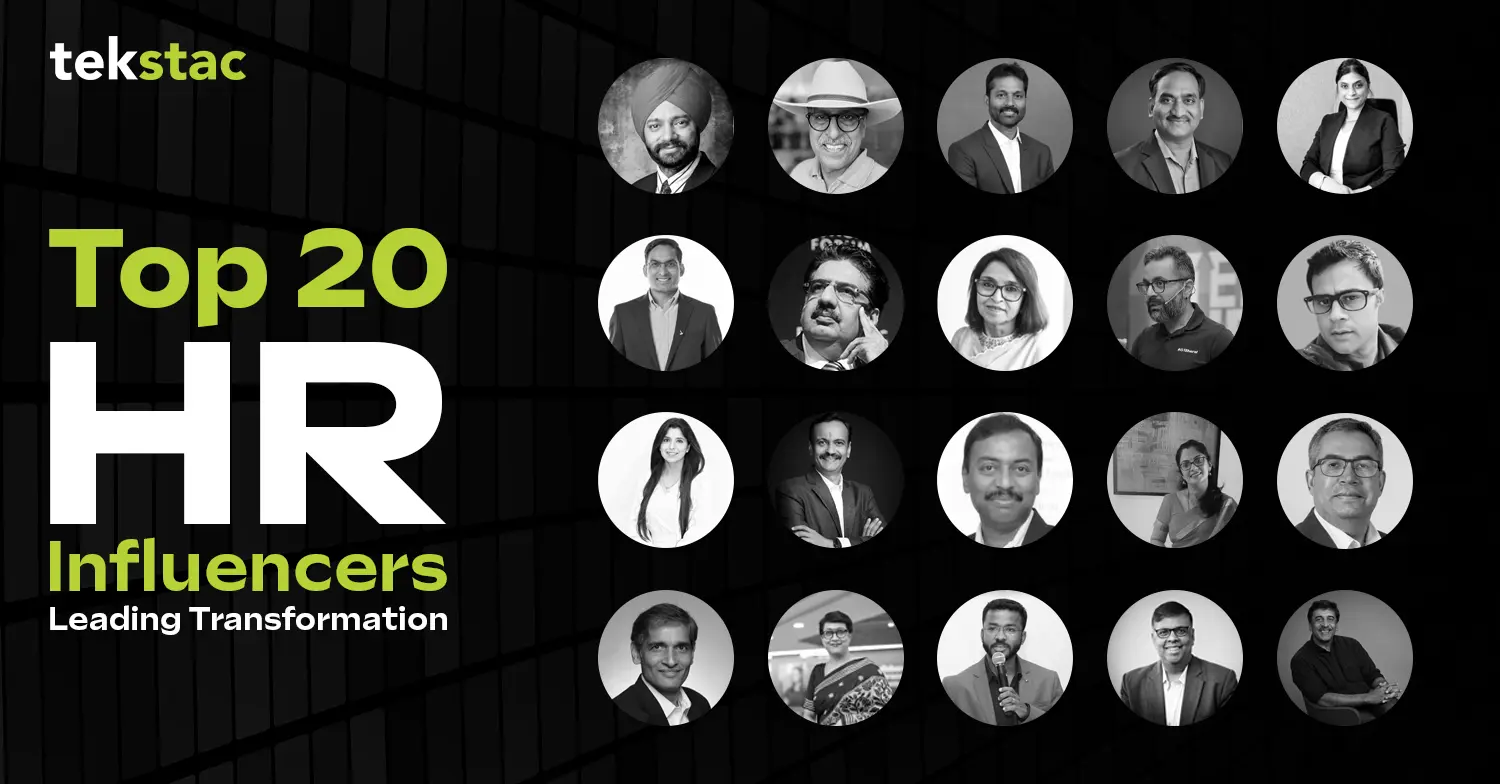
India’s talent or human resources is powering a $5T digital economy. To harness this opportunity, HR influencers play a pivotal role in shaping how organizations reskill employees, cultivate agile mindsets, and embed AI fluency into everyday work.
These HR and L&D leaders occupy a pivotal role because they influence how organizations reskill employees, cultivate agile mindsets, and embed AI fluency into everyday work. They are shaping new talent strategies, pioneering innovative learning models, and fostering cultures that embrace continuous transformation.
What sets these leaders apart is their commitment to testing emerging approaches, sharing knowledge openly, and leading change with real-world impact. They act as catalysts and role models, driving adoption of AI-powered talent development through bold vision and practical execution.
This curated list highlights 20 influential CHROs, L&D pioneers, and HR tech advocates who are leading India’s workforce transformation in 2026. Following their journeys offers valuable lessons on navigating the complexities of AI readiness while empowering people to thrive.
Below is an overview of who they are, how they are influencing the future of work, and why organizations should look to them as inspiration for their own AI and talent transformation strategies.
Reliance Jio | Sr. VP HR
Harjeet Khanduja is an author of seven books on HR and leadership, a TEDx speaker, and holds multiple patents in HR technology. He has been honored with awards such as the Economic Times Top 20 HR Influencers in 2023, named among the Top 200 Global Leadership Voices in 2022, and featured among Thinkers360’s Top 50 Global Thought Leaders on HR.
Prabir Jha People Advisory | Founder & CEO
Prabir Jha is a prominent HR strategist, LinkedIn Power Profile, TEDx speaker, columnist, and HR commentator with extensive experience spanning the civil service, engineering, IT, pharmaceuticals, automotive, hydrocarbons, retail, media, and telecom and digital services. He has served as CHRO of two New York Stock Exchange-listed companies and two Fortune 500 companies, with significant global exposure to HR and organizational effectiveness, particularly large-scale transformation.
Infosys | CHRO
As CHRO of Infosys and Group companies, leads global HR strategy, leadership development, and education/training for 250K+ employees while serving as Trustee of Infosys Foundation driving impactful CSR initiatives. Governance Board member at IIIT Bangalore and CII National Committee on Leadership & HR.
Cognizant | Chief Learning Officer
Heads the world’s largest corporate university serving 250K+ employees. Arohi brings over three decades of experience and is known for building scalable learning ecosystems and driving innovation in digital education.
Trinity Life Sciences | Head of People (India)
Seasoned HR professional who drives healthcare sector talent excellence strategies. She is recognized consecutively as Top 100/101 HR Minds in India (World HRD Congress 2018-2019) and Asia’s Top 100 Power Leaders (2022), among other prestigious accolades.
Persistent Systems | Chief People Officer
Visionary HR leader driving organizational transformation through “Employee First” strategies. Youngest Country/Region/Global HR Head at GlobalLogic, Dassault Systèmes, and Infogain; recipient of CEO Awards and Asia’s Best Employer Brands “Young HR Professional of the Year.”
Sampark Foundation | Founder & CEO
Management visionary who transformed HCL from $0.7B to $4.7B global tech services leader. Author of bestselling Harvard Business Press book; Fortune’s first “Executive Dream Team” 2012 and Thinkers 50 list member; Forbes’ 48 Heroes of Philanthropy 2016 for Sampark Foundation’s education innovation impacting millions.
Tech Mahindra | Chief People Officer
Global HR leader with 25+ years transforming people functions and strategically aligning talent to drive business growth in complex environments. Recognized as Economic Times HR Leader of 2023. Active CII/NASSCOM contributor and mentor nurturing future leaders through teaching at top management institutes.
Grant Thornton Bharat LLP | Chief Learning Officer
As the Chief Learning Officer at Grant Thornton, Ankit leads the learning and development strategy. With 17 years of experience in HR, he has a proven track record of delivering business impact through innovative, agile solutions that leverage social sciences, analytics, and branding. He is also a TEDx speaker, certified coach, clinical hypnotherapist, and author of 10 books on personal/professional growth.
Atos | Group Head L&D
Prasanna focuses on building learning ecosystems and preparing global technology workforces for the future of work. He was honored as the “Future Learning Leader” in 2024 for his contributions to digital reskilling and learning innovation. Beyond his work in enterprise learning, Prasanna is the founder of “Unlearn with Prasanna,” an initiative focused on helping individuals recognize the stories, patterns, and conditioning that shape their choices.
These leaders offer valuable insights into how organizations are adapting to AI-driven change and workforce transformation. To understand the strategies, tools, and frameworks behind this shift, explore our AI in HR guide.
CIGNEX | Chief People Officer
Ankita Singh leads CIGNEX Datamatics’ HR, Administration, Travel, and Resource Management teams, driving a performance-driven culture that earned multiple “Great Place to Work” certifications. She is recognized with Forbes India’s Top 100 Great People Managers and numerous accolades including CHRO of the Year (2017-2020) and Femina’s Women Personality of the Year (2018-2019).
ElasticRun | CHRO
Featured in “HR 100: People Leaders Shaping the Future of Startups,” Salil brings 28 years of HR and general management experience across organization strategy, talent/leadership development, employee engagement, global HR, labor relations, and M&A. Consistently high performer leading diverse HR functions in fast-paced unicorn environments, creating thriving workplaces that drive growth and culture.
Bennett Coleman & Co. Ltd. (Times Group) | Director HR & CHRO
Strategic HR leader with 35+ years across MNCs like Tata Motors, Vodafone, Britannia, Taj Hotels, and Reliance Group, spanning diverse sectors and global geographies. Board/Governing Council member for corporate and educational entities; key Think Tank advisor to Central/State Government ministries driving transformational growth.
Newage Software & Solutions | HR Director
An HR Director who oversees Quality and HR functions, with Lean Six Sigma Black Belt, focused on process excellence and automation. Exemplifies the “never-give-up” mindset and recognized with The Global Excellence Awards – Edition 09.
SHRM India, APAC & MENA | CEO
As one of the top HR influencers in India, Achal Khanna serves as CEO of SHRM for India, APAC, and MENA region, driving global HR transformation and inclusive workplaces. Recipient of prestigious “Best Women Executive in India” award. She is a board member at Ascentios Advisors and MPS Limited, championing women’s empowerment, company culture, and leadership development.
Microsoft | Human Resources Leader
Seasoned HR leader driving business strategy, culture, and organization capability at Microsoft India. Expert in leadership development, high-performing teams, and strategic change management across global tech and manufacturing sectors.
Accenture India | CHRO
With 20+ years in HR leadership roles at Accenture and prior experience at iGate and Nestle, Lakshmi champions equal, empowering cultures and mentors diverse young talent, especially women. Lakshmi co-chairs FICCI’s HR & Skills Committee and serves on XLRI’s advisory board for Gender Equality & Inclusive Leadership.
Nokia | Talent Attraction Leader
Influential HR leader at Nokia with expertise in workforce trends, policy, and business alignment, fostering integrity-based employee-organization relationships. Recognized as Economic Times Top 20 HR Influencers 2020, official SHRM Influencer, People Matters Authors Squad, rise.global Top 100 Global HR Influencer, and Glassdoor Top Contributor at Employer Branding Summit 2015.
Wipro | President & CHRO
Saurabh Govil leads Wipro’s entire HR function, including talent acquisition, engagement, and learning & development programs. With over two decades in HR, he has driven key people, processes, and structural initiatives fueling Wipro’s growth. He serves on SHRM India’s advisory board, speaks regularly at NASSCOM HR summits, and contributes to NHRDN’s journal.
Genpact | CHRO & Country Manager India
Piyush Mehta leads global HR for Genpact, driving talent strategy, employer branding, and Data-Tech-AI transformation while representing the company with key India stakeholders. Key leadership council member with 20+ years of experience. NASSCOM Executive Council member and SHRM global certification commissioner.
These 20 popular HR voices represent the future of India’s talent transformation landscape. Their pioneering work across technology, pharma, manufacturing, and services is driving scalable, AI-powered workforce strategies crucial for succeeding in today’s digital economy.
Explore more insights from India’s HR leaders in our in-depth analysis. Check out this blog.
👉 https://www.tekstac.com/hr-insights-from-leaders/
2026 is almost here, and the L&D function is gearing up for another year of transformation. From AI-powered upskilling to skills-first workforce planning, learning and development events are becoming the spaces where our industry resets, rethinks, and realigns.
Across India, several L&D events in India are lined up for 2026, bringing together practical case studies, future-skills frameworks, and discussions on talent transformation in GenAI era. Whether your focus is immersive learning or building employee learning programs at scale, these events offer high-value insights for every stage of growth.
Here are seven high-impact workplace learning conferences in India you should consider attending. Each one offers something unique, strategy playbooks, peer conversations, tech showcases, and fresh inspiration for your next phase of talent transformation.
Date: 28 January 2026
Venue: Radisson Blu Mumbai International Airport
Visit: https://lndleadershipsummit.com/
Synopsis:
A long-standing industry favorite, this summit brings together CHROs, CLOs, and talent leaders to decode what’s next for capability building. Expect conversations around leadership transformation, digital academies, skill mobility, and scaling training and development events across enterprise teams.
Date: 13 February 2026
Venue: Mumbai
Visit: https://futurelnd.com/
Synopsis:
With the theme of Engage – Empower – Elevate, this conference offers deep dives into immersive learning, hybrid architectures, and AI-enabled skilling. It’s a must-attend for teams redesigning employee learning programs for long-term impact and agility.
Date: 13 February 2026
Venue: Hotel The Den, Bengaluru
Visit: https://www.ibcinfo.com/events-details/event/asia-ld-employer-branding-conference-awards-2nd-edition/
Synopsis:
This event combines L&D strategy with culture and communication. Expect discussions on learning experience design, reskilling frameworks, employee value propositions, and capability building. Emphasizing strong identity and talent transformation in GenAI era, this event recognizes a crucial theme across skill development conferences.
Date:18–19 February 2026
Venue: The Leela Ambience, Gurugram
Visit: https://hr.economictimes.indiatimes.com/nextech
Synopsis:
Themed Minds & Machines: Shaping Tomorrow, NexTech explores how India can advance as a global talent capital. With its strong focus on automation, workforce readiness, and scalable skilling, it’s a core event for organizations investing in future skills summits and digital transformation.
Date: 17 April 2026
Venue: Radisson Blu, Outer Ring Road, Bengaluru
Visit: https://summit.bestfirm.aim.media/
Synopsis:
Designed for leaders building AI-driven workplaces, this summit covers automation-integrated talent ecosystems, capability academies, and intelligence-driven workforce planning. Perfect for teams working at the intersection of AI and enterprise learning.
Date: 11 July 2026
Venue: Chennai Trade Centre, Chennai
Visit: https://vanakkamhrd.com/events.php/
Synopsis:
HR Festival 2026 brings together HR leaders, CHROs, talent professionals, and industry experts for a day of learning, networking, and future-focused conversations. The event explores AI-powered workplaces, leadership in a borderless world, and the evolving role of HR in shaping future-ready organizations. Ideal for professionals seeking practical insights, community-driven learning, and innovative people strategies.
Date: 15–16 July 2026
Venue: Hyderabad International Convention Centre (HICC), Hyderabad
Visit: https://www.shrmconference.org/unconference
Synopsis:
As the top learning conference in India, SHRM UnConference 2026 combines peer-led discussions, hands-on learning labs, workplace innovation showcases, and cross-disciplinary experiences. The event explores talent strategy, leadership, workforce design, culture, and HR technology through highly interactive sessions designed to spark fresh thinking and practical innovation.
Date: 6–7 August 2026
Venue: Yashobhoomi Convention Centre, New Delhi
Visit: https://india.techhrconference.com/
Synopsis:
Asia’s largest HR & work-tech conference, TechHR is one of the prestigious learning events where L&D meets the future of work. From behavioral analytics to next-gen platforms and capability intelligence systems, this is the place for organizations prioritizing upskilling and reskilling and talent transformation in GenAI.
Date: 26–27 November 2026
Venue: Taj Palace, New Delhi
Visit: https://www.shrmconference.org/iac
Synopsis:
One of India’s most influential HR and L&D industry events, SHRMIAC brings global experts, masterclasses, and research-backed insights. Expect future-skills playbooks, capability frameworks, GenAI strategies, and case studies from high-performing enterprises.
Date: 12 December 2026
Venue: Sterlings Mac, HAL Airport Road, Bengaluru
Visit: https://www.hrsummit.co.in/
Synopsis:
Organized by the Institute of HRD, the Bangalore HR Summit 2026 brings together HR leaders, business executives, learning professionals, and talent strategists to explore the future of people management. The agenda focuses on digital-age talent strategies, learning and development innovation, leadership development, talent analytics, and technology-enabled workforce transformation.
Across all seven learning and development events, a few powerful themes consistently emerge:

GenAI is moving from pilots to enterprise-scale adoption. Learning teams are overhauling content operations, personalization engines, and taxonomies using AI.
Organizations are shifting to agile skill architectures, prioritizing skills mapping, adjacent skills, skills-based career pathing, and internal mobility.
Simulations, microlearning, practice labs, and mentor interventions drive higher retention and provide real-world application-based learning.
L&D is now directly tied to business outcomes. Leaders want clearer impacts such as faster deployment readiness, reduced cost of hiring, better build vs buy vs borrow talent decisions, skills insights to build proactive talent pipeline that helps in measurable ROI.
As tool fatigue rises, L&D must re-design people-first systems that feel simple, intuitive, and human by default. A powerful theme that propagates talent transformation in the GenAI era.
Throughout 2026, Tekstac will actively participate in these learning and development events, conducting roundtables, working on new research, unveiling capability frameworks, and hosting demos. These interactions help us stay deeply connected to the evolving challenges of learning teams, enabling us to co-create solutions with the industry.
Learning and Development Events are no longer passive industry gatherings; they’re catalysts for transformation, capability building, and meaningful collaboration. As 2026 brings a new wave of innovation, these seven conferences offer the insights, networks, and frameworks to help L&D teams stay ahead of rapid change.
Whether you’re refining your skilling strategy, rethinking systems, or preparing your workforce for the future, these learning events offer everything you need to accelerate talent transformation in the GenAI era.
1. What are the top learning and development conferences to attend in India in 2026?
India will host several leading learning and development conferences in 2026, including People Matters TechHR India, SHRM India Annual Conference, SHRM UnConference, HR Festival 2026, the Future of Learning & Development Summit, and the L&D & Talent Management India Summit. These events cover AI-powered learning, skills development, workforce transformation, leadership, and future-ready talent strategies.
2. What makes L&D events valuable for business leaders, not just learning teams?
These events provide insights into workforce productivity, talent development, organizational transformation, and business strategies that directly impact long-term growth and competitiveness.
3. Which L&D topics are expected to dominate conferences over the next five years?
Topics likely to remain prominent include Agentic AI in learning, skills intelligence, workforce transformation, learning analytics, leadership development, employee experience, and future-ready talent strategies.
4. What are the key benefits of attending Learning and Development events in India?
Learning and Development events offer more than networking opportunities. They provide access to industry research, emerging learning technologies, expert insights, and real-world case studies from leading organizations. Attendees can learn how companies are addressing challenges such as skill shortages, workforce transformation, leadership development, and AI adoption.
The HRTech 2026 conference, a gathering of global HR leaders and innovators, highlighted the trends, challenges, and breakthroughs shaping the future of work. We’ve compiled 26 key HR insights from sessions, panels, and conversations with leading voices.
These insights are organized into seven themes that capture the latest trends shaping HR. Let’s take a look.
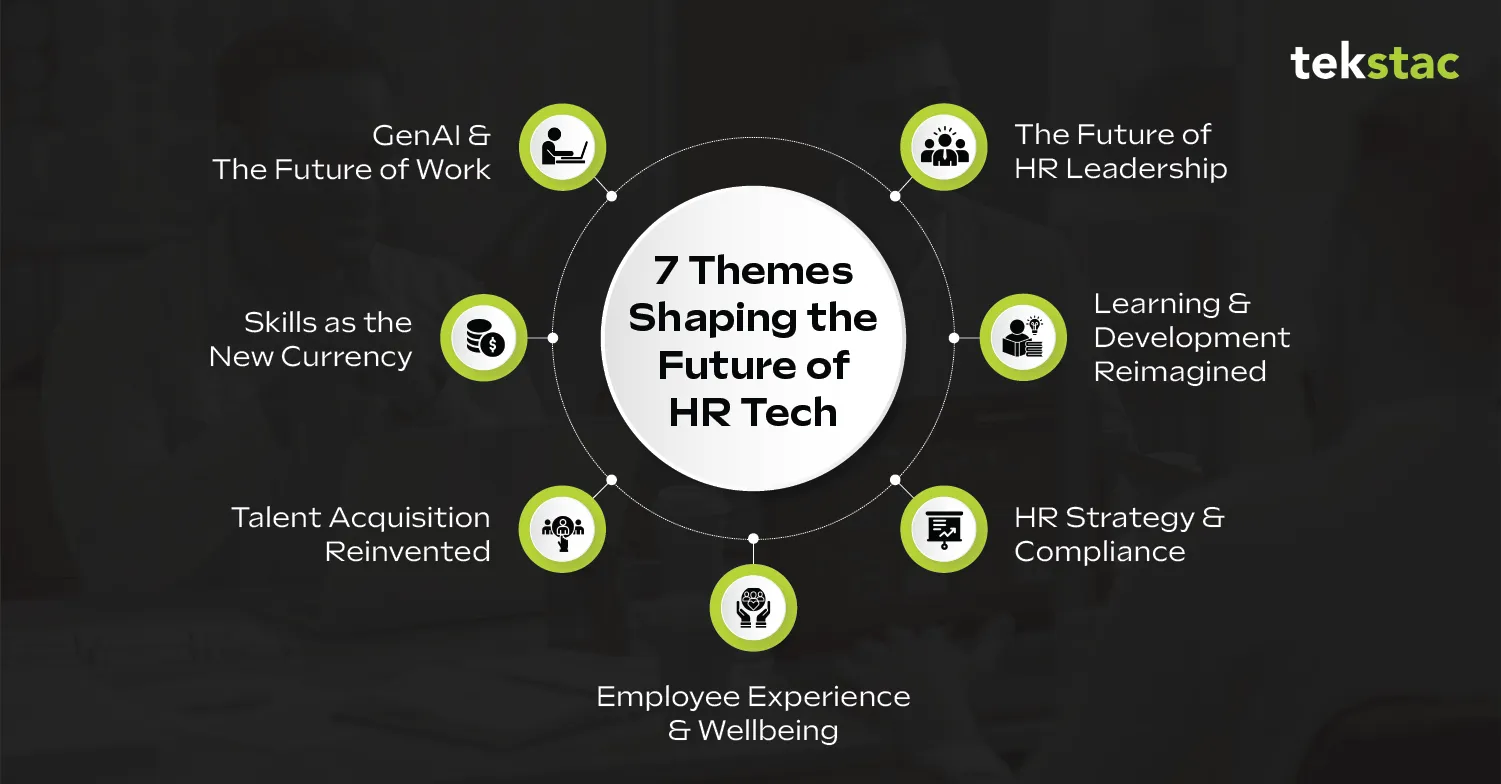
Discovery: Phenom and Paradox showcased GenAI-powered candidate communication—automated but personalized.
Why it matters: Candidate drop-offs happen when the process feels impersonal or slow. AI can help close that gap.
Action: Audit your candidate journey for speed, personalization, and human touch.
Quote: As Yvette Cameron (Oracle) noted, “The future of AI in enterprise software will become more conversational,” fundamentally changing how candidates and employees interact with HR systems.
Quote: “The talent shortage isn’t about numbers — it’s about skills alignment.”
Why it matters: Recruiting strategies must focus on quality hires and internal mobility, not endless sourcing.
Action: Build “talent intelligence” dashboards that connect hiring with performance.
Added insight: Kathi Enderes (Josh Bersin Company) challenged, “How can we make every person count more?” emphasizing outcomes over sheer headcount.
Discovery: Platforms like SHL, Pymetrics, etc., are using adaptive AI-driven assessments to personalize difficulty and reduce bias.
Why it matters: Fairness and scalability in hiring depend on intelligent assessment tools.
Action: Replace one-size-fits-all assessments with adaptive, feedback-driven models.
Quote: Robin Barbacane (Rackspace) said, “When you first create your AI tool, talk to it like an intern,” highlighting practical ways to integrate AI safely.
Stat: 65% of companies invest in improving manager and employee mobility experiences (Aptitude Research).
Why it matters: Moving people internally is more cost-effective and improves morale.
Action: Create internal job boards and mobility marketplaces.
Quote: Josh Gosliner (SAP) reminded us, “HR data can’t live in silos anymore,” reinforcing the need for connected internal talent strategies.
Stat: 58% of companies prioritize skills-based hiring and internal mobility.
Discovery: Platforms like Eightfold, Gloat, and SkyHive showcased live skills graphs linking learning to career paths.
Action: Start with a skills baseline; Platforms like Tekstac make this easier by capturing learning performance data that reflects actual skill growth, helping organizations keep their skills business aligned.
Quote: Heidi Barnett (isolved, Talent Acquisition) advised, “Think about complementary skills and help describe who a job would be perfect for.”
Quote: Madeline Laurano noted, “Employees don’t want a static career ladder—they want dynamic growth journeys based on skills.”
Why it matters: Retention improves when employees see a personalized path forward.
Action: Use platforms that visualize “if you learn X, you can move into Y role.”
Discovery: Vendors like Visier, CompXL link pay to skills, not just job titles.
Why it matters: It’s a fairness and DEI issue—and reduces bias in compensation.
Action: Explore skills-based compensation frameworks.
Quote: Heather Kruger (Salary.com) reminded, “Compensation is the foundation—organizations won’t get to higher-order culture dynamics if they don’t get the foundation right.”
Discovery: Platforms like Tekstac, Cornerstone, and Docebo embed adaptive learning journeys that adjust pacing, difficulty, and content.
Why it matters: Personalized learning improves retention, satisfaction, and outcomes.
Action: Shift toward adaptive learning paths tailored to performance and career goals.
Quote: Sandra Loughlin, PhD observed, “Real learning happens in practice, feedback, and flow—not just through structured content.”
Discovery: Tools like Degreed, Credly, and blockchain-based platforms offer verifiable skill credentials.
Why it matters: Employers want proof of capability, not just course completion.
Action: Incorporate verifiable assessments into programs.
One of the panelists quoted: “The ROI black hole is closing AI gives us real business outcome tracking.”
Why it matters: Learning is expected to drive promotion, performance, and retention.
Action: Tie learning outcomes to business metrics.
Quote: Jason Averbook emphasized, “In 2025-26, HR needs a reset. Otherwise, we’re putting digital lipstick on an analog pig.”
Discovery: ServiceNow, Qualtrics, and Microsoft integrate surveys, workflows, and learning.
Why it matters: Employees expect consumer-grade experiences at work.
Action: Invest in EX platforms that unify communications, HR tasks, and career tools.
Gartner found that among HR decision-makers, leader and manager development remains the number one priority.
Action: Give managers AI copilots for feedback, coaching, and visibility.
Quote: Bill Pelster, Amber Grewal, and Jaclyn Zhuang shared that managers may lead both people and digital agents, emphasizing hybrid leadership skills.
Discovery: Vendors like Modern Health and Spring Health integrate AI for personalized well-being nudges.
Why it matters: Burnout is a top turnover driver.
Action: Embed well-being into daily workflows.
Quote: Ami Graves said, “Without trust and strong leadership skills in our companies, the technology and AI implementations that we want to implement will fail.”
Discovery: ADP and CloudPay offer real-time pay and AI-driven anomaly detection.
Why it matters: Payroll errors erode trust quickly.
Action: Evaluate tools for speed, fairness, and reliability.
Quote: Pim Altena (Remote) warned, “Trust has a timestamp,” highlighting the link between accuracy and credibility.
Quote: Josh Bersin emphasized, “Without trust, none of this tech matters.”
Action: Communicate openly about AI and data usage.
Stat: 75% of companies plan to increase HR tech budgets.
Action: Build a strong ROI narrative.
Discovery: Big HR tech players are expanding fast: Workday acquired Sana, Deel bought Assemble, Paychex snapped up Paycor, Dayforce went private with Thoma Bravo, and HiBob added Pento and Mosaic—while startups keep innovating in niche areas like payroll, AI, and skills taxonomies.
Action: Pilot with smaller players when innovation matters.
Discovery: Workday, Phenom, and Eightfold showcased enterprise-ready GenAI features.
Why it matters: 64% of HR leaders see GenAI as essential.
Action: Start with low-risk, high-impact areas.
Quote: Nickle LaMoreaux (IBM) said, “It’s HR’s moment in the sun,” urging leaders to seize AI opportunity proactively.
Quote: Josh Bersin: “Transparency, bias management, and trust will define which vendors win.”
Action: Audit AI explainability.
Discovery: Microsoft Copilot in Viva, Workday’s AI agent features.
Action: Train teams to collaborate with AI as a partner.
Quote: Kyle Forrest emphasized, “You can’t slap AI solutions on top of existing processes,” underlining the need for integration.
Action: Upskill HR teams on data literacy, AI fluency, change management.
Quote: Patrick Leddin, PhD, asked, “Do I move towards the change, or do I move towards stability?”—guiding leaders to embrace uncertainty.
Discovery: Textio, Unitive, and certain ATS platforms integrate inclusive language and bias detection.
Action: Audit tools for bias.
Discovery: Microsoft, Zoom, Slack show hybrid tools as core utility.
Action: Invest in tech that supports hybrid collaboration.
Action: Collaborate with legal and IT; secure sensitive employee data.
Discovery: Platforms show employees their skill gaps and potential career paths.
Action: Give employees access to their own skills data.
Quote: Josh Bersin: “This is HR’s time. Don’t wait for tech vendors to define the future — build it yourself.”
Why it matters: Being proactive shapes culture, tools, and strategy.
Quote: Sarah Hodges (UKG) added, “HR tech is the bridge between ideas and outcomes,” reinforcing the strategic impact of HR.
At Tekstac, we see HR Tech 2026 as more than an event; it’s a reflection of how innovation, skills, and strategy are converging. And that’s exactly where our focus lies. The conference brought together industry’s best minds, covering HR insights, innovations, and technology to help organizations stay ahead of change and build the future-ready workforce of tomorrow.
1. What are HR Insights?
HR insights are data-driven, strategic understandings derived from workforce, talent, and performance data that help organizations improve hiring, learning, engagement, productivity, and business outcomes.
2. What are the 7 pillars of HR?
The 7 pillars of HR include talent acquisition, learning and development, performance management, employee engagement, compensation and benefits, workforce planning, and HR analytics, all working together to drive organizational growth.
3. What are the 4 types of HR analytics?
The four types of HR analytics are descriptive (what happened), diagnostic (why it happened), predictive (what will happen), and prescriptive (what should be done), enabling data-driven HR strategies.
4. How do HR insights impact business strategy?
HR insights help organizations align talent, skills, and leadership with business goals, enabling faster decision-making, improved productivity, and sustainable workforce transformation.
The hands-on labs vs. traditional training debate has gone on long enough. It is one of the most consequential decisions an L&D team can make, and the research shows they don’t produce the same outcomes.
Hands-on training puts employees in real or simulated work environments where they can practise, make mistakes, correct them, and build confidence through application. Traditional training typically builds structured knowledge first, before learners apply it in practice.
The right choice depends on role complexity, learner experience level, and the stakes involved when a mistake is made. This guide breaks down both methods, the evidence behind each, and how to choose or combine them effectively.
A hands-on lab is a structured learning environment, physical, virtual, or hybrid; where learners develop skills by performing real tasks, not observing them. Common formats include virtual sandboxes, cybersecurity simulation ranges, clinical skills labs, coding environments, and manufacturing floor simulations.
Also called experiential labs or practice environments, hands-on labs are designed around a single principle: the fastest path to competency is doing the job, not watching it explained.
Now compare that to traditional training. It’s more about lectures, slides, and guided lessons. Everything’s laid out in a set format, usually in a classroom or through online courses. This approach prioritizes understanding concepts before moving to application.
Completing training and demonstrating capability are not the same thing. This is becoming a bigger issue as enterprises move toward skills-based workforce planning. SHRM’s L&D research shows that skills training, skills identification and gap analysis are central priorities for L&D leaders.
An employee may finish every module in a learning path and still need support when asked to troubleshoot a production issue.
To measure real skills faster, we look at metrics such as:
Measuring speed in skill development requires looking at how fast learners reach actual job competency, i.e., the point where they can perform tasks independently without constant guidance or review.
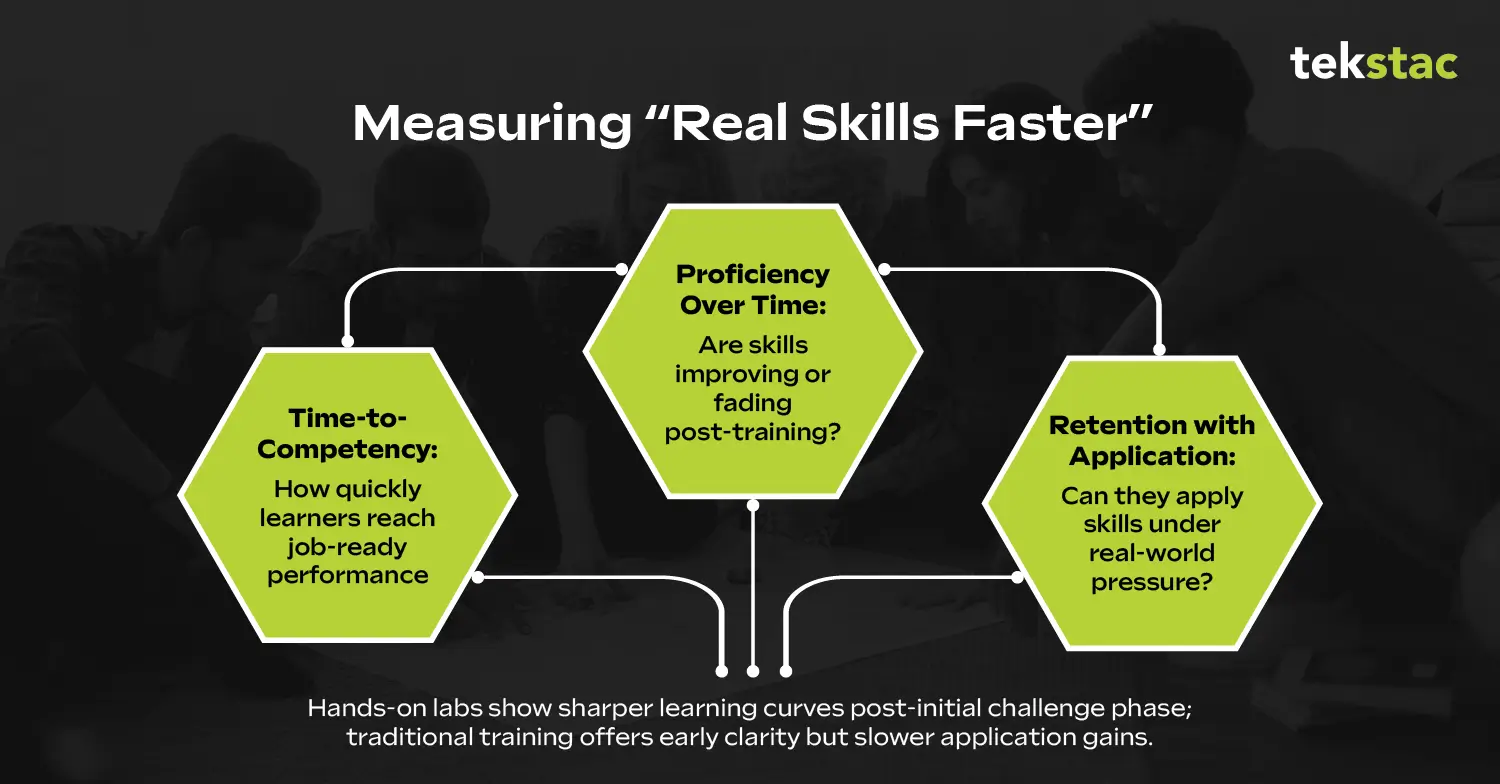
1. Time-to-competency: This tracks the period from initial exposure to independent performance. This metric matters especially in hands-on labs training method because it shows real business impact. Some learners might finish traditional courses quickly but can still struggle when faced with actual work situations.
2. Proficiency over time: This metric checks how skills evolve after initial training, whether learners are continuing to improve. More importantly, it helps understand if employees retained and built on what they learned, or if skills deteriorated without reinforcement.
3. Retention with application: This metric helps measure if skills are translating successfully into real-world scenarios. It assesses whether learners can successfully apply learned skills weeks or months later when the pressure is on. It’s one of the core metrics of training methods such as hands-on labs or immersive labs.
Studies show hands-on training and traditional learning don’t follow the same curve. People in labs might hit a rough patch early on. It feels harder at first. But once they get it, things move fast.
On the other hand, traditional training methods typically produce smoother, more predictable curves early on. Learners build knowledge, and assessment results look more consistent in the short term. However, the real test comes during transition to actual application, where learners face a secondary learning curve as they adapt to practical situations.
Below, let’s examine in detail which training method helps build and apply skills faster, whether it’s hands-on labs, traditional training, or both.
Hands-on labs can require higher investment amounts due to purchase of equipment, software, and specialized instruction. But they may reduce the time employees spend transitioning from training to productive work.
Hands-on training creates conditions that naturally accelerate skill development. When learners face challenges in simulated environments, they must solve them immediately. This can create a pressure-cooker effect where learning happens under conditions that mirror real business situations.
Hence, the feedback loop in hands-on environments operates at a higher speed. Quick feedback makes a big difference. People catch mistakes early and learn what works by actually doing it. In hands-on setups, they’re more likely to try stuff, mess up, and figure things out. That kind of trial-and-error helps build real problem-solving skills, not just for the task at hand, but for situations they haven’t even seen yet. More than anything, it gives them the confidence to handle the unknown.
Traditional training is best at building systematic understanding efficiently. Difficult topics can be broken down logically, with each concept building on previous ones. This helps develop comprehensive mental models before employees start practicing application.
Traditional training usually moves slow and steady, unlike hands-on labs. The instructor can stop and explain things before jumping ahead. That helps people who might need more time. With hands-on stuff, it’s easy to feel lost early on, especially when things get too complex too fast.
However, in contrast to hands-on labs, traditional approaches struggle with the transfer problem. Knowledge gained does not always translate smoothly to real-world application. Learners may understand concepts but hesitate when faced with actual decisions or problem-solving situations.
This nature can create artificial delays, where learners might be ready to tackle practical applications before the curriculum allows them to, leading to frustration and missed opportunities for reinforcement through practice.
Smart organizations increasingly recognize that the hands-on labs versus traditional debate does not always create the right choice for every organization. For some companies, the most effective training approach can be a combination of both, using each method’s strengths to address the other’s limitations.
Sometimes training mixes both. First, you learn the basics in a class. Then you do hands-on work to practice. Or you try things out first, ask questions, and then get the lessons to make sense of it all.
Here, the key is in timing and integration. Rather than treating these as separate phases, effective blended approaches integrate theory and practice together, allowing learners to move fluidly between understanding concepts and applying them in realistic contexts.
With technology, organizations can perfectly balance theoretical resources while working through practical challenges, or where simulation environments include embedded coaching and explanatory content that appears when needed.
The best training blends both worlds.
Give your team the skills they need now—and the growth path for tomorrow.
See How Tekstac Helps.
One question comes up often in our conversations with L&D and capability leaders: “When should we actually use hands-on labs?” The answer usually comes down to what employees need to do with the skill after they learn it.
As AI is changing what employees need to learn, hands-on labs are useful when the goal is to build a skill employees will need to perform, troubleshoot, or adapt in their actual roles.
They are especially valuable for:
Coding, cloud infrastructure, cybersecurity, data engineering, DevOps, AI development, and other skills where proficiency depends on actually working with tools and environments.
When employees are moving to a new framework, platform, or technology stack, practice helps shorten the distance between understanding the technology and using it productively.
Real work rarely arrives as a perfectly framed question. Labs can introduce incomplete information, errors, constraints, and unexpected outcomes that require learners to diagnose rather than recall.
When the objective is to determine whether someone can perform a defined role or task independently, practical assessments provide stronger evidence than completion data alone.
That does not make hands-on practice the answer for every learning objective. For foundational knowledge, context, policy, conceptual frameworks, or topics where experimentation is impractical, structured instruction still has an important role.
This gives readers an actual decision framework.
After understanding both approaches, the evidence points to a clear conclusion that the hands-on labs versus traditional training misses the real opportunity to integrate them intelligently through technology platforms that combine the systematic knowledge-building of traditional training with the immediate application benefits of hands-on labs.
The most effective approach integrates structured learning content with immersive practice environments. These are backed by real-time assessment and personalized guidance. When learners can access resources when they need them while working through realistic scenarios, they develop both understanding and performance.
Organizations using blended learning models, combining structured content with hands-on lab environments report 24% higher profit margins than those relying exclusively on instructor-led training. (Source: Brandon Hall Group) Platforms like Tekstac are built around this integration model, combining sandbox lab environments with adaptive assessment and real-time skill tracking.
While speed matters, sustainable speed matters more. Hence, integrated learning platforms deliver both immediate impact and long-term capability, creating learning experiences that truly improve performance.
You can explore Tekstac’s platform demo to see how this integrated approach supports real skill development.
1. What is hands-on training?
Hands-on training is a method where learners build skills by performing tasks in a real or simulated environment, receiving immediate feedback rather than passive instruction. It includes labs, simulations, on-the-job practice, and scenario exercises.
2. How do hands-on labs improve workplace learning?
Hands-on labs allow employees to practise job-relevant tasks in a controlled environment, make mistakes safely, receive feedback, and repeat the task. This can help reduce the gap between understanding a concept and applying it independently. Their value is strongest when practice is connected to realistic tasks and followed by meaningful assessment.
3. How should enterprises measure the impact of hands-on training?
Enterprises should look beyond completion rates and learning hours. Useful measures include time-to-proficiency, practical assessment performance, skill progression, task accuracy, project performance, and the number of employees who can demonstrate a defined capability independently. The exact measures should be linked to the role and business outcome the training is intended to support.
4. Are hands-on labs enough to build job-ready skills?
Not on their own. Hands-on practice is most effective when it is connected to foundational knowledge, feedback, assessment, mentoring, and opportunities to apply skills to realistic problems. A strong enterprise learning journey moves from understanding to practice and then validates whether the learner can demonstrate the skill independently.
As we move through 2026, talent strategies have evolved from a nice-to-have to a business necessity for survival.
CHROs (Chief Human Resources Officers) aren’t just managing people anymore. They’re using data, much like architects, to reshape entire organizations from the inside out.
Here’s the reality: your competition already knows what you’re thinking. They can predict your next hire, spot your talent gaps, and attract your best performers before you even realize they’re unhappy.
Companies that master data-driven talent decisions are outperforming those still relying on gut feelings and annual reviews. Your people aren’t just employees. They’re your competitive edge. When human potential meets strategic precision, competitors can’t keep up.
The question isn’t whether you need to evolve your approach; it’s whether you can. It’s whether you dare to reimagine how you think about people completely.
Your most significant competitor just hired three of your key people. They knew those employees were unhappy six months before you did.
How?
AI told them.
AI tools are exposing everything. Statista reports that 72% of organizations worldwide have adopted AI in at least one business function. Skills inventories, performance patterns, flight risks – it’s all transparent now.
Modern approaches aren’t about posting jobs and hoping anymore. They’re about intelligence, and you’re fighting blind.
While you’re sitting in meetings talking about “hiring challenges,” your competitors are building talent machines that make your approach look amateur.
Modern workforce planning isn’t about spreadsheets anymore – it’s about survival. Here’s what’s happening while you sleep: McKinsey found that AI can automate up to 70% of what your people do every day. That accountant you just hired? Half of their job is already replaceable. That marketing coordinator? AI is writing better copy than they are.
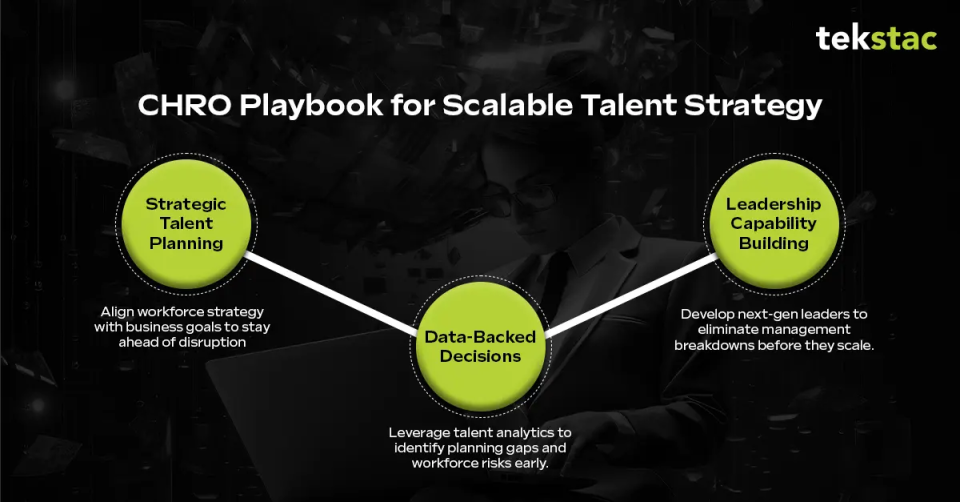
Three moves that separate winners from losers:
Five brutal truths about workforce planning you need to face:
How your current approach is failing:
Your leadership programs are failing – here’s why:
Your current approach is stuck in the past, and your top talent is aware of it. While you’re conducting annual reviews and basic recognition programs, innovative companies are engaging in real-time coaching conversations and creating personalized growth experiences for each employee.
Research shows employees with positive experiences are 16 times more engaged. That’s the difference between people who stay and grow versus people who quietly quit and leave.
Your current programs are expensive team-building retreats disguised as strategy. While you send people to weekend workshops about “authentic leadership,” your competitors are building leaders who know how to navigate chaos, inspire teams, and drive results when everything falls apart.
You think leadership development means soft skills training and motivational speakers. Real development creates people who can make tough decisions under pressure and turn uncertainty into opportunity.
Discover how cutting-edge platforms can accelerate your workforce development initiatives and drive measurable business impact.
Explore innovative solutions that align with your strategic objectives at Tekstac.
Today, leadership is in crisis. Workers are losing faith in leaders because many just aren’t measuring up.
DDI Global Leadership Forecast 2025 states that the trust in management fell from 46% in 2022 to as low as 29% in 2024, an enormous plunge. It shows how much everybody distrusts their leaders now.
While so much of the world is changing at the speed of light due to technology and remote work, leaders are still blamed for lacking rudimentary human competencies such as empathy and clear communication, which are one of the best leadership skills.
If you examine legendary leaders throughout history, you will see that they possessed these competencies in abundance. Today, far too many leaders lack these competencies.
Then, what do today’s professionals need to learn to keep up with today’s requirements and thrive amidst all this change? This blog will discuss the top 10 leadership skills required in 2026 and how to develop them.
In India and Southeast Asia, the best leadership skills combine emotional intelligence, digital and AI literacy, adaptability, inclusive communication, and change leadership. India’s GCC sector — employing over 1.66 million professionals (NASSCOM, 2024) — demands leaders who can manage large, diverse, hybrid workforces while scaling talent development and business performance across global teams. These skills enable leaders to manage large, diverse, hybrid workforces while scaling talent development and business performance effectively.
The 10 best leadership skills for 2026 span two categories: timeless human competencies that no technology can replace — emotional intelligence, communication, coaching — and emerging capabilities that AI-driven workplaces now demand, including technology literacy, adaptive leadership, and data-driven strategic thinking. Here is what each skill means and how to build it.
But the world keeps evolving at this fast pace, and with it, the kind of skills leaders need. For example, computer literacy was not as critical previously as it is today. Today, the skill of coping with AI and technology is what any leader needs. With new opportunities and challenges by 2026, leaders will have to change and evolve.
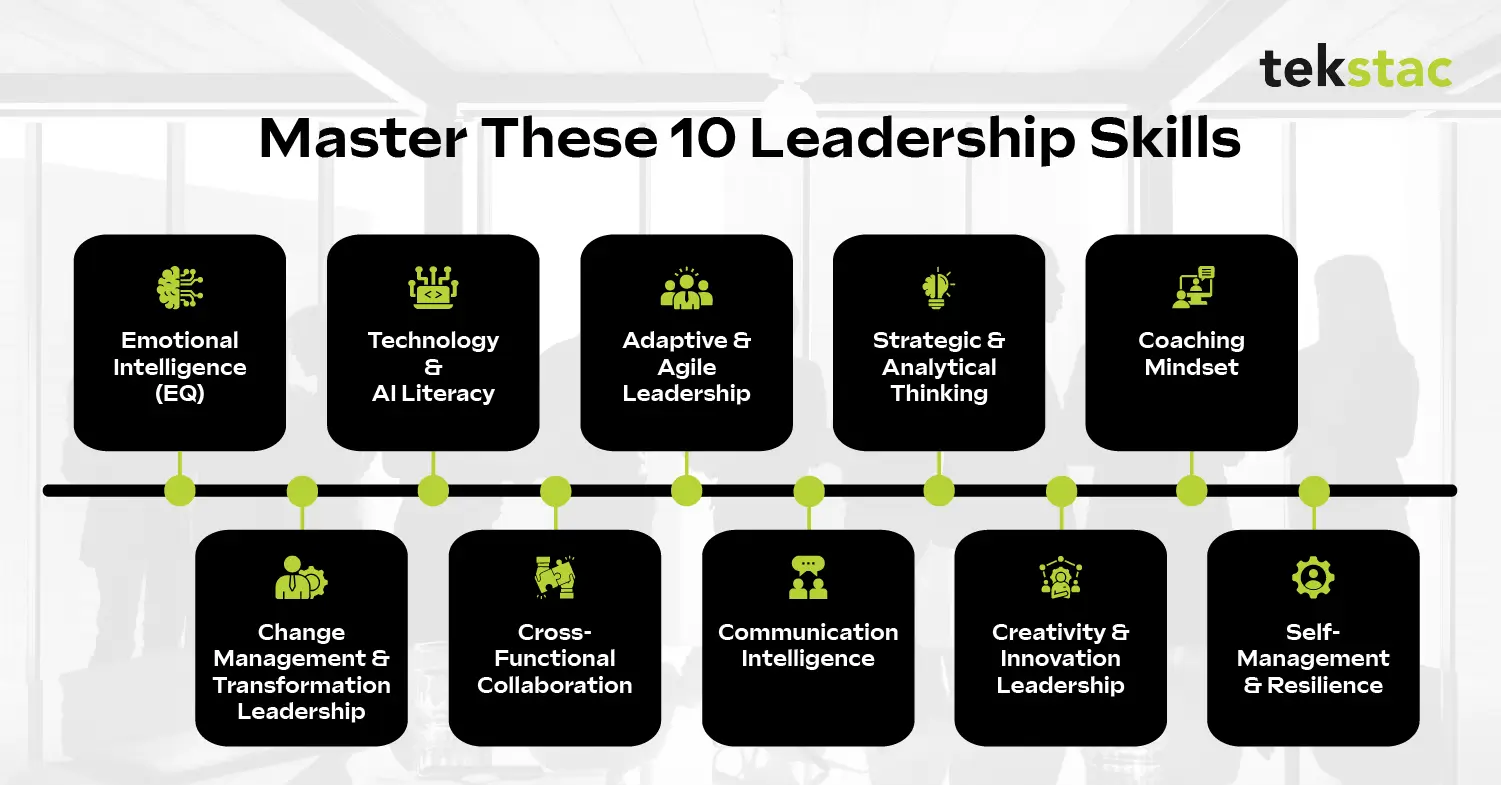
What if it is possible to be a good leader through emotional understanding? Emotional Intelligence (EQ) has already passed from being a soft skill to being the basis of fearless leadership. EQ is about paying attention to your feelings and others’, managing your reactions, and establishing genuine relationships.
In the age of AI dominance, we cannot live without trust and empathy. EQ leaders create psychologically safe environments, with collaboration and innovation thriving even when teams are separated by geography across continents. For instance, the most incredible testimony to Satya Nadella’s Microsoft transformation is where he created the learning and empathy culture and re-stoked the growth and morale of the company.
How to build it: Practice vulnerability by opening up your problems. Always consider your emotions, and ask your colleagues for straightforward opinions to become sensitive to forming relationships. Practice empathy daily.
Talent in 2026 will need to ride the wave of AI. 71% of CEOs in Korn Ferry’s 2025 Global Workforce Survey are confident that AI will add value to their worth within three years. Leaders today must have first-hand experience with AI and new technology. Organizations building this capability at scale are investing in structured workforce upskilling solutions that move beyond awareness training to hands-on AI literacy programs embedded in daily workflows. This skill enables them to identify improvements in efficiency, anticipate risk, shape responsible use of AI, and increase the agility and creativity of decision-making.
This leads to more effective decision-making and facilitated groups of de-drudged work. Amazon’s early implementation of AI to maximize logistics set industry standards and pushed hyper-growth revenue, demonstrating tech know-how pays.
How to build it: Get AI and digital literacy skills training, engage with tech forums, and collaborate with internal experts to stay competitive.
Most leaders are playing catch-up on talent as though it were 2010, and their leadership is outdated. John Maxwell’s book, Leadershift, is about leaders shifting their style so they can keep up with the pace of a changing world. Adaptive leaders create a culture where teams learn fast, turn fast, and embrace failure as a stepping stone.
For example, Netflix’s transition from DVD rentals to streaming is a quintessential example of agile leadership, making an early bet on video streaming revolutionized the company and kept it ahead of the curve.
How to build it: Condition yourself to be agile in mind by exposing yourself to something new and getting a great many different ideas every day.
Strategic thinking is seeing the big picture, connecting the dots, and making well-thought-out decisions driven by long-term organizational goals. This is reinforced by analytical thinking, which assists leaders in filtering information, identifying trends, and projecting possible risks or opportunities. With increasingly dynamic markets and data being the default norm, leaders possessing such skills create lasting competitive advantages.
As Jim Collins notes in Good to Great, disciplined strategic thinking is a defining trait of companies that outperform others over the long term. Among the best leadership skills, this capability helps leaders move beyond short-term fixes and set goals based on objective analysis. It enables cost-effective resource allocation, clear prioritization, and confident decision-making amid uncertainty.
How: Work actively with information, encourage shared goal-setting, and test assumptions regularly. Acquiring skills in applying decision-making templates and thinking about alternative perspectives requires applying those skills to build them.
Leaders’ actions are shifting from commanding and controlling to empowering and constructing. The coaching method can be implemented through good questions, listening, and nudging others to their solutions. Jacob Morgan outlines in his book The Future Leader that this shift is a necessity as workplaces become more complicated and growing talent is priority number one.
By 2026, coaching will play a critical role in employee training by building trust, boosting motivation, and accelerating learning across teams—especially in distributed or hybrid organizations. This approach enables leaders to develop autonomy, encouraging employees to innovate, take initiative, and apply new skills effectively on the job.
Organizations like Google have demonstrated the impact of performance enhancement with coaching in projects like Project Oxygen, which found that managers’ coaching styles strongly impact team performance.
How to develop: It can be achieved through regular growth conversations, emphasis on development and strengths areas, and a culture of continuous learning.
Change is inevitable, but outstanding leaders can make change an imperceptible evolution and not an interruption. For enterprise organizations navigating large-scale transformation, understanding how leadership transformation in GCC is being redesigned offers a practical model for applying change management at the organizational level — not just the team level. It is especially important in the aftermath of AI, hybrid workplaces, and digital shifts that are redefining companies.
By 2026, open-speaking leaders who can speak to their teams in advance and establish psychological safety will facilitate more adoption and maintain productivity amid change. This leadership skill also reduces fear and increases resilience in organizations.
Taking Microsoft as an example, its transformation under Satya Nadella as a change leadership story of a software giant becoming a cloud giant could be an example of the best type of change leadership. Nadella’s open communication and guidance pushed employees toward acquiring alternative thinking and operational outlooks.
How to construct: Leaders learn good change management by observing best practice models, constructing empathic conversations and involving stakeholders at all change levels.
Inclusive decision-making involves seeking alternative perspectives to enhance thinking and avoid blind spots. Cross-functional teamwork breaks down silos, speeds up execution, and puts teams on purpose. Korn Ferry discovered that 43% of senior leaders experience impostor syndrome, which inhibits full participation, rendering inclusivity even more important to unlock collective leadership potential.
Leaders who practice inclusive leadership skills by creating space for employees to be heard foster innovation and accelerate business outcomes. Salesforce is a strong example, where a focus on diversity and inclusion has strengthened culture while delivering sustained financial performance.
How to build: Daily collaboration habits, constructing psychological safety, and learning decision-making approach to create inclusive input.
Clear, open, and emotionally smart communication is the foundation of great leadership. Companies are only just beginning to figure out how to work hybrid and run at speed, and communication intelligence keeps people on track, engaged, and energized. It’s not about communicating, but communicating in such a way as to speak to people’s emotions and build trust.
Netflix’s communication culture and reward culture is a classic example of communication contributing to innovation and accountability.
How to create: Embed frequent feedback loops, role-playing narratives, and sensitivity to body language even in virtual environments.
No matter how much participation is augmented by AI, human ingenuity remains the best equalizer in leadership. Creativity is all about generating fresh ideas, while innovation is the way one converts those ideas into feasible products, services, or processes. Structured or disciplined creativity is what Jim Collins calls the answer to the Great to Good companies.
Among the most important leadership skills is the ability to create environments where experimentation is encouraged, failure becomes a source of learning, and diverse viewpoints are valued. This approach drives teams to develop innovative solutions and deliver more compelling customer experiences. Apple’s culture of innovation demonstrates how creativity-driven leadership enables companies to remain industry leaders year after year.
How to build: Provide room for brainstorming, enable cross-functional collaboration, and freely reward creative efforts.
Self-management, emotional, mental, and physical is the recipe for long-term success. Self-management requires emotional control, stress control, and keeping your focus in the midst of trouble. Resilient leaders need to practice the behavior they want their teams to embody.
How to construct: To construct this capability, one needs to develop reflective habits, practice intentionally, and establish sharp boundaries between play and work.
Developing the best leadership skills starts with an honest self-assessment: identify the specific competencies where you are weakest relative to your current or target role, then build a deliberate practice plan. Leadership is not a personality type — it is a skill set built through structured feedback, applied practice, and continuous learning.
Leadership does not happen naturally. Leadership is a skill set, a checklist of habits, and attitudes that you learn with time. Begin by asking for counsel from your teammates or colleagues. Listen to how you are handling challenges. Are you listening too little? Are you responding quickly enough? Making space for other people’s voices and ideas? Then, learn something new every day. Whether it is reading, mentoring, learning online courses, or simply observing good leaders ahead of you, every one counts. And as you grow, take your people with you. Great leaders do not raise themselves alone, they raise people alongside them.
Hence, leadership competence, which is anchored in the best leadership skills, is what differentiates a bad leader from a great one. It is the set of attitudes, behavior, experience, and competences that enables you to lead with influence, particularly in a digital-first world.
Tekstac helps enterprise L&D teams build the best leadership skills across their workforce — through AI-powered capability assessments, personalized development paths mapped to role requirements, and skills intelligence dashboards that make leadership growth measurable rather than aspirational.
1. What are examples of leadership skills at work?
Leadership skills at work include: emotional intelligence in managing team conflict, AI and technology literacy for data-driven decisions, coaching mindset for employee development conversations, change management for guiding teams through restructuring, and cross-functional collaboration for breaking down silos. For L&D leaders, these skills map directly to the capabilities that distinguish high-performing managers from functional executors.
2. What is the difference between leadership skills and leadership qualities?
Leadership skills are learned, practiced capabilities — communication, strategic thinking, coaching — that can be deliberately developed through training and experience. Leadership qualities are inherent or deeply cultivated character traits — integrity, empathy, resilience — that underpin how a leader applies those skills. Great leaders develop both: the qualities define who they are as a leader, and the skills determine how effectively they act on those values.
3. What are the 5 qualities of good leaders?
The five core qualities of good leaders are emotional intelligence, adaptability, strategic thinking, effective communication, and integrity. These qualities are foundational across leadership styles and industries — and unlike technical skills that evolve with technology, these qualities remain consistently predictive of long-term leadership effectiveness. For L&D teams, developing these qualities alongside role-specific skills builds leaders who perform across multiple contexts.
4. What is the most important leadership skill in 2026?
Emotional intelligence is the most important leadership skill in 2026. As AI handles more analytical and process-driven tasks, the distinctively human capabilities — empathy, self-awareness, the ability to build trust and psychological safety — become the primary differentiators of leadership effectiveness. Research confirms it: DDI’s Global Leadership Forecast 2025 found trust in management fell from 46% in 2022 to 29% in 2024, and the primary driver was leaders failing at interpersonal, not technical, competence.
5. How can organizations develop the best leadership skills through training?
Organizations develop the best leadership skills through structured programs that combine self-awareness tools (360-degree feedback, assessments), applied practice (coaching conversations, simulation-based decisions), and continuous reinforcement (microlearning, peer learning, manager accountability). AI-powered platforms like Tekstac make leadership skills training scalable — delivering personalized development paths based on individual capability gaps, role requirements, and career trajectory rather than generic cohort-based programs.