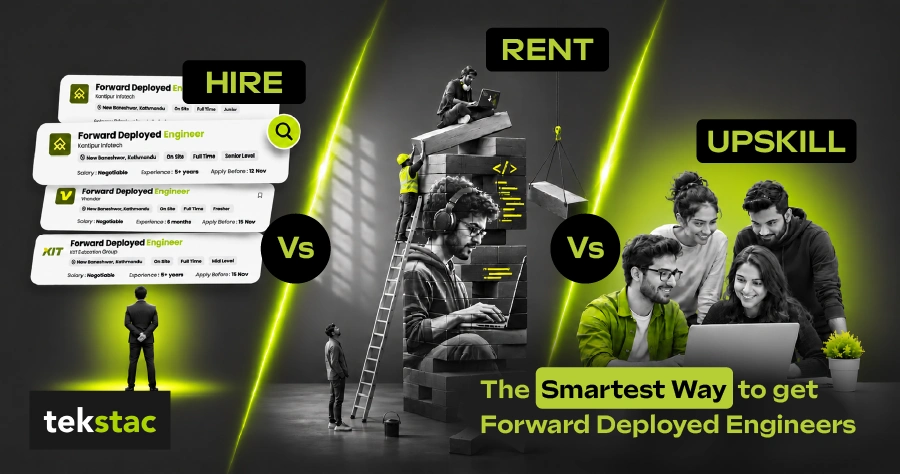
For CEOs, CTOs, CIOs, CAIOs, and other C-suite leaders, recognizing the immense value of a Forward Deployed Engineer (FDE) is only the first decision on the path to operational AI maturity. The harder, more complex question is this: Should you hire a full-time FDE internally, bring in fractional FDE talent for a defined period, or upskill your existing software engineering workforce?
Crafting the right FDE talent strategy is no longer just an HR concern; it is a critical business imperative that dictates whether your enterprise AI initiatives will generate measurable revenue or languish as expensive, unusable prototypes. The correct answer depends entirely on your organization’s AI maturity, delivery pipeline, internal engineering capability, time-to-value pressure, long-term demand, and tolerance for hiring risk.
Key Takeaways:
Demand for this specific role has expanded well beyond early pioneers like Palantir. Today, businesses urgently need versatile forward deployed engineering talent across multiple cities and functions. These roles span crucial areas such as model deployment, government integration, platform engineering, and technical deployment leadership.
The underlying reason for this surge is straightforward: The enterprise AI bottleneck is no longer about gaining access to foundational models. The bottleneck is deployment. Businesses urgently need versatile professionals who can seamlessly move between high-level architecture discussions, detailed user interviews, writing production code, structuring data, managing APIs, defining operational metrics, and driving executive outcomes, all without losing ownership or momentum between these stages.
The build-versus-buy decision in software is usually framed as a simple cost question. However, that framing is dangerously incomplete when it comes to highly specialized roles. The real tradeoff exists across four critical dimensions: cost, speed, flexibility, and institutional knowledge. If you want to successfully build an FDE team, you must evaluate how each path performs across all four of these dimensions.
What it looks like: This involves recruiting a full-time employee who is salaried and deeply embedded in your product or engineering organization. Supporting this path requires a mature FDE talent development infrastructure to keep high-priced talent engaged and growing.
Pros:
Deep Institutional Knowledge: This knowledge builds and compounds over time. An in-house FDE learns the idiosyncrasies of your codebase, understands your customers deeply, and navigates internal company politics smoothly, which becomes exponentially more valuable the longer they stay.
Complete Incentive Alignment: There are no conflicting client relationships or divided attention across other engagements. Their success is tied directly to your company’s success.
Scalability of Playbooks: Once the first deployment succeeds, an in-house engineer makes it easier to scale a repeatable playbook across multiple subsequent deployments.
Direct Control: You maintain direct control over the hiring bar, cultural fit, and long-term career progression of your team.
Cons:
High Salary Expectations: Forward deployed engineer salary ranges run exceptionally high, frequently landing in the $160,000 to $250,000 base range in the US (₹1.51 Crores to ₹2.35 Crores in INR) for experienced hires. This is before accounting for equity, bonuses, and the full load of corporate benefits.
Extended Hiring Cycles: Hiring cycles for this specific, rare skill set can take months. The pool of engineers who can simultaneously write flawless production code and gracefully manage a tense client relationship is vanishingly small.
Utilization Risk: Deployment work is inherently lumpy. You may desperately need three FDEs during a major six-month rollout and zero the following quarter. A full-time headcount does not flex down when demand wanes.
Retention Risk: FDEs are in incredibly high demand. Once trained and proven, they become prime targets for well-funded AI-native competitors looking to poach top talent.
What it looks like: Bringing in fractional FDE talent makes sense when you are testing whether agentic AI deployment is the right investment before hiring a full-timer to your FDE talent strategy.
Pros:
Cost Efficiency: Your cost scales directly with actual usage. You pay for weeks or months of intense deployment work, not a year-round salary for someone who might be underutilized during slow periods.
Dramatic Speed: Speed to start is a major advantage. A fractional hiring arrangement can typically place an experienced engineer on the ground in weeks, rather than the months a full-time executive search requires.
Cross-Industry Pattern Recognition: A fractional FDE who has already executed a dozen agentic AI implementations across different industries brings invaluable knowledge of failure modes and architectural shortcuts that an in-house first-timer simply has not seen yet.
Supreme Flexibility: If you need two engineers for an intensive three-month sprint and then need to scale down to one for ongoing maintenance, fractional structures make that adjustment straightforward and painless.
Cons:
Fading Institutional Memory: You risk developing less deep, long-term institutional memory unless the engagement is specifically structured for continuity and handoff.
Partner Dependency: This path requires a trusted staff augmentation or consulting partner with a real, vetted bench of qualified talent, rather than a firm that merely resells generic contractors.
Coordination Overhead: There can be significant coordination overhead if the fractional engineer is juggling multiple clients simultaneously, potentially leading to divided focus.
While the debate often centers on hiring externally or renting fractional talent, the smartest FDE workforce strategy for many established enterprises involves looking inward. The 2026 report from Boston Consulting Group (BCG) states it perfectly: “The talent is already on your payroll. The clock isn’t.”
The tech services market is staring down a massive $100-200B Applied AI opportunity by 2030. However, to capture this, the delivery model must fundamentally change. Currently, AI-native firms place approximately 45% of their Applied AI talent in forward-deployed roles. In stark contrast, traditional Tech SIs place under 5% of their talent in these critical, client-embedded positions.
Instead of paying massive premiums for external hires, organizations must invest heavily in forward deployed engineer training. BCG’s analysis of over 2,500 AI-tagged postings revealed 40 distinct Applied AI roles, and crucially, every single one has a direct internal lineage to a role a company already employs.
However, transitioning existing staff into these roles requires rigorous FDE workforce development. For example, transitioning a traditional Data Scientist into a Forward-Deployed Engineer requires 3x the upskilling effort compared to moving a Data Engineer into an AI Data Engineer role. This is because the FDE path demands adding completely new skill layers: agentic orchestration, AI platform operations, rigorous evaluation, and, importantly, client advisory and commercial ownership.
Tekstac can help make that transition possible. Its FDE upskilling programs help organizations turn existing software engineers into deployment-ready Forward Deployed Engineers through structured, role-based learning paths.
Want to build your next generation of FDEs from within? Book a demo today.
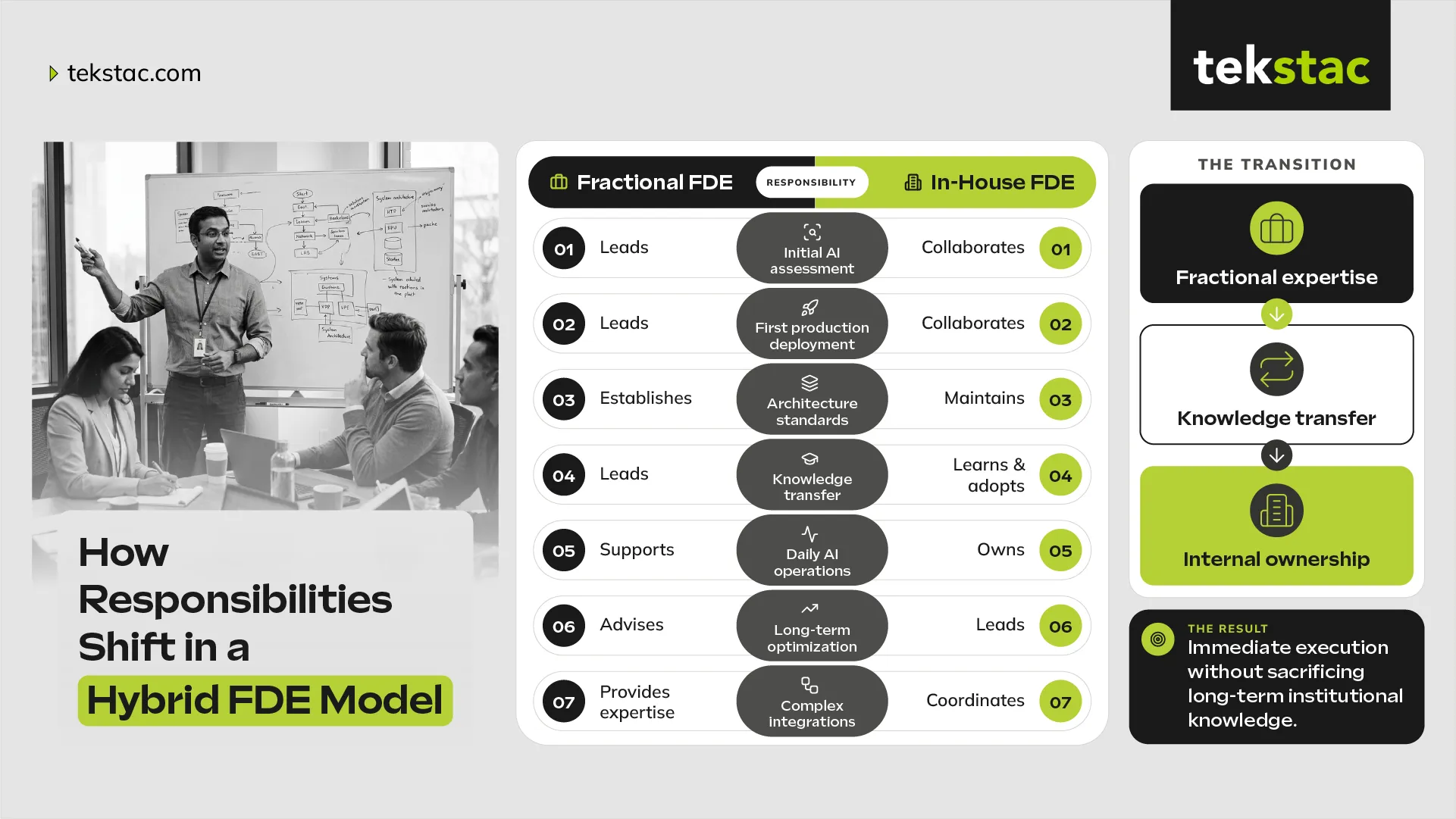
For most enterprises, the build-versus-rent decision does not need to be binary. The most effective approach often begins with fractional FDE talent to generate immediate momentum, followed by a transition to an internal capability built through targeted training and strategic hiring.
A practical hybrid model unfolds in five phases:
This hybrid model dramatically reduces hiring risk, accelerates immediate time-to-value, and ultimately preserves long-term institutional ownership of your AI infrastructure.
| Comparison factor | Hire | Rent | Upskill |
| Cost | High salaries and recruitment costs | Pay for the time and expertise required | Investment in training and upskilling |
| Speed | Can take months to hire | Faster onboarding, often within weeks | Takes time to develop the required skills |
| Flexibility | Fixed headcount and commitments | Scale up or down based on project needs | Builds long-term internal capacity |
| Expertise | Brings dedicated FDE expertise | Access to experienced specialists | Builds on existing technical and business knowledge |
| Knowledge retention | High; knowledge builds over time | Requires planned knowledge transfer | High; skills stay within the organization |
| Best suited for | Sustained, high-volume deployment needs | Pilots, short-term projects, and immediate expertise | Long-term FDE capability building |
The takeaway: Hire for long-term capability, Rent for speed and flexibility, and Upskill for dedicated ownership. For many enterprises, combining all three offers the most practical path to building an FDE team.
Moving from AI experimentation to full-scale, revenue-generating production requires bridging the gap between cutting-edge models and legacy enterprise realities. Whether you choose to hire aggressively, rent fractional experts, or invest deeply in training your existing workforce, your FDE talent strategy must be deliberate. By understanding the true costs, acknowledging the 3x upskilling effort required, and carefully mapping your utilization rates, you can execute an AI deployment strategy that turns today’s workforce into tomorrow’s competitive advantage.
Upskilling existing engineers can be more cost-effective than hiring experienced FDEs, particularly when companies already have strong engineering talent. It also reduces recruitment costs, shortens talent acquisition cycles, and creates new career opportunities for existing employees.
Relying entirely on external talent can create challenges around cost, availability, knowledge retention, and continuity. Companies may also become dependent on external specialists for customer-specific knowledge and critical AI deployment capabilities.
Companies should decide whether to buy, borrow, or rent FDE talent based on their immediate project requirements, existing workforce capabilities, budget, and long-term business goals.