
Forward Deployed Engineer readiness is the measure of an engineer’s ability to transition from executing isolated technical tasks to autonomously discovering, building, and delivering end-to-end business outcomes in client-facing environments. Assessing this readiness requires organizations to move beyond traditional coding tests and evaluate engineers through realistic customer journey simulations. Ultimately, it determines whether an engineer can handle ambiguity, align cross-functional stakeholders, and drive a technical solution from initial concept through production without requiring constant managerial oversight.
The AI revolution is fundamentally reshaping the competitive landscape of IT services and enterprise software delivery. While many engineers can now use AI tools to write code faster, speed alone does not translate into business value. The critical gap in today’s tech workforce is not AI proficiency, but the complete skill set required to deliver autonomous customer outcomes.
Organizations that successfully transform their engineering workforce from traditional, internally focused developers to Forward Deployed Engineers (FDEs) are positioned to capture greater value in the coming years. This is not merely a staffing trend; it is a strategic business imperative for CXOs.
FDEs are central to this new delivery model. They build deeper client relationships, uncover opportunities that traditional developers may miss, and drive customer value. But how do you know if an engineer is actually ready to be deployed to the front lines?
Assessing Forward Deployed Engineer readiness begins with understanding that this is not simply an incremental skill upgrade. It is a shift in professional identity and accountability.
| The AI-Enabled Engineer | The Forward Deployed Engineer |
| Uses AI and coding to deliver defined engineering work. | Uses engineering and AI to deliver a customer outcome. |
| Works strictly from provided requirements. | Discovers the root problem before building. |
| Owns a specific component or ticket. | Owns the end-to-end solution and its business impact. |
| Escalates major ambiguity to product managers or architects. | Makes informed decisions with incomplete information. |
| Stops at code deployment. | Stays accountable through production, adoption and value realization. |
To evaluate an engineer’s readiness for client deployment, leadership must look for evidence of four interconnected capability shifts. Excellence in one or two areas is insufficient; effective FDE performance requires a balance of all four.
Traditional engineers often work with clearly scoped Jira tickets. FDEs clarify workflows, pain points, constraints and the actual business problem before proposing a technology solution.
A ready FDE looks beyond their assigned code repository and remains accountable for the complete customer result.
FDEs must build trust and alignment across a complex network of business leaders, engineering teams, enterprise architecture and security stakeholders.
FDE readiness means owning the evaluation, reliability, user adoption, cost management and measurable value of a solution, not just its initial deployment.
One of the most common mistakes technology leaders make when developing and assessing FDEs is over-indexing on technical skills while overlooking the business and interpersonal capabilities that differentiate FDEs from strong back-end engineers.
Technical foundations such as full-stack development, cloud infrastructure, RAG architecture, AI agents, debugging, observability and cost awareness are essential. However, they are only part of the Forward Deployed Engineer skills required for successful client deployment.
The real differentiators lie in structured inquiry, comfort with ambiguity, customer empathy, rapid experimentation and the ability to influence without formal authority.
In its February 2026 research, Gartner highlights the growing pressure on IT services leaders to align contracts with business outcomes, innovation and cost objectives. Delivering on these expectations requires engineers who can take ownership beyond individual technical tasks.
For organizations building FDE teams, this reinforces the need for a balanced Forward Deployed Engineer competency framework that evaluates both engineering depth and the ability to work effectively with customers.
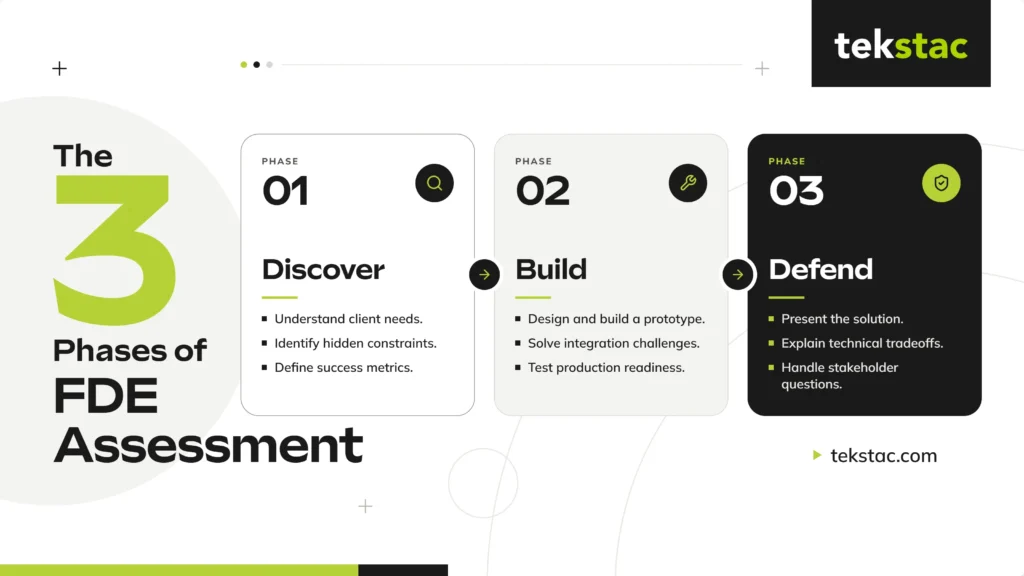
An effective Forward Deployed Engineer assessment should not rely on isolated algorithmic interviews or standard whiteboard coding sessions. FDEs must be evaluated through realistic customer journey simulations that test their ability to discover, build and defend a solution.
Here is a practical approach to evaluating engineers before customer deployment.
In this phase, provide the candidate with a vague, contradictory or incomplete client request.
The Task: The candidate must conduct a mock discovery session, uncover hidden assumptions and define success measures without receiving a complete technical specification.
What to Evaluate: Score the quality of the questions asked. Does the candidate structure ambiguous information effectively? Do they recognize unstated constraints, such as data privacy requirements or legacy system limitations? Do they define clear, measurable success criteria before writing a line of code?
These exercises can also form part of Forward Deployed Engineer interview questions, helping interviewers understand how candidates approach unfamiliar customer problems rather than simply testing what they already know.
FDEs still need to be strong builders. In this phase, transition the candidate from discovery to execution.
The Task: The candidate must choose an architecture, build a working prototype and respond to a simulated production failure or integration blocker midway through development.
What to Evaluate: Evaluate architectural choices based on how well the candidate explains their trade-offs rather than strict adherence to technological preferences. Assess their ability to produce working code under time pressure, their debugging methodology and their foresight regarding production readiness, including scalability, security and logging.
This is where a Forward Deployed Engineer technical assessment becomes particularly important. A hands-on engineering assessment should test practical capabilities such as API integration, system integration, cloud infrastructure, troubleshooting and production debugging.
Here, Tekstac FDE Framework can serve as a useful reference when designing evaluation criteria around secure development practices, vulnerability management and software release readiness.
An FDE must be able to stand in front of a client’s steering committee and justify their decisions.
The Task: The candidate must present their rollout strategy, risk controls and expected business outcomes to a panel acting as mixed stakeholders, such as a highly technical client CTO and a non-technical VP of Operations.
What to Evaluate: Focus on their ability to translate complex technical decisions into plain business language. Assess their stakeholder listening skills, how they articulate trade-offs and their ability to remain confident under challenging questions.
Together, these three phases provide a practical way to measure engineering readiness for client projects, covering problem discovery, technical execution and customer communication.
A suggested Forward Deployed Engineer readiness assessment model could look like this:
| Assessment Dimension | Weight | What to Evaluate |
| Engineering Judgment | 35% | AI engineering capability, architectural thinking, system integration expertise, evaluation frameworks and production depth. |
| Outcome Ownership | 25% | Reliability, user adoption, business value measurement and accountability beyond personal code commits. |
| Problem Discovery | 25% | Ambiguity handling, intellectual curiosity, assumption testing and rapid learning agility. |
| Customer Influence | 15% | Active listening, communication clarity, trust-building and stakeholder alignment. |
Organizations can use this model as an engineer readiness assessment, adapting the weightage to the complexity of the client environment, project requirements and expected level of autonomy.
Not every engineer should, or wants to, become a Forward Deployed Engineer. Attempting to transform the entire engineering workforce will likely result in organizational disruption, burnout and client dissatisfaction.
Instead, adopt a selective, strategic approach.
This approach also creates a continuous development cycle: identify potential, assess existing capabilities, address skill gaps, provide practical learning experiences and reassess before deployment. A structured pre-deployment readiness assessment can help organizations determine whether an engineer is ready to work independently, needs further development or requires additional support.
The FDE capability gap represents both a strategic vulnerability and a significant competitive opportunity. Leadership teams must ask themselves honestly: How many of our engineers could we confidently deploy alone into a highly ambiguous customer environment and trust to deliver an end-to-end solution?
If the answer is a small fraction, the organization has significant risk concentration.
The path forward is clear. Organizations that build systematic FDE capability will be better positioned to compete in premium market segments. Those that continue hiring solely for tool proficiency and coding speed risk remaining trapped in commoditized delivery models with eroding margins.
Ultimately, Forward Deployed Engineer readiness should not be determined by a job title, years of experience or the number of technologies an engineer knows. It should be established through demonstrated evidence of technical judgment, problem discovery, ownership and customer-facing capabilities.
A structured practical assessments and targeted development gives organizations a more reliable way to identify who is ready for deployment, who needs further preparation and where capability gaps remain.
The goal is not simply to build more engineers who can code. It is to build engineers who can understand customer problems, navigate complexity and turn technology into measurable business outcomes.
1. How is a Forward Deployed Engineer assessment different from a traditional coding assessment?
A traditional coding assessment primarily evaluates programming knowledge, logical thinking and problem-solving ability. A Forward Deployed Engineer assessment evaluates a broader set of capabilities, including how an engineer interprets unclear requirements, makes architectural decisions, handles integration challenges and communicates solutions to stakeholders.
2. What should a Forward Deployed Engineer technical assessment include?
A Forward Deployed Engineer technical assessment should include practical exercises involving coding, API integration, cloud environments, system design, troubleshooting and production debugging. It should also evaluate how engineers handle security constraints, scalability and integration challenges in realistic customer environments.
3. When is an engineer ready for client deployment?
An engineer is ready for client deployment when they can independently understand customer requirements, make sound technical decisions, build and troubleshoot solutions, communicate with stakeholders and take ownership of production outcomes.