
Today, traditional methods of building and shipping software are no longer sufficient. Organizations are quickly realizing that having powerful AI models is entirely different from actually making those models work securely and effectively within complex business environments. This is where forward deployed engineering comes into the picture.
As businesses look to transition from experimental AI to scalable, production-grade systems, understanding and adopting a structured AI deployment strategy is critical for long-term success.
At its core, a forward deployed engineer does much more than write code. They operate as a hybrid between a software engineer, solutions architect, and technical consultant. They work directly with stakeholders to understand messy, real-world workflows, identify opportunities for AI integration, and build scalable solutions inside the customer’s actual technical infrastructure.
These roles differ significantly from traditional engineering positions. While a conventional software engineer might focus entirely on building core product features in a sanitized environment based on a product manager’s specifications, the forward deployed engineer is actively involved in the problem-discovery phase.
| Forward Deployed Engineer (FDE) | Traditional Software Engineer |
| Core Focus: Customizes, integrates, and deploys AI solutions directly into client environments. | Core Focus: Builds, maintains, and scales foundational internal products and features. |
| Collaboration: Highly client-facing; embedded directly with business stakeholders. | Collaboration: Internally focused; works closely with product managers and other developers. |
| Work Environment: Writes code within messy, external, and legacy customer infrastructures. | Work Environment: Writes code in controlled, standardized internal systems. |
| Problem Solving: Navigates high ambiguity to solve unstructured, real-world business problems. | Problem Solving: Builds highly structured technical requirements and defined user stories. |
Moving AI from a flashy proof-of-concept to a reliable production system is the defining challenge for today’s technology leaders. This transition is precisely why forward deployed engineering matters so deeply for enterprise AI deployment.
Moving AI from experimentation to production: Many organizations have successfully piloted AI, but scaling it across the enterprise is a massive hurdle. FDEs possess the exact skill set required to navigate the “last mile” of implementation, dealing with latency, data governance, and system integration to ensure models function predictably in production environments. Bridging business and technical teams: There is often a profound disconnect between what business leaders expect AI to do and what technical teams are building. FDEs speak both languages fluently.
General-purpose AI tools are impressive, but the real ROI comes from solving highly specific business bottlenecks. FDEs dive deep into proprietary workflows, customizing algorithms and integrations so that the technology directly addresses a unique customer pain point rather than offering a generic capability.
Because they are embedded on the front lines, FDEs bypass the traditional, slow feedback loops of conventional software development. They prototype rapidly, test in real environments and accelerating the speed at which organizations realize value from their AI investments.
Building this capability requires more than just changing job titles. It requires a fundamental shift in how you deploy technical talent. McKinsey’s research highlights that while 88% of organizations are using AI in at least one function, only about 39% have mature deployments operating beyond the pilot stage.
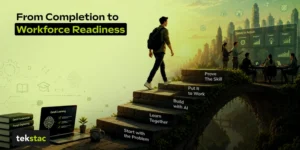
Here is the step-by-step framework to bridge this gap:
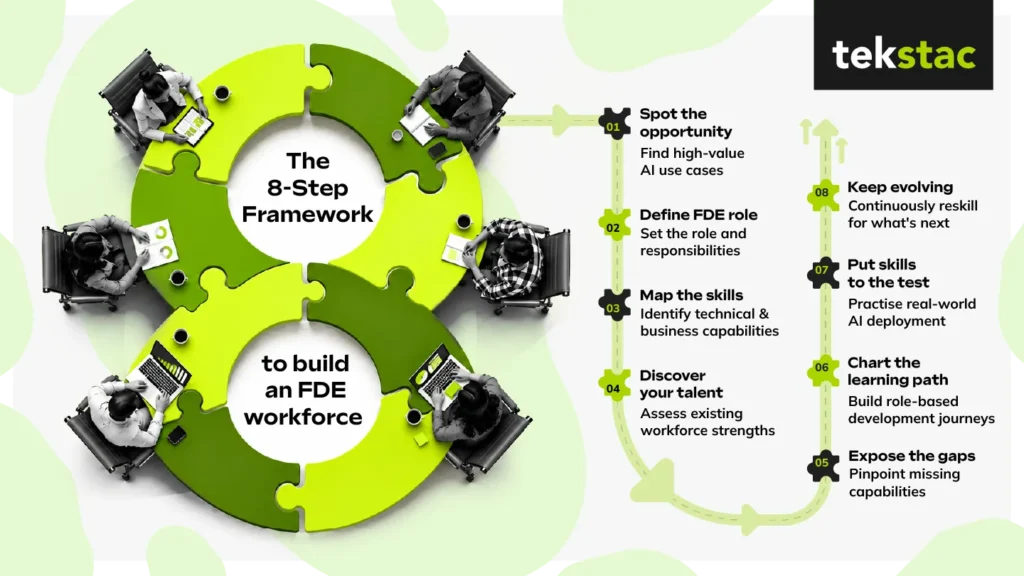
A forward deployed engineering strategy is only as strong as the talent executing it. These engineers require a rare “T-shaped” skill profile. The prominent skills include having a strong fundamental in coding, version control, and system architecture to write robust production code. Practical experience with applied AI is non-negotiable. This includes knowledge of retrieval-augmented generation (RAG), model fine-tuning, and prompt optimization. The resilience to enter a highly ambiguous customer environment, identify the root technical blockage, business acumen to understand why a workflow matters to the company’s bottom line are some of the important ones.
Explore the essential skills for Forward Deployed Engineering and learn how to build the capabilities needed for real-world deployment.
To successfully execute an enterprise AI implementation, you must accurately measure your organization’s current readiness.
This involves assessing talent across multiple dimensions:
Crucially, learning must move beyond theory. Incorporate hands-on labs where engineers can practice building integrations in simulated environments. Pair this with real-world projects where trainees shadow experienced FDEs on actual client deployments. Establish robust mentoring networks to help them navigate the political and communicative challenges of the role, followed by continuous reassessment to track their growth.
This is where leveraging an enterprise upskilling and skills intelligence platform like Tekstac becomes invaluable. By utilizing intelligent capability mapping and hands-on deployment labs, organizations can systematically identify, train, and deploy internal talent, seamlessly pivoting their workforce toward the future of AI engineering.
Transitioning to an FDE-first organization is no longer just an operational upgrade; it is a strategic necessity for survival in the AI era. The companies that will win the AI race are not those with the most expensive models, but those with agile teams capable of solving messy, real-world workflow problems directly at the source.
A successful enterprise AI deployment requires bridging the gap between theoretical software development and front-line business execution. By adopting a robust forward deployed engineering strategy, organizations can ensure their AI investments don’t just sit in a sandbox, but actively translate into measurable ROI.
Building this foundation and driving true AI workforce transformation requires a commitment to continuous learning. This is where an upskilling and skills intelligence platform like Tekstac becomes an invaluable partner. By utilizing targeted capability mapping and hands-on deployment labs, Tekstac equips your existing talent with the exact technical and consultative skills needed to master the last mile of AI implementation, ensuring your entire organization is built for the future.
1. What is the hottest emerging role in the IT industry right now?
Forward Deployed Engineer (FDE) is emerging as a notable role in the AI era. FDEs combine software engineering, AI implementation, systems integration and customer problem-solving to turn technology into working solutions in real business environments. As enterprises move from experimenting with AI to deploying it in production, this combination of skills is attracting growing attention.
2. How do enterprises build FDE teams?
Enterprises build these teams by identifying high-value AI use cases, assessing their current technical workforce for individuals with strong communication skills, and establishing targeted upskilling programs featuring hands-on deployment labs.
3. Can a Software Engineer become a Forward Deployed Engineer?
Yes. Software engineers with strong coding fundamentals can transition into FDE roles by developing additional skills in AI implementation, systems integration, customer discovery and production deployment. Building end-to-end solutions and demonstrating the ability to solve real business problems can help prepare them for the transition.
4. What is the Palantir FDE model?
The Palantir Forward Deployed Engineer (FDE) model places engineers close to customers to understand complex business problems, build tailored software solutions, and deploy them directly in real-world environments. Rather than working solely from product requirements, FDEs collaborate with customers to translate operational challenges into working technology, gather feedback, and help drive adoption. The model combines software engineering, customer discovery, and hands-on implementation to bridge the gap between technology and business outcomes.