What happens when cost centers start becoming innovation hubs? When your “support team” begins leading global digital strategy? That’s the story of Global Capability Centers (GCCs) today.
Global Capability Centers (GCCs) — offshore or nearshore units set up by multinational corporations to consolidate functions like IT, finance, analytics, and increasingly, digital innovation — are no longer back-end operations units.
“You can’t power the future with a leadership model built for the past“.
This is where the Chief Human Resources Officer (CHRO) must step in, not just as an HR function head but as a transformation architect. One who doesn’t merely manage talent but champions transforming leadership re-engineering mindsets to drive performance, agility, and innovation.
The scale and sophistication of GCCs are growing rapidly. India, for instance, now houses over 1,580 GCCs employing more than 1.66 million professionals (NASSCOM, 2024). McKinsey observes the “10/30/50 approach”: 10% of enterprise leaders, 30% of global talent, and 50% of new-age skills now sit in GCCs- signaling their shift from support arms to innovation powerhouses.
This evolution demands a mastery of leadership skills—shifting focus from managing processes to managing outcomes, from task execution to strategic thinking, and from local efficiencies to global collaboration.
Leadership- more than technology- is the defining factor in this transformation.
Mindset is central to leadership transformation because tools and processes cannot change how leaders make decisions, tolerate risk, or drive innovation. In GCCs, where operational habits run deep, mindset is the upstream blocker that every downstream capability program depends on.
GCC leadership often lags in this area. Built in traditional operational models, leaders tend to exhibit behaviors that are risk-averse, delivery-focused, and hierarchical. This doesn’t fit today’s environment that thrives on innovation, agility, and digital thinking.
A 2024 Deloitte Human Capital Trends report reveals that only 21% of GCC leaders feel prepared to lead in a digital-first, innovation-driven world
CHROs must be deliberate in shifting these deep-seated beliefs and behaviors, and that starts with reimagining how leadership is defined, developed, and deployed in the GCC context.
CHROs drive leadership transformation in GCCs through five core strategies: redesigning development programs to mirror business goals, enabling strategic thinking over execution, using people analytics to personalize growth, building inclusive leadership archetypes, and redefining success metrics for the innovation era.
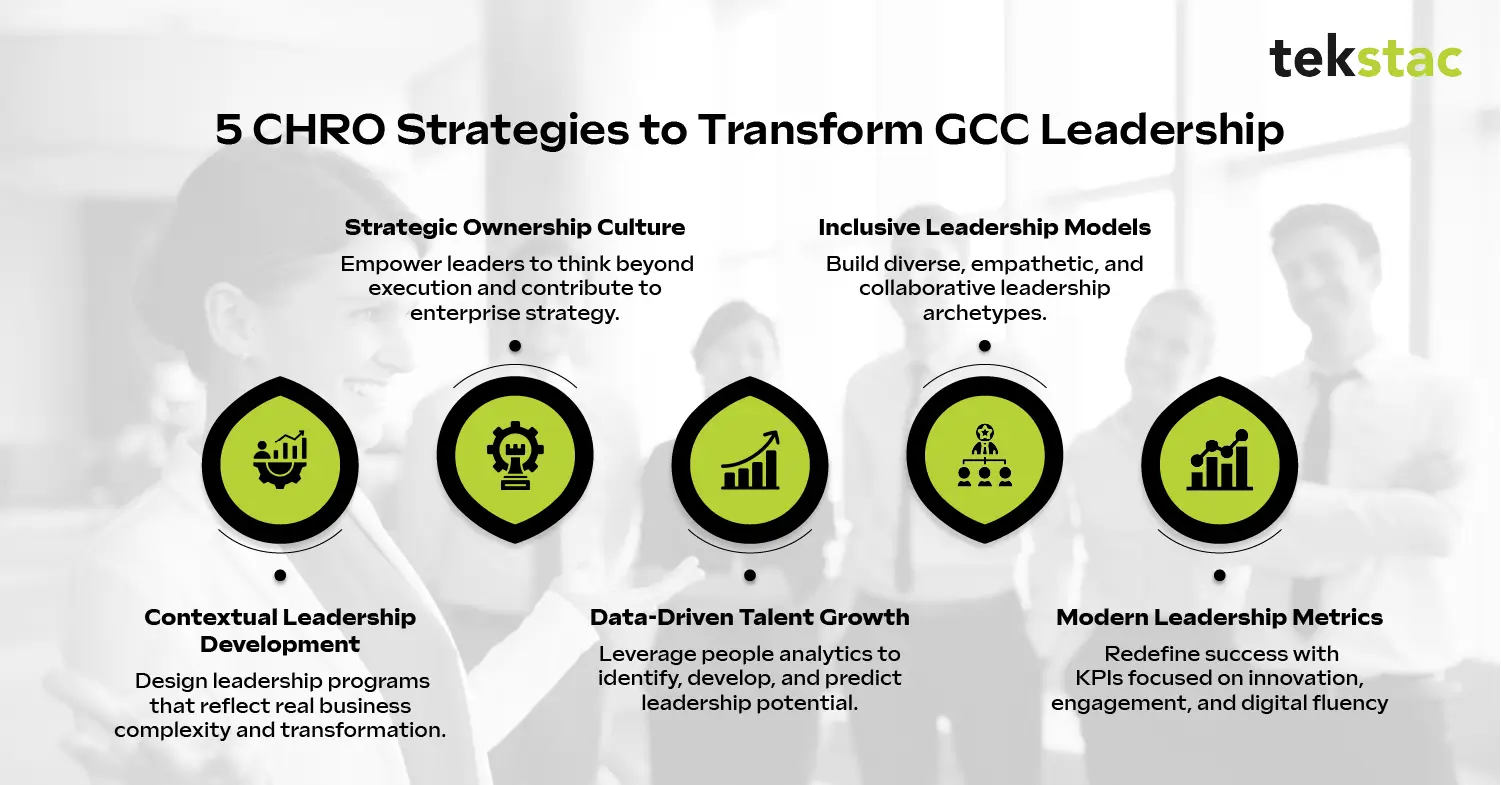
The problem: Most leadership development programs within GCCs are standardized, generic, and often imported from global HQs without contextual relevance. These programs fail to address the unique blend of operational, cultural, and innovation demands that GCC leaders face.
CHRO solution: Redesign leadership development to mirror real-time enterprise goals. Leaders must experience challenges that are ambiguous, complex, and cross-functional, just like the world they operate in.
End goal: Leaders don’t just learn- they transform how they think, lead, and solve.
The problem: Many GCC leaders still operate in a “tell me what to do” culture. They focus on executing HQ directives instead of questioning, innovating, or suggesting strategic improvements. This restricts the GCC’s potential to lead value creation.
CHRO solution: Empower leaders to own strategy, not just execution. This involves fostering a mindset shift from servitude to stewardship.
End goal: Leaders begin to act like entrepreneurs inside the enterprise—thinking bigger, faster, and beyond boundaries.
The problem: Leadership identification and growth are often subjective. Promotions are based on tenure, visibility, or “who you know,” rather than data-backed potential. This blocks real talent from emerging.
CHRO solution: Use people analytics for leadership transformation; measurable, personalized, and predictive.
Example: A GCC in the healthcare tech sector used behavioral analytics to identify that 65% of its mid-level leaders struggled with ambiguity. They rolled out a “Leading in Uncertainty” track, resulting in better decision-making speed during project pivots.
End goal: Talent decisions are no longer based on intuition- they’re based on intelligent, predictive, and personalized data.
The problem: Many existing leadership models are still built on outdated ideals- assertiveness, dominance, and output over empathy, inclusion, and long-term impact. This makes leadership homogeneous and limits innovation.
CHRO solution: Build inclusive leadership archetypes rooted in modern behaviors- collaboration, adaptability, authenticity, and empathy. These models must reflect the diverse, global, and hybrid nature of today’s GCCs.
Some advanced GCCs are now using AI-based sentiment analysis tools to assess inclusion in everyday communication- emails, meetings, and feedback sessions.
End goal: Leaders become magnets for diverse talent and create spaces where all voices are heard, valued, and leveraged.
The problem: Too often, leadership success is measured by outdated metrics: output volume, team size, budget managed, or on-time delivery. These miss the essence of transformational leadership.
CHRO solution: Redefine leadership KPIs to align with enterprise innovation, human impact, and future readiness.
A US-based retail GCC shifted from individual performance ratings to team-based leadership effectiveness ratings, directly linked to team innovation output and engagement.
End goal: Leadership success becomes about what value you create, not what title you hold.
The CHRO is no longer responsible just for culture fit- they are responsible for culture shift.
This includes:
When CHROs lead mindset transformation at the top, the ripple effect is enterprise-wide.
A leading European banking GCC based in Bangalore recently transformed its leadership layer through a CHRO-led initiative called “Leadershift.” The program combined reverse mentoring, agile team rotations, leadership “lab” projects, and analytics-backed coaching.
Results in 12 months:
This proves that leadership transformation is not theoretical, it delivers measurable ROI.
By 2027, over 60% of GCCs will own end-to-end digital product portfolios (Bain & Company), requiring leaders fluent in cross-cultural collaboration, digital strategy, and ambiguity navigation. Building that leadership resilience now is the CHRO’s most urgent mandate.
This means that future-ready GCC leadership will be:
The CHRO’s influence is central to shaping this profile.
We often talk about digital transformation, but without leadership transformation, it’s just automation. GCCs need leaders who can unlock exponential value, not just optimize processes.
CHROs who act now challenging outdated norms, rewiring culture, and building innovation-ready mindsets — will determine which GCCs lead and which ones follow.
Tekstac helps CHROs and L&D teams build the skills intelligence infrastructure that powers leadership transformation — from predictive analytics to personalized development journeys. [Explore Tekstac for GCC Teams →]
1. Why do GCCs need leadership transformation?
GCCs have evolved from cost centers into innovation hubs — yet many leadership models have not kept pace. Without transformation, leaders remain order-takers rather than value creators, limiting the GCC’s ability to own digital strategy, drive agility, and compete globally.
2. What role does the CHRO play in GCC leadership transformation?
The CHRO acts as a transformation architect — redesigning leadership development programs, deploying people analytics, building inclusive archetypes, and redefining success metrics. They shift from managing HR to driving enterprise-wide culture and capability change.
3. How can people analytics support leadership transformation?
People analytics enable CHROs to make leadership decisions based on data rather than intuition. Through 360-degree feedback aggregation, predictive potential dashboards, and attrition risk tracking, organizations can identify who is ready to lead, who needs coaching, and where toxic leadership patterns exist.
4. How long does leadership transformation take in a GCC?
Results vary, but structured programs typically show measurable impact within 12 months. A European banking GCC reported a 37% increase in employee trust in leadership and 21% faster digital product cycle times after one year of a CHRO-led transformation initiative.
5. What metrics measure leadership transformation success?
Modern GCCs measure leadership transformation through innovation velocity, psychological safety scores, cross-team collaboration indices, engagement uplift post-leadership transition, and Digital Quotient (DQ) scores — not just output volume or team size.