
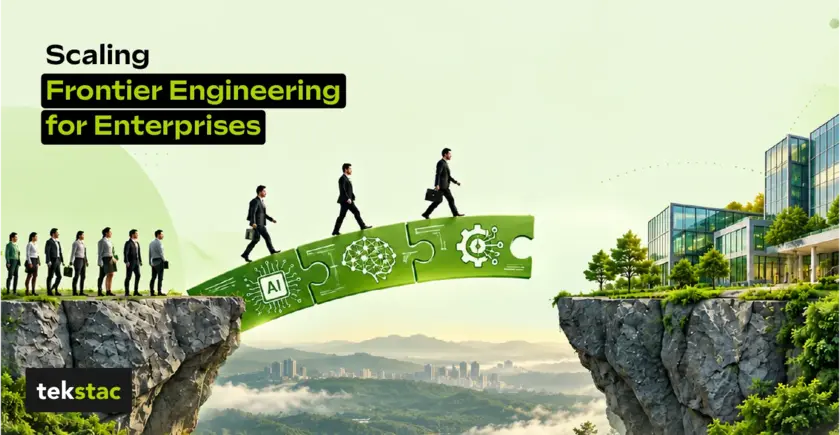
AI is changing the economics of software engineering. Frontier engineering is emerging as enterprises look beyond using AI as a coding assistant and toward fundamentally changing how engineering work gets done.
AI agents can increasingly support coding, testing, research and other development tasks. But the enterprise challenge is bigger than developer productivity. The question is no longer simply whether engineers can build software. It is whether they can define the right problem, direct AI systems, integrate them into existing environments, validate their output and take solutions into production.
The gap between experimentation and execution is where frontier engineering becomes important.
Frontier engineering for enterprises involve using AI and modern engineering to solve real business problems, from identifying the problem to building, deploying, and improving the solution.
Cognizant’s Frontier Certified Engineer is one example of an enterprise formalizing this emerging role. It combines software engineering with business-process redesign: understanding an existing workflow, identifying where AI agents, automation and people can create value, and then building and deploying the redesigned system.
The idea extends beyond a particular job title.
A frontier engineer needs to combine:
They can take an ambiguous business problem, determine where AI can help, build the solution, integrate it into the enterprise environment, test whether it works and improve it based on real-world outcomes.
“Frontier Certified Engineers who design for agentic outcomes, and Frontier Business Operators who own them, represent a new kind of professional, trained from day one to turn AI capability into business reality. The most important innovation of this decade may not come from AI itself, but from empowering every worker to use it.”
Thirumala Arohi
Chief Learning Officer, Cognizant
This shift comes at a time when AI adoption is growing rapidly, but enterprise-scale deployment remains difficult. McKinsey’s global AI survey found that 88% of surveyed individuals found that organizations use AI in at least one business function, while only 7% said AI had been fully scaled across their organizations.
Building an AI proof of concept is very different from building an AI capability that can operate reliably across an enterprise. Here are a few challenges of scaling AI engineering:
Enterprise AI engineering has to account for integration, security, data access, monitoring, evaluation, reliability and human oversight. Engineers need to understand not just how to build an AI application, but how that application fits into the larger business process.
The challenge is moving from “Can we build it?” to “Can we operate it reliably at scale?”
Most enterprises cannot start with a clean architecture. Critical workflows often depend on legacy applications, databases, APIs and systems that were not designed for AI. Replacing all of them is rarely practical.
The quality of an AI system depends heavily on the quality and accessibility of the information it can use.
Enterprise teams need reliable data pipelines, retrieval systems, evaluation datasets and appropriate access controls. Depending on the use case, techniques such as data augmentation, synthetic data and transfer learning can also play a role.
As AI systems become capable of taking actions rather than simply generating responses, governance becomes part of engineering.
Teams need to determine what an AI agent can access, which actions it can perform autonomously, when human approval is required and how its decisions and actions are evaluated and traced.
Enterprises don’t only need more AI specialists. They need existing engineers to become comfortable working with AI-native development, agentic systems, data, cloud infrastructure and automated evaluation.
That makes engineering workforce transformation a capability-building challenge, not simply a hiring challenge.
Building this capability does not necessarily mean creating an entirely new workforce.
For many enterprises, the starting point is the engineering talent already on payroll.
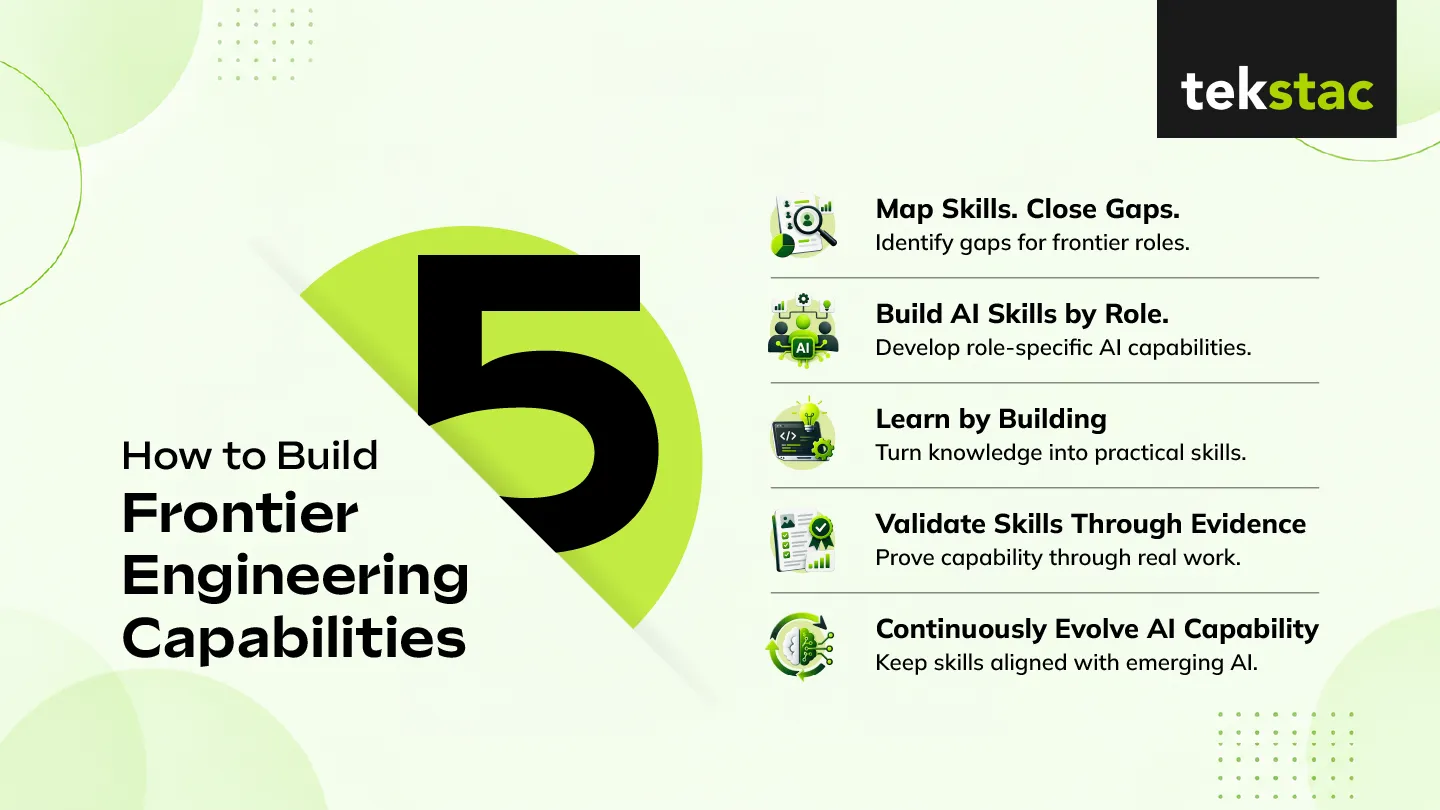
Map the capabilities your engineers already have across software engineering, cloud, data, AI and systems integration. Then identify the skills gap for the specific frontier roles the organization needs.
This creates a more useful picture than simply categorizing people as “AI-ready” or “not AI-ready.”
A backend engineer, cloud engineer and solution architect will not need the same AI capabilities. Their development paths should reflect the work they are expected to perform. This means moving beyond generic AI literacy toward role-specific AI upskilling for engineers.
Knowing how RAG works is different from building a RAG application. Knowing what an AI agent is different from building one that can interact with enterprise systems.
Frontier engineering capabilities therefore need hands-on practice with realistic problems, technology stacks, data and deployment scenarios.
Completion is not the same as readiness. For engineering workforce transformation to deliver meaningful results, enterprises need evidence of what engineers can actually build: working applications, evaluated outputs and demonstrated problem-solving.
This creates a shift from tracking learning activity to understanding capability at the individual, team and enterprise level.
Frontier engineering will continue to evolve as models, agent frameworks and enterprise architectures change. That means capability building cannot be a one-time AI training initiative.
Organizations need an ongoing system for identifying emerging skills, mapping them to roles, building those skills and validating capability against real work.
The next phase of enterprise AI will not be defined only by how many models an organization deploys. It will be defined by how effectively its people can turn those models into working systems and redesigned ways of doing business.
That is the opportunity behind frontier engineering.
For enterprises, the starting point is often closer than it appears: the engineers already building software, solving customer problems and operating critical systems. Rather than building AI capability only through new hiring, organizations can progressively equip these teams to take on AI-native engineering work.
That requires more than just AI upskilling for engineers. They need the right combination of technical skills, business context, hands-on practice and evidence that they can apply those skills to real problems.
This is where a structured capability-building approach becomes important. Enterprises can map the skills required for emerging engineering roles, identify gaps across their existing workforce, and create targeted development paths around areas such as AI engineering, agentic AI, cloud, data, application development and AI evaluation.
But learning alone is not enough. Engineers also need opportunities to work with realistic environments, build solutions on relevant technology stacks and demonstrate that those solutions work. Assessments, hands-on labs and project-based evaluation can help enterprises move from tracking learning completion to understanding actual engineering readiness.
Tekstac can support this progression by bringing together skills intelligence, role-based Learning Paths, hands-on labs, assessments and real-world project experience. This gives organizations a way to identify where capability exists, where intervention is needed and whether engineers are ready to apply their skills in the context of real enterprise work.
Want to build a frontier-ready engineering workforce? Book a demo with Tekstac.
1. How is frontier engineering different from traditional AI engineering?
Traditional AI engineering can focus primarily on building and deploying AI systems. Frontier engineering extends this into the business process itself; identifying where AI, automation and people should contribute, integrating the solution with enterprise systems and measuring its real-world outcomes.
2. What skills do frontier engineers need?
Frontier engineers need a combination of software engineering, AI and agentic AI, cloud and data engineering, systems integration, evaluation, security and problem-solving. Communication, adaptability and end-to-end ownership are also important because the role often involves ambiguous business requirements.
3. How can enterprises build frontier engineering capabilities?
Organizations can start by mapping existing engineering skills, identifying role-specific gaps and creating applied development paths. Hands-on projects, realistic environments and assessments can then provide evidence of whether engineers can apply those skills to real problems.
Agentic AI is rapidly moving from experimentation to enterprise adoption, and corporate learning is emerging as one of its most promising applications. From personalized learning journeys to real-time mentoring, agentic AI use cases are redefining how organizations build, validate, and deploy workforce capabilities. As enterprises look to close skill gaps faster and prepare employees for an AI-driven future, a new set of trends is beginning to shape the future of corporate learning.
Unlike a chatbot that waits for a prompt, an agentic AI system observes, decides, and acts; assessing a learner’s skill level, flagging a capability gap, recommending the next module, and adjusting the path the moment performance data changes.
An agentic AI system is distinguished by four traits:
Explore our in-depth AI in HR guide to understand how AI is transforming every stage of the employee lifecycle, from hiring and onboarding to learning, talent management, and workforce planning.
Gartner projects that 40% of enterprise applications will embed task-specific AI agents by the end of 2026, up from less than 5% in 2025; one of the fastest technology adoption curves the enterprise software market has seen. If you lead Learning & Development, Talent Management, Workforce Transformation, or Enterprise Skilling initiatives, these are 10 Agentic AI use cases worth knowing.
| Use Case | L&D Function | Reported Impact |
|---|---|---|
| Onboarding Agents | Role-based training assignment | Less manual HR effort |
| Compliance Training | Certification tracking & audit prep | Weeks of coordination saved/quarter |
| Adaptive Learning Journeys | Personalized content pathing | Higher completion rate |
| Skills Mapping & Gap Analysis | Live capability visibility | Better workforce readiness |
| Real-Time Analytics & Intervention | Disengagement detection | Increase in completions |
| Feedback Loops & Optimization | Sentiment-driven content fixes | Weeks-to-hours analysis time |
| Document-to-Course Generation | Automated content authoring | Faster development |
| Contextual Microlearning | In-flow, just-in-time delivery | Higher participation |
| Reinforcement Learning | Spaced retention prompts | Better retention scores |
| Automated ROI Measurement | Cross-system impact correlation | Faster ROI analysis |
AI tools are transforming HRTech in many ways. Employee onboarding is usually the first place agentic systems get deployed. These agents assign personalized learning paths, surface resources at the right moment, answer routine questions via AI chat, and track completion automatically, learning from every interaction to refine the next hire’s journey.
Compliance is repetitive by design, making it an ideal candidate for agentic ownership. Instead of relying on L&D coordinators to manually track certification expiries in spreadsheets, AI-driven employee training systems continuously monitor compliance, auto-assign refresher modules, generate audit-ready dashboards.
This is arguably the most cited of all agentic AI use cases, and for good reason; generic learning paths fail the moment a workforce has mixed experience levels. An AI agent continuously reads learner behavior, performance, and feedback, then adjusts content difficulty, skips mastered topics, and recommends the next-best module in real time.
Static skill matrices go stale the moment they’re published. Agentic AI in HR continuously integrates data from HR systems, performance reviews, and learning activity to maintain a live view of workforce skills and organizational capability.
Traditional L&D analytics report on what has already happened. Agentic systems intervene while it’s still happening. It reads engagement signals, quiz performance, and participation to detect a disengaging learner and automatically deploying a nudge before that learner drops off entirely.
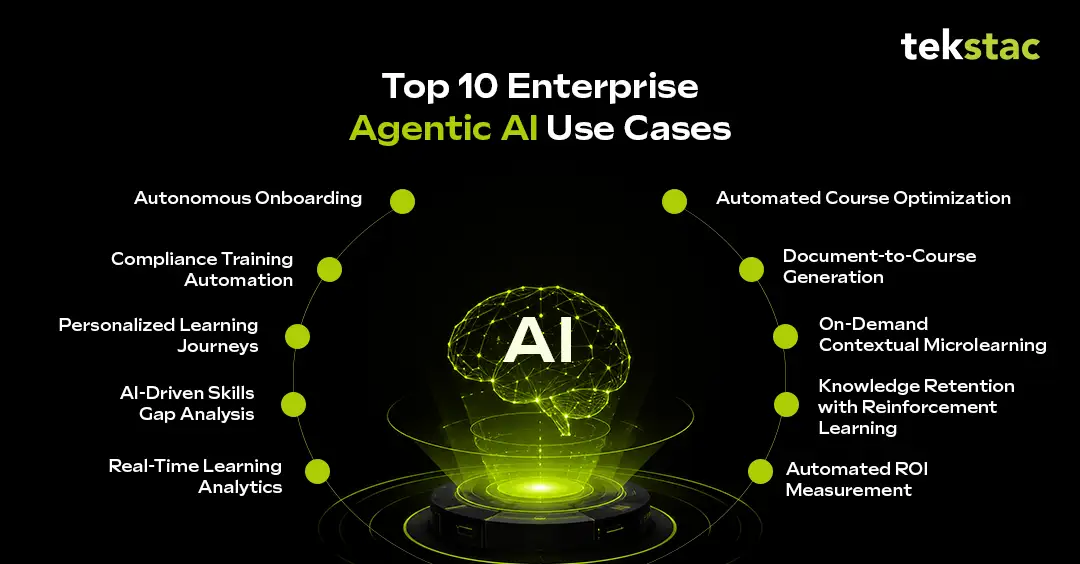
Post-training feedback is usually collected, then ignored for months. Agents surface what’s failing inside a no-code dashboard, and let L&D teams adjust content, pacing, or delivery style immediately.
Course creation is one of L&D’s most expensive bottlenecks; turning SOPs, manuals, and technical documents into structured learning content can take weeks per program. AI-driven employee training addresses this challenge by enabling intelligent content builders to read source documents, extract learning objectives, and automatically generate structured learning modules that L&D teams can review and refine.
Agentic systems deliver a short, relevant lesson at the exact moment it’s useful; a leadership tip before a 1:1, a compliance refresher before an audit, directly inside the tools people already use, like Slack or Teams.
The forgetting curve is L&D’s oldest problem, and agentic reinforcement is one of the more durable fixes. After a course ends, the agent schedules follow-up micro-quizzes, sends spaced summaries, and prompts scenario-based challenges to keep key concepts active in memory rather than letting them decay.
Proving L&D’s business impact has historically required manually correlating training records with performance data. Agentic dashboards now pull from the LMS, HRIS, CRM, and project tools simultaneously, correlating learning activity with productivity, engagement, or sales metrics in a continuously updating view. A telecom enterprise using this approach cut analysis time by 90% while giving leadership a far more transparent picture of training ROI.
SAP’s Value of AI Report 2026 projects that Indian enterprises will increase Agentic AI investment fivefold over the next two years. As organizations accelerate adoption, the challenge is no longer access to AI technology; it’s building the workforce capabilities required to use it effectively.
That challenge became evident for one of the world’s top five IT consulting and services organizations. Despite significant investments in AI learning programs, very few engineers had hands-on experience building and deploying multi-agent systems in production environments.
To bridge that gap, the organization partnered with Tekstac in January 2026 to launch a 1,200-engineer Agentic AI Project Accelerator. Designed around a project-first approach, the four-week program required engineers to build and deploy live multi-agent applications using CrewAI and LangGraph on real AWS and Azure environments. Every stage of the development process was automatically evaluated, scored, and supported with instant feedback.
The results are measured the way the thesis demands. In the first batch of 340 engineers, 40% have already built and shipped production Agentic AI applications, with 100% of project delivery auto-evaluated against capability rather than attendance.
AI fluency at work is already a thing, and the enterprise adoption curve is accelerating. And the most impactful agentic AI use cases are already moving beyond pilots into real-world workforce transformation initiatives.
For L&D and talent leaders, the opportunity is not simply to automate existing processes, but to rethink how skills are developed, measured, and applied at scale. Organizations that act now will be better positioned to build the workforce agility required in an AI-driven future.
Ready to accelerate your enterprise’s Agentic AI journey?
Book a demo to see how Tekstac can help your teams build production-ready Agentic AI capabilities.
1. What do you mean by Agentic AI use cases in corporate skilling?
Agentic AI use cases in corporate skilling refer to applications where AI agents can autonomously assess, decide, and take actions to support workforce development. Common agentic AI use cases include personalized learning journeys, skills gap analysis, onboarding automation, compliance management, learning analytics, coaching assistants, content generation, and workforce readiness tracking.
2. What type of AI agents are used in corporate upskilling initiatives?
Corporate upskilling initiatives typically use a combination of specialized AI agents rather than a single AI assistant.
Some of the most common types include:
3. What are some popular Agentic AI certifications and learning programs?
Popular options include certifications and programs focused on AI agents, multi-agent systems, LLM orchestration, autonomous workflows, and AI application development. To address this need, Tekstac offers specialized Agentic AI capability-building programs for enterprises.
Some commonly pursued learning paths offered by Tekstac:
4. How does Agentic AI improve enterprise learning and workforce upskilling?
Agentic AI improves enterprise learning by moving beyond static training programs to deliver personalized, adaptive, and outcome-driven learning experiences. Unlike traditional AI tools that simply respond to prompts, AI agents can autonomously assess employee skill levels, identify capability gaps, recommend tailored learning pathways, provide real-time coaching, and continuously adapt learning based on performance and business needs.
HR challenges include hiring qualified candidates, retaining talent, ensuring employee engagement, and complying with labor laws, among many others. In 2026, HR challenges are becoming more complex as the function sits at the intersection of workforce transformation, AI adoption, productivity, employee expectations, and rapid skill disruption.
However, one of the biggest challenges is the lack of clear visibility into workforce skills. Most organizations still don’t have reliable, role-level data on what their workforce can actually do, making it difficult to plan hiring, reskilling, internal mobility, and future workforce strategies effectively. The data tells a stark story. According to the WEF’s Future of Jobs Report 2025, 63% of employers globally identify skills gaps as the single biggest barrier to business transformation.
That gap between conviction and infrastructure is where organizations stall. Before looking at what modern skills intelligence platforms can solve, it’s worth being precise about what’s actually broken.
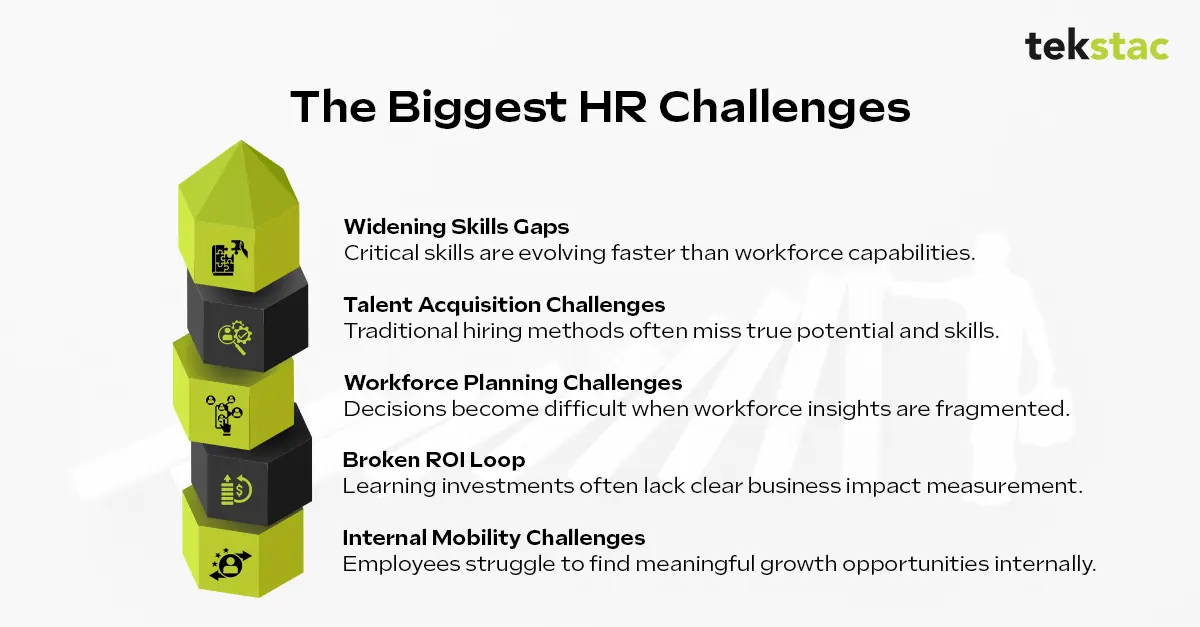
The WEF projects that 39% of workers’ current skill sets will be outdated or require transformation by 2030, and 59 out of every 100 workers will need reskilling or upskilling before then. More than 120 million workers globally are at medium-term risk of redundancy if that training doesn’t happen.
But the deeper problem isn’t the size of the gap. It’s the invisibility of it. Despite 98% of business executives agreeing that skills are becoming central to how organizations define work and value people (Deloitte), only 8% of those same organizations have reliable skills data to act on (Gartner, 2025). Training budgets get spent on generic programs, reskilling initiatives target the wrong gaps, and the skills drain caused by attrition goes unmeasured until critical project stalls.
As Jason Desentz, CHRO of Toshiba, noted at UNLEASH America 2026: “By 2030, successful organizations will be defined not by generational differences, but by a shared set of human skills that enable employees and managers to thrive alongside AI. These are no longer ‘nice to haves’ — they are the non-negotiable capabilities that HR leaders must intentionally cultivate.”
Hiring has grown more competitive and more expensive, but not more predictive. McKinsey data shows that 20–30% of key roles in many organizations are not filled by the most suitable people don’t exist, but because evaluation still relies on proxies: degrees, job titles, years of experience.
Strategic workforce planning is the second-highest HR priority globally, yet it ranks only 15th in current organizational capability, according to BCG’s “Creating People Advantage 2026.” What’s missing is a living, continuously updated picture of organizational skills; one that can inform decisions about internal mobility, succession, and whether to build, buy, borrow, or automate specific capabilities.
Patricia Frost, CHRO of Seagate, captures the challenge clearly: “Middle managers are really the powerhouse of any company. How well do they understand their teams and the skills within their teams, and understand also what people are passionate about?”
LinkedIn’s 2025 Workplace Learning Report reveals that 88% of organizations are concerned about employee retention and that providing learning opportunities is the top retention strategy. Yet most L&D and HR teams cannot demonstrate the business impact of development investment in terms that CFOs or boards respond to.
The gap between spend and provable outcome is a budget risk with compounding consequences. When HR ROI measurement can’t be quantified, training budgets become vulnerable at precisely the moment the skills crisis demands more investment.
As Mark Whittle, VP of Advisory in the Gartner HR practice, put it: “CHROs should take an enterprise-wide view of AI’s impact on work, the impact of change on leaders and employees, and how to evolve organizational culture to support performance expectations.”
Despite increased investment in internal mobility programs, mobility rates have remained flat. Only 24% of organizations have structured programs in place.
The barrier is rarely culture alone; it’s data. Without visibility into verified employee skills profiles, matching internal talent to new roles relies on manager networks and informal knowledge, which introduces bias. The result is a pattern that costs organizations on both ends: external hiring for those roles existing talent could fill, while tenured employees leave because they see no pathway forward.
Stacia Garr, Co-Founder of Redthread Research, captures the stakes at UNLEASH America 2026: “AI transformation will only deliver tangible results when HR, IT and the organization jointly own it — aligning on clear ROI, intentionally redesigning work, and preserving culture and connection as core differentiators.”
The most consequential shift in enterprise HR technology over the past two years has been the move toward skills intelligence platforms. As AI in HR continues to reshape workforce planning and talent decision-making, these platforms are becoming critical for organizations looking to build data-driven talent strategies. Skills gap analytics from these platforms allow HR leaders to prioritize development investments at the role, team, or organizational level.
Modern HR platform evaluation increasingly centers on predictive capability. By combining internal skills data with role demand signals, skills intelligence platforms help HR leaders anticipate which capability gaps will become critical in the next 6–18 months.
Skills data becomes significantly more actionable when it links directly to development content. Platforms that integrate skills gap analytics with curated learning pathways allow organizations to move from “we have a gap in data engineering” to “here are 14 engineers who are 60% of the way there, and here’s the 90-day pathway to close it.” This is the mechanism that transforms HR ROI measurement from an aspiration into a reportable business metric.
Tekstac is built as an enterprise skills intelligence platform that makes skills data the connective tissue between talent acquisition, development, and strategic workforce planning.
The platform gives organizations a validated, role-specific view of where their workforce stands against industry benchmarks. Rather than relying on self-assessments or anecdotal input, the platform runs structured auto evaluations that produce skills gap analytics at the individual, team, and organizational level. This enables the HR leaders identify which roles carry the highest capability risk and which internal talent is ready to step up.
For enterprises managing high-volume hiring or large-scale internal skills audits, The assessment engine combines adaptive, scenario-based questions with AI proctoring for enterprises. This ensures that the skills data entering your workforce planning decisions is accurate and trustworthy.
One of the clearest ways Tekstac supports HR ROI measurement is by connecting pre- and post-development skills data. When an organization runs an upskilling cohort, Tekstac shows how capability scores shifted, which roles are now better covered, and what the business impact looks like. This transforms the learning investment conversation from cost to measurable return.
The HR challenges of 2026 share a single root cause: organizations are making consequential decisions about their people without the skills infrastructure to make those decisions well.
Carrie Rasmussen, CHRO at Dayforce, frames the imperative plainly: “The old ways of deploying new technology will not suffice. CIOs and CHROs must move together. AI demands a unified mission.”
For HR leaders, the message is clear. The future of workforce transformation will depend on how effectively organizations can identify skills, close capability gaps, and align talent strategies with business goals. Explore how Tekstac can help your teams stay future-ready in an evolving world of work.
1. What are the current HR trends & challenges?
In 2026, HR leaders are navigating 5 challenges. Skills gaps are widening faster than hiring pipelines can fill them. Talent acquisition is shifting toward skills-based hiring, but most organizations lack the assessment infrastructure to operationalize it. Workforce planning remains largely reactive, with only 12% of companies having plans that extend beyond a single year (McKinsey). Employee retention is under pressure. And internal mobility, despite being a stated priority, stays flat because organizations don’t have reliable visibility into what skills their existing workforce actually holds.
2. How are HR leaders addressing the AI skills gap in 2026?
First, they’re building visibility using skills intelligence platforms like Tekstac to run structured assessments that reveal exactly where AI-related capability gaps exist at the team and role level. Second, they’re connecting that data directly to targeted learning pathways, so reskilling efforts are precise rather than broad. What’s changed in 2026 is the recognition that AI literacy isn’t a single skill; it spans prompt engineering, AI governance, human-AI collaboration, and role-specific application.
3. Why do most HR teams struggle to turn reskilling initiatives into measurable business outcomes?
Organizations invest in training but can’t connect it to performance, retention, or revenue. The answer naturally leads into why skills data infrastructure (assessments, benchmarking, pre/post tracking) is the missing link, which is exactly what Tekstac solves.
4. What are the top 5 HR priorities for 2026?
HR leaders are prioritizing closing skill gaps through upskilling and reskilling, integrating AI into HR and learning processes, and using skills intelligence platforms to gain better visibility into workforce capabilities. Improving employee retention and internal mobility has also become critical as organizations compete for skilled talent. At the same time, HR teams are expected to align talent and learning strategies more closely with business growth, productivity, and long-term workforce readiness.

For decades, organizations structured workforce strategies around jobs, and skill insights were rarely a priority. That model is now under pressure. According to research by Microsoft and LinkedIn, the skills employers require are expected to change by 50% by 2030 compared to 2016, with Generative AI potentially accelerating the shift to 68%.
Yet many organizations still struggle to answer a fundamental question: What skills actually exist within our workforce today? This visibility gap is pushing companies to rethink how they track and develop workforce capabilities, making skills intelligence a critical part of modern talent strategy. At the center of this shift is the concept of skill insights, which helps organizations make more informed, data-driven workforce decisions.
Skill Insights are comprehensive, analytics-driven evaluations of workforce capabilities. They combine multiple sources of data, such as assessments, certifications, project outcomes, and performance feedback, to create a dynamic understanding of employee skills.
Unlike traditional skills inventories that rely heavily on self-reported information, Skill Insights are continuously updated through workforce skills analytics and validated through learning activity and performance signals..
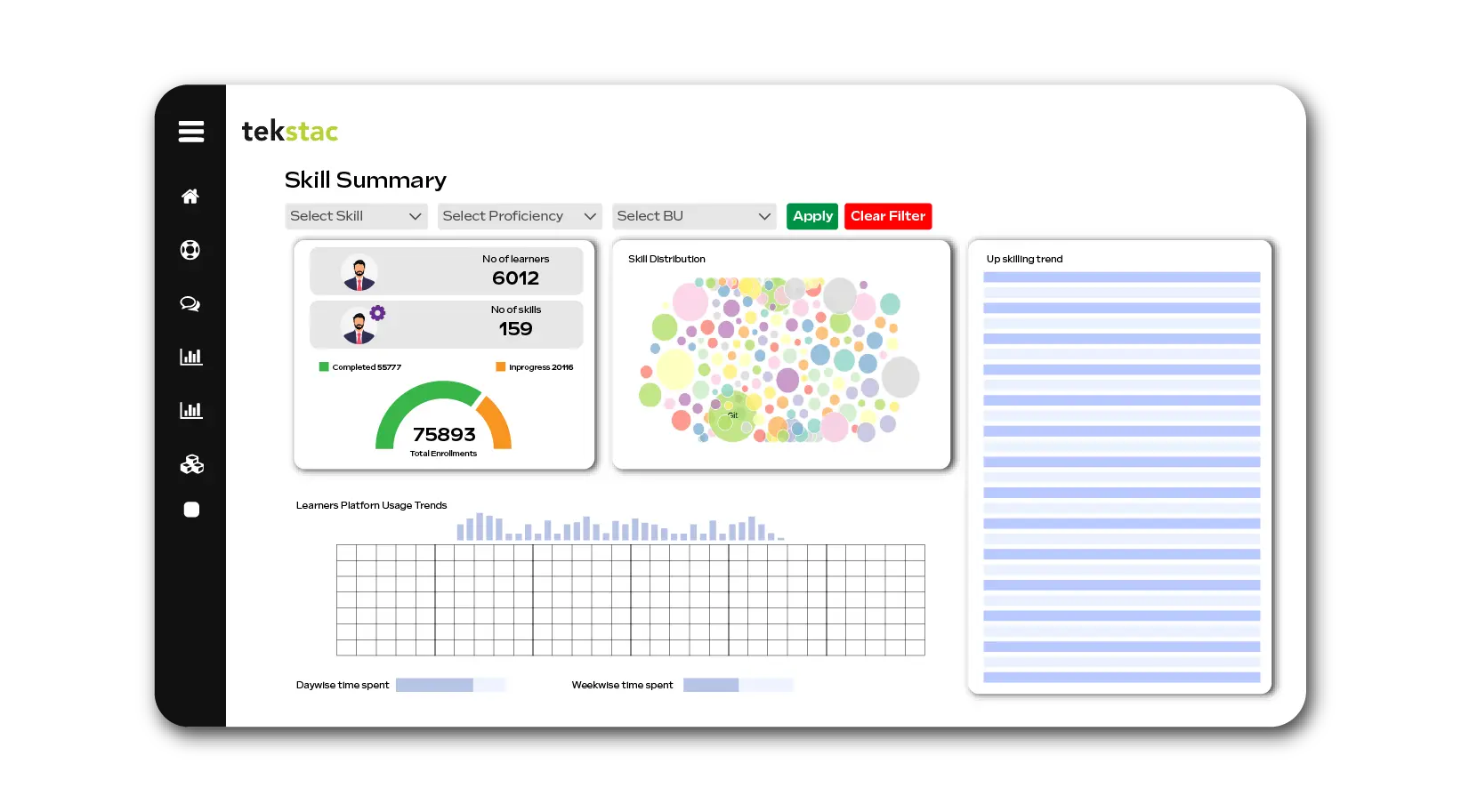
This approach enables organizations to move beyond tracking training participation and instead understand how capabilities evolve across teams and roles.
Through structured employee skills assessment, Skill Insights help organizations:
In practical terms, Skill Insights transform learning data into actionable talent analytics that inform workforce decisions.
47% of leaders list upskilling existing employees as a top workforce strategy for the next 12–18 months.
Organizations today face an unprecedented rate of capability change. Mere certifications will not suffice to prove we have skills- workforce. While IT certifications provide a strong foundation, organizations increasingly need hands-on labs to truly understand workforce capabilities.
According to the SHRM Talent Trends Report, 28% of organizations now require candidates to possess new skills for full-time roles, and 47% of those roles are existing positions that now demand updated capabilities.
This means that workforce transformation is not only about creating new roles; it’s also about redefining existing ones.
Meanwhile, the World Economic Forum’s Future of Jobs Report 2025 highlights another challenge: 63% of organizations cite skills gaps as the primary barrier to business transformation.
These trends are driving organizations toward skills-based workforce planning, where decisions about hiring, learning, and mobility are guided by skills data rather than static job titles.
When organizations lack visibility into workforce capabilities, strategic decisions become harder.
Skilling programs may target the wrong skills. Hiring strategies may overlook internal talent. Workforce planning may rely on assumptions rather than evidence.
The cost of this invisibility can be significant.
According to McKinsey research, 87% of organizations globally are already experiencing or expect to experience a skills gap within the next few years.
At the same time, the World Economic Forum estimates that nearly six out of ten workers will require substantial reskilling or upskilling by 2030 in order to keep pace with evolving job demands.
Without reliable workforce skill insights, organizations risk making workforce investments that fail to address the real capability gaps that affect performance and growth.
To generate meaningful Skill Insights, organizations typically build a structured workforce capability framework that integrates skills data, performance signals, and role requirements.
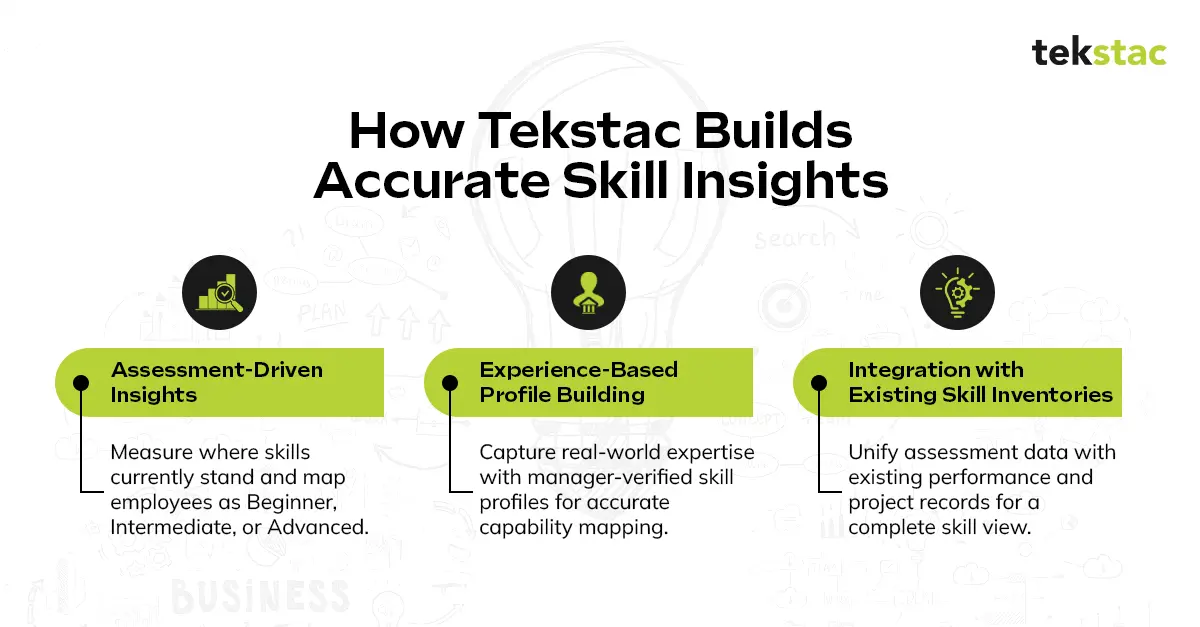
Skill Insights framework combines three powerful methods:
Assessment-Driven Insights
This allows employees to gauge their proficiency levels across specific skills. The results categorize individuals as beginner, intermediate, or advanced, providing a clear foundation for the organization’s skill inventory.
Experience-Based Profile Building
Not all expertise can be measured through assessments alone. For experienced professionals, we can enable the creation of skill profiles based on self-declared data, verified by managers, or cross-referenced with organizational records. This ensures that practical experience and institutional knowledge are accurately represented.
Integration with Existing Skill Inventories
Many organizations already maintain some level of skill tracking through performance reviews or project data. It can be integrated with insights from the pre-held assessments and learning modules.
Two key metrics often form the backbone of this framework.
The Skill Match Score evaluates how closely an employee’s current capabilities align with the requirements of their role.
This metric functions as a workforce “fitness indicator.” It shows whether employees possess the competencies necessary to perform their responsibilities effectively.
Beyond operational reporting, the skill match score can also support skills-based workforce planning. Employees with high match scores may be ready for expanded responsibilities, leadership roles, or more complex projects.
The Skill Gap Metric builds upon the skill match score by identifying capability deficiencies.
For example, if an employee’s match score falls below a defined threshold, the system flags this as a development need.
Aggregated across teams and roles, these insights allow organizations to conduct targeted skill gap analysis and design focused upskilling and reskilling strategies.
Our ultimate goal is to create a dynamic and evolving database of skill profiles, which we refer to as ‘SkillTag’. The idea behind SkillTag is to track and reflect the continuous development of skills over time, offering a comprehensive, real-time view of an individual’s expertise and growth.
Krishnan Unni, Chief Business Officer, Tekstac
Organizations rarely adopt Skill Insights all at once. Instead, they typically begin with one part of the talent lifecycle and gradually expand toward a more comprehensive skills-based model.
In our experience working with organizations embarking on this journey, they typically take one of three different approaches mentioned below.
Many organizations begin by redesigning L&D programs around skills rather than jobs.
One Fortune 500 Services Company, for example, began by shifting its skilling recommendations away from job-based training toward skills-based development pathways.
Courses were mapped to specific capabilities instead of job titles, allowing employees to develop targeted competencies aligned with business needs.
As the company expanded this approach to hiring and internal mobility initiatives, leaders realized that they needed a centralized workforce capability framework to support the transformation. This led to the development of an enterprise-wide skills hub that used skills as the core unit for managing workforce capabilities.
Other organizations start by creating the underlying infrastructure for skills management.
One of our IT clients began by developing a shared language for describing workforce capabilities that defined categories, proficiency levels, and relationships between skills.
This framework allowed the organization to map skills across roles and learning resources, identify high demand “hot skills,” and design more targeted development pathways.
Over time, the skills framework became the foundation for broader talent analytics, influencing recruitment, workforce planning, and compensation strategies.
A third approach focuses on the work itself rather than the structure of jobs, encouraging employees to demonstrate a willingness to learn at work. Some organizations are introducing internal talent marketplaces where projects and short-term assignments are matched to employees based on skills.
This allows employees to gain experience in new domains while organizations deploy talent more flexibly. Through structured skills insights, employees can assess their current capabilities, explore future roles, and develop plans to close skill gaps.
One of the biggest challenges in building a skills-based workforce is the portability of verified skills data. At the same time, structured skills development is increasingly becoming the foundation for sustainable career progression in modern organizations.
Some organizations are beginning to address this gap. For example, a defense organization introduced a platform that allows service members and veterans to record skills gained through training, education, and operational experience. By linking these records to a common framework, individuals can better understand how their capabilities translate to civilian roles and where further development is needed.
As organizations gain better visibility into workforce skills, career structures are evolving from traditional career ladders to more flexible career lattices, where employees build capabilities through cross-functional and cross-skilling opportunities. According to the ACCA Global Talent Trends Survey, 58% of employees expect their next career move to be outside their current organization, highlighting the importance of workforce skills analytics in supporting talent development and retention. These shifts are supported by workforce skills analytics, which help organizations identify adjacent skills and potential career transitions.
Skill Insights are increasingly shaping several core workforce strategies. Here are some of the ways in which they play a significant role.
By analyzing workforce capability insights, organizations can match employees to roles or projects based on their capabilities rather than their job titles.
This improves talent utilization while reducing reliance on external hiring.
Learning leaders use employee skills assessment data to design more targeted development programs.
Rather than delivering broad training programs, organizations can prioritize learning initiatives that address the most critical capability gaps.
Research from Gallup shows that 41% of employees say lack of time is their biggest obstacle to participating in training programs.
Skill Insights help organizations ensure that learning time is invested where it will deliver the greatest impact.
Skill Insights also support long-term workforce planning. Through structured skills intelligence, organizations can decide when to:
This decision model enables organizations to respond more effectively to evolving skill demands.
The impact of Skill Insights becomes clearer when organizations apply them to real workforce challenges.
Challenge:
The client, with a 300,000+ global workforce, wanted to accelerate workforce mobility and efficiency through lateral training programs. But they faced multiple hurdles: limited visibility into skill gaps, generic learning programs, and an inability to link training efforts with performance outcomes.
Our Solution:
Challenge:
Graduates were arriving with low Day-1 readiness, forcing extended onboarding programs that increased training costs and delayed time-to-billable deployment.
Our Solution:
Impact:
Objective:
Create a structured talent pipeline to identify, skill, and onboard large volumes of graduates efficiently across product development and niche technology roles.
Challenges:
Our Solution:
Implemented a three-stage skilling framework covering the entire talent lifecycle.
Impact:
The future of workforce strategy will increasingly be defined by skills rather than jobs. The employee development trends are shifting toward continuous learning, internal mobility, and skills-first talent strategies. That’s where skill insights come into the picture. In a world where skills change rapidly, the ability to understand and act on workforce capabilities will become one of the most important strategic advantages an organization can possess.
1. What is Skill Insights? Why are they important for the future of work?
Skill Insights are analytics-driven evaluations of workforce capabilities derived from assessments, learning activity, and performance signals. They allow organizations to adapt to rapidly evolving skill requirements and build effective upskilling and reskilling strategies.
2. What is the difference between Skill Insights, Skill Gap Analysis and Talent Analytics?
Workforce Skill Insights provide a comprehensive understanding of workforce capabilities through integrated skills data.
Skill Gap Analysis focuses specifically on identifying the difference between current skills and required capabilities.
Talent Analytics represents a broader category of HR analytics that includes workforce metrics related to hiring, engagement, and retention.
3. What are some of the skills gap analysis tools organizations can use?
Organizations today use a combination of skills intelligence platforms, talent analytics tools, and learning management systems to identify and address workforce skill gaps. Some commonly used skills gap analysis tools include Tekstac. These platforms perform skills gap analysis to provide organizations with deeper visibility into workforce capabilities.
4. How can workforce skill insights improve employee training programs?
Workforce skill insights help organizations design more effective employee training programs by identifying real skill gaps and aligning learning initiatives with business needs. With better visibility into workforce capabilities, organizations can:
A tech talent pipeline is a structured, continuous system for building job-ready technical skills inside an organization — combining role-based learning, AI-driven skill-gap analysis, and measurable readiness tracking, instead of one-off training or reactive external hiring.
Here’s what happens without one: when a critical tech project came up, one of our client organizations was confident their team could deliver. The talent was experienced, the processes were in place, and the skills seemed sufficient. But when the project required newer AI, cloud, and data integration capabilities, performance dropped. The team needed immediate reskilling — and external hiring became the only short-term fix.
This is not an isolated story. It’s a reminder that tech capability doesn’t scale on its own. In reality, future-ready talent isn’t hired—it’s built through deliberate design. That design is what we call a tech talent pipeline.
In today’s fast-changing digital economy, continuous upskilling has become the backbone of enterprise competitiveness.
Technology evolves faster than job roles. A cloud migration project can demand new certifications within a single quarter; an AI integration initiative can make last year’s skill map obsolete before it’s finished. Without a structured system to build capabilities on an ongoing basis, even strong, experienced teams risk falling behind the tools their own projects require.
While most enterprises recognize this, many still rely on ad-hoc training. What’s needed instead is a data-driven, AI-enabled talent framework that continuously builds, tracks, and sustains skill readiness across functions and technologies.
At Tekstac, we’ve seen this gap firsthand. Traditional training programs can’t keep pace with new tech stacks, agile workflows, and the speed of AI adoption.
That’s where Tekstac’s AI-driven learning platform transforms how organizations develop tech capability—aligning skill development with measurable performance outcomes.
Tekstac’s learning ecosystem is built around one idea: Tech readiness should be business-aligned, continuous, and measurable.
Our platform helps enterprises operationalize tech talent pipelines that move beyond certifications and one-time bootcamps—into a system of lifelong learning and performance-linked growth.
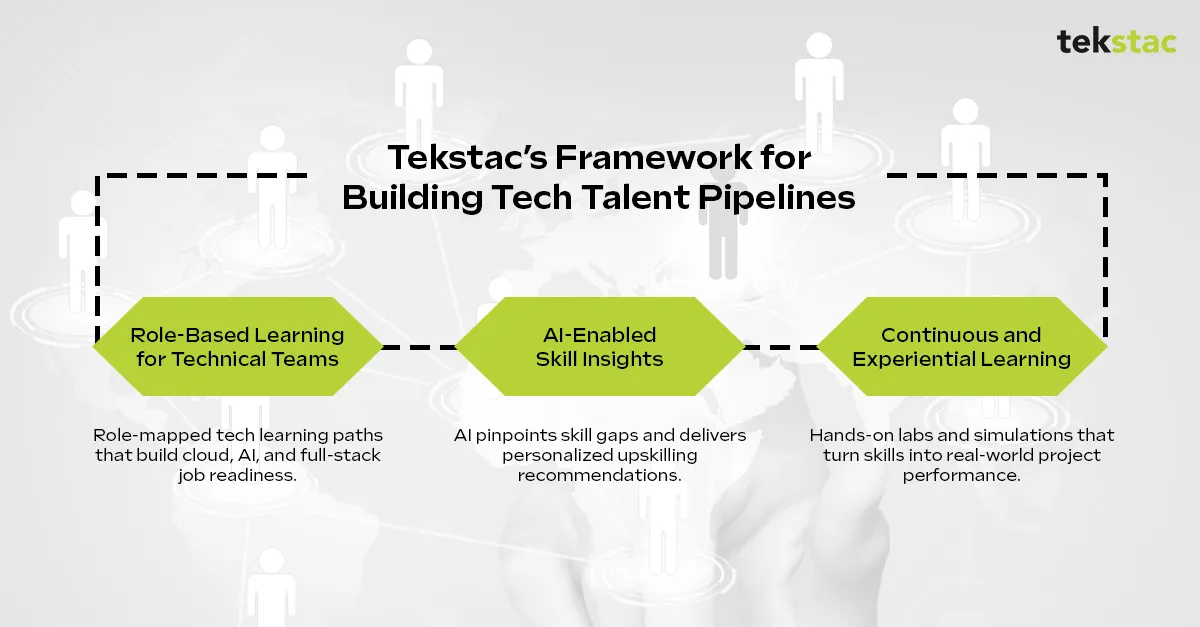
Here’s how it works:
Tekstac’s role-based learning structure maps every module to real-world project needs—whether that’s cloud migration, full-stack development, or AI implementation.
Each pathway blends course modules with hands-on coding labs, simulations, and project assessments, building real world application ready, deep technical mastery for each role.
AI in talent development is no longer a nice-to-have—it’s mission-critical.
Tekstac uses AI-powered analytics to identify skill gaps, benchmark capabilities, and recommend personalized learning paths.
This approach helps enterprises proactively develop internal talent—reducing dependency on external hiring and ensuring readiness for emerging technologies.
Technical skills evolve every quarter. Tekstac integrates experiential learning that helps teams apply what they learn immediately in the flow of work.
This gives L&D and business leaders data-backed visibility into skill progress, role readiness, and workforce ROI.
When new technology initiatives arise, organizations often default to hiring externally. But a recent Forbes research report shows that 58% of companies are now focused on building a culture of continuous learning, and 69% believe every employee needs technical upskilling opportunities.
External hires, meanwhile, often struggle with culture fit, take longer to reach peak productivity, and add real cost — from recruiter fees to the 3–6 months it typically takes a new technical hire to reach full output.
Building a tech talent pipeline helps organizations develop talent that already understands the systems, culture, and clients they serve.
At Tekstac, tech learning isn’t just course-driven—it’s experience-led. Each program simulates real-world engineering challenges.
Learners progress through interactive, structured modules, hands-on labs, and instant feedback for performance improvement.
Key platform highlights:
By the end of each program, learners earn a SkillTag—a verified record of competencies that reflects job readiness and tech mastery.
Tech skills now have shorter half-lives than ever before.
In the AI era, the future workforce must be capable of re-skilling, adapting, and integrating new technologies continuously.
Skill gaps don’t appear overnight—they grow silently when learning is reactive. A well-structured tech talent pipeline changes that narrative. It ensures readiness at every level, continuity in every transformation, and a workforce that grows as fast as technology does.
Tekstac’s Learning Platform helps organizations move from reactive hiring to proactive capability design—enabling HR and L&D leaders to build, measure, and sustain the tech talent their businesses need for the future.
Book a Tekstac demo today and start building your tech talent pipeline.
1. Why is tech hiring so bad right now?
Tech hiring is challenging because technology evolves faster than available skills. Employers increasingly need specialized AI, cloud, cybersecurity, and hybrid capabilities, creating skills mismatches and making qualified talent harder to find.
2. What is the current demand for tech talent?
Demand remains strong for specialized technology talent, particularly in AI, machine learning, cybersecurity, cloud, and platform engineering. In India, AI-related IT hiring increased 16% year over year in June 2026.
3. How does AI improve skill-gap identification?
AI analyzes employee skills, benchmarks capabilities against role requirements, identifies proficiency gaps, and recommends personalized learning paths. This gives organizations data-driven visibility into workforce readiness and supports proactive talent development.
4. What is a SkillTag?
A verified, Tekstac-issued record of the competencies a learner has demonstrated through hands-on labs and assessments — used as evidence of job readiness.
Imagine this: You’re leading L&D and need to decide how to spend your training budget. But you’re not sure how to measure if the programs are working. Sounds tricky, right? Actually, it’s not as hard as it seems. That’s where ROI comes in.
When comparing Tekstac vs Pluralsight, L&D leaders need to evaluate more than course content. Skills development, learner readiness, and measurable business outcomes all influence the return on learning investments.
Hence, choosing the right skilling platform that aligns with your goals becomes paramount. Here is a detailed ROI comparison between the two top-rated skilling platforms Tekstac and Pluralsight, to help you choose the right one.
When comparing Tekstac vs. Pluralsight, it’s crucial to understand their differences in content, certification, pricing, and learner focus. Both platforms cater to learners, but they differ in measuring corporate training ROI metrics.
Tekstac is an enterprise tech skilling platform with learning content, hands-on practice labs, assessments, ROI measurement dashboards and skills inventory tracking.
In contrast, Pluralsight specializes in 6,500+ tech-focused courses, tailored for IT professionals, developers, and engineers.
Tekstac is best suited for enterprises and learning leaders who need a 360-degree skilling platform to enable large-scale talent transformation. It is designed for organizations that want to upskill employees, accelerate role readiness, and track ROI on learning investments.
Plural-sight is best for programmers, data scientists, data analysts, software engineers, computer engineers, IT professionals, and anyone in the tech workforce.
Here is the concise comparison table:
| Tekstac Features | Pluralsight Features |
|---|---|
The all-in-one platform features:
|
Prominent features include:
|
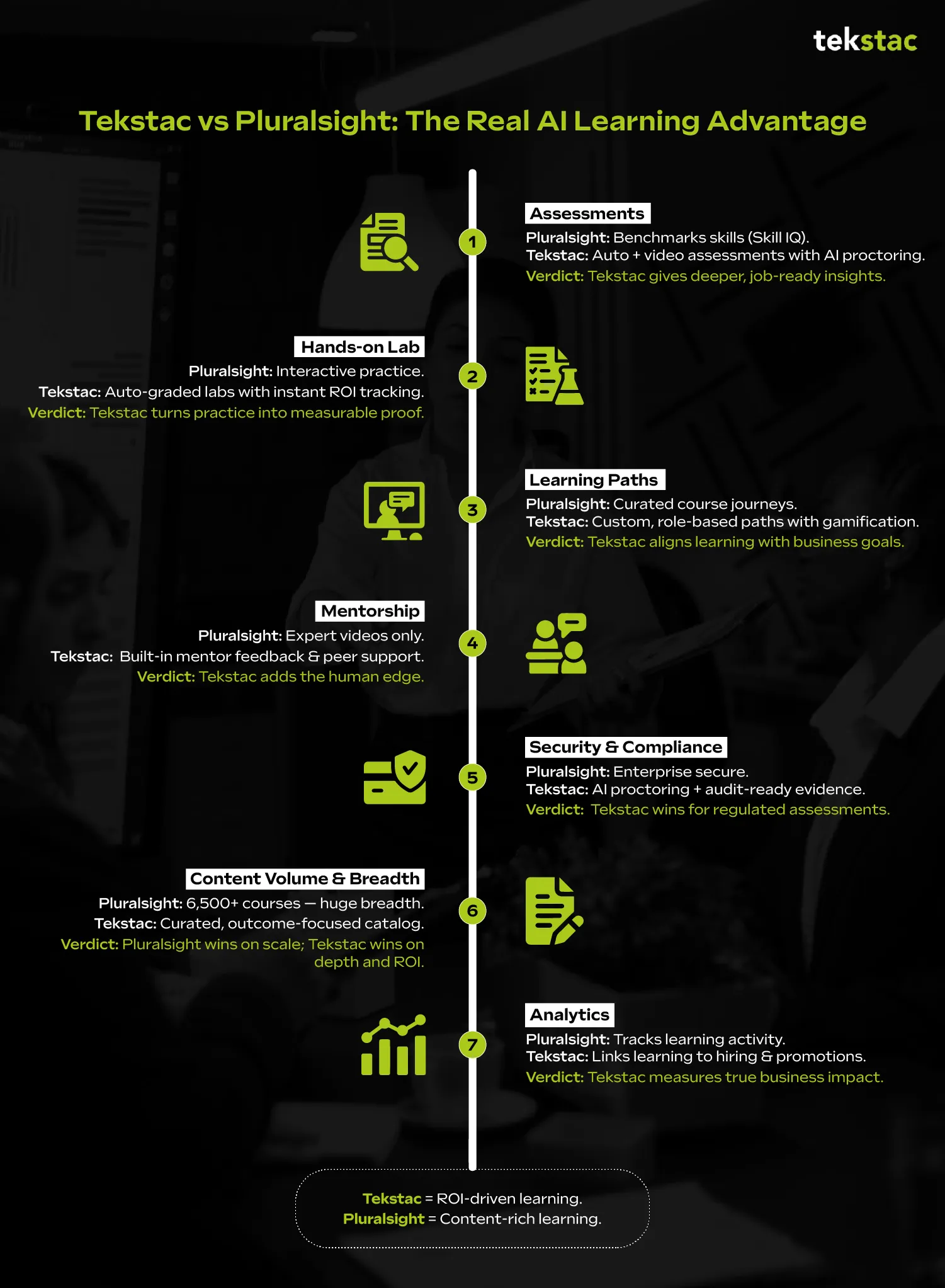
Pluralsight offers structured skill assessments (Skill IQ/Role IQ) to benchmark knowledge and recommend learning paths; these are useful for quickly measuring where a learner stands and for driving recommended content.
Tekstac, however, approaches assessment as a two-layered capability: instant, auto-evaluated assessments that gamify learning and deliver granular analytics, plus video assessments that evaluate communication, problem-framing, and applied thinking.
For companies doing a training ROI analysis, Tekstac provides a clearer picture of learner readiness and impact.
Verdict: Pluralsight’s Skill IQ provides a good benchmark, but Tekstac’s mix of auto-evaluated scoring, video responses, AI proctoring and mentor rubrics gives a richer, hire-ready assessment signal.
Pluralsight has invested heavily in hands-on experiences: interactive labs, sandboxes, and in-browser code labs that let learners practice with cloud and desktop environments. These labs are great for isolated practice and platform familiarity.
Tekstac’s Auto-Evaluated Labs take it a step further, offering instant grading, personalized feedback, and corporate training ROI metrics by tracking skills acquisition in real time. Every submission is auto graded against test cases and performance metrics, with step-by-step personalized feedback and cohort analytics.
Tekstac’s labs are positioned as part of a continuous learning lifecycle, which reduces manual grading load and makes lab results usable as hiring or promotion evidence
Verdict: Pluralsight’s labs are excellent for practice; Tekstac’s auto-evaluation and integrated analytics convert practice into defensible proof of ability that clearly influences L&D ROI comparison.
Pluralsight’s core strength is a mature, searchable catalog and curated learning paths that guide learners from fundamentals to advanced topics, and the platform surfaces tailored recommendations based on assessment results.
Tekstac takes a different tack: instead of only offering pre-built paths, Tekstac promises 100% customizable, role-aligned learning journeys, LTI integration so existing third-party content can be unified, and gamified milestones to drive engagement. This ensures learning outcomes are directly tied to training ROI analysis.
Verdict: The combination of role mapping, gamification, and live dashboards means Tekstac’s paths can be tuned to business outcomes rather than just course completion.
Pluralsight primarily scales through expert-authored video content and automated assessments; while it does offer guided learning experiences, direct mentoring/rubric-driven mentor review is not a core platform differentiator in the same way Tekstac makes mentoring part of the learning flow.
Tekstac’s Mentor Connect couples one-on-one and group mentoring, structured rubric feedback, and peer forums so learners get timely human guidance tied directly to assessment outputs. That human loop is especially valuable for borderline cases, candidate interviews, or nuanced technical topics where automated feedback can’t capture judgment or communication.
Verdict: Mentorship is blended into Tekstac’s product design, contributing to a higher Tekstac ROI, whereas Pluralsight focuses more on self-paced content and automated benchmarking.
Pluralsight markets enterprise features and governance for teams, and it’s widely used across companies for secure upskilling. But when it comes to integrated, assessment-level proctoring, that is not the headline differentiator Pluralsight promotes.
Tekstac’s Secure Proctoring Hub is designed natively into the assessment flow: AI monitors for impersonation, tab switching, unusual audio, produces confidence scores, and generates concise evidence packages for mentor review.
For regulated assessments, hiring decisions, or certification-grade testing, Tekstac’s approach reduces risk and administrative overhead while preserving learner experience. This level of compliance demonstrates the cost vs benefit of learning platforms in highly regulated environments.
Verdict: For high-stakes assessments and auditability, Tekstac’s native AI proctoring and reporting are stronger.
Here Pluralsight’s strength is indisputable: the platform advertises access to 6,500+ courses and thousands of hands-on labs and sandboxes, covering an exceptionally wide range of tech domains and vendors. For individual learners or teams who need breadth, Pluralsight’s catalogue is a compelling advantage.
Tekstac intentionally focuses on curated learning paths, role-aligned journeys and integrated assessment rather than quantity of discrete courses. If your priority is access to the largest possible library and immediate on-demand topic variety, Pluralsight gives more in volume
Verdict: Pluralsight has the upper hand here, when sheer scale and variety of course content are the deciding factor.
Pluralsight provides analytics and enterprise reporting (usage, skill gaps, role IQs) that help teams measure progress, but those analytics are principally consumption and assessment-level signals.
Tekstac layers skill-inventory analytics, cohort trend analysis, growth path analyzers, and ties assessment outputs (auto-graded labs + video rubrics + proctoring signals) to role readiness and hiring/upskilling decisions. The result is a product that not only shows who watched what, but shows who is demonstrably ready for a particular role or responsibility — and why.
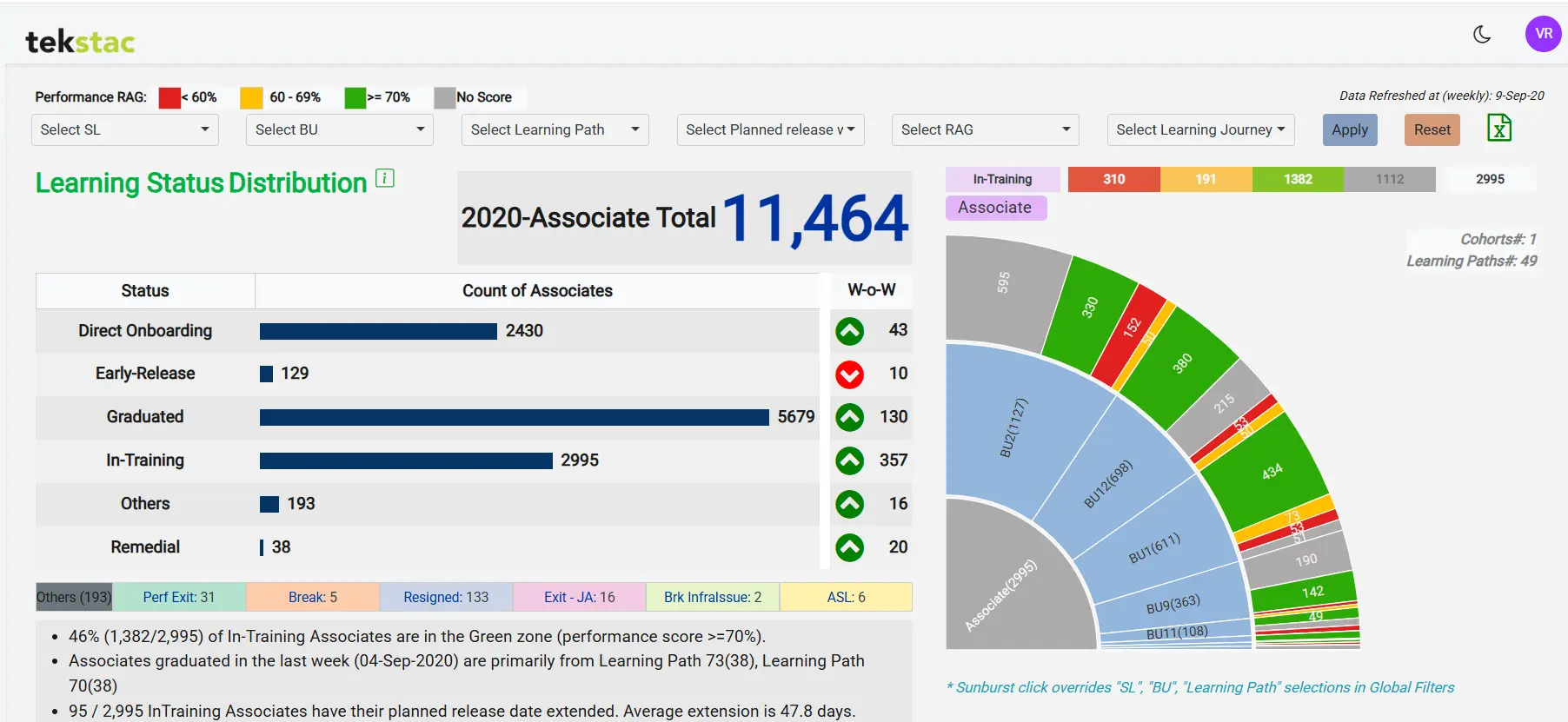
Verdict: Tekstac’s analytics are explicitly designed to drive HR and L&D decisions (hiring, promotions, targeted reskilling), not just measure activity.
Measuring the ROI of online courses requires organizations to look beyond completion rates and assess skills gained, productivity improvements, role readiness, and business impact. You need to answer a lot of questions. How do enhanced skills impact the organization’s financial strength? How does the company scale with other competitors in L&D ROI comparison? And so on.
Tekstac v/s Pluralsight ROI comparison will give insights on how they compare to one another in one of the most crucial metrics.
Pluralsight training ROI analysis suggests that a 295% return on investment (ROI) over three years, with organizations seeing full payback in under six months, according to a Forrester Total Economic Impact™ study.
The ROI is driven by faster onboarding, improved employee retention, and accelerated product development, resulting in millions in productivity gains.
Unlike Pluralsight’s ROI comparison, Tekstac measures learning impact through skills outcomes, productivity, retention, and alignment with business goals.
Tekstac supported 110,000+ learners for one of its leading tech clients, improving talent identification, reducing hiring and training costs, accelerating productivity, boosting engagement, optimizing program management, and improving ROI.
Tekstac builds evolving, real-time skill profiles (“SkillTag”) per learner, integrating assessments and workplace data to inform talent strategies.
Both Pluralsight and Tekstac are top upskilling platforms—Pluralsight with expert-led learning, and Tekstac with real-world coding practice.
So, what’s right for you?
Pluralsight remains an industry leader for individuals and teams looking for an expansive, expertly authored course library with hands-on practice options. For organizations seeking a Pluralsight alternative that goes beyond content consumption, the focus may shift toward verified skills, hands-on practice, and measurable role readiness.
For organizations looking beyond content, Tekstac vs Pluralsight comes down to how learning impact is measured. Tekstac combines assessments, hands-on labs, AI proctoring, mentoring, and skills analytics to help organizations move beyond course completion and evaluate the ROI of online courses through measurable skills and role readiness.
Ready to move beyond course completion and build a skills-ready workforce?
Book a demo with Tekstac to see how you can measure learning outcomes, verify skills, and connect workforce development to business impact.
1. What is ROI in L&D?
ROI in Learning & Development is a way to measure how much value your organization gets from investing in employee training and development.
2. What factors influence L&D ROI comparison in companies?
Several factors impact L&D ROI comparison, including relevance of learning content, engagement levels, skill application on the job, and alignment with career progression or internal mobility goals. Platforms that integrate assessments, mentorship, and analytics, like Tekstac, provide richer insights for comparing ROI and making informed talent decisions, including promotions and lateral hiring.
3. How can organizations measure training ROI effectively?
Training ROI can be measured by tracking improvements in employee performance, time-to-competency, internal mobility readiness, and impact on business outcomes.
The top 7 learning and development trends for 2026, from AI-driven skill development to gamification and hyper-personalized learning. A practical guide for L&D leaders planning next-year strategies.
With growing dependencies on Gen AI, learning & development departments will continuously evolve in 2026. In order to stay relevant in the growing market, it’s imperative to follow the latest trends and be a part of a futuristic workplace.
So, what are the top Learning and Development Trends for 2026?
The leading L&D trends include AI-driven upskilling, hyper-personalized learning paths, microlearning, and data-driven learning strategies.
Read on to deep dive into what’s new in L&D and where it’s all headed.
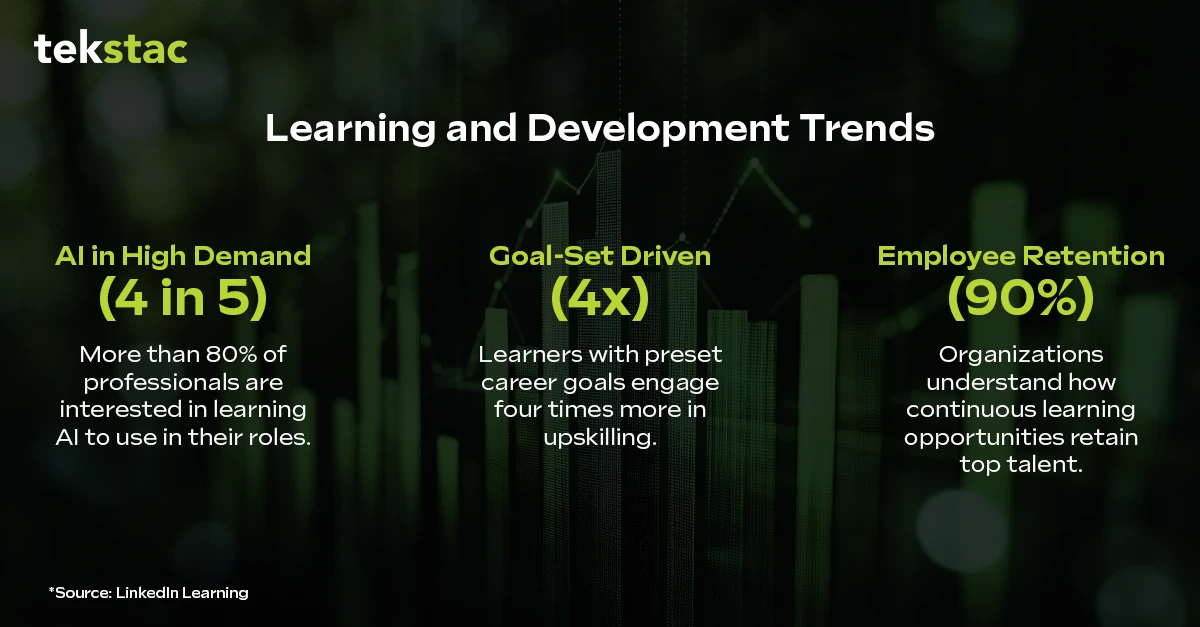
India’s workforce is undergoing rapid transformation, driven by AI adoption, digital skills demand, and evolving business needs. Multiple industry reports highlight both the scale of upskilling momentum, and the gaps organizations must address.
These insights highlight why organizations must rethink their learning strategies. Here are the key learning and development trends shaping the future of work.
Whether you’re looking to reskill, upskill, or future-proof your workforce, staying aligned with the latest L&D innovations is essential.
Let’s explore the top 7 corporate learning and development trends set to create growth waves in 2026.
AI is now the central driver of enterprise L&D strategy — not as a replacement for human learning, but as the infrastructure that makes personalized, continuous skill development scalable.
In 2026, the critical shift is from AI-assisted learning to responsible AI adoption: organizations must design Human+AI frameworks where AI handles adaptive content delivery, gap identification, and progress tracking, while human facilitators focus on mentorship, judgment, and collaboration skills that AI cannot teach.
Practically, this means L&D teams are deploying AI to map real-time skill gaps against business objectives, auto-generate personalized learning paths, and predict which skills their workforce will need 12–24 months ahead. Platforms like Tekstac combine skills intelligence with AI-driven recommendations — giving L&D leaders data to act on, not just data to review.
The corporate L&D Program has shifted towards personalized learning where content is customized based on each learner’s skill, responsibility, and goal in career.
In the coming years, companies will focus on specific skills for each person rather than on predefined roles. It leads to greater agility and fills the skill gaps more easily.
As professionals are becoming busier, on-demand upskilling has concise. Microlearning is going to dominate L&D strategies in the coming years. It involves bite-sized content to be learned in minutes, which makes it perfect for IT teams who manage tight schedules.
They can learn quickly and apply at any time level of experience. They are perfect for mobile learning and reinforce knowledge through repetition. Tekstac supports microlearning, allowing learners to get access to training modules anywhere, anytime.
2026, like this year, will equally advocate continuous learning culture with the power of immersive learning technologies. AR or Augmented Reality and VR or Virtual Reality will reign supreme in 2026 also.
With this, IT professionals can engage in the simulated environment to practice troubleshooting systems and coding and handling any complex projects without the risk of the real world.
With the great pressure of the ROI of training programs, the Learning and Development trends in 2026 have been data-driven. Data analytics is the core of any training these days to optimize and customize training programs based on performance metrics, skill gaps, and learning experiences.
For instance, at Tekstac, trainers collect and analyze information from different sources like learning management systems, performance assessments, and feedback surveys, to learn the areas of improvement. Later the insight is used to customize training content, and progress tracking, and to adjust strategies for real-time upskilling.
The future of corporate learning mostly relies on engagement metrics. The more engaging the training, the better results. Gamification is more than a buzzword. It’s a powerful tool for engaging employees, driving motivation, and fostering collaboration within teams. Gamified learning in 2026 will include AI, VR and AR in the learning environments, setting new benchmarks in immersive learning experiences.
Hybrid and remote working are the future, and it becomes necessary to create engaging L&D programs for remote teams through gamified eLearning. And who doesn’t enjoy a dynamic, game-based learning experience with a bit of healthy competition?
Social learning methodologies are transforming employee training and development in miraculous ways. Platforms like LinkedIn and internal social platforms within organizations are taking precedence for knowledge sharing and group discussions.
Not only that, incorporating interactive forums within LMS tools helps employees engage in real-time and share insights.
In 2026, Learning and Development will be shaped by AI, continuous learning, and deeper employee engagement. Organizations that invest in real-world skill development and data-driven learning strategies will be better positioned to adapt, innovate, and grow.
Platforms like Tekstac enable this shift by combining hands-on labs, continuous assessment, and analytics to deliver measurable skill outcomes at scale.
👉 Explore the Tekstac platform demo to see how you can build a future-ready, skills-first workforce.
1. Which companies offer AI-driven learning and development solutions for enterprises?
Several companies provide AI-driven L&D solutions for enterprises, including platforms like Tekstac, Degreed, and Coursera for Business. These platforms combine AI-powered learning, skill assessments, and analytics to help organizations upskill employees, track progress, and align learning with business outcomes at scale.
2. What are the top learning and development trends for modern workforces?
Key L&D trends include AI-powered personalized learning, continuous upskilling, skills-first workforce strategies, data-driven learning analytics, and immersive hands-on training. Organizations are also focusing on aligning learning programs with business goals and improving employee engagement through real-world, application-based learning experiences.
3. How do companies implement effective L&D programs?
Companies implement effective L&D programs by identifying skill gaps, aligning training with business objectives, and using scalable learning platforms. They integrate hands-on learning, continuous assessment, and analytics to track progress, while enabling personalized learning paths that improve engagement and ensure measurable outcomes across the workforce.
4. How is AI changing learning and development in enterprises?
AI is transforming L&D by enabling personalized learning paths, automating assessments, and providing real-time insights into skill development. It helps organizations predict skill gaps, recommend relevant content, measure learning impact, make training more efficient, scalable, and aligned with business performance goals.
L&D workplace challenges show up the same way in every organization: employees finish training, but their behavior at work doesn’t change. Sarah from marketing completed 12 training modules last quarter. However, she still struggles with the same workplace challenges she faced six months ago.
This happens everywhere. Employees complete training, yet nothing changes in their daily work. They finish courses on time management, but still miss deadlines. They take leadership workshops but avoid difficult conversations. They learn presentation skills but freeze up during client meetings.
Workplace challenges persist. Teams still struggle with communication breakdowns. Managers still micromanage instead of delegating effectively. Projects still fail due to poor planning and execution. The skills people need to succeed at work remain underdeveloped, despite all the training investment. Why?
Remember the last time employees sat through mandatory training? That glazed-over feeling when the instructor asked if there were any questions and the room went dead silent?
One of the main workplace challenges in L&D is not that employees are resistant to growth, but that most companies do not yet treat skills like abilities that need practice. Here are a few reasons why workplace challenges persist despite employee development efforts:
1. Learning is not treated like a process: Most companies offer workshops or courses and consider the job done. But skills take repetition and real-world practice to develop, not just a single chunky session or video. Innovative strategies like microlearning can address these issues.
2. Learning content doesn’t address specific job problems: Employees often face specific challenges, like handling conflict, managing deadlines, or delegating tasks. But the training they receive is too generic and doesn’t help solve those real issues.
3. There are no clear goals tied to learning: Employees complete training, but they do not understand what’s expected to change in their work afterward. Hence, without specific goals, it’s hard to apply what was learned.
4. Managers don’t support ongoing development: After training, most employees are left on their own. If managers don’t follow up or create space to apply new skills, the learning may be quickly forgotten.
5. L&D is not a long-term plan: Learning programs are often launched only after problems show up. There’s no proactive strategy to build skills ahead of time — which means the same challenges keep repeating.
While most organizations focus heavily on delivering learning, very few take the next step to define what employee development should look like in practice. Without clear outcomes tied to learning, employees walk away from training unsure of what’s expected to change. This also means, when managers fail to reinforce those expectations, even well-designed programs can lose their value and impact.
Goal setting helps fix these workplace challenges, bringing structure and accountability into the development process. For example, a leadership goal might be:
These become signals of whether someone is actually developing the skill. With goals like these, employees can track progress, apply what they learn, and get targeted feedback from their managers. Some other major reasons why goal-setting helps:
1. It turns learning into action: Goal-setting strategies in L&D bridge the gap between knowing and doing, giving employees a clear target to apply what they have learned in real work situations.
2. It adds structure to development: Without goals, employee development can feel incomplete. Employees need specific, time-bound outcomes that guide their growth step by step.
3. It makes progress visible: Learning without visible milestones can make employees feel stuck. Goals give employees and managers a clear way to track movement in regard to skill change.
4. It personalizes the learning journey: Setting individual developmental goals helps employees focus on what they need, along with what the company rolls out.
5. It creates accountability and momentum: When goals are clear, ownership becomes easier. Employees stay engaged while managers know how to support them, review progress, and celebrate development wins.
Most companies use SMART goals or OKRs during performance reviews. These work fine for tracking quarterly targets or project milestones. But they fall short when applied to skill development.
Traditional goal frameworks ignore this messiness. They assume you can learn delegation skills the same way you’d complete a sales quota – with clear milestones and predictable timelines. But developing capabilities means breaking old patterns, which takes time and repeated practice. Real skill development looks different. Someone learning to give feedback might nail it with friendly colleagues but struggle with difficult personalities. Someone building presentation skills might excel at internal meetings but panic during client calls. These aren’t failures – they’re normal parts of learning and workplace challenges that goal-setting must account for.
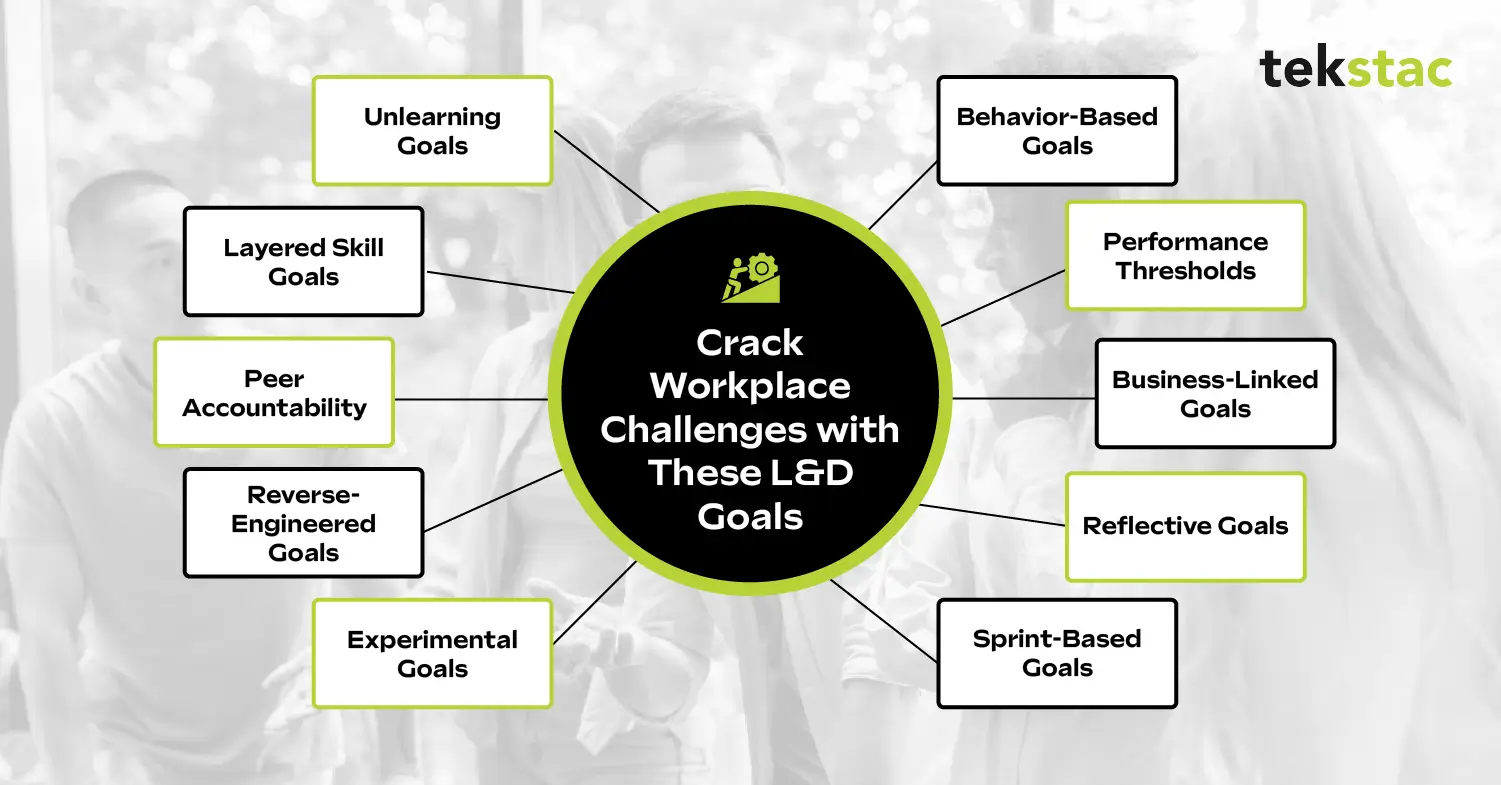
The strategies below recognize this reality. They work with the natural ups and downs of skill development instead of fighting against them.
One of the biggest gaps in L&D is assuming learning equals doing. High performing organizations take it further and define success as an observable behavior. For example, an objective like “complete negotiation training” can look like “negotiate three client contracts without senior support” as an outcome. This changes the focus from input (the training) to output (the behavior change). To implement this, organizations must align every learning intervention with a concrete, on-the-job action they expect to see post-training, and review it in one-on-ones. Strategies like gamification can change how organizations build skills for practical outcomes.
Most goals are set around finishing something, be it attending sessions or completing a module. These don’t always translate to real-world application, especially when workplace challenges come into play. Top L&D leaders set thresholds, minimum performance standards that indicate readiness. For instance, a presentation skills program might require the employee to lead two internal briefings rated at least 4 out of 5 by peers. This measures if an employee performed at an acceptable level, and this works best when you link learning goals to clear evaluation rubrics or feedback criteria.
Instead of setting goals in isolation, tie them to upcoming business shifts, be it a new product launch, market expansion, or process change. This makes learning feels urgent, relevant, and visible too, helping stakeholders buy in as the goal supports actual business movement.
One underrated strategy is making self-assessment part of the goal. This promotes self-awareness and helps employees internalize learning before rushing into execution. Organizations can implement this via reflection logs, post-training prompts, or weekly development check-ins.
Borrowed from agile methodology, this involves setting short, focused development goals over 2-4 week sprints, with check-ins baked in. The key is the midpoint checkpoint to provide course correction. Sprint-based goals create urgency without overwhelming employees, while allowing for real-time coaching. These sprints employ strategies that help bridge the gap between classroom training and real-world workplace challenges with workplace training, ensuring skills improve through practical application.
Leaders stress that development is not merely about acquiring skills, it’s also about unlearning ineffective habits. If someone’s been micromanaging for years, a good goal must allow them to delegate with only one follow-up per week and allow autonomous decisions. For this to work, goals should explicitly call out what needs to stop.
Rather than isolate a skill in one goal, layer goals across exposure, practice, and mastery. Each layer deepens the skill and reinforces it through repetition. To apply this, structure L&D goals into progressive levels that build on one another over time, similar to scaffolding in instructional design. This approach aligns with Deloitte’s findings that organizations with skills-based strategies are 57% more likely to anticipate and respond effectively to change, enabling them to build a more agile and future-ready workforce.
Peer support builds consistently. One effective approach is to pair employees with a peer following a similar development path and set shared learning goals. This fosters collaboration, strengthens accountability, and creates informal coaching opportunities. Organizations can scale this through buddy systems or learning cohorts.
According to LinkedIn’s Workplace Learning Report, 94% of employees say they would stay longer at a company that invests in their career development. Peer learning and collaborative development initiatives can reinforce that investment by creating a culture of continuous growth and shared success.
Instead of asking, “What should they learn?” ask, “What impact do we want to see?” Then set development goals that target those inputs. This approach ensures that learning is directly linked to measurable outcomes rather than assumptions. When goals become skill-based, companies are 63% more likely to achieve results, thereby creating a direct link between employee development and workplace challenges.
Growth is rarely linear, and we must acknowledge this by framing goals as hypotheses rather than certainties. For example: “Test running team check-ins without a formal agenda to increase engagement over one month.” This lowers the fear of failure and encourages employees to try new behaviors, assess the results, and refine. Implementing this requires managers to be coached on setting short-term experimental goals to debrief outcomes without judgment.
Effective employee development is uncomfortable and requires commitment from everyone involved, but it’s also the only approach that actually works. Here, the right platform makes all the difference. Organizations that successfully implement these goal-setting strategies for L&D workplace challenges, they need systems that support focused, measurable development. Platforms like Tekstac bridge this gap by combining structured learning paths with hands-on practice environments and real-time progress tracking.
When employees can practice skills in immersive labs, receive AI-powered assessments that identify specific improvement areas, and follow customized learning journeys aligning with their career development plan, goal setting turns into measurable progress. Additionally, comprehensive dashboards and analytics help managers track whether the goal is actually translating into improve stakeholder relationships and business outcomes.
Over 1 million+ professionals have already experienced this focused approach to development, with organizations reporting 100% retention rate when learning is tied to clear, achievable goals. Your employees too are waiting for you to give them a real path forward, one that’s measurable, practical, and directly connected to their daily work. Explore Tekstac today!
1. What are the most common workplace challenges in L&D?
Common L&D workplace challenges include skill gaps, low learner engagement, limited budget, difficulty measuring training ROI, rapidly changing business needs, and aligning learning programs with organizational goals. Addressing these challenges requires a strategic, skills-based approach to workforce development.
2. What are the best practices for solving workplace challenges in L&D?
Successful L&D teams align learning with business objectives, conduct regular skills assessments, personalize learning paths, encourage continuous feedback, and use learning analytics to measure outcomes. These practices improve engagement, close skill gaps, and deliver measurable business impact.
3. What software tools can track learning program ROI and impact?
Learning Experience Platforms (LXPs), Learning Management Systems (LMS), skills intelligence platforms, and learning analytics tools help track learner progress, skill development, assessment results, and business KPIs to measure the ROI and effectiveness of training programs.
4. How can digital learning platforms help overcome L&D challenges at work?
Digital learning platforms help L&D teams deliver personalized learning, automate skills assessments, track learner progress, provide real-time analytics, and scale training efficiently. These capabilities improve engagement, reduce skill gaps, and support continuous workforce development.
If more than 90% of employees say they’d stay longer at a company that invests in their career, why are so many still leaving?
The answer is simple. Most workforce development strategies are not working. They’re well-intentioned, but too generic, reactive, or completely disconnected from what employees need to grow—and what the business needs.
Organizations are spending time and money on learning initiatives. Over half of them list upskilling and reskilling as a top priority. However, only 21% believe their efforts are practical. While this internal pressure causes misalignment, external pressure is mounting.
With AI and automation expected to disrupt nearly half of all jobs in the coming years, most organizations still lack access to the right resources.
This is the gap companies need to close, and in this blog, we’ll discuss exactly how, with the most effective employee upskilling strategies.
If we look at the root cause of most ineffective workforce development strategies, we find they’re performative. A few courses here, a new platform there, perhaps some annual compliance training—they rarely drive any change on the ground.
According to the LinkedIn Workplace Learning Report, 94% of employees would stay longer at a company that invests in career development — yet most organizations still struggle to offer structured, measurable workforce development.
In 2026, a good workforce development strategy is built with intention. Let’s see how.

Just because employees are learning something doesn’t mean it’s moving the needle. A solid strategy focuses on the adoption and practical use of future-forward skills. The goal isn’t to train for training’s sake. It’s to ensure your workforce is equipped for the shifts across your industry.
Throwing generic content at employees and hoping it sticks is not a strategy. A meaningful employee upskilling strategy personalizes learning to the employee’s role, growth path, and learning style, while ensuring every resource serves a clear purpose. Whether self-paced modules, peer mentoring, or live sessions, every touchpoint should move the learner (and the business) forward.
Learning in isolation won’t drive results. The strongest strategies are mapped directly to business goals: increasing customer satisfaction, enabling digital transformation, or closing leadership gaps.
As always, a good employee development strategy must be measurable. If you can’t track skill development, impact, and progress, you’re just guessing. Additionally, development shouldn’t be a separate activity employees do when they “find the time.” The best strategies are embedded into everyday workflows through feedback, real projects, coaching, and collaboration.
As we often notice, some development strategies die quietly after a while, even after allocating training budgets or launching an LMS. If you’re wondering why nothing’s changing on the floor or if you want to take a more innovative approach to workforce development, below are the top 7 workforce development strategies.
If your workforce development strategy starts with you looking at current roles and asking, “What’s missing?” you’re already going backward. The smarter question is, “What roles and skills will we need in two years—and how do we build for that now?” Future-back skill planning starts with forecasting future capabilities based on business goals, market shifts, and industry evolution. It requires a partnership between HR, L&D, and leadership to identify skill adjacencies, define learning paths, and bake them into career journeys.
With the rise of AI, most companies are excited to invest in GenAI or piloting chatbots. However, employees may still be unaware how exactly it embeds into their work. For example, does your payroll team know how AI affects them? Does your customer service team understand how it’ll change how they work?
AI literacy can’t be just for the IT crowd or the early adopters. Everyone in your company needs to know what AI means for their job — what it automates, what it makes easier, and what it demands from them now.
Most learning strategies assume people are all starting from the same point, learning in the same way, and aiming for the same goal. This usually ends up in choosing a same course or a learning platform that leave high performers bored and struggling folks overwhelmed.
A better approach would be to build learning journeys like real paths based on where someone actually is, rather than assuming where the employee stands, knows, or wants to go.
Ask people how to grow in their company, and most will shrug. Very few know what leads to a promotion or a role switch. This is a big problem. Career paths are usually vague, unspoken, or left to chance. And when there’s no clarity, the same types of people keep getting promoted while others get stuck.
Make growth feel intentional. Start by mapping out what success looks like in each role. Be specific. What skills, outcomes, and behaviors are needed to level up? Don’t keep it locked in a PDF either, bring it into everyday conversations. Managers should reference these paths in check-ins.
Some traditional L&D strategies run like a school timetable, involving annual plans, quarterly workshops, and calendars. But work doesn’t wait for Q3 to teach you something. It throws new tools, priorities, and challenges at you out of nowhere. When learning doesn’t show up in those moments, people either wing it or stall.
A better way would be to make learning immediate by using microlearning. If someone’s stepping into a new project, give them a quick how-to guide right then. Learning has to move at the speed of change. Otherwise, it’s already too late.
Solely looking at whether the employee has completed the course doesn’t help determine if they learned anything. Hence, measure impact. If someone took a negotiation course, are they actually closing deals better? If they were trained on giving feedback, is their team communicating more clearly? Tie learning to actual outcomes — better performance, fewer errors, stronger collaboration.
As we often notice, workforce development gets boxed into L&D or HR. However, real growth happens in the flow of work, driven by managers, shaped by teams, owned by employees. That shift only happens when everyone sees development as their job. Give employees visibility into skill paths. Equip managers to enable growth, not just review it. And get leaders to invest in learning as a lever for business impact. Ultimately, when employee development becomes a shared ownership, it scales.
In many organizations, managers are expected to drive both project outcomes and team development. However, without the right tools, they often struggle to provide consistent, personalized growth opportunities for their teams. This gap can lead to disengagement and high turnover.
The right tools, like Tekstac, address this challenge by offering an AI-powered, end-to-end skilling platform that automates and personalizes the learning journey for each employee.
With over 500+ curated learning paths covering in-demand tech areas like data analytics, cloud computing, and cybersecurity, Tekstac ensures that employees have access to relevant, up-to-date content.
The platform’s integrated lab environment enables real-time, hands-on practice across various technologies, allowing employees to apply new skills in a controlled setting. Additionally, AI-driven personalization analyzes skill assessments to identify knowledge gaps and recommends tailored learning paths aligned with individual career goals.
Tekstac provides real-time insights into team progress through intuitive dashboards and analytics. This visibility allows managers to track development, plan interventions, and make informed decisions without micromanaging the learning process.
Ultimately, managers and organizations can focus on strategic leadership and team engagement, confident that their teams are progressing along personalized, goal-oriented learning paths.
Want to apply these workforce development strategies inside your organization? Book a free strategy consultation with our L&D experts.
Create a workforce development plan by assessing current skills, identifying future skill needs, building training paths to close gaps, assigning ownership, and tracking progress with measurable outcomes.
The most effective global strategies emphasize continuous learning, skills-based career paths, digital skilling, remote-friendly learning platforms, and culturally adaptable training content that support diverse teams.
Success is measured using KPIs like skill assessments, project outcomes, goal achievement, time-to-productivity, promotion rates, and employee engagement.
A talent development strategy is the system that closes the gap between the skills your business needs and the capabilities your people currently have. Without one, organizations train reactively spending on programs that don’t connect to business priorities, losing talent that sees no growth path, and falling behind competitors who treat capability building as a strategic function.
49% of learning and talent leaders admit their executives are worried employees cannot deliver on business strategy. The problem is not ambition, it is architecture.
The most innovative companies are doing more than upskilling and reskilling. They’re building internal ecosystems for growth, including coaching, leadership training, internal mobility, etc.
These “career development champions,” organizations that are pulling ahead on profitability, retention, and AI readiness through employee development, are 42% more likely to be Generative AI frontrunners, as per LinkedIn’s Workplace report.
And yet, only 36% of organizations qualify as champions. This means 64% of companies haven’t even started. There is no roadmap, no commitment—just scattered programs.
Let’s be honest—many organizations are still in the early stages of developing a strong talent development strategy. They don’t know what it looks like. This is exactly where we begin.
A talent development strategy fails when it is designed around content rather than business outcomes. The organizations that close the gap between training investment and measurable performance treat development as a strategic function, not an HR program connecting every learning initiative to a specific business priority, role requirement, or succession need. A true talent development strategy starts with a business problem, and ends with measurable impact. Career development champions connect employee development strategy to outcomes that actually matter:
Now, here’s what the champions are doing differently:
These organizations don’t train for its own sake. The strategy builds AI fluency if the business is shifting to AI-powered tools. If a growth market opens, they groom internal talent to lead that charge.
Career development should never be a one-time conversation. It’s designed into jobs, into culture, into how managers lead. Champions make growth visible, expected, and tracked. To truly grow employees, career development must be built into your performance management processes. That means development goals are set alongside business goals. Managers talk about growth in regular 1:1s. People know what skills they’re expected to build, and how that ties into the next role or project.
Employees need more than a new title; they need new challenges as well. The best organizations move talent laterally, vertically, and even across geographies. It’s less about hierarchy and more about exposure and stretch.
Budgets are focused on critical roles, high-potential employees, and future skills. These companies treat talent development like product R&D.
The biggest secret isn’t more content—it’s better managers. Champions are more likely to provide their managers with training to support career development because if they aren’t on board, your strategy won’t land.
Most companies miss the mark by treating employee training and development as a series of disconnected programs instead of a cohesive strategy. They focus on content, assuming more training equals better performance, without aligning learning to business goals. This step-by-step process helps avoid this:
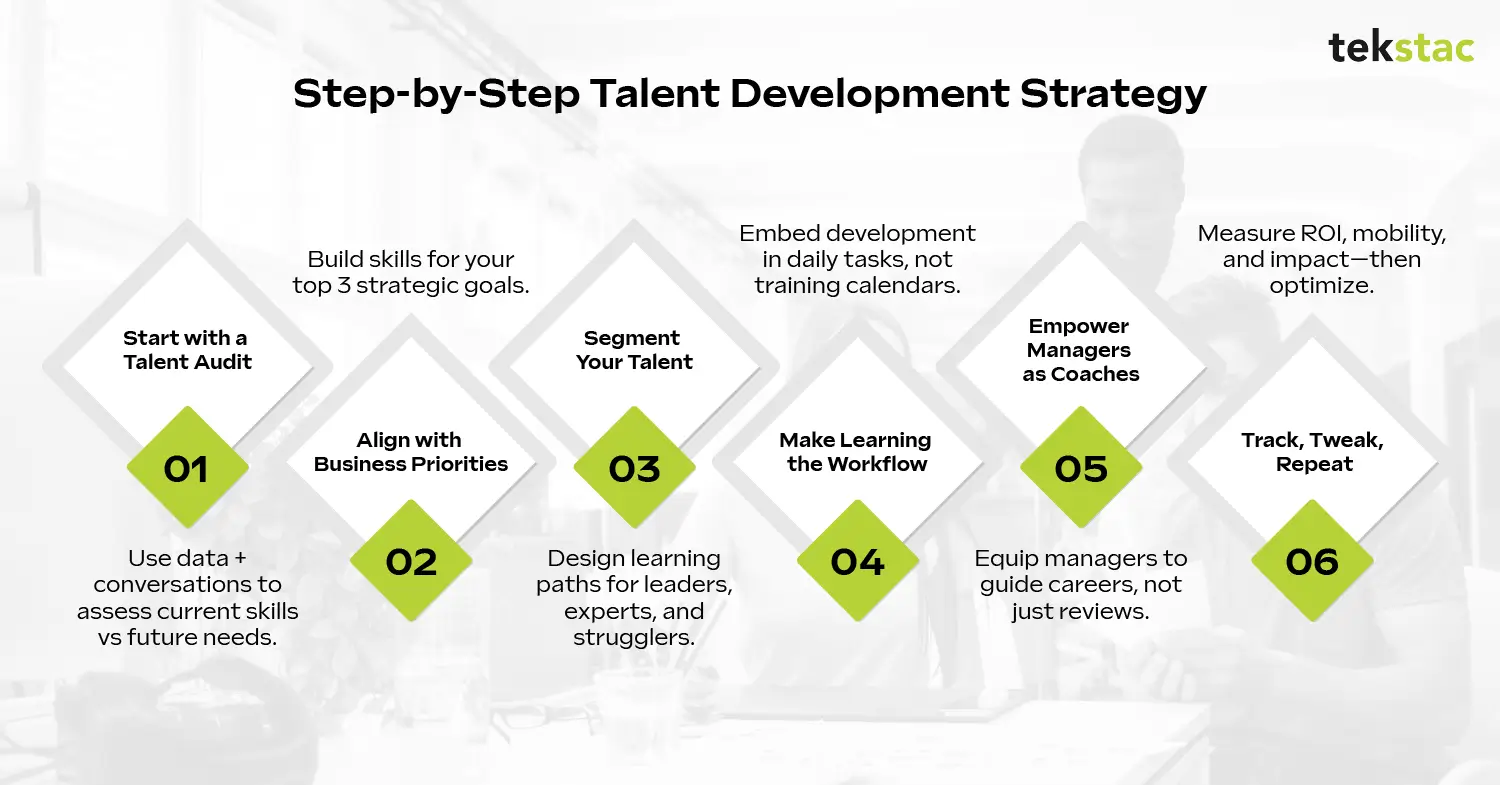
A talent audit is the mandatory first step in any talent development strategy because without it, every subsequent investment is guesswork. It assesses current employee skills, identifies capability gaps versus business requirements, and reveals which roles are most at risk from attrition, AI disruption, or market change, giving L&D teams a prioritized, evidence-based starting point rather than a training calendar.
Before jumping into upskilling, take stock of what you actually have. Conduct a talent audit to assess employees’ current skills, roles, and potential or your workforce against where the business is headed.
Tools like Tekstac’s skills insights give L&D teams a real-time view of capability gaps across roles, departments, and levels — replacing pulse surveys and spreadsheet audits with continuous, AI-driven skills intelligence.
Start by asking:
Pull in hard data (performance, exits, skill gaps), but don’t stop at dashboards. Run pulse conversations, interview managers, and look at internal mobility patterns. These don’t just help diagnose skill gaps but also in predicting future failure points.
Champions are 49% more likely to use internal data to identify skill gaps and 48% more likely to build career paths with aligned skills and courses. Most organizations are flying blind. Don’t be one of them.
Anchoring talent development to business priorities means translating your organization’s top strategic bets directly into capability requirements. If the business is shifting to AI-powered workflows, the development strategy builds AI fluency. If a new market is opening, it grooms internal talent to lead that expansion. The strategy reads like a GTM plan — not a policy document.
Then, think of the capabilities that these bets would demand. Build talent around these moves, be it expanding into new markets, implementing new tech, or overhauling operations. Your talent development strategy must read like a GTM plan rather than a policy document. That’s what gets executive buy-in as well.
Your employees are not one audience. They’re high potentials, legacy SMEs, restless Gen Zs, and mid-level managers stuck in the middle. So why offer them the same workshops?
Prioritize your development paths:
Champions offer 33% more tactics than non-champions: internal job postings, cross-functional gigs, career plans, gig-based work, and peer learning—all tailored.
Most organizations still treat learning like a perk. But in top companies, learning is the workflow. They embed it to create a continuous learning culture through:
Building this kind of infrastructure requires more than content — it requires AI-powered workforce upskilling solutions that adapt to each employee’s role, pace, and capability level in real time.
For instance, instead of sending new team leads to a generic leadership training, you could create a shadowing sprint where new leads spend their first month observing senior leaders in action, paired with weekly feedback reviews. This leads to faster ramp-up and fewer early missteps.
Champions are 88% more likely to offer career-enhancing project work, and 32% more likely to deploy AI training.
Managers make or break development. Yet only 15% of employees say their manager helped them build a career plan in the last six months. This is because managers are underequipped. They’re drowning in operations and rarely trained to discuss growth.
What you can do:
No company would leave a marketing campaign untracked, so why treat employee development like a static initiative? Make sure to track:
This helps ensure if your talent development strategy is growing fast enough to match market shifts and if people are moving into critical roles, or out of the company.
Workforce development plans shouldn’t depend on annual budgets or which HRBP’s leading the charge this year. If it does, your development plan is already fragile and may be forgotten by Q3.
Career development champions build infrastructure—systems that outlast people, roles, and restructures. Here’s how:
Career development plans should be company-wide mandates. Executives define the bets, HR turns them into critical capabilities, and managers translate them into meaningful conversations about growth.
Internal mobility starts with visibility. Employees must see what’s possible across teams, roles, and business units. Then comes normalization, where you reward managers who let talent move instead of hoarding it. Finally, automation and AI can match people’s skills with real opportunities.
When asking employees to grow, organizations must clearly define what growth means.
If you build talent development strategies on spreadsheets, siloed platforms, and scattered learning content:
Organizations need a comprehensive talent development platform, like Tekstac, built for companies serious about capability building. It’s a full-stack skills development program trusted by IBM, PwC, Cognizant, Accenture, and many more to build a competent, future-ready workforce.
It directly plugs into your organizational infrastructure:
A development initiative on its own won’t solve the bigger problem. Without a solid system in place, processes will inevitably fall apart. An infrastructure, or system, ensures every initiative is connected, repeatable, and scalable. And that’s precisely how Tekstac integrates learning into your broader business strategy.
Ready to change how your team learns, grows, and performs? [Request a Tekstac Demo]
1. Why is Talent Development Important in 2026?
Talent development is important in 2026 because AI and automation are reshaping the majority of roles faster than traditional hiring can compensate. A 2024 AI-Enabled ICT Workforce Consortium report found 91.5% of ICT jobs face high or moderate AI-driven transformation. Organizations that build continuous development infrastructure retain institutional knowledge, reduce external hiring costs, and adapt to market shifts without restructuring — giving them a measurable competitive advantage over those that treat development as a periodic initiative.
2. What is the difference between HR strategy and talent strategy?
An HR strategy manages people operations — payroll, policies, compliance, and workforce planning. A talent strategy goes further: it connects skill development, succession planning, and internal mobility directly to business goals and future growth requirements. HR strategy asks ‘do we have the right number of people?’. Talent strategy asks: ‘Do our people have the capabilities our business strategy demands — and are we building those capabilities faster than the market changes?’.
3. How to develop a talent acquisition strategy?
Start by defining your ideal talent profile, then align recruitment with your long-term skill needs. Use data, employer branding, and talent pipelines to attract, evaluate, and retain high-performing employees.
4. What does a talent development plan guide include?
A talent development plan guide includes six components: a talent audit identifying current skill gaps and future capability requirements; business-aligned development priorities mapped to strategic goals; segmented learning paths differentiated by employee role, potential, and career stage; embedded learning mechanisms integrated into daily workflows rather than offsite programs; manager enablement tools and coaching frameworks; and measurement systems tracking skill progression, internal mobility, and leadership pipeline readiness against business KPIs.
5. What is an effective talent assessment strategy?
An effective talent assessment strategy combines quantitative data (performance metrics, skill gap scores, exit patterns) with qualitative input (manager interviews, pulse conversations, internal mobility patterns) to build a complete picture of workforce capability versus business requirements. Champions are 49% more likely to use internal data to identify skill gaps and 48% more likely to build career paths with aligned skills and courses. The output is a skills map that identifies critical role gaps, high-potential employees, and development investment priorities.