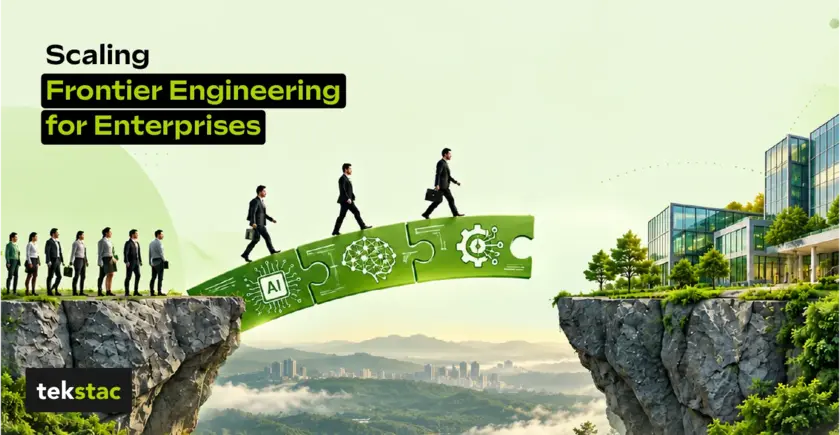
AI is changing the economics of software engineering. Frontier engineering is emerging as enterprises look beyond using AI as a coding assistant and toward fundamentally changing how engineering work gets done.
AI agents can increasingly support coding, testing, research and other development tasks. But the enterprise challenge is bigger than developer productivity. The question is no longer simply whether engineers can build software. It is whether they can define the right problem, direct AI systems, integrate them into existing environments, validate their output and take solutions into production.
The gap between experimentation and execution is where frontier engineering becomes important.
Frontier engineering for enterprises involve using AI and modern engineering to solve real business problems, from identifying the problem to building, deploying, and improving the solution.
Cognizant’s Frontier Certified Engineer is one example of an enterprise formalizing this emerging role. It combines software engineering with business-process redesign: understanding an existing workflow, identifying where AI agents, automation and people can create value, and then building and deploying the redesigned system.
The idea extends beyond a particular job title.
A frontier engineer needs to combine:
They can take an ambiguous business problem, determine where AI can help, build the solution, integrate it into the enterprise environment, test whether it works and improve it based on real-world outcomes.
“Frontier Certified Engineers who design for agentic outcomes, and Frontier Business Operators who own them, represent a new kind of professional, trained from day one to turn AI capability into business reality. The most important innovation of this decade may not come from AI itself, but from empowering every worker to use it.”
Thirumala Arohi
Chief Learning Officer, Cognizant
This shift comes at a time when AI adoption is growing rapidly, but enterprise-scale deployment remains difficult. McKinsey’s global AI survey found that 88% of surveyed individuals found that organizations use AI in at least one business function, while only 7% said AI had been fully scaled across their organizations.
Building an AI proof of concept is very different from building an AI capability that can operate reliably across an enterprise. Here are a few challenges of scaling AI engineering:
Enterprise AI engineering has to account for integration, security, data access, monitoring, evaluation, reliability and human oversight. Engineers need to understand not just how to build an AI application, but how that application fits into the larger business process.
The challenge is moving from “Can we build it?” to “Can we operate it reliably at scale?”
Most enterprises cannot start with a clean architecture. Critical workflows often depend on legacy applications, databases, APIs and systems that were not designed for AI. Replacing all of them is rarely practical.
The quality of an AI system depends heavily on the quality and accessibility of the information it can use.
Enterprise teams need reliable data pipelines, retrieval systems, evaluation datasets and appropriate access controls. Depending on the use case, techniques such as data augmentation, synthetic data and transfer learning can also play a role.
As AI systems become capable of taking actions rather than simply generating responses, governance becomes part of engineering.
Teams need to determine what an AI agent can access, which actions it can perform autonomously, when human approval is required and how its decisions and actions are evaluated and traced.
Enterprises don’t only need more AI specialists. They need existing engineers to become comfortable working with AI-native development, agentic systems, data, cloud infrastructure and automated evaluation.
That makes engineering workforce transformation a capability-building challenge, not simply a hiring challenge.
Building this capability does not necessarily mean creating an entirely new workforce.
For many enterprises, the starting point is the engineering talent already on payroll.
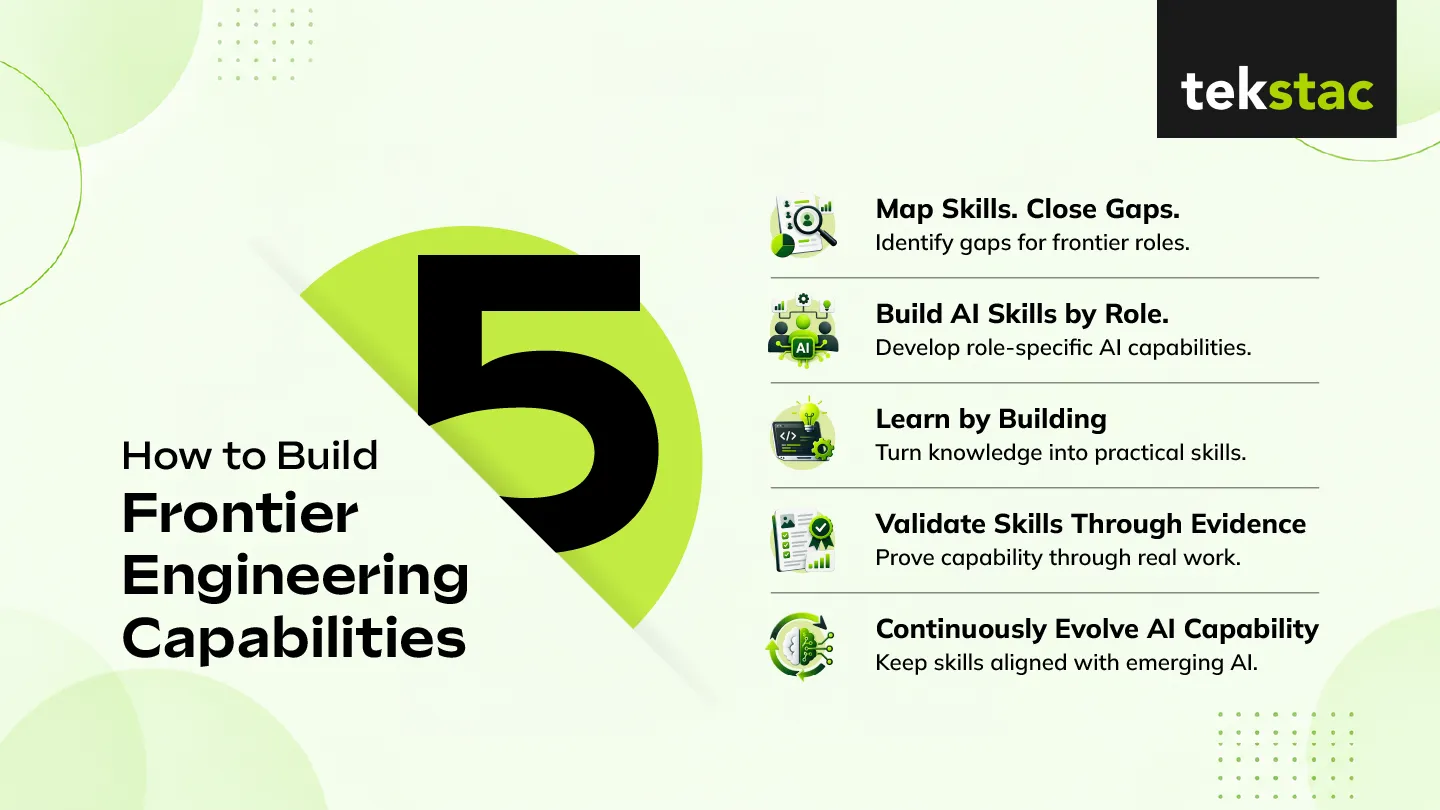
Map the capabilities your engineers already have across software engineering, cloud, data, AI and systems integration. Then identify the skills gap for the specific frontier roles the organization needs.
This creates a more useful picture than simply categorizing people as “AI-ready” or “not AI-ready.”
A backend engineer, cloud engineer and solution architect will not need the same AI capabilities. Their development paths should reflect the work they are expected to perform. This means moving beyond generic AI literacy toward role-specific AI upskilling for engineers.
Knowing how RAG works is different from building a RAG application. Knowing what an AI agent is different from building one that can interact with enterprise systems.
Frontier engineering capabilities therefore need hands-on practice with realistic problems, technology stacks, data and deployment scenarios.
Completion is not the same as readiness. For engineering workforce transformation to deliver meaningful results, enterprises need evidence of what engineers can actually build: working applications, evaluated outputs and demonstrated problem-solving.
This creates a shift from tracking learning activity to understanding capability at the individual, team and enterprise level.
Frontier engineering will continue to evolve as models, agent frameworks and enterprise architectures change. That means capability building cannot be a one-time AI training initiative.
Organizations need an ongoing system for identifying emerging skills, mapping them to roles, building those skills and validating capability against real work.
The next phase of enterprise AI will not be defined only by how many models an organization deploys. It will be defined by how effectively its people can turn those models into working systems and redesigned ways of doing business.
That is the opportunity behind frontier engineering.
For enterprises, the starting point is often closer than it appears: the engineers already building software, solving customer problems and operating critical systems. Rather than building AI capability only through new hiring, organizations can progressively equip these teams to take on AI-native engineering work.
That requires more than just AI upskilling for engineers. They need the right combination of technical skills, business context, hands-on practice and evidence that they can apply those skills to real problems.
This is where a structured capability-building approach becomes important. Enterprises can map the skills required for emerging engineering roles, identify gaps across their existing workforce, and create targeted development paths around areas such as AI engineering, agentic AI, cloud, data, application development and AI evaluation.
But learning alone is not enough. Engineers also need opportunities to work with realistic environments, build solutions on relevant technology stacks and demonstrate that those solutions work. Assessments, hands-on labs and project-based evaluation can help enterprises move from tracking learning completion to understanding actual engineering readiness.
Tekstac can support this progression by bringing together skills intelligence, role-based Learning Paths, hands-on labs, assessments and real-world project experience. This gives organizations a way to identify where capability exists, where intervention is needed and whether engineers are ready to apply their skills in the context of real enterprise work.
Want to build a frontier-ready engineering workforce? Book a demo with Tekstac.
1. How is frontier engineering different from traditional AI engineering?
Traditional AI engineering can focus primarily on building and deploying AI systems. Frontier engineering extends this into the business process itself; identifying where AI, automation and people should contribute, integrating the solution with enterprise systems and measuring its real-world outcomes.
2. What skills do frontier engineers need?
Frontier engineers need a combination of software engineering, AI and agentic AI, cloud and data engineering, systems integration, evaluation, security and problem-solving. Communication, adaptability and end-to-end ownership are also important because the role often involves ambiguous business requirements.
3. How can enterprises build frontier engineering capabilities?
Organizations can start by mapping existing engineering skills, identifying role-specific gaps and creating applied development paths. Hands-on projects, realistic environments and assessments can then provide evidence of whether engineers can apply those skills to real problems.