The rise of AI is redefining the workforce at an unprecedented pace. Automation, machine learning, and intelligent systems are not just streamlining operations—they are transforming the very nature of jobs. The skills that once guaranteed career stability are now outdated, making workforce upskilling an urgent priority. Without proactive learning initiatives, companies risk falling behind in an AI-driven economy. As job roles evolve and new technologies take center stage, organizations face a critical challenge: How can they future-proof their employees for the era of AI?
Workforce upskilling in today’s context is no longer optional—it is the foundation for future-ready talent. AI-powered insights are shifting the way businesses approach learning and development. Traditional training models, built on static courses and classroom-style sessions, no longer align with the needs of a dynamic workforce. The demand now is for AI-powered workforce upskilling solutions that are agile, data-driven, and tailored to individual learning paths.
Organizations that embrace this shift are not just closing skill gaps; they are building a workforce that is resilient, adaptable, and ready for the next wave of innovation.
Skills define success, but the challenge is keeping them relevant. As AI continues to integrate into workflows, the gap between emerging technology and employee capability is widening. Many companies recognize the urgency of workforce upskilling, but the execution remains a challenge. Investing in skill development is no longer an HR initiative—it’s a business priority.
A July 2024 AI-Enabled ICT Workforce Consortium report found that 91.5% of ICT jobs are expected to experience either high or moderate transformation due to AI advancements. Automation is reshaping industries at an unprecedented pace, making data science, machine learning, and cybersecurity the most sought-after skills, while traditional skills like basic coding are becoming less valuable.
Companies that fail to upskill their workforce risk productivity losses. Without proper upskilling initiatives, industries face risks such as technological stagnation, trade imbalances, and even national security threats.
AI and automation are not just changing roles; they are creating entirely new job categories. Employees must be equipped with digital expertise, analytical thinking, and problem-solving capabilities to stay competitive. However, upskilling must go beyond generic training modules. Organizations need solutions that:
An intelligent approach to workforce upskilling ensures companies are not just keeping pace with change but staying ahead of it.
AI is no longer a futuristic concept—it is the engine powering workforce transformation. Unlike conventional training programs, AI-driven upskilling platforms provide a personalized, measurable, and scalable approach to skill-building.
This data-driven approach enables companies to deploy workforce upskilling strategies that are precise, efficient, and results-driven — moving from guesswork-based training calendars to adaptive, always-current development programs that scale with the organization.
A one-size-fits-all approach to learning is ineffective. AI-driven platforms customize training programs based on an employee’s current skills, learning pace, and career goals. By offering tailored content, businesses ensure employees gain relevant expertise that directly impacts their roles.
A recent survey revealed that employees are three times more likely to be using AI at work than their leaders expect. While only 4% of executives believe their employees currently use AI for over 30% of their daily tasks, the actual percentage reported by employees is 13%. This gap highlights the need for structured, AI-powered upskilling strategies to harness existing enthusiasm and maximize workforce potential.
Traditional assessments fail to provide immediate, actionable insights. AI-powered evaluations continuously track progress, offering instant feedback and recommendations. This ensures employees stay on course while allowing organizations to measure the effectiveness of their workforce upskilling initiatives.
According to a recent McKinsey report on AI in the workplace, 94% of employees and 99% of C-suite executives report having some level of familiarity with generative AI tools, highlighting the rapid adoption of AI across organizations. Yet, many organizations are slow to implement AI-driven upskilling programs. This hesitation is a missed opportunity, as real-time assessments not only enhance learning outcomes but also help businesses optimize their training investments.
Workforce trends evolve rapidly. AI-driven analytics help businesses anticipate future skill demands, enabling proactive upskilling. By preparing employees in advance, companies ensure a seamless transition into new roles and technologies without disruption.
These capabilities highlight how upskilling is becoming a core part of HR strategy rather than just a learning initiative. For a complete view on aligning AI with workforce transformation, refer to our AI in HR guide.
Research shows that 92% of executives plan to increase AI investments over the next three years, yet only 1% consider their organizations to be “mature” in AI deployment. This disconnect underscores the need for predictive analytics in upskilling initiatives, ensuring businesses can forecast skill requirements and bridge gaps before they impact productivity.
The most effective workforce upskilling solutions for enterprises combine three capabilities: AI-driven skills gap assessment that identifies what each team member needs, personalized learning paths that adapt to role and pace, and analytics that connect skill progression to business performance. Without all three, upskilling remains a training calendar — not a capability strategy.
The three most common barriers to effective workforce upskilling are: inability to identify the right skill areas for investment, employee resistance to training perceived as additional workload, and difficulty measuring whether upskilling is producing business impact. AI-powered solutions address all three — through data-driven gap identification, workflow-integrated learning, and outcome analytics that connect training to performance.
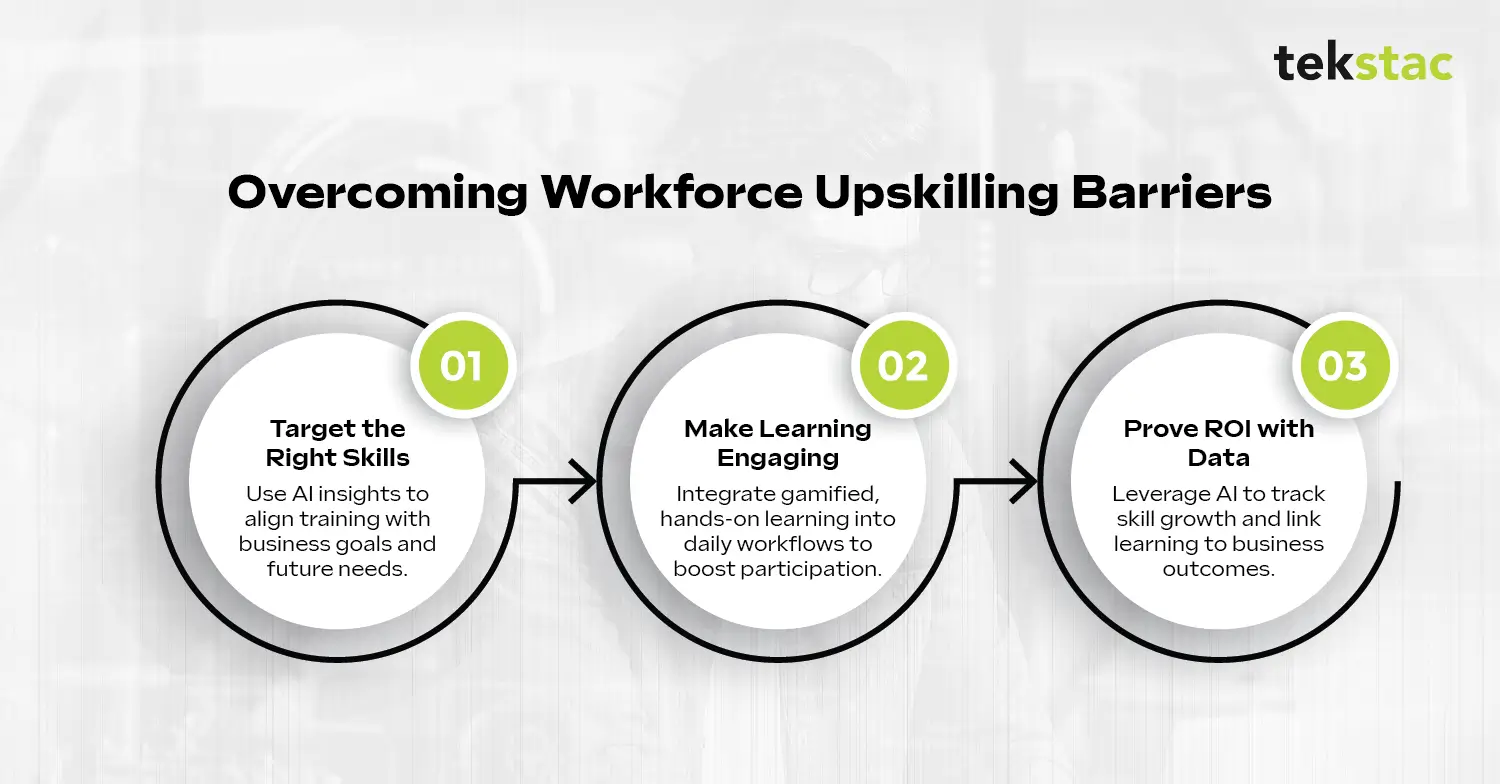
Many organizations struggle with identifying the right skill areas for investment. AI-driven insights remove the guesswork by pinpointing critical skills needed across teams. This enables companies to build a workforce upskilling strategy that directly aligns with business growth.
The shift toward AI is already happening—employees are 47% more likely than leaders realize to believe that AI will replace 30% of their work in the next year. Without targeted learning initiatives, businesses risk losing talent and falling behind competitors who are actively investing in AI-driven training solutions.
Resistance to change is common, especially when employees perceive upskilling as an additional workload. By integrating learning into daily workflows, offering hands-on labs, and using gamified experiences, companies can create a culture where continuous learning feels natural and engaging.
Studies show that employees trust their organizations more than universities and tech firms when it comes to responsible AI deployment. Companies that invest in transparent, well-structured upskilling programs can leverage this trust to drive higher participation and engagement in AI learning initiatives.
Without measurable outcomes, upskilling remains an expense rather than an investment. AI-powered platforms track skill progression, measure performance improvements, and tie learning outcomes to business impact. This ensures workforce upskilling delivers tangible value rather than just ticking a compliance box.
Executives are aware of this challenge—half of business leaders believe AI tool development within their companies is too slow. Talent skill gaps are cited as a primary reason for the delay. By investing in AI-driven workforce upskilling, companies can accelerate AI adoption, maximize efficiency, and drive long-term business success.
Companies that prioritize workforce upskilling are not just future-proofing their business—they are gaining a competitive edge. AI-powered learning solutions enable organizations to cultivate a highly skilled workforce capable of driving innovation and operational excellence.
As the pace of technological change accelerates, the question is no longer whether to invest in upskilling—but how quickly companies can implement intelligent, AI-driven learning solutions. The time to act is now. Workforce upskilling and reskilling for digital transformations is the foundation of long-term business success.
Start by identifying the skills your team will need—not just today, but for the future.
Tekstac, an enterprise AI skilling platform trusted by IBM, PwC, and Capgemini, delivers AI-powered workforce upskilling through personalized learning paths, hands-on labs, and skills intelligence dashboards — giving L&D teams the data to build capability strategically, not reactively. [Explore Tekstac’s workforce upskilling platform]
1. What are the best workforce upskilling solutions for enterprises?
The most effective enterprise workforce upskilling solutions combine three capabilities: AI-powered skills gap assessment to identify what each employee needs, personalized learning paths that adapt to individual pace and role requirements, and real-time analytics that tie skill progression to measurable business outcomes. Platforms like Tekstac deliver all three in an integrated LMS environment, enabling L&D teams to move from guesswork-based training to evidence-based capability building at scale.
2. How does AI improve workforce upskilling?
AI improves workforce upskilling in three ways: it personalizes learning by analyzing each employee’s current skills, learning patterns, and career goals to recommend targeted content; it tracks progress in real time through continuous assessments rather than periodic tests; and it uses predictive analytics to identify future skill requirements before gaps affect productivity. Together, these capabilities make upskilling faster, more relevant, and measurable — replacing static training calendars with adaptive, always-current development programs.
3. What is a workforce upskilling platform and what should it include?
A workforce upskilling platform is a technology solution that enables organizations to assess employee skills, deliver personalized learning content, track progress, and measure business impact — all in one system. Key capabilities to look for include: AI-driven skills gap analysis, role-based learning path customization, hands-on labs and practical assessments, integration with existing HRIS and LMS systems, and analytics dashboards that connect learning outcomes to performance metrics.
4. What is data and AI upskilling and why does it matter?
Data and AI upskilling is the process of building literacy and practical capability in data analysis, machine learning, AI tool usage, and related disciplines across a workforce — not just in technical teams. It matters because AI adoption fails without employees who can interpret data, work alongside AI systems, and make decisions informed by analytical outputs. A 2024 AI-Enabled ICT Workforce Consortium report found that 91.5% of ICT jobs face high or moderate transformation due to AI — making data and AI upskilling a business continuity requirement, not a nice-to-have.
5. How do you measure the ROI of workforce upskilling programs?
ROI from workforce upskilling is measured through four indicators: productivity improvement (output per employee before and after training), skill progression rate (speed at which employees move from assessed gap to demonstrated capability), retention impact (comparing turnover rates between upskilled and non-upskilled cohorts), and AI adoption velocity (how quickly employees integrate new tools into daily workflows). AI-powered platforms that track learning outcomes against performance data make this measurement continuous rather than retrospective.