
50+ Learning and Development Statistics Every Leader Should Know in 2026
August 5, 2026

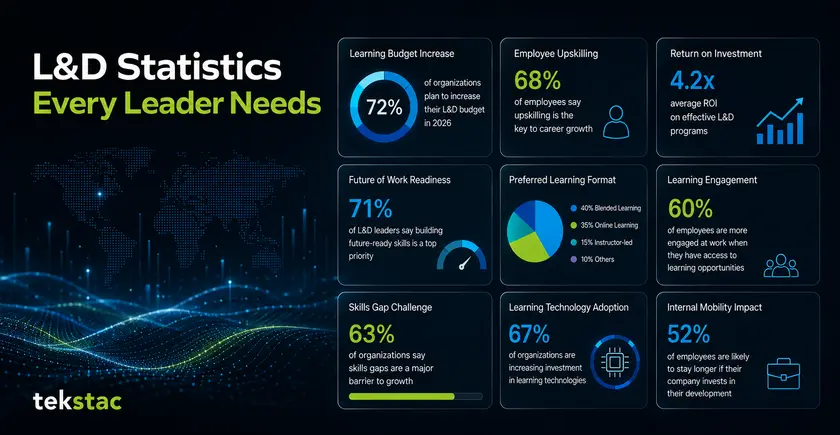
Learning and Development Statistics show how workplace learning has changed in recent years. As AI reshapes jobs and skill requirements evolve faster than ever, L&D teams are expected to equip employees with the right capabilities and deliver measurable ROI.
Want to know more about how L&D professionals are driving learning transformation? Keep reading for a list of compelling L&D statistics.
Trusted Sources Behind These Learning and Development Statistics
Every stat below is linked back to its original source that is credible; RedThread Research, Gallup, SHRM, Deloitte, WEF, Gartner, BCG, Korn Ferry, PwC, ATD, Training Magazine, LinkedIn Learning, and Tekstac’s own research report with SHRM.
This blog compiles 50+ L&D statistics for 2026, grouped into four categories that mirror how L&D actually operates today:
- AI in Learning & Development
- Skills Gaps, Upskilling & Reskilling
- Career Development & Leadership Growth
- Learning Investment, Delivery & Business Impact
1. AI in Learning & Development
The Global Sentiment Survey 2026 highlights that AI adoption in L&D is selective rather than comprehensive. Organizations are using AI in content creation, adaptive learning, and learner support, but are slower to adopt AI in analytics, measurement, and proving business impact.
The following Learning & Development Statistics reveal some of the biggest L&D Trends pertaining to AI in 2026.
- By 2026, only 2% of L&D technology vendors reported not using AI or large language models (LLMs), down from 24% and 48%, respectively, in 2023. The findings indicate that AI has become a mainstream capability across the learning technology market. (RedThread Learning Technology Market Report)
- Jobs requiring specific AI skills, such as prompt engineering or machine learning, are growing almost 8x faster (69%) than the overall jobs market (9%) — a direct signal of where training budgets are following demand. (PwC Global AI Jobs Barometer)
- In a joint survey of 50+ enterprises, the widening skill gap in the workforce (26.6%) came out as the single most pressing workforce challenge, with resistance to change (21.8%) close behind as the second-biggest disruptor. (Tekstac x SHRM Research)
- 92% of CHROs anticipate AI will be further integrated into the workforce in 2026, and 87% forecast greater AI adoption within HR processes specifically — up from 83% in 2025. (SHRM)
- Organizations taking a technology-first approach to AI are 1.6x more likely to fall short of expected returns compared to those taking a human-centered approach. (Deloitte)
- 72% say AI has already considerably changed skills expectations in their roles, and nearly half (47%) report spending more time managing and directing AI than doing the work itself. This highlights the growing need for continuous upskilling and reskilling. (BCG’s Annual AI at Work Report)
- 66% of leaders recognize the importance of designing effective human-AI interactions at work, yet only 6% say they’re making great progress on it. (Deloitte)
- By 2028, Gartner predicts 40% of employees will be trained and coached by AI when entering new roles, up from less than 5% today. (Gartner)
- One of the noteworthy corporate training statistics highlights that organizations which intentionally design how employees and AI interact are 2.5x more likely to report stronger financial results than those that don’t. (Deloitte)
- In a survey of 700+ CIOs, Gartner found that by 2030 organizations expect 75% of IT work to be done by humans augmented with AI, 25% by AI alone, and 0% by humans working without AI at all. (Gartner)
- 61% of employees believe autonomous AI agents could handle at least half of their job within the next three years. (BCG AI at Work)
- 52% of talent leaders plan to add autonomous AI agents to their recruiting teams in 2026, with some organizations already creating employee-style records for AI agents. (Korn Ferry)
- AI adoption among frontline employees has surged to 74% of regular users, up more than 20 percentage points in two years. (BCG AI at Work)
- Even as AI adoption accelerates, 73% of talent leaders still rank critical thinking as their top hiring and development priority. (Korn Ferry)
- Only 28% of HR functions currently lead their organization’s AI reskilling agenda, leaving most upskilling ownership scattered across other teams. (SHRM)
- 7 in 10 business leaders say being fast and nimble is their primary competitive strategy for the next three years, a shift that’s putting pressure on L&D to move at AI speed. (Deloitte)
- 40% of CHROs say the biggest obstacle to integrating AI into talent management is insufficient AI-related knowledge and skills within their own HR teams. (Korn Ferry)
- Close to 40% of employees say their workplace has offered workshops on practical, day-to-day AI skills, while 37% received an introduction to AI tools and roughly a third had access to coaching. (SHRM)
2. Skills Gaps, Upskilling & Reskilling
Upskilling and reskilling have become central to workforce planning. The following Employee Training Statistics highlight how employers are responding to evolving skill requirements, where learning investments are being prioritized.
- Employers expect 39% of workers’ core skills to change by 2030, a sign that upskilling efforts are starting to pay off. (World Economic Forum)
- Skills required in the most AI-exposed jobs are changing more than twice as fast as those in the least AI-exposed jobs. (PwC Global AI Jobs Barometer)
- 74% of companies are not able to keep up with their company’s demand for new skills. (Josh Bersin Research)
- 63% of employers identify the skills gap as the single biggest barrier to business transformation today. (World Economic Forum)
- The fastest-growing skills in the US split almost evenly between AI capabilities and human-centered skills like executive communication, leadership influence, and cross-functional collaboration. (LinkedIn Skills on the Rise)
- Upskilling for emerging technologies (25%) and building a culture of continuous learning (25%) ranked as the top two L&D priorities for the year ahead – ahead of leadership development (19.1%), innovation (16.4%), and closing skill gaps (14.5%). (Tekstac x SHRM Research)
- 22% of global CEOs say their organizations are highly exposed to a shortage of workers with key skills. (PwC’s Global CEO Survey)
- The share of the workforce that has completed a training, reskilling, or upskilling initiative has climbed to 50%, up from 41% in the previous edition of the report. (World Economic Forum)
- 72% of HR professionals say their organization’s L&D strategy is driven primarily by the skills employees will need in the next one to two years — only 4% plan against longer-term skills needs. (SHRM)
- Analytical thinking remains the most sought-after core skill among employers, with 7 in 10 companies rating it essential. (World Economic Forum)
- Structured, repetitive cognitive job postings fell 13% following the launch of ChatGPT, while demand for analytical, creative, and leadership-intensive work grew 20% over the same period. (Harvard Business School research via Inc)
- 49% of L&D and talent leaders say their executives are concerned that employees don’t have the right skills to execute the business strategy. (LinkedIn Workplace Learning Report)
- Hiring in advanced economies remains 20–35% below pre-pandemic levels, even as emerging markets like India (+40%) and the UAE (+37%) show continued momentum — reshaping where skills investment is concentrated globally. (LinkedIn data via World Economic Forum)
- 56% of the workforce said they learned new skills at work that help their career. (PwC’s Global Workforce Hopes & Fears Survey)
- 52% of workers globally are actively job hunting in 2026, and close to 80% of them say they don’t feel prepared to find a new job. (LinkedIn data via World Economic Forum)
- Skills shortages and selective upskilling to close them remain the top challenges cited by L&D executives heading into 2026, alongside workload management. (SHRM)
3. Career Development & Leadership Growth
Developing technical skills alone is no longer enough to build a future-ready workforce. Organizations are increasingly investing in leadership development, internal mobility, coaching, and career progression to improve employee engagement and retention. These Workplace Learning Statistics show why career growth has become a critical part of modern L&D strategies.
- Only 36% of organizations qualify as “career development champions” with robust, business-driving programs in place — 31% have limited programs, and 33% are just starting out. (LinkedIn Workplace Learning Report)
- Only 16% of L&D professionals say they participate in business strategy discussions, while just 28% are involved in future workforce planning. (RedThread Research on State of L&D)
- Leadership and manager development is the top CHRO priority for 2026, cited by 46% of CHROs — the second year running that it has topped the list. (SHRM)
- Even as AI reshapes hiring, 73% of talent leaders still rank critical thinking as their top priority for people they hire and develop — ahead of AI-specific skills. (Korn Ferry)
- Training alone lifts manager wellbeing from 28% to 34% — but pairing it with ongoing coaching and encouragement pushes manager thriving up to 50%. (Gallup)
- 88% of organizations are concerned about employee retention, and providing learning opportunities is the number one retention strategy they’re leaning on. (LinkedIn Workplace Learning Report)
- Less than 44% of managers globally have received formal management training, even though Gallup finds that training cuts active disengagement in managers roughly in half. (Gallup, 2025)
- 31% of CHROs now name workplace culture as a top priority for 2026, up sharply from just 15% in 2025. (SHRM)
- Global manager engagement fell from 30% to 27% in the last year, a steeper decline than the one seen among individual contributors, who held steady at 18%. (Gallup)
4. Learning Investment, Delivery & Business Impact
Today’s L&D leaders are expected to demonstrate how training contributes to workforce readiness, AI adoption, ROI and business performance. These Employee Training Statistics highlight why measuring capability is becoming the new benchmark for learning success.
- Businesses spend over $400 billion on training, content libraries, L&D technology, trainers, and learning consultants. (Josh Bersin Research)
- U.S. corporate training expenditure climbed 4.9% to $102.8 billion in 2025, up from $98 billion in 2024. (Training Magazine, Training Industry Report)
- Average formal learning hours per employee rose to 16.7 in 2025, up from 13.7 the year before — even as direct learning spend per employee fell to $846, from $1,254. (ATD, State of the Industry Report)
- Employees who received more than five hours of AI-related training were far more likely to become regular AI users (79%) than those who received under five hours (67%) — training, not access, is what drives adoption. (BCG AI at Work)
- Spending on outside training products and services jumped 29% to $16 billion, even as spend on travel, facilities, and equipment declined. (Training Magazine, Training Industry Report)
- The “super-star” companies leaning hardest into AI have posted labour productivity gains of 163% — far outpacing less AI-exposed businesses. (PwC Global AI Jobs Barometer)
- 66% of C-suite leaders say traditional functions like HR, finance, IT, and legal need to fundamentally change how they operate — yet only 7% say they’re making real progress toward that goal. (Deloitte Global Human Capital Trends Report)
- 87% of HR professionals using AI report improved efficiency, and 70% report enhanced creativity in their own work. (SHRM)
- Practical, hands-on AI skills training is now more common than purely technical AI training in workplace programs — 55% vs. 45% of organizations, respectively. (ATD, State of the Industry Report)
- Productivity growth is running 40% higher at companies most exposed to AI than at companies least exposed to it. (PwC Global AI Jobs Barometer)
- Workers with in-demand AI skills now command an average 62% wage premium over peers without them, up from 57% a year earlier. (PwC Global AI Jobs Barometer)
- Only 1 in 10 organizations (based on insights from 51 senior L&D leaders across IT, technology, and GCC organizations) say they are fully prepared to measure learning based on demonstrated skills and business outcomes rather than training completion. (Tekstac x SHRM Research)
The data tells a clear story!
In 2026, L&D trends are evolving. They are helping organizations build AI-ready workforces, close critical skills gaps, develop future leaders, and demonstrate measurable business impact. These Learning and Development (L&D) Statistics highlight how rapidly workplace learning is changing.
Want to move beyond completion rates and build an AI-ready workforce? Book a demo with Tekstac to see how leading enterprises are measuring skills, closing capability gaps, and transforming learning into business impact.