
An enterprise learning adoption curve is the journey employees follow from initial awareness of a learning platform to consistent skill application and measurable business impact. The adoption curve of any enterprise learning initiative rarely follows a straight line. Some employees actively explore every new learning opportunity, while others wait until they see clear value before participating. Many engage only when learning becomes directly relevant to their work.
Understanding these different patterns of learning adoption is the key to improving learner engagement, strengthening workforce capability, and delivering measurable business outcomes.
Adoption curves, often called S curves, are one of the more insightful tools, which is the cumulative rate at which a population adopts a product, service, or technology over time.
This idea is not new. In 1962, communication theorist Everett Rogers introduced the Diffusion of Innovations theory, explaining how new ideas spread through populations over time. His adoption curve showed that people embrace change at different speeds, from innovators and early adopters to the early majority, late majority, and laggards. Although Rogers originally applied this thinking to innovations and technology, the same principle is remarkably relevant to enterprise learning adoption.
Organizations often invest significant time and resources in deploying learning platforms, designing learning paths, and creating skill development programs. However, many still assume that once a platform is available, employees will naturally use it. In reality, learning platforms are adopted much like any other enterprise technology. Success depends less on the availability of learning content and more on how effectively organizations guide employees through the adoption journey.
This is the thinking behind the Tekstac Adoption Curve. Rather than viewing learning as a one-time enrollment or course completion, it treats enterprise learning adoption as a progressive journey where employees build awareness, develop engagement, demonstrate competence, and eventually contribute to organization-wide capability intelligence.
One of the biggest misconceptions in workplace learning is that providing access automatically creates engagement. Most organizations measure platform success through enrollments, course completions, or login statistics. While these metrics indicate activity, they rarely demonstrate whether employees are building capabilities that improve business performance.
The same pattern exists across enterprise software. Organizations purchase sophisticated platforms with powerful capabilities, yet employees often use only a small portion of what is available. The problem is rarely the technology itself. Instead, it is the absence of structured adoption strategies that help users gradually discover, trust, and incorporate new workforce capabilities
Learning platforms face a similar challenge. Without clear skill visibility, personalized recommendations, continuous guidance, and meaningful validation, many learners lose momentum after their initial interaction. Learning becomes another corporate initiative rather than an integrated part of professional growth.
This is particularly significant as organizations respond to rapidly changing skill requirements. According to LinkedIn’s Report, four out of five professionals want to develop AI-related skills, while organizations increasingly recognize learning and career development as essential drivers of retention and business performance. The report also found that organizations with stronger learning cultures demonstrate healthier leadership pipelines, greater internal mobility, and higher employee retention.
According to McKinsey report, 55% of leaders say successfully building AI capabilities of employees will bring exponential productivity gains.
These findings reinforce an important point: learning outcomes improve not because organizations offer more content, but because they build environments where employees continuously engage with learning.
In fact, our joint research with SHRM India found that only 1 in 10 organizations have the foundational building blocks needed to transform workforce skills, highlighting why enterprise learning success depends on adoption.
The Tekstac Adoption Curve applies this understanding to enterprise learning. Instead of focusing only on content delivery, it structures the learner journey into five progressive stages that move employees from awareness to measurable business impact.
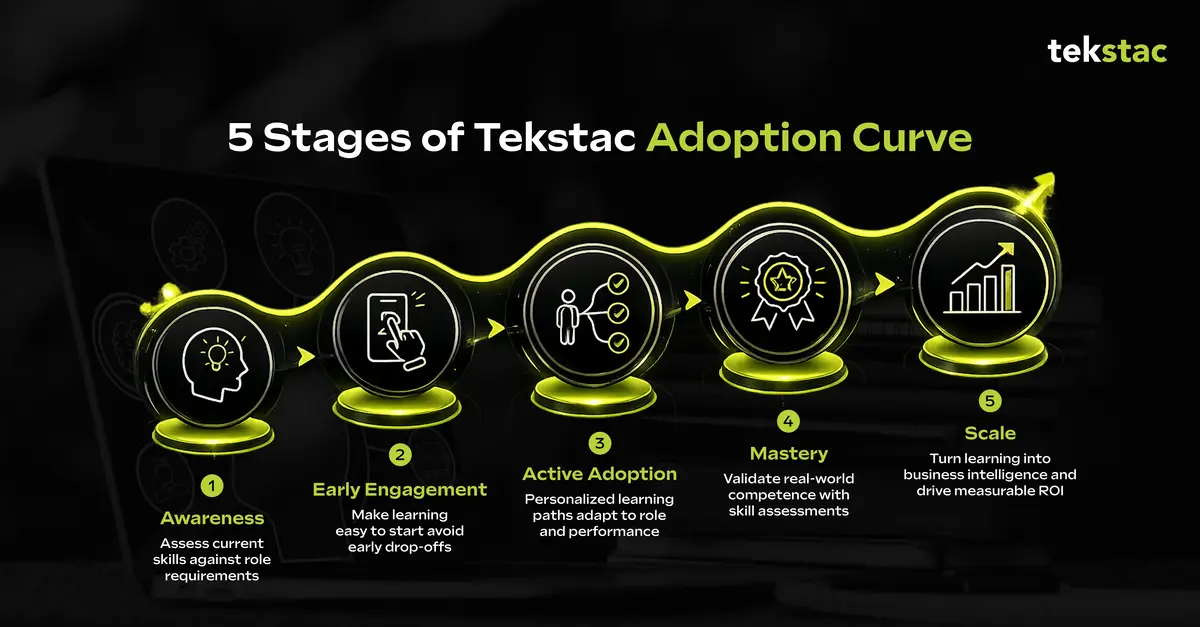
The first stage of the Tekstac Adoption Curve focuses on building this awareness through structured skill assessments. Rather than asking employees what they would like to learn, organizations first establish where existing capabilities stand against role expectations.
This approach enables enterprises to identify critical skill gaps before recommending learning interventions. It also provides employees with greater confidence because learning is connected directly to their current role, future aspirations, and business objectives instead of generic course catalogs.
Many enterprise learning initiatives lose participants during the earliest stages. Complex onboarding, overwhelming content libraries, and unclear learning priorities often prevent meaningful employee learning engagement.
The second stage focuses on reducing this initial friction.
Instead of presenting hundreds of disconnected courses, learners receive guided recommendations that make it easier to take the first step. Personalized suggestions, AI-assisted guidance, and intuitive learning experiences help employees move quickly from intention to action.
For example, Johnson & Johnson redefined workforce development by moving beyond skills alone to a whole-person model that also considers experience, motivation, and aspirations. This shows that courses alone are not enough.
Employees rarely progress at the same pace. Some learners quickly master foundational concepts and require advanced challenges, while others need additional practice before moving forward. Treating every learner identically often results in disengagement at both ends of the spectrum.
The third stage emphasizes personalized learning paths that continuously adapt based on learner progress, role requirements, assessment performance, and evolving skill priorities.
At this stage, learning curve becomes habitual rather than event-driven.
The fourth stage of the Tekstac Adoption Curve focuses on validating competence rather than measuring attendance through skill insights.
Skill assessments, practical exercises, coding environments, simulations, project-based evaluations, and performance validation provide organizations with far greater visibility into actual capability development.
This distinction is becoming increasingly important as enterprises prepare workforces for emerging technologies such as artificial intelligence, cloud engineering, cybersecurity, and data science. Organizations require employees who can confidently apply skills in business situations, not simply recall theoretical concepts.
The final stage extends beyond individual learners.
As organizations accumulate assessment results, skill inventories, learner engagement data, and competency validations, learning evolves into an enterprise-wide intelligence system.
Leaders can begin answering strategic workforce questions with greater confidence.
Instead of measuring learning through course completions, organizations measure workforce readiness.
This creates a continuous feedback loop where enterprise learning supports workforce planning, talent development, succession planning, and business transformation simultaneously.
At this stage, learning adoption curve becomes an organizational capability rather than an individual activity.
Every organization contains innovators who eagerly explore new ideas, early adopters who demonstrate value, and larger groups who require evidence before changing established behaviors. Enterprise learning follows the same pattern.
Rather than expecting immediate organization-wide participation, successful learning ecosystems recognize these differences and design experiences that support every stage of adoption. Employees receive clarity before learning, guidance during learning, validation after learning, and opportunities to continue growing throughout their careers.
This progression creates stronger learner engagement because employees understand not only what they need to learn, but also why that learning matters to their individual growth and organizational success.
The future of enterprise learning will not be defined by the number of courses organizations provide or the sophistication of their technology stacks. It will be defined by how effectively they move employees through the adoption curve: from awareness to engagement, from engagement to mastery, and from individual growth to enterprise capability.
Agentic AI is all over, and the only way to skill up is to view learning as a continuous capability-building journey rather than a transactional training event. When organizations understand where employees are on that journey and provide the right support at every stage, learning adoption becomes sustainable,workforce upskilling becomes measurable, and enterprise learning begins delivering the business outcomes it was designed to achieve.
Book a demo and see how Tekstac’s Agentic AI capability helps your workforce learn, practice, and demonstrate the skills needed to build and work with AI agents.
1. What is enterprise learning adoption?
Enterprise learning adoption refers to how effectively employees embrace and consistently use a learning platform, program, or capability-building initiative within an organization. It goes beyond enrollment numbers to measure meaningful participation, course completion, knowledge application, and long-term behavior change.
2. What makes a learning platform successful?
A successful learning platform is one that delivers measurable business outcomes while providing an engaging learning experience. It offers personalized learning paths, relevant content, hands-on practice, and clear progress tracking. Most importantly, it helps employees build job-relevant skills that improve individual performance and organizational capability.
3. How long does enterprise learning adoption take?
The timeline for enterprise learning adoption varies depending on the organization’s size, culture, change management strategy, and platform implementation. Initial adoption may begin within a few weeks, but achieving sustained engagement and organization-wide usage typically takes between 3 to 12 months.
4. How can organizations improve learner engagement?
Organizations can improve learner engagement by making learning personalized, and easy to access. Role-based learning paths, AI-powered recommendations, interactive labs, gamification, social learning, and manager involvement encourage continuous participation. Regularly measuring learner behavior, collecting feedback, and refining learning experiences also helps maintain engagement and ensures employees see tangible value from their learning journey.