AI-powered proctoring is the technology that makes virtual assessments credible at enterprise scale — monitoring learner behavior in real time, flagging suspicious activity across webcam, screen, and audio channels, and generating a verifiable Trust Score for every assessment attempt.
As organizations scale training across geographies and job roles, one challenge consistently surfaces for L&D leaders: how do you verify that the person behind the screen is genuinely learning — and not gaming the result?.
AI-powered proctoring leverages artificial intelligence to monitor video and web activities of learner behavior during assessments and flag suspicious activities in real time.
Tekstac’s proctoring suite includes:
But Tekstac’s solution goes beyond surveillance- it delivers data-backed trust by giving L&D teams evidence they can act on.
AI-powered proctoring bridges the trust gap in virtual assessments by making it technically difficult to cheat without detection. Where digital learning creates loopholes.
All of this raises a key concern: How do you ensure the person behind the screen is truly learning, not just performing?
Tekstac’s AI Proctoring Platform technology is purpose-built to answer that.
According to the 2025 LinkedIn Workplace Learning Report, 94% of companies say upskilling and reskilling are vital for business success, yet 62% of L&D leaders cite “assessment credibility” as a top challenge in virtual learning environments.
In a world where training data influences promotions, hiring, role-fitment, and project allocation, unreliable assessment results can undermine the entire learning initiative.
This is exactly why Tekstac’s AI-Powered Proctoring exists, to bridge the trust gap between learning and performance by making assessments smart, secure, and credible.
Upgrade your employee training and development strategy with AI-powered insights — book a quick demo.
Integrated AI-powered proctoring delivers six measurable advantages over bolted-on third-party tools: built-in activation at every assessment type, verifiable video submissions, learner-transparent fairness signals, HR-usable credibility data, ethical deterrence without punishment, and configurable oversight matched to assessment criticality.
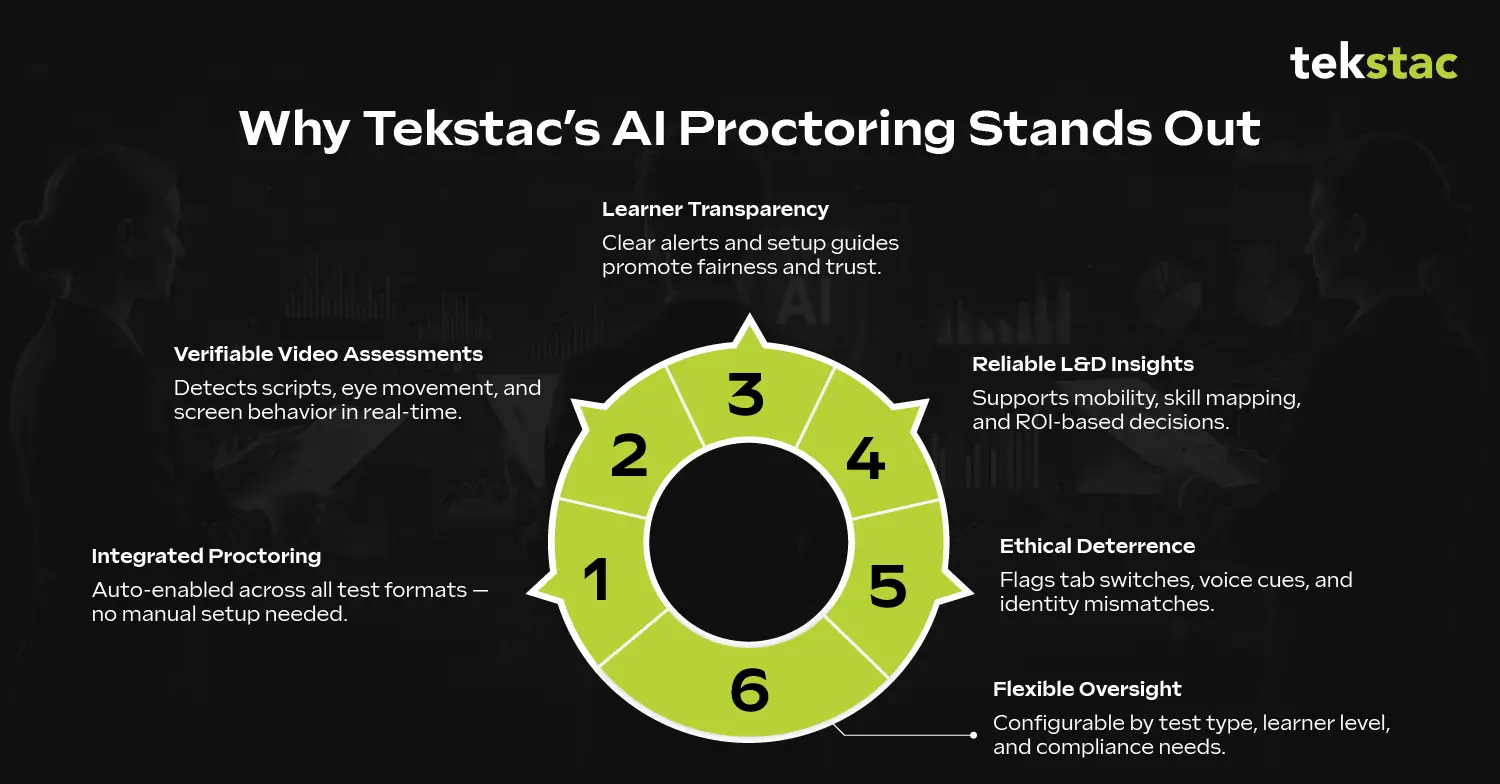
Many platforms add third-party proctoring as a post-process. Not Tekstac. Proctoring is deeply integrated within the assessment engine.
Every time a learner attempts a test, whether it’s MCQs, assignments, coding tasks, or video submissions. Tekstac automatically activates AI-based monitoring. There’s no manual step required.
What organizations get:
This allows managers to review learner behavior in context and take fair, confident decisions based on facts, not assumptions.
Video-based assessments are increasingly popular for evaluating real-world capabilities like communication, problem-solving, and tech fluency.
But are they truly reliable when done remotely?
Tekstac enhances video assessments by:
This ensures that what appears as a confident video submission is genuinely the learner’s work, not a scripted or assisted performance.
Trust doesn’t only go one way; learners need to feel the system is fair too.
Tekstac empowers learners by:
This approach builds a culture of accountability, where learners are motivated to perform well because their honest effort will be recognized and rewarded.
A certificate means nothing without credibility. But when proctoring data is reliable, it becomes a decision-making tool.
Here’s how:
With Tekstac’s AI-Powered Proctoring, assessment scores carry real weight — not just as symbols of completion, but as proof of competence. That data becomes even more powerful when connected to skills insights — giving L&D leaders a unified view of capability gaps, assessment performance, and role-readiness across the entire workforce.
When learners know monitoring is inactive, assessment of integrity degrades. A 2025 SHRM study found that 43% of employees were admitted to searching for answers during unproctored online tests. Intelligent deterrence not punishment — is the most effective response.
These features act as non-intrusive deterrents, encouraging learners to give their best effort, knowing there’s intelligent oversight in place.
One assessment doesn’t fit all. A coding challenge for entry-level engineers requires different oversight compared to a leadership evaluation.
Tekstac offers configurable proctoring based on:
This ensures that proctoring isn’t rigid, it’s custom-fit for your organization’s structure and values.
In the digital age, skill development is not a one-time event, it’s a continuous journey. But for that journey to mean something, there needs to be trust- trust in data, trust in results, and trust in the learner.
Tekstac’s AI Proctoring makes that trust possible.
By offering built-in proctoring, intelligent violation tracking, reliable video evaluation, and transparent learner engagement- Tekstac ensures that every assessment is fair, evidence-based, and business-aligned.
So, the next time you evaluate someone’s readiness for a role, a promotion, or a new project, you won’t just see scores, you’ll see truth.
Don’t let questionable results shape your business decisions.
See Tekstac’s AI-Powered Proctoring in Action – Book a Free Demo to Experience Trusted, Secure, and Fair Assessments.
1. What is AI-powered proctoring in employee training?
AI-powered proctoring in employee training is the use of artificial intelligence to monitor learner behavior during online assessments — tracking webcam activity, screen usage, audio signals, and content patterns to detect and deter dishonesty. Unlike traditional invigilation, it operates automatically at scale, generating a Trust Score for each learner that L&D and HR teams can use for promotion, certification, and role-fitment decisions.
2. How does AI-powered proctoring work in a virtual assessment?
AI-powered proctoring works by activating multiple monitoring layers simultaneously when a learner begins an assessment: webcam tracking detects face identity and multiple persons, screen monitoring flags tab switching and unauthorized applications, audio detection identifies external voices or prompts, and copy-paste detection matches submitted content against known web sources. Each violation is timestamped, severity-rated, and consolidated into a single learner of Trust Score.
3. How does remote AI proctoring detect suspicious learner behavior?
Remote AI proctoring detects suspicious behavior through continuous pattern analysis across three channels. Visually, it uses face detection to flag identity mismatches, multiple persons in frame, or prolonged eye movement away from the screen. Behaviorally, it monitors tab switching frequency, unauthorized application launches, and unusual response timing that may indicate external assistance. Content-wise, it analyzes pasted text against web sources and AI-generated output patterns. Each signal is severity-rated in real time — so reviewers see not just that a violation occurred, but how serious it was and when.
4. What are the data privacy implications of using AI proctoring tools?
AI proctoring tools collect sensitive personal data biometric identifiers, screen recordings, audio feeds, and behavioral patterns — which places them under data protection regulations including GDPR, India’s DPDP Act 2023, and enterprise data governance policies. Key implications for organizations are learner consent must be obtained before monitoring begins, recorded data must be stored with defined retention limits and access controls, and proctoring providers must be able to demonstrate compliance with applicable privacy frameworks. Tekstac addresses this through configurable proctoring modes that allow organizations to adjust monitoring scope based on compliance requirements — ensuring oversight does not come at the cost of learner data rights.
5. Can AI proctoring detect ChatGPT or AI-generated answers?
Yes. Modern AI proctoring platforms including Tekstac flag AI-generated content patterns by analyzing writing style consistency, pasting behavior, and response timing. Copy-paste detection also traces submitted text against known AI tool outputs. As generative AI adoption grows, AI-generated content detection has become a core proctoring capability for enterprise L&D teams.