
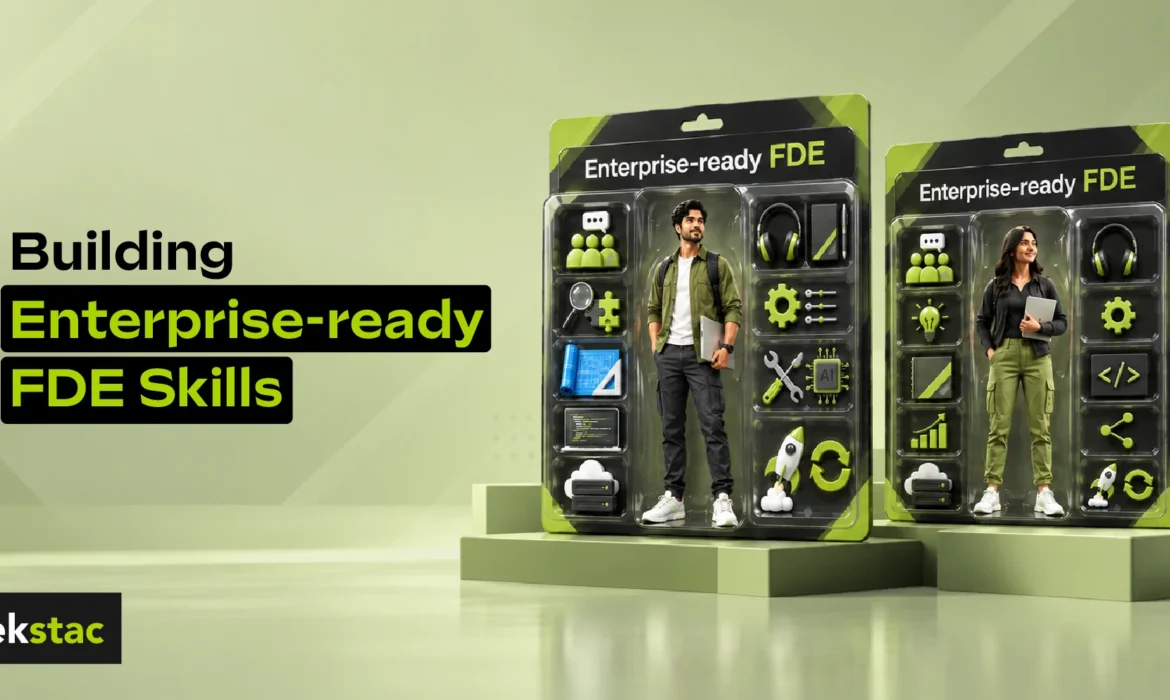
Forward Deployed Engineer skills go well beyond programming or AI expertise. An effective FDE combines software engineering, systems integration, applied AI, customer discovery, product thinking, communication, problem-solving and the ability to work through ambiguity. For enterprises, building FDE readiness requires more than an AI learning path or coding assessment. It requires a way to develop and validate whether an engineer can take up a real business problem, build a solution around real-world constraints and move it into production.
In simple terms, a Forward Deployed Engineer is a software engineer who works closely with a customer to build, integrate and deploy a working technical solution in the customer’s environment.
That can mean connecting an AI application to an existing enterprise system, adapting a workflow to a customer’s requirements, debugging an integration that behaves differently in production, or figuring out why a solution that worked perfectly in a prototype is not being adopted by users.
This also explains why FDEs are often confused with adjacent roles such as software engineers, solutions engineers and consultants.
A software engineer may build a product designed for many customers. A solutions engineer may help demonstrate how that product could solve a customer’s problem, particularly during the sales process. An FDE goes further into implementation, working directly with the customer to build and deploy the solution.
The role has become particularly relevant in AI because AI systems are highly dependent on context. An LLM or agent can perform well in a controlled demonstration and still need significant engineering work before it can operate reliably within an enterprise workflow.
The FDE effectively occupies that last-mile space between “the technology can do this” and “the customer can actually use this.” That is also why the role increasingly combines technical execution with customer and product responsibilities.
According to World Economic Forum, 1.3 million new roles like Forward-Deployed Engineers are emerging as AI reshapes the world of work. As organizations focus on AI workforce readiness, it is natural that there is growing curiosity around what this new role entails and the skills needed to succeed in it.
Does an FDE need AI skills? It’s one of the first questions that comes up when we talk about the role today. The strongest Forward Deployed Engineer capabilities can be grouped into four broad areas: engineering depth, systems integration, applied AI and customer-facing problem solving.
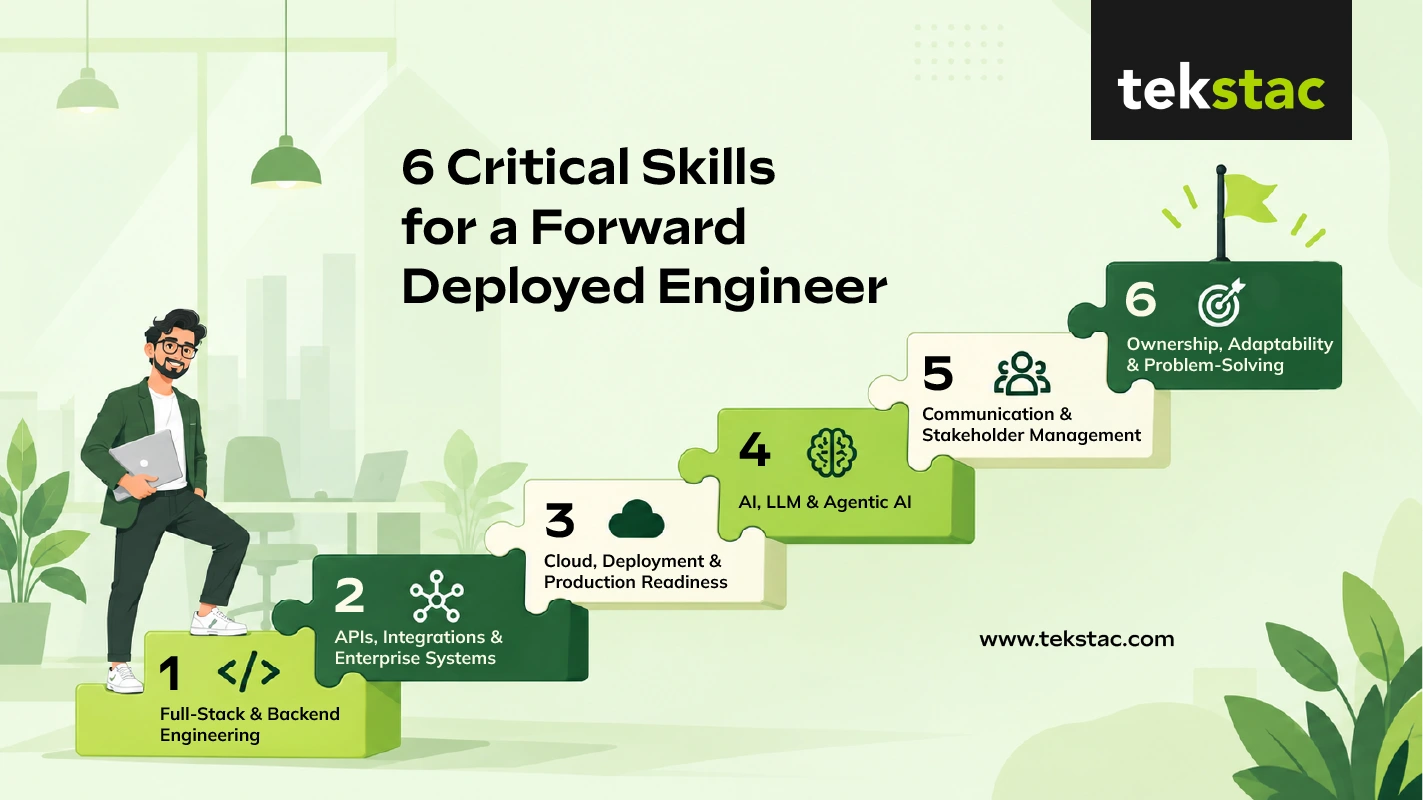
FDEs frequently work across the stack because customer problems rarely arrive neatly packaged for a single engineering team. A solution may require a backend service, a frontend workflow, an API integration and a database change within the same engagement.
Key capabilities include:
This is one of the most important Forward Deployed Engineer competencies.
An FDE may encounter a legacy CRM, an undocumented API, multiple authentication layers, inconsistent data formats and systems that were never designed to work together.
FDEs should be comfortable with:
These are important Forward Deployed Engineer skills because production introduces constraints that a classroom or development environment cannot fully reproduce.
Key skills include:
For AI-native FDE roles, applied AI is increasingly part of the technical foundation.
This can include:
This is where the FDE role starts to separate itself from conventional engineering. FDEs operate across technical and non-technical groups.
A strong FDE can explain:
Finally, FDE work requires a high degree of ownership. An engineer does not become FDE-ready simply because they have completed learning paths covering Python, cloud or GenAI.
They need to demonstrate that they can apply those skills together.
India’s IT services industry alone is planning for thousands of FDE roles. TCS has said it plans to build a team of up to 8,900 FDEs, while Infosys is targeting around 6,000 over the coming years. Hence, a stronger Forward Deployed Engineer skills validation approach must be taken to build its readiness.
For large organizations, the more scalable approach may be to identify adjacent talent and build the missing capabilities.
Before launching an FDE program, define what the role actually requires in your organization.
An FDE deploying enterprise agents will need a different capability profile from an FDE supporting a conventional SaaS implementation. Map the role across technical, AI, customer, product and delivery capabilities.
Learning should move from concept to application through realistic scenarios. A learner might have to build an AI workflow, connect it to enterprise data, evaluate its outputs, troubleshoot failures and present the solution to a simulated stakeholder.
The scenario becomes a learning environment.
Not every engineer needs to become an FDE overnight. A more practical model is to create progressive pathways that build from existing strengths.
For example:
Engineering foundation → Cloud and integration → Applied AI → Customer discovery → Solution delivery → Production deployment → FDE readiness
Tekstac approaches this by bringing technical learning, hands-on practice, assessments and project-based validation into a single capability journey.
Learners can build across the technology layer; from Python, cloud and APIs to GenAI, RAG, agentic AI and application development, while also working through scenarios that require them to apply those skills to realistic problems.
For an FDE pathway, that can mean moving from technical foundations into integration, AI application development, deployment, evaluation and end-to-end project work, with evidence generated along the way.
For L&D and talent leaders, that creates a more useful question than “Who completed the FDE curriculum?”
The rise of the Forward Deployed Engineer reflects a larger change in how technology is being built and deployed.
AI has made it possible to create sophisticated solutions faster. But faster creation does not automatically mean faster adoption. The difficult part often begins when technology encounters real data, existing systems, business processes, security constraints and people.
That is why FDEs need a broader combination of capabilities.
They need to code, integrate, deploy and understand AI. But they also need to ask good questions, understand customer workflows, make trade-offs, communicate clearly and stay accountable when the path from prototype to production gets messy.
For enterprises, that means FDE readiness cannot be reduced to a list of technologies. It has to be demonstrated through skills validation, realistic scenarios and evidence of applied capability.
The organizations that build this capability effectively will not simply have more people who know AI. They will have more people who can make AI work where it matters.
Book a demo to see how Tekstac can help you build and validate FDE capabilities across your workforce.
1. What programming languages do FDEs use?
Python is one of the most common languages for FDEs, particularly for AI, data and automation work. Depending on the customer environment, FDEs may also work with JavaScript/TypeScript, Java, C#, Go or other languages.
2. What AI skills are important for Forward Deployed Engineers?
Important AI skills can include LLMs, prompt engineering, RAG, vector databases, AI APIs, agentic AI, model evaluation and AI application development. The exact depth required depends on the type of solutions the FDE works on.
3. What is the difference between an FDE and a software engineer?
Both roles require strong engineering skills, but their working environments differ. Software engineers often build products within a defined product and engineering roadmap, while FDEs work more directly with customers to adapt and deploy technology for specific real-world problems.
A focused Agentic AI capability roadmap can help enterprises turn Agentic AI learning into capability and capability into deployment readiness. Today, the challenge is no longer simply giving employees access to AI. It is building a workforce that can actually design systems.
That is where many organizations are finding a gap. Teams may have completed GenAI training, experimented with agents, or gained access to the latest frameworks, but leaders still need a clear answer to a practical question: who is ready to work on Agentic AI projects, and who needs more development?
That is why success of enterprise AI adoption depends on how clear a capability roadmap is.
Agentic AI introduces a different kind of skills challenge for enterprises. Employees need to understand how models interact with context, tools, data, memory, and Agentic AI workflows. An enterprise-ready practitioner also needs to understand when an agent is appropriate for a problem, what level of autonomy makes sense, how permissions should be designed, how the system should be monitored, and what happens when an agent fails.
That creates five layers of capability:
This is why a practical learning path must be designed to build agentic AI capability rather than just tutorials. The more durable capability lies in understanding the architecture and principles underneath them.
A structured roadmap can still fail if it is designed around completion rather than capability. According to an IDC report, 56% of organizations are increasing investment in AI skills development for current employees, highlighting the shift from simply delivering learning to building practical, usable AI skills.
Some of the persistent challenges are:
Jumping directly into agent-building tools can produce shallow proficiency. Employees may learn where to click or which library to import without understanding the architecture underneath.
Frameworks can make development faster, but agentic AI readiness is not about learning a set of tools. Tools and frameworks will continue to evolve. What enterprises need to retain is the ability to reason about models, regardless of which framework is being used.
Agentic AI is difficult to learn passively. Reading documentation or completing videos can bring familiarity, but building an agent develops a very different level of proficiency. For enterprise learning, practice needs to be part of the architecture of the learning path, not an optional activity at the end.
The platform brings different components of the journey into a single skilling environment, connecting assessment, Learning Paths, hands-on practice, mentoring, and capability intelligence.
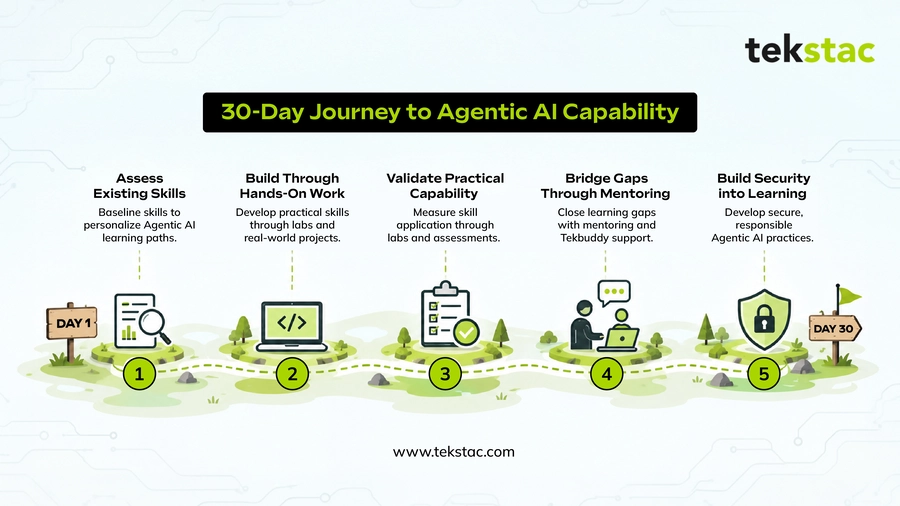
Employees do not enter an Agentic AI journey with the same experience. The platform can establish a skills baseline through assessments and skills validation, helping organizations understand existing proficiency before assigning development paths. This allows the learning journey to be aligned to the learner rather than assuming that every employee needs the same starting point.
The learning experience moves beyond theoretical content through practical labs and real development environments. Learners can work with relevant Agentic AI technologies and build workflows and applications rather than simply consuming instructional content.
One of our biggest strengths in building agentic AI workforce readiness is its ability to measure practical capability, not just learning completion. Its auto-evaluated labs and assessments allow organizations to evaluate how employees apply their skills in real-world scenarios at scale.
When learners get stuck in between their course, we provide mentoring to bridge the gap between understanding a concept and applying it effectively. The platform has embedded an AI assistant called Tekbuddy to solve any real-time doubts.
Our approach also incorporates the trust and security considerations that become important when employees work with agentic systems. That includes areas such as guardrails, safe agent permissions, prompt-injection defense, evaluation, red-teaming, transparency, and responsible AI practices.
The first week should establish technical foundation before employees start building.
Learners work through the concepts that sit underneath modern agentic systems: LLM interaction, prompting and context engineering, APIs and tool calling, retrieval, memory, agent architecture, and orchestration.
By the end of the first week, the enterprise has more than a list of participants. It has an initial view of capability and development needs.
Once the fundamentals are established, employees can move from understanding systems to building Agentic AI solutions. This is where tools and frameworks become useful. Depending on the role and technology environment, learners can work with platforms and frameworks such as n8n, Langflow, Flowise, LangGraph, CrewAI, MCP, A2A, and LangFuse.
This is where the learning journey needs to move beyond technology. During the third week of enterprise agentic AI training, learners can work on a project that requires them to identify a business problem suited to an agentic approach. Additionally, debug failures and improve the solution.
The final week brings together development, evaluation, and enterprise considerations. An agent that works under ideal conditions may still fail when it encounters unexpected inputs, unavailable tools, incorrect information, or unsafe requests. Employees therefore need to test more than functionality.
At the end of the 30 days, the organization can begin distinguishing between employees who are ready for relevant project work, those who are close to readiness, and those who require targeted development.
For enterprise leaders, the final value of an Agentic AI skilling initiative is not simply the number of employees trained. It is the visibility that comes from understanding what the workforce can actually do.
A conventional learning report might show enrollment, completion, assessment scores, or hours spent learning. Those metrics are useful, but they do not necessarily answer the questions technology and business leaders need to make workforce decisions.
This Agentic AI capability roadmap can provide a focused, measurable progression and evaluate the capabilities required for the next stage. With Tekstac, organizations can bring learning paths, hands-on labs, assessments, mentoring, security, and capability intelligence into one structured journey.
Book a demo to get a detailed 30-day Agentic AI capability roadmap with Tekstac.
1. Is 30 days enough to make an employee deployment ready in Agentic AI?
The 30-day roadmap establishes a baseline, develops practical skills, enables project-based application, and validates readiness against defined criteria. Employees who are not yet ready can continue through targeted Learning Paths and mentoring.
2. What should an enterprise include in an Agentic AI Learning Path?
A strong Learning Path should cover AI and LLM foundations, agent development, orchestration, tools and APIs, real-world projects, evaluation, observability, security, and governance. It should also include hands-on practice and assessment so that capability can be demonstrated rather than assumed.
3. How does Tekstac measure Agentic AI readiness?
Tekstac combines skill profiling, hands-on labs, auto-evaluated assessments, project work, and mentoring to generate evidence of capability. Results can then be viewed by role, team, skill, and technology stack to identify employees who are ready, near-ready, or require further development.
4. What is the difference between Agentic AI training and Agentic AI capability building?
Training primarily focuses on what employees learn. Capability building goes further by measuring what they can apply. An Agentic AI capability program combines learning with hands-on development, projects, assessment, mentoring, and evidence that can be connected to specific roles and enterprise requirements.
As organizations navigate AI disruption, digital transformation, and evolving workforce expectations, a new generation of HR and L&D leaders in India is redefining how talent is built, nurtured, and retained.
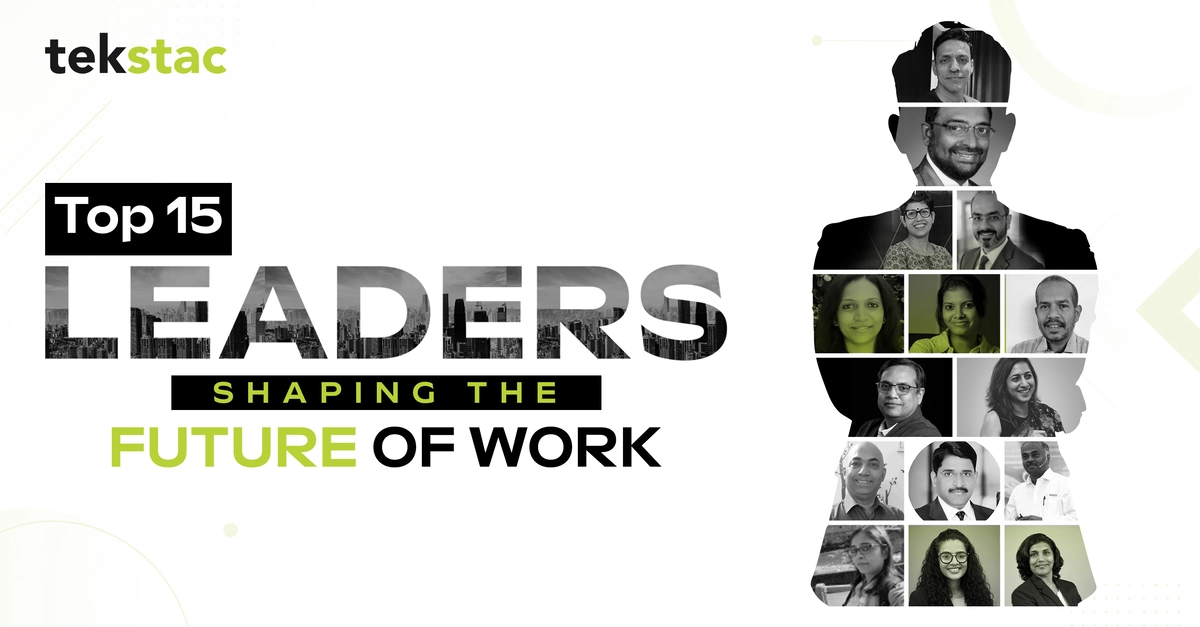
Across India’s leading enterprises, these visionaries are driving enterprise-wide reskilling, leadership development, organizational transformation, and capability-building initiatives that prepare businesses for tomorrow’s challenges. Their work goes beyond training programs; they are shaping cultures of continuous learning, building future-ready leaders, and ensuring organizations remain competitive in an AI-driven world.
Here’s a look at some of the most influential HR and L&D leaders making an impact in 2026.
Enterprise L&D and Talent Transformation Leader | Infosys BPM
With over 2 decades of experience, Sivakumaran Ranganathan has emerged as a leading force in enterprise learning transformation. He has successfully aligned large-scale reskilling initiatives with business outcomes, enabling organizations to build future-ready talent pipelines across technology and services sectors. His expertise spans capability building, leadership development, role readiness, and digital skilling strategies that accelerate productivity and business growth.
Practice Lead – OD & Senior Leadership Development (Global) | Amdocs
Simren Mehn is widely recognized for blending organizational development with leadership transformation and AI-driven talent strategies. With more than 18 years of experience, she has designed global leadership programs, executive coaching ecosystems, succession frameworks, and AI-powered capability initiatives that drive measurable business impact. Her human-centered approach, combined with deep expertise in inclusion and organizational design, has made her one of India’s most respected L&D leaders.
Director – Learning Design & Development | Dell Technologies
With more than 30 years of industry experience, Biju Mathew has played a pivotal role in advancing digital learning and enterprise capability development at Dell Technologies. His expertise spans learning design, customer experience transformation, technical enablement, and global training operations. His leadership has consistently contributed to strengthening learning ecosystems that support digital transformation at scale.
Senior Director – Innovation and Learning, Technology and Product | Salesforce
Bobby Joy is a globally recognized talent development leader with over 25 years of experience in leadership development, innovation, and organizational learning. An executive coach and industry thought leader, he has influenced learning strategies across multinational organizations while speaking at leading global forums including Brandon Hall, NASSCOM, and Zinnov. His passion for building high-performing teams continues to shape next-gen learning practices.
Talent Development Leader | Walmart Global Tech India
Aishwarya Iyer leads enterprise talent development initiatives focused on leadership growth, workforce capability building, manager enablement, and future-skills readiness. Known for her learner-centric and data-driven approach, she combines organizational psychology with strategic learning design to build scalable learning ecosystems. Her work continues to empower technology talent through inclusive and experience-led development programs.
People and Talent Leader – India Technology Center | Lennox
Madhurya Hariharan brings nearly 2 decades of experience across talent development, HR strategy, analytics, and organizational transformation. From building large cloud and data organizations to leading talent initiatives across North America and India, she has consistently helped businesses navigate technology shifts through people-centric strategies. Her passion for innovation, workforce analytics, and leadership development makes her a prominent voice in India’s HR landscape.
Executive Director – Talent and Learning | Wells Fargo
Palekar Anand has built an impressive career spanning banking, financial services, and GCCs, leading learning and talent functions across organizations including Wells Fargo, WNS Global Services, DSP Merrill Lynch, and Standard Chartered Bank. With nearly two decades of leadership experience, he has been instrumental in shaping enterprise learning strategies, leadership development frameworks, and organizational capability-building initiatives that support business transformation at scale.
Vice President & Head – People & Organization | Siemens Technology and Services
With over three decades of global HR leadership experience, Srikanth Vachaspati has led large-scale people transformations across multinational organizations. His expertise spans organizational change, leadership coaching, cultural integration, and HR strategy, making him a key driver of future-ready workplaces that balance business growth with people excellence.
Chief Talent Officer | Publicis Sapient India
Shefali Sharma Garg is a strategic talent leader known for building high-performing organizations through innovative people-centric practices. With deep expertise across talent management, leadership development, employee engagement, organizational design, and HR transformation, she has consistently aligned people strategy with business priorities to drive sustainable growth and performance.
Global Talent & Learning Leader | Neurealm
Thomas Raj is a seasoned HR and L&D leader championing AI-powered workforce transformation. From establishing enterprise AI Skilling Academies to redesigning onboarding and learning ecosystems that deliver measurable business impact, his work demonstrates how strategic talent development can accelerate organizational agility and innovation at scale.
Chief Learning Officer | UST
Krishnan Nilakantan, popularly known as NK, is one of India’s most respected learning leaders with nearly three decades of experience in organizational transformation and capability development. Renowned for modernizing corporate learning through technology and business-aligned strategies, he has been recognized among the country’s top CLOs for driving continuous learning cultures that deliver measurable business outcomes.
Head – Learning & Development | Tata Electronics
Jagatheesh Jayanand leads learning and talent transformation for one of India’s fastest-growing manufacturing organizations, driving capability building for a workforce of over 70,000 associates. Drawing from extensive experience across consulting, manufacturing, and technology services, he focuses on integrating business strategy with innovative learning solutions to build agile and future-ready talent.
Head of People & Culture | Centrico India
Anamika Sinha brings more than two decades of HR leadership experience across workforce transformation, people strategy, and organizational development. Passionate about leveraging AI and digital technologies in HR, she combines data-driven decision-making with inclusive talent practices to create employee experiences that foster innovation, collaboration, and long-term growth.
Director – People Learning Lead | Deloitte South Asia
Aruna Nair Pawaskar leads learning strategy for Deloitte South Asia, designing enterprise-wide capability development aligned with business priorities and global talent strategies. Her expertise lies in competency-based learning, curriculum design, stakeholder collaboration, and analytics-driven learning interventions that strengthen organizational capability across every career stage.
Global Head of Learning | GlobalLogic
Seema Acharya is a global learning leader driving digital transformation through enterprise-wide capability building and AI-enabled learning ecosystems. With over 25 years of experience spanning technology and education, she has successfully scaled technical academies and workforce upskilling initiatives that position learning as a strategic business advantage rather than a support function.
As AI reshapes industries and skills evolve faster than ever, the role of the L&D leader has become one of the most influential positions in the modern enterprise. In 2026, India’s most impactful HR and L&D leaders are proving that the future of business will belong to organizations that invest in learning with the same intensity as they invest in technology. Their work serves as a blueprint for building agile, resilient, and future-ready workforces that can thrive through constant change.
Most L&D leaders don’t suffer from a lack of data. They suffer from too much fragmented data, too little trust in it, and no clear way to translate it into better business decisions.
The default metrics such as completion rates, satisfaction scores, and average quiz marks feel precise. They’re easy to pull from an LMS and easy to put in a report. But they almost never answer the question a CFO or COO is actually asking: Is our team capable? What’s our learning ROI?
This is where the conversation in L&D needs to change — from data-driven to data-informed decision making. Without this shift, L&D will continue to struggle to demonstrate learning ROI to the C-suite.
Organizations collect vast amounts of L&D data, but converting that information into meaningful business decisions is often challenging. Without the right context and insights, learning metrics can create confusion instead of driving action.
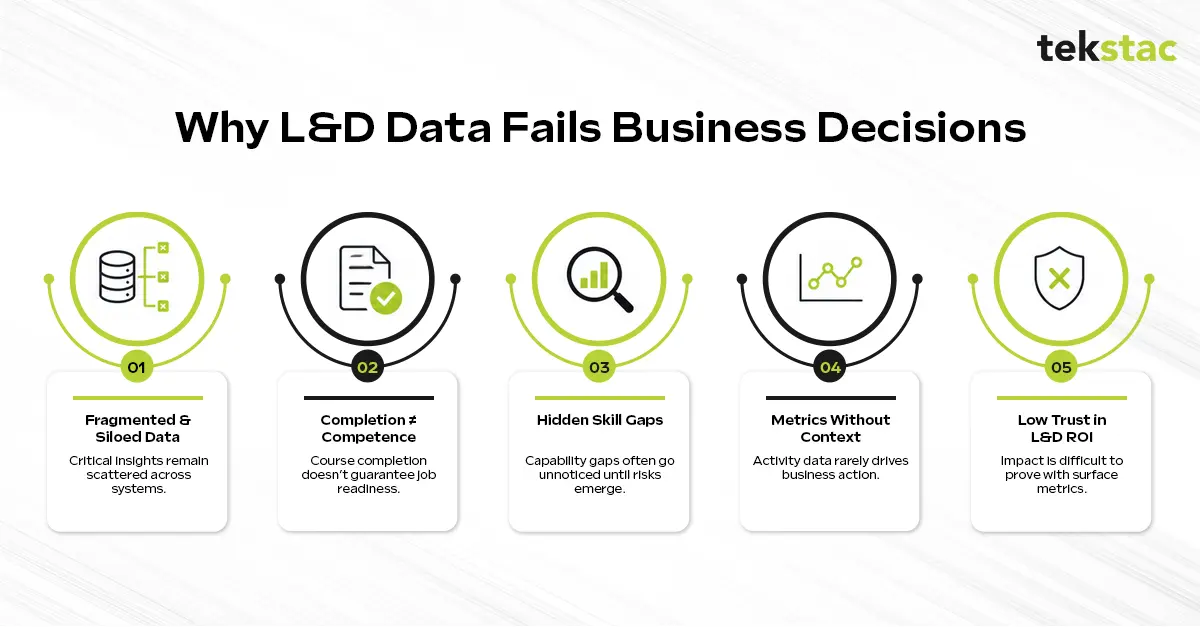
Ask any L&D leader where their data comes from, and the answers are familiar: LMS reports, post-training surveys, assessment scores, manager feedback, HR systems. And yet the most common complaint remains: “We don’t have enough data.”
In reality, the problem is almost never data availability. It’s that data lives in silos, owned by different functions, in different systems, with different access controls. Performance data sits in HR. System usage data sits in IT. Customer interaction data sits in operations. Each island holds a piece of the puzzle, but no one is assembling the picture.
If LMS completion data is your primary evidence base, you’re operating within very narrow boundaries, and every business decision you inform is built on an incomplete foundation.
In L&D, too many teams are operating on autopilot, following the waggle dance of LMS reports and quiz scores without asking what those numbers actually mean, or what they’re failing to surface. A learner can score 90% on a cloud security assessment and still fail to stop a live breach. Completion is not competence. Passing is not performance.
The hard truth: An LMS tells you who completed what and when. It cannot tell you who is actually job-ready, where capability gaps are quietly growing, or whether training reduced a single point of business risk.
According to the World Economic Forum (WEF), 50% of the global workforce completed formal training in 2025, but many L&D teams still face challenges in translating learning activity into measurable business decisions.
Beyond the silo problem, there’s a more fundamental limitation: your LMS can only ever reflect the environment you designed. It surfaces insights you thought to look for. It will never show you what you didn’t think to measure.
The shift we need is from treating data as a dictator; something that tells us what to do, to treating it as one critical input in a larger business decision-making process.
As Jerry Z. Muller argues in The Tyranny of Metrics, chasing numbers can cause organizations to miss their real objectives entirely. Completion rates, satisfaction scores, and quiz averages feel precise, but without context, they can actively mislead. They reward compliance, not competence. They measure what was easy to measure, not what actually matters.
The most effective fix is not better dashboards. It’s a declared, documented, pre-agreed methodology for how your function engages with data; one that ties training effectiveness directly to workforce capability and business outcomes.
”The goal of analytics isn’t to report on the past. It’s to separate the signal from the noise so we can predict the future.”
— David Green, Global Leader in People Analytics
L&D often struggles to earn trust, not because of a lack of capability, but because of a lack of documented methodology. When a business leader asks “Why did you choose a workshop over e-learning?” or “How do you know this is a training problem and not a management problem?”, the answer is too often “we judged it based on experience.”
Experience is valuable. But it’s not auditable. And in an environment where every function is being asked to justify its budget in outcome terms, “we felt it was the right call” is not a defensible position.
Without a clear methodology tying learning activity to workforce capability and business outcomes, L&D insights will always feel subjective, even when the underlying data is sound.
Tekstac is a skills intelligence platform built to close the gap between learning activity and real workforce capability, giving organizations the data intelligence needed to make confident business decisions.
Tekstac doesn’t start with reports. It starts with the questions business leaders actually need answered:
Each of these capabilities shifts the conversation from “Did training happen?” to “Can the team perform?”
At the core of this platform is role–skill fitment. Rather than treating learners as course completers, it maps individuals against required role skills and proficiency levels. This gives L&D teams, managers, and leaders a shared, objective view of where the workforce stands and ultimately translates into better business decisions.
The platform replaces passive quizzes with auto-evaluated hands-on labs. When a developer works inside the platform’s sandbox, the platform doesn’t simply record whether they got the right answer; it tracks their logic, their error-correction speed, and their technical accuracy under realistic conditions. The result is a proficiency heatmap: not “100 people passed” but “40 people are ready for senior DevOps work; 60 need targeted support with deployment automation.”
Using AI-driven, multi-dimensional talent matching, it identifies employees who are closest to role-readiness. For large organizations hiring or redeploying at scale, this directly reduces time to productivity, training costs, and project risk. In one consultancy case study, targeted micro-lab interventions identified from Tekstac data reduced time-to-competency by 20%, moving staff to billable projects weeks ahead of schedule.
Data-informed decision making in L&D means using learning data such as proficiency scores, skill gap analysis, role-fitment assessments as one input alongside business context. Unlike purely data-driven approaches where numbers dictate action, data-informed teams use analytics to ask better questions and validate decisions, not replace human thinking.
The future of L&D is not about collecting more data; it’s about turning the right signals into smarter business decisions. Completion rates and quiz scores may show activity, but they rarely reveal whether teams are truly capable, deployable, or ready for change.
In a business environment where speed, adaptability, and capability define competitive advantage, L&D can no longer afford to operate on assumptions. That’s where Tekstac changes the conversation. By combining role–skill fitment, hands-on assessments, and AI-driven skill intelligence, it helps organizations move beyond reporting metrics to making informed business decisions.
👉 Book a Tekstac demo and see your workforce capability data in action
1. What is decision-making in business?
Business decision-making is the process of analyzing information, evaluating risks and opportunities, and choosing the best course of action to achieve organizational goals. Effective decision-making combines data, business context, experience, and strategic priorities to drive better outcomes across operations, people, finance, and growth.
2. What is the difference between data-driven and data-informed L&D?
Data-driven means the numbers dictate the action. Data-informed means data is one critical input alongside professional judgment, qualitative signals, and business context. The latter produces better decisions because it accounts for what data can’t capture: the messiness of real work, shifting organizational context, and the knowledge held by experienced practitioners that never makes it into a dashboard.
3. How do you measure L&D impact beyond completion rates?
Track proficiency improvement over time using pre/post assessments, speed to competency (how fast capability develops, not just whether a course was finished), role–skill fitment scores that show readiness against actual job requirements, and downstream business metrics such as QA scores, deployment speed, error rates, and time-to-productivity. Tekstac connects practice behavior in hands-on labs directly to on-the-job performance, creating a defensible link between learning activity and business outcome.
4. How should L&D present impact data to the C-suite?
Lead with outcomes, not activity. Structure the narrative as: the problem → the signal → the action → the result. Executives don’t need a dashboard; they need a decision. Make the business outcome the hero of the story, not the L&D team or the platform.
5. How do we stop being ‘order takers’ and become strategic partners?
Stop saying yes to every course request. If the data shows no meaningful skill gap exists, the problem is likely a process issue, a management issue, or a confidence issue, none of which a training course will fix. Having a documented methodology for how you diagnose problems and communicate that clearly to the business.
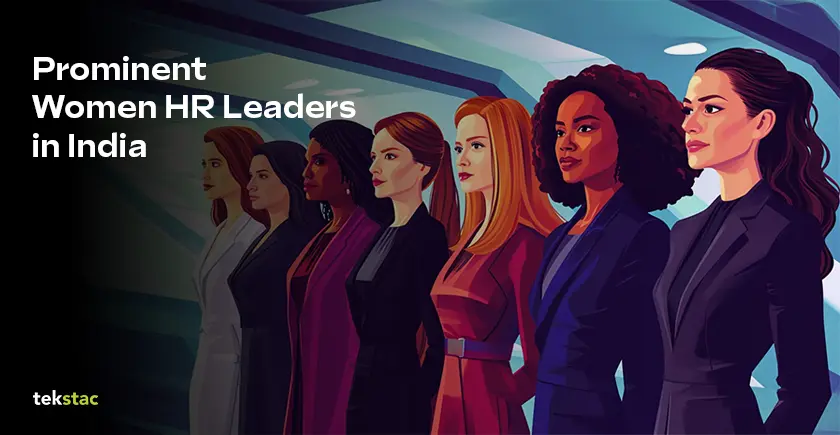
For decades, human resources was viewed as a company’s administrative backbone. Today, it is the central nervous system. As the corporate landscape shifts toward a skills-first approach, talent strategy has become the most critical infrastructure for sustainable company growth. Leading this transformation are women leaders in India who are redefining what modern HR looks like.
We aren’t just measuring representation; we are measuring impact. Across India’s rapidly scaling tech ecosystems and Global Capability Centres (GCCs), women leaders are no longer just participating in the dialogue around diversity and talent; they are rewriting the entire playbook.
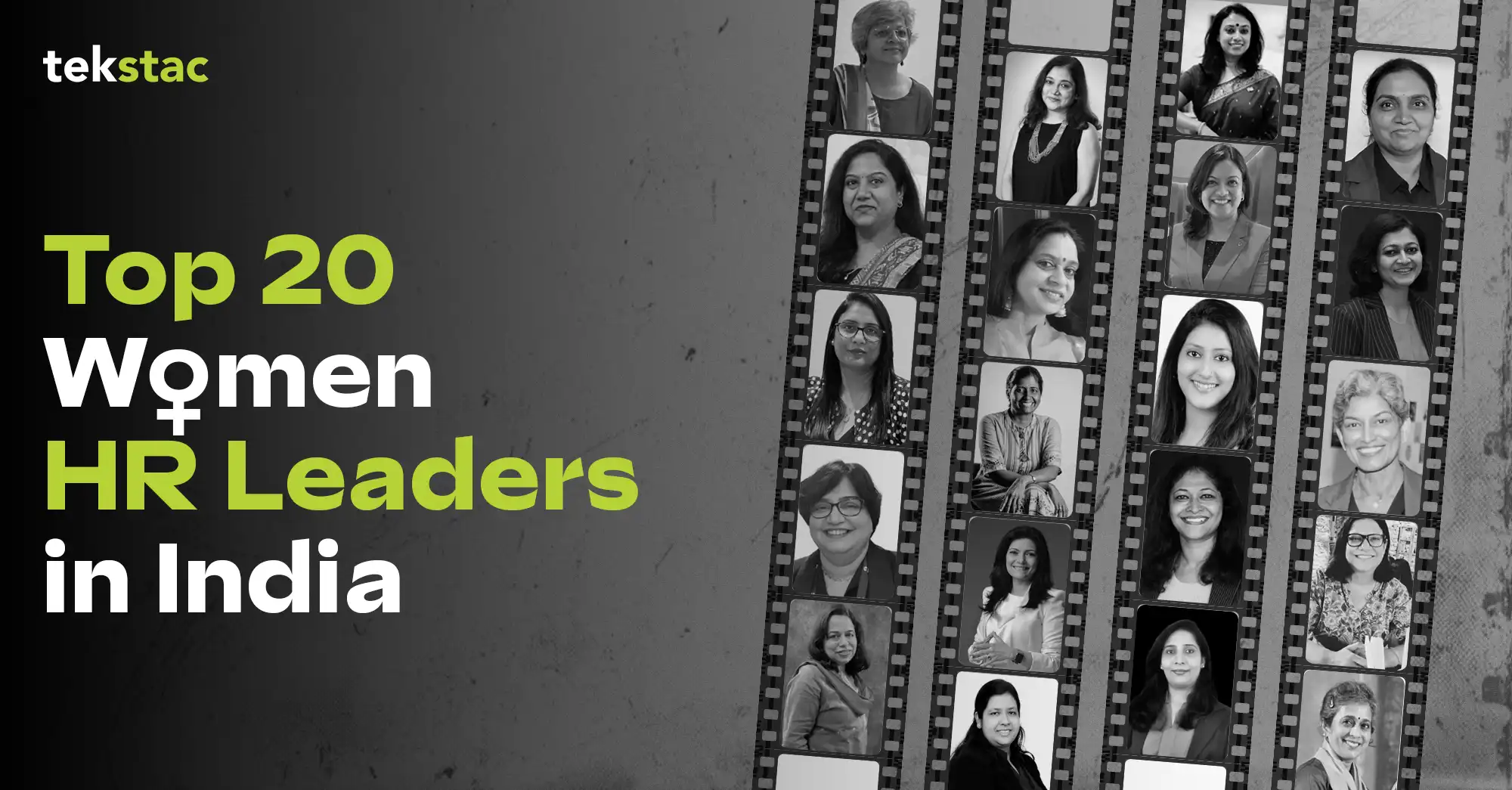
As American author Harriet Beecher once said, “Women are the real architects of society.” In today’s corporate ecosystem, HR leaders are the architects of culture.” In this blog, we are spotlighting 20 women leaders in India transforming HR narrative.
The push for gender parity and inclusive leadership is no longer just an initiative; it is a macroeconomic imperative.
We are witnessing a remarkable rise of women ascending to leadership roles specifically within Global Capability Centres. Leaders in these environments bring unique perspectives that are reshaping the corporate landscape, fostering innovation, and driving agile work cultures. By combining technological efficiency with human sensitivity, they are ensuring that the future of tech is built on a foundation of diverse, skills-first capabilities.
Here are 20 inspiring women leaders in India who are breaking the mold and redefining talent strategy: be it from IT, Pharma or GCC sectors.
MD, SAP Labs India
Rising from a software developer in 1999 to the first woman to lead SAP Labs India as MD, Sindhu is a global tech visionary. She serves as the Chairperson of NASSCOM and sits on the boards of Siemens India and Titan, blending deep technical capability with human-centric leadership.
IT Country Head, Merck IT India
With roughly 17 years of experience steering digital innovation, Anuprita leads one of Merck’s most critical global digital hubs. Her strategic push for skills intelligence recently empowered her teams to deliver breakthrough AI-driven lab solutions, proving that modern HR is directly tied to tech infrastructure.
Associate Vice President – Global Head Technical Learning CoE, Zensar
Priya spearheads global talent acquisition and technical learning with a focus on capability building. She is known for developing robust talent pipelines and creating safe spaces for cross-functional leadership, acting as a strong advocate for women navigating the tech industry. Her leadership has been associated with several marquee achievements, including CEO Excellence Award 2024, Brandon Hall Gold & Silver Awards – 2022, 2023, among many others.
Head of Learning & Talent Development, KPMG
As one of the renowned women leaders in India, Anindita brings over 25 years of experience and focuses on enterprise talent and developing robust learning architectures designed to foster continuous professional growth and dynamic skills intelligence. She develops robust learning architectures designed to foster continuous professional growth and dynamic skills intelligence.
VP – Learning, Talent & Organization Development, AXA Global Business Services
Amrita brings over 18 years of strategic HR leadership, functioning as an ICF-ACC certified coach and NLP Practitioner. She is renowned for driving large-scale HR automation and technology adoption to ensure workforce capabilities directly support global business goals. As a Gartner Peer Ambassador, she actively contributes to global HR communities, staying ahead of evolving workforce trends and sharing insights on building human-centric HR ecosystems.
HR Director – Head of L&OD, Rakuten
A key driver of technological upskilling in high-paced SaaS environments, Shree cultivates an internal culture heavily focused on continuous improvement and building an agile talent infrastructure for the modern tech landscape.
Senior VP, Indium Software
With over 20+ years of experience, Mangala designs and executes highly impactful learning initiatives, seamlessly equipping engineering and product teams with cutting-edge, future-focused capabilities. She was awarded Learning Leader of the Year 2024 in L&D Event conducted by UBS Forums and awarded Under 40 Trailblazer by Business World.
VP – Global Technical Training Head, L&D, HR, Mphasis
With over 25 years in the learning space, including major stints at Accenture and Infosys—Jyothi is dedicated to bridging the technical skills gap. She leads global training programs that drive technological excellence and future-proof engineering workforce.
Senior VP – Capability, Culture & Leadership Transformation, NAB
With over two decades of shaping executive talent, Dr. Singh has established massive Learning & Development Centers of Excellence. Her data-backed strategies and impact have earned her multiple Brandon Hall and Ragan Platinum Awards, establishing her as a heavyweight in global operational capability.
Head – Human Resources, Delta Technology and Management Services Pvt. Ltd
With a robust career spanning more than 25 years, Vijayalakshmi has led HR initiatives across the US, Europe, and Asia. She is a respected thought leader in building highly competitive employee value propositions and seamlessly integrating human capital systems.
Global L&D Head, Sonata Software
A prominent voice in modern HR, Shubhra architects agile, global learning strategies. A frequent speaker on leadership transformation, she champions continuous learning, adaptability, and emotional intelligence to accelerate holistic business transformation.
CEO & MD, Lloyds Technology Centre India
A powerhouse engineer with prior leadership stints at JP Morgan and Mastercard, Sirisha is a recognized trailblazer for women in tech. Her exceptional impact on the industry is highlighted by recent top-tier accolades, including the NASSCOM Trailblazing Women in Tech Award (2024), Impact Leader of the Year at the GCC Summit (2025), and Winner of Trailblazer GCC (2024).
HR Professor, IIM Kozhikode
With over 35 years of combined industry and academic experience, she is currently shaping future leaders as faculty at IIM Kozhikode. A former Sr VP at Schneider Electric and an ICF-certified executive coach, she frequently publishes impactful research in the Harvard Business Review.
VP, People & Culture, Zafin
Bringing over 25 years of HR expertise to the table, Divya drives a people-centric, high-growth culture in the SaaS space. An IIM Calcutta alumna recognized among the Top 250 Great Managers in India, she excels at aligning talent infrastructure with global business objectives.
CHRO, USV Private Ltd
With over 25 years of strategic HR experience across Fortune 500 companies and startups, Aparna has earned accolades like the ‘Iconic Women Award’ (2020) and the ‘Top 101 HR Minds in India’ (2019). She is instrumental in aligning talent infrastructure with long-term organizational scaling.
Deputy Vice President – Global Head – L&D, Tata Technologies
With 24 years of work experience, Tracy drives the global learning infrastructure, focusing heavily on continuous upskilling in emerging areas like GenAI and software-defined vehicles. She plays a critical role in ensuring legacy workforces remain agile and future-ready during rapid industry transformations.
Director – Global Learning and Talent Development, Fime
Bringing over 20 years of expertise in HR transformation, Annapurna orchestrates global learning frameworks. She is also the founder of Emotionalytics & Co. and is highly regarded as a certified OD professional for her focus on emotional intelligence and leadership development.
Transformational Coach | Advisor | Speaker
An ICF-ACC certified coach and Chief Customer Officer at RippleHire, Keerthi brings over two decades of experience, including heading Customer Success at LinkedIn India. She leverages deep coaching to drive cultural shifts and authentic leadership growth.
Founder, HRGurukul
Founder of HRGurukul and a former Employer Branding Lead at IBM, Ruchi brings 25 years of industry experience to the table. This IIM-C alumna is repeatedly recognized as a Top 100 Future of Work Influencer and a leading voice in talent strategy.
Group CHRO, Sterlite EdIndia Foundation
With two decades of experience across diverse sectors, Ruhie is an ICF-certified coach holding an MSc in Occupational Psychology from Birkbeck, London. She is frequently recognized among India’s most influential HR leaders for her data-driven empathy and strategic focus on D&I.
As we celebrate International Women’s Day, it is vital to recognize women leaders in India, within all sectors. They are the architects of our future workforce. By blending high emotional intelligence with data-driven decision-making, and by prioritizing continuous upskilling, they are ensuring that our organizations are not only high-performing but genuinely inclusive.
At Tekstac, we understand that building a transformative, skills-first organization requires diverse perspectives at the helm. We are incredibly proud of the strong representation of women leaders within our own ranks who continuously drive our company growth.
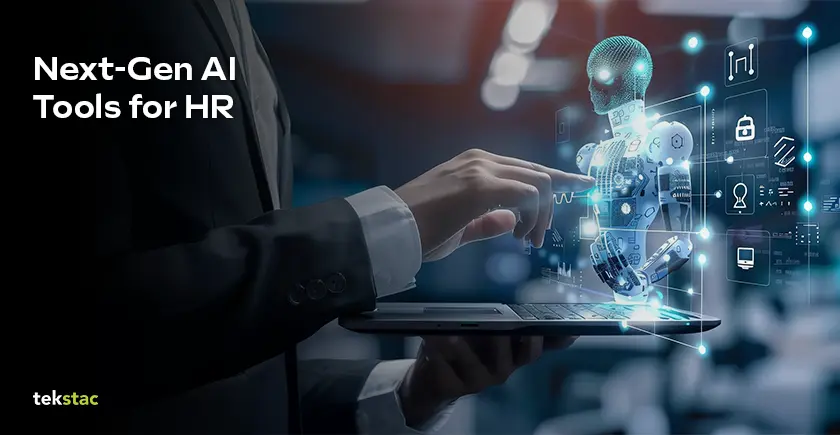
Choosing the right HR AI tools is essential for improving workforce efficiency, enhancing employee experiences, and achieving business goals. With a growing number of AI tools for HR, finding the right solution can be challenging. Here’s a curated list of 26 HR AI tools every enterprise should know in 2026 to streamline HR operations, strengthen talent management, and drive measurable business impact. Let’s explore them by category.
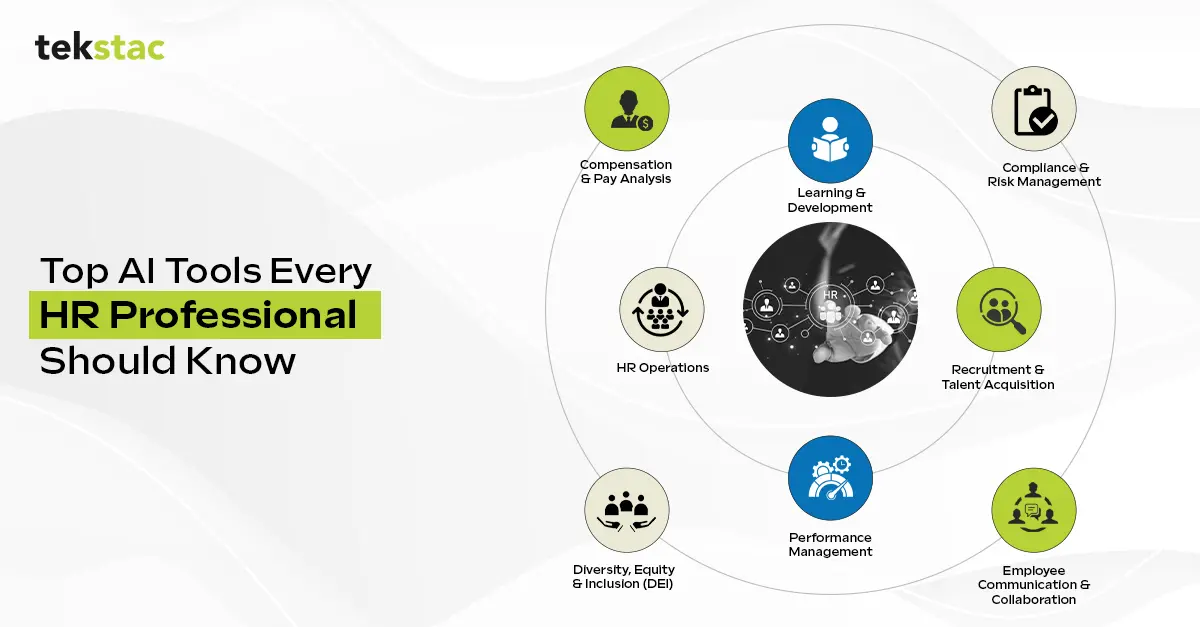
While these tools address specific HR functions, their real impact depends on how they align with overall HR strategy. For a complete view on integrating AI across hiring, learning, and workforce transformation, refer to our AI in HR guide.
| Category | Company Name | Pricing |
|---|---|---|
| Learning & Development | Tekstac | Custom pricing |
| Degreed | Custom pricing | |
| Fuse Universal | Starts at $25,000 annually | |
| Recruitment & Talent Acquisition | LinkedIn Talent Insights | $170/month (single license); $270/month per license (licenses 2–5); $1,680/year (single license); $2,670/year (licenses 2–5) |
| Pymetrics | Starts at $10,000 annually | |
| SeekOut | Basic: $499/month; Pro: $999/month; Enterprise: $1,999/month | |
| HireVue | Entry-level plans start at $39/month | |
| Performance Management | Effy AI | Free for up to 5 members; $6–$8 per seat/month for employee reviews; $3–$7 per seat/month for performance and 360° reviews |
| ClearCompany | Custom pricing | |
| HR Operations | Leena AI | Custom pricing |
| BambooHR | Starts at $99/month for 12 users; additional users at $8.25/user/month | |
| Praisidio | Custom pricing | |
| Lattice | Starts at $11/user/month; custom pricing for larger organizations | |
| Monday.com | Basic: $49/month for 10 users; Standard: $79/month; Pro: $119/month; Enterprise: custom pricing | |
| Zapier | Free plan available; paid plans start at $19.99/month | |
| UiPath | Custom pricing | |
| Compliance & Risk Management | HR Acuity | Custom pricing |
| Compliance.ai | Custom pricing | |
| BrightMine | Custom pricing | |
| Employee Communication & Collaboration | Workday | Custom pricing |
| Slack | Free plan available; paid plans start at $6.67/user/month | |
| Trello | Free plan available; paid plans start at $5/user/month | |
| Diversity, Equity & Inclusion (DEI) | Asana | Free plan available; paid plans start at $10.99/user/month |
| Diversio | Custom pricing | |
| Blendoor | Custom pricing | |
| Compensation & Pay Analysis | PayScale | Custom pricing |
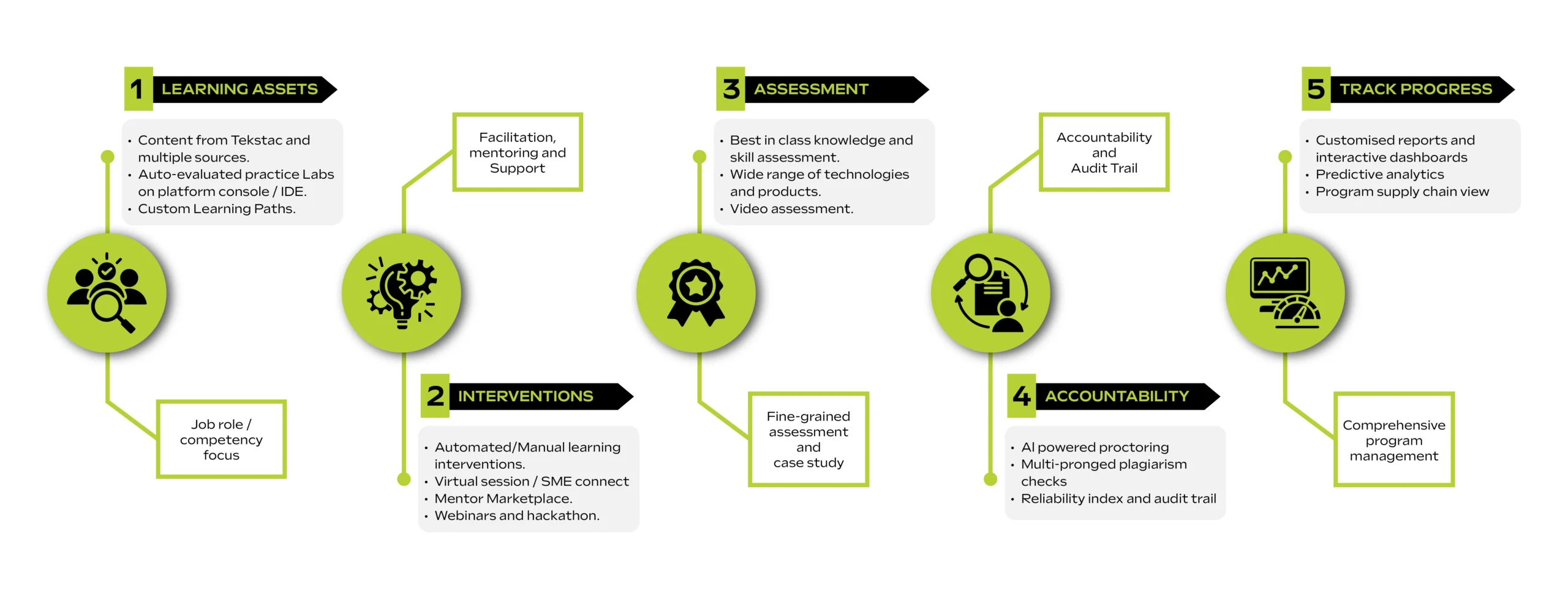
Best For: Organizations seeking verifiable upskilling, measurable ROI, and business-aligned learning outcomes.
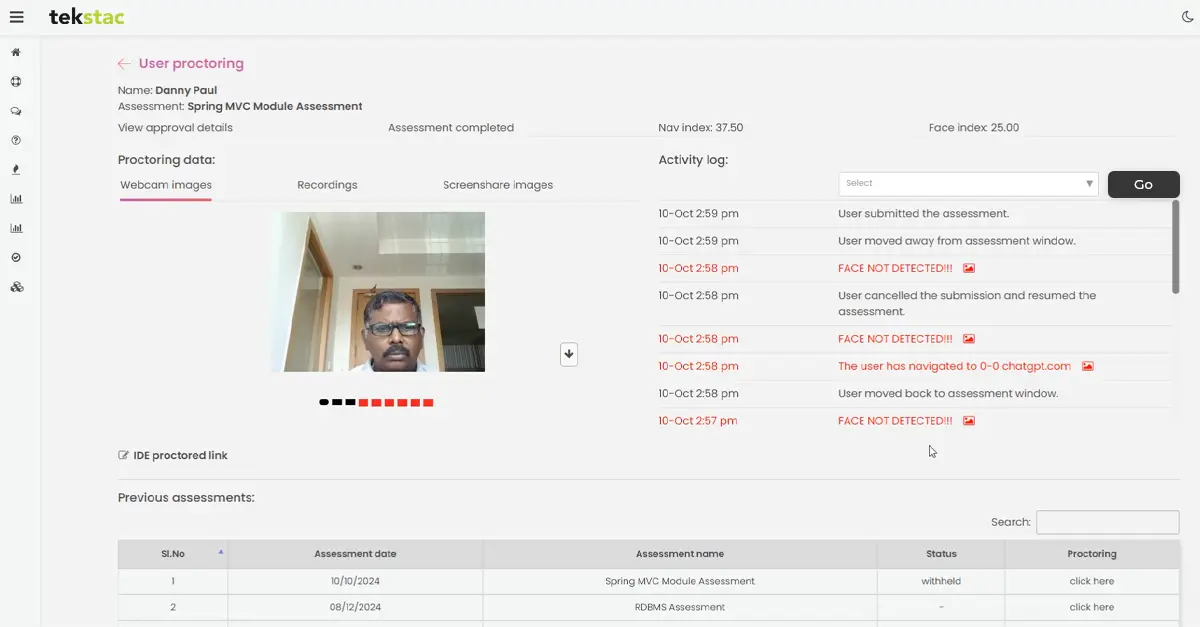
Standout Feature: Dual-layered assessments (auto + video with AI proctoring)
Best For: Organizations that want to centralize learning, upskilling, and continuous education
Standout Feature: Highly flexible learning pathways and personalized content recommendations.
Features:
Best For: Organizations and L&D teams building a culture of continuous learning.
Standout Feature: AI-powered personalized learning journeys + social learning.
Features:
Best For: HR leaders, recruiters, and organizations seeking data-driven workforce planning
Standout Feature: Real-time insights on talent availability and workforce trends
Features:
Best For: Talent acquisition teams looking for bias-free candidate evaluation
Standout Feature: Neuroscience-based games assessing cognitive & emotional traits
Features:
Best For: Companies prioritizing diversity hiring
Standout Feature: Advanced AI filters for diversity & real-time skills analysis
Features:
Best For: High-volume recruitment across industries
Standout Feature: AI insights into candidate personality & cultural fit
Features:
Best For: Growing companies streamlining performance reviews
Standout Feature: Complete 360-degree review in just 60 seconds
Features:
Best For: Companies fostering continuous improvement & data-driven performance
Standout Feature: AI-powered alignment of individual & team goals
Features:
Best For: Large/distributed enterprises with high HR query volumes
Standout Feature: “Siri for employees” – instant query resolution
Features:
Best For: Small to mid-sized companies seeking efficient HR automation
Standout Feature: End-to-end AI automation of HR workflows
Features:
Best For: HR leaders seeking insights to improve recruitment & retention
Standout Feature: AI-driven organizational insights
Features:
Best For: Organizations with existing HRIS wanting predictive workforce insights
Standout Feature: Context-aware AI Agent for trends, risks, & insights
Features:
Best For: HR teams automating onboarding, approvals, tasks, & status tracking
Standout Feature: Pre-built automation recipes + deep integrations
Features:
Best For: HR teams looking to automate repetitive tasks
Standout Feature: AI-powered “Zaps” for workflow automation
Features:
Best For: Enterprises with repetitive, large-scale HR/back-office tasks
Standout Feature: Robotic Process Automation (RPA) with AI task execution
Features:
Best For: HR/employee relations teams seeking compliant & proactive case management
Standout Feature: AI-driven executive summaries & trend reporting
Features:
Best For: Highly regulated industries (finance, healthcare)
Standout Feature: Real-time legal & regulatory AI alerts
Features:
Best For: Enterprises operating across multiple geographies
Standout Feature: AI Assist with access to 23,000+ HR resources
Features:
Best For: Organizations modernizing HR with AI efficiency & inclusivity
Standout Feature: Holistic AI integration across all HR functions
Features:
Best For: Remote-first & hybrid teams
Standout Feature: AI-generated conversation recaps
Features:
Best For: HR teams managing projects & onboarding tasks
Standout Feature: AI-powered task automation with visual workflow boards
Features:
Best For: Teams improving project execution & productivity
Standout Feature: AI converts notes into actionable tasks & predicts optimal timelines
Features:
Best For: Organizations improving DEI across teams & geographies
Standout Feature: Real-time DEI metric tracking with AI recommendations
Features:
Best For: Organizations committed to equitable recruiting & bias reduction
Standout Feature: Anonymized hiring filters + equity-focused analytics
Features:
Best For: Organizations seeking competitive & equitable compensation strategies
Standout Feature: Real-time market data for informed salary decisions
Features:
With the 26 AI tools outlined above, HR leaders can identify solutions that align with their specific needs, whether it’s boosting employee engagement, fostering continuous learning, reducing bias in hiring, or optimizing workforce planning.
Among these, Tekstac stands out in HR Tech for its dual-layered assessments, AI-powered personalization, and data-driven skills insights, making it ideal for organizations that want measurable ROI from learning programs, verifiable upskilling, and business-aligned outcomes.
Take the next step toward AI-powered HR transformation. Request a Tekstac demo to discover how organizations accelerate hiring, upskilling, and workforce readiness with measurable ROI.
1. What are the leading AI tools for HR recruitment automation?
Leading AI tools for HR recruitment automation include Tekstac, Eightfold AI, Beamery, Paradox, and HireVue. These platforms help automate candidate screening, skills assessments, interview workflows, and skills-based hiring to improve recruitment efficiency.
2. Which software offers AI features for employee performance management?
AI features for Employee performance platforms such as Tekstac, Lattice, Betterworks, Workday, and SAP SuccessFactors offer AI-powered performance management. They support continuous feedback, goal tracking, skills intelligence, and performance analytics to help organizations develop high-performing teams.
3. How do HR AI tools improve learning and development outcomes?
HR AI tools improve learning and development by personalizing learning paths, identifying skill gaps, tracking learner progress, and providing workforce insights. Platforms like Tekstac combine AI-powered learning with skills intelligence to help organizations build future-ready talent.
4. What are the affordable AI platforms for HR analytics in India?
Affordable AI platforms for HR analytics in India include Tekstac, Darwinbox, Keka, Zoho People, and greytHR. These platforms offer AI-powered analytics, skills insights, performance tracking, and workforce management features for growing organizations.

In boardrooms and on the front lines, a Learning Shift is underway.
The world of corporate Learning & Development (L&D), once centered on compliance checklists and scheduled seminars, is undergoing a transformation as companies rethink how employees learn, build skills, and adapt to changing business needs.
The old playbook of delivering training for the sake of coverage is being replaced by a far more ambitious mandate: build capability through continuous learning and skill development.
It’s less about pushing content into people’s calendars and more about creating learning ecosystems where employees are pulled toward growth because they see the direct value in developing skills that matter to their roles and the business.
This learning transformation is the heartbeat of The Learning Shift, a new LinkedIn series by Tekstac featuring insights from seasoned L&D leaders. It’s not just an internal shuffle or a passing trend. It’s a strategic imperative for organizations aiming to thrive in an era defined by disruption, rapid technological change, AI adoption, and shifting workforce expectations.
The consensus from the leaders we spoke to is unmistakable: L&D is moving from a support service to the engine room of business agility and resilience.
The role of L&D has fundamentally expanded.
As DJ Jaeger, Senior Training Manager at Akamai Technologies, puts it: “L&D is becoming a strategic driver of organizational capability, not just a service provider.” The expectation has shifted from simply “doing more with less” to “delivering greater impact with less.”
That’s not just semantics; it’s a mindset shift. It means moving beyond measuring success by course completions and attendance sheets. Instead, the focus is on fostering genuine skills, workforce agility, and adaptability priorities that have firmly landed on the board’s agenda.
But here’s the thing: strategic alignment doesn’t happen by accident.
Meeta Kanhere, a leadership consultant, points out a critical blind spot in many organizations: a lack of clarity on the why behind workplace learning. Before engaging consultants or launching a program, leaders must articulate what success looks like.
Without that clarity, L&D risks operating in a vacuum, designing elegant solutions to problems no one has defined. The most impactful learning strategies emerge when L&D partners with the business to diagnose challenges, define desired outcomes, and co-own the results.
Imagine two scenarios:
No conversation about the future of L&D can ignore Artificial Intelligence.
Its role, however, is widely misunderstood. Santosh Akella, an L&D professional and keynote speaker, frames it perfectly: “AI should be the co-pilot, not the pilot.”
AI’s value lies in the heavy lifting of curating content, identifying skill gaps, and automating time-consuming administrative tasks. DJ Jaeger adds that AI can handle taxonomy management, smart tagging, and even initial learning path creation, freeing L&D professionals to focus on higher-order work: engaging learners, coaching leaders, and shaping culture.
For Aveshkumar Jha, Global Head of Organization Development at Hinduja Global Solutions, the message is blunt: “Stop fearing technology. Embrace it. Befriend it.”
L&D leader Sheena backs this up with data, pointing to research that shows how AI powered adaptive learning can dynamically adjust content based on a learner’s pace, preferences, and performance. That turns skills development from a generic exercise into a deeply personalized growth journey. An employee struggling with a new sales process is automatically recommended targeted simulations and peer-led case studies, while another who’s excelling is served advanced modules and mentoring opportunities. Both are engaged, challenged, and supported at scale.
Perhaps the most profound change in modern learning is the shift from “push” to “pull.” For decades, corporate learning was built on a push model of mandatory modules, compliance checklists, and quarterly workshops. Employees participated because they had to.
But today’s workforce, especially Millennials and Gen Z, learns differently. They expect learning to be on-demand, relevant, and embedded into the flow of work. As Santhosh puts it: “An employee facing a tough client call won’t wait for the next webinar; she’ll find what she needs right now.”
This is pull learning when employees actively seek out knowledge and skills because they see immediate value.
Avesh explains that employees want learning that speaks directly to their current roles, future ambitions, and personal interests. They prefer formats they can consume in short bursts, bite-sized videos, quick simulations, or peer discussion threads.
Sheena’s research shows that microlearning often outperforms traditional training in both engagement and retention. And when it’s integrated into the tools people already use, like Microsoft Teams or Slack, it becomes part of the workday rather than an interruption.
Social learning, too, is gaining ground. Peer-led communities and collaborative forums don’t just distribute knowledge; they strengthen culture and boost application. In fact, Sheena cites data showing that social learning can improve on-the-job application by up to 75%*.
The question for leaders, Santhosh says, must evolve from “How do we make them complete this course?” to “How do we make them want to?”
*According to the 2023 Brandon Hall Group Study.
For all the excitement around AI and automation, the human element remains the anchor of impactful learning.
Santhosh reminds us: no algorithm can replace the spark of a great mentor, the resonance of a compelling story, or the thrill of discovery.
Sheena points to psychological safety as a crucial driver of deeper learning. When people feel safe to ask questions, challenge ideas, and admit mistakes without fear of judgment, they engage more fully and innovate more freely.
Avesh adds a deceptively simple truth: learning sticks when it’s fun. Whether through gamified simulations, creative challenges, or interactive storytelling, enjoyment deepens retention.
DJ Jaeger notes that coaching, once reserved for executives, is now being democratized. Everyone, from entry-level employees to mid-career professionals, can benefit from personalized guidance. This doesn’t just accelerate skill development; it reinforces a continuous learning culture where growth is accessible to all.
The path forward demands courage, experimentation, and a willingness to lead from the front.
DJ Jaeger cautions leaders against a “wait and see” stance on innovation, especially with AI. The bigger risk, he argues, is being left behind. Early adopters have the advantage of shaping the tools to fit their culture and needs.
Meeta warns against common pitfalls: making decisions driven purely by short-term cost savings, underestimating the importance of sustained sponsorship, and neglecting the creation of internal champions who can carry momentum forward.
In the end, L&D transformation won’t just imply the number of training courses. As DJ Jaeger puts it: “Your legacy isn’t the content you create; it’s the capability you build.”
That’s the real measure of success in the new era of learning: whether your people are more adaptable, more confident, and more capable of taking on tomorrow’s challenges than they were yesterday.
The learning shift is not a memo you send out. It’s a cultural rewire. It’s the difference between a workforce that survives change and one that drives it. And it starts with leaders willing to see L&D not as a cost center, but as the architect of the future.
Tekstac empowers L&D professionals with a 360 degree end to end skilling platform to stay current with rapidly changing technologies. See our mission in action.
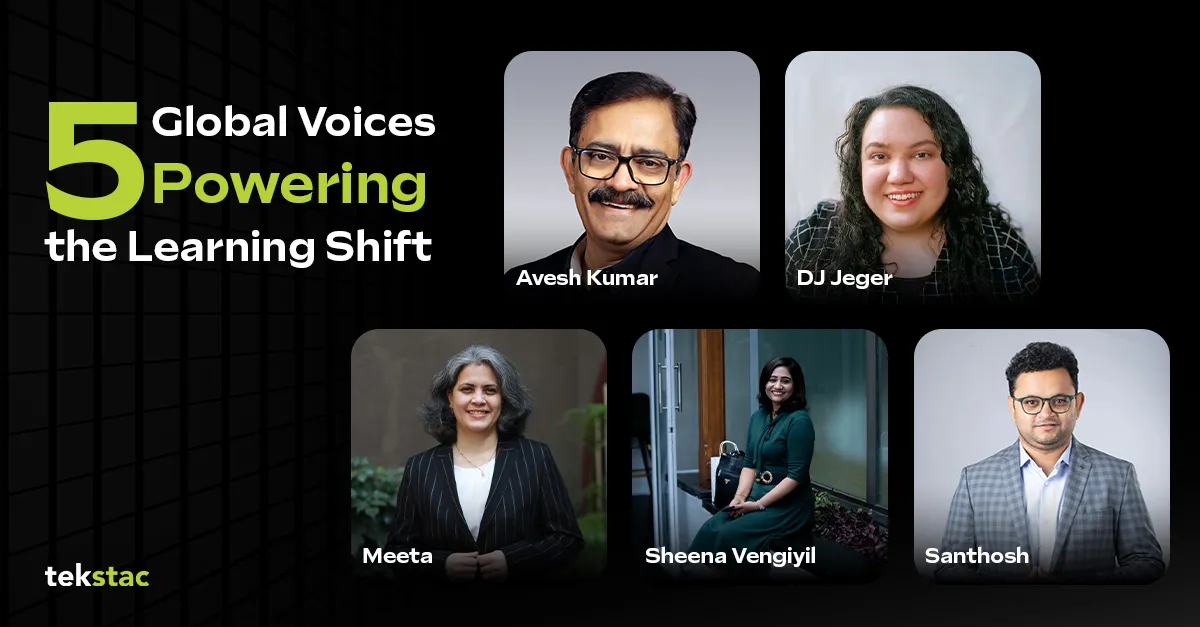
This article brings together insights from industry leaders who are shaping the future of learning and development. Below are the voices behind these perspectives—leaders whose experiences across global organizations, startups, and academia offer a rich view of how capability-building is evolving in the GenAI era.
Avesh Jha is Senior Vice President of Global Organizational Development & Performance Management at Hinduja Global Solutions. With 30+ years of global experience, he specializes in leadership development, performance management, and guiding large-scale business transformations.
Sheena Vengiyil is Learning Lead for the India GCC Business at Maximus and a 2024 HR 40 Under 40 honoree. She brings 16 years of expertise in designing impactful learning strategies across global organizations.
DJ Jaeger is Senior Training Manager for Customer Learning and M&A at Akamai Technologies and an adjunct instructor at Portland State University. She focuses on enterprise learning systems, upskilling programs, and inclusive workplace practices.
Meeta Kanhere is Co-Founder of Meraki Leadership Solutions and a seasoned consultant in leadership and organizational development. She works with organizations to build high-performance teams and value-driven cultures.
Santosh Akella is Assistant Manager – L&D at Cognitus and a former president of the Hyderabad Chapter of the Professional Speakers Association India. He is known for creating coaching cultures and designing learning programs that align with business goals.
1. What is the Learning Shift in L&D?
The Learning Shift is the move from traditional, course-based training toward continuous, skills-focused learning aligned with employee and business needs.
2. How can companies implement an effective Learning Shift?
Companies can implement the Learning Shift by identifying skill gaps, personalizing learning, enabling continuous development, leveraging technology, and aligning L&D with business priorities.
3. How is technology changing L&D transformation?
Technology enables personalized learning, AI-powered recommendations, skills tracking, digital learning platforms, and real-time insights that make employee development more scalable and effective.
4. How can companies measure the success of L&D transformation?
Companies can measure success through skill development, learning engagement, employee performance, internal mobility, productivity, retention, and the impact of learning on strategic business outcomes.
Corporate leaders today are navigating a far more complex environment than ever before. Global compliance regulations are tightening. Cross-border operations increase corruption risks. Yet many organizations still treat corporate ethics training as an annual compliance formality.
The result? Leaders struggle with inconsistent decision-making, hidden ethical risks, and reactive crisis management. According to global integrity surveys, nearly 1 in 3 organizations have reported experiencing some form of fraud or misconduct in recent years.
This blog solves that gap.
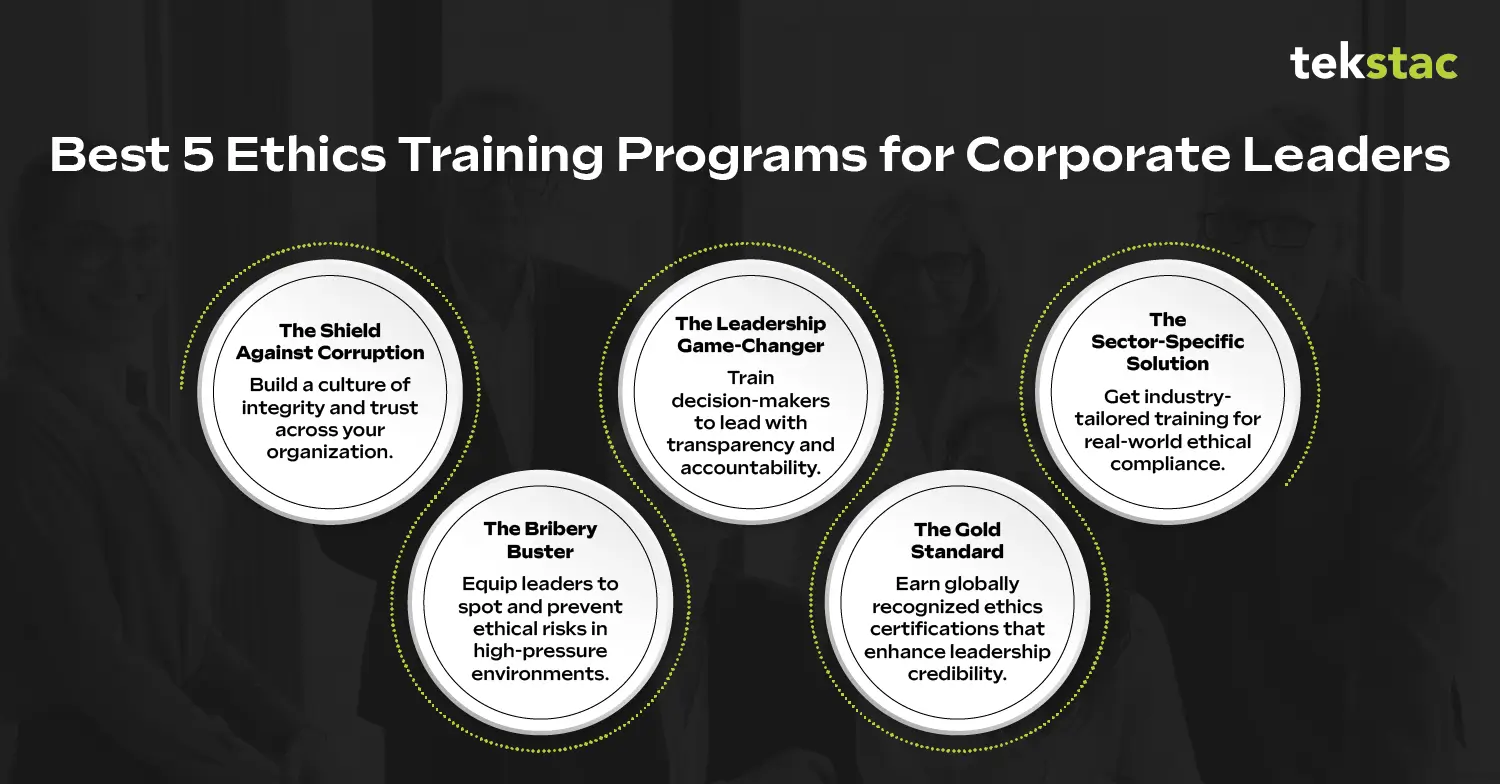
We break down the 5 best corporate ethics training courses for business leaders, programs designed to build long-term organizational trust.
Your company runs smoothly when everyone knows right from wrong. Corporate Ethics training makes this happen naturally. It’s not about boring rule books. It’s about transforming your team into individuals who consistently make the right call every time.
There are 5 types of Ethics Training
Not all corporate ethics training courses are created equal. The programs below go beyond compliance checklists; they equip leaders with practical tools to prevent risk, strengthen governance, and build a culture of accountability.
Let’s be brutally honest here. When was the last time you saw a business ethics training program that didn’t put people to sleep?
Most programs are boring, theoretical, and completely disconnected from real workplace challenges.
That’s where modern Ethics and Code of Conduct training breaks the mold.
What makes this different?
This isn’t your typical lecture-style training. It’s designed like a game where employees face real ethical dilemmas and learn to make the right choices.
Think of it as compliance and ethics courses that stick.
The course covers everything from protecting company assets to maintaining confidentiality—all the stuff that can make or break your business.
Innovative organizations are already using this approach to build unbreakable ethical cultures.
According to Ernst & Young’s Global Integrity Report, 38% of businesses worldwide reported that bribery and corrupt practices are widespread in their country.
Even scarier?
Many employees don’t even recognize when they’re crossing ethical lines.
That’s where comprehensive Anti-Bribery and Anti-Corruption training is like having a personal ethics bodyguard for your team.
Why this program hits differently:
This program doesn’t just tell people “don’t take bribes.” It explains why ethical behavior is good business.
It shows how companies that maintain high ethical standards consistently outperform their competitors. When your team understands that ethics equals profits, they’re more likely to stay on the right path.
Management isn’t just about hitting targets; it’s also about achieving overall success. It’s about setting the right example. Advanced Ethics Management training is specifically designed for managers and supervisors who need to lead by example while keeping their teams on the ethical path.
What makes leaders love this program:
This course addresses challenging topics, including time theft, abusive conduct, and conflicts of interest.
It doesn’t sugarcoat anything. Instead, it provides managers with the tools to address problems directly while maintaining team morale and productivity.
The Global Leadership Challenge: In hierarchical business cultures worldwide, managers often struggle with addressing ethical issues without seeming “preachy.” This program demonstrates how to make ethics feel natural and beneficial rather than like a punishment.
Want to talk about serious credentials? The Leadership Professional in Ethics & Compliance (LPEC) certification is the MBA of ethics training. This isn’t just another certificate. It’s a career game-changer that the smartest professionals are pursuing through comprehensive training platforms.
Why professionals fight for this certification:
This program is intense, thorough, and worth every penny. It covers everything from building ethical cultures to handling complex investigations. If you’re serious about making ethics your superpower, this is your ticket.
Different industries face different ethical challenges. Banking has money laundering concerns. Healthcare has patient privacy issues. It has data security dilemmas. Generic ethics training misses these nuances entirely.
Industry-specific programs that deliver:
Why specialization matters:
These programs recognize that a software engineer’s ethical challenges differ from those of a bank manager. They provide targeted solutions that work in the real world. Forward-thinking organizations are leveraging sophisticated training platforms that can deliver this level of customization efficiently and effectively.
Pro Tip: Use real-world case studies from your industry. Employees learn faster when they see how ethical gray zones appear in familiar situations, supplier negotiations, hiring referrals, performance bonuses, or AI decision-making systems.
Still thinking corporate ethics training is just an annual HR ritual? Recent corporate scandals show a consistent pattern: Ethical failure rarely happens because policies don’t exist. It happens because people are not trained to apply them under pressure.
The Cost of Getting It Wrong:
The Reward of Getting It Right:
On the other side, companies that embed ethical leadership into training frameworks build resilience that lasts decades:
Here’s the truth nobody tells you: Most ethics & compliance training fails because it’s implemented poorly. Here’s how to make it stick:
The Smart Approach:
The Global Context:
Modern ethics training isn’t just about boring PowerPoint presentations. As workforce demographics shift, expectations are evolving.
“Gen Z is not going to negotiate. They have really strong values and ethics, and they don’t bend them because of intimidation or because they are just getting a paycheck,” says Michael McCarthy, instructor at Harvard Division of Continuing Education’s Professional & Executive Development.
The most innovative companies are using:
The question isn’t whether you need ethics training—it’s which program will transform your organization. Here’s your action plan:
Remember, in the game of business, ethics isn’t just about playing fair—it’s about playing smart. Innovative companies know that integrity in leadership isn’t just a nice-to-have—it’s the foundation of sustainable success.
The choice is yours. Your company’s future depends on it.
At the end of the day, ethics start at the top. Senior leaders shape the culture, through the decisions they make, the behavior they tolerate, and the standards they reinforce. In a world where scrutiny is constant and one misstep can undo years of credibility, principles-based ethics training isn’t a formality; it’s a necessity. It helps leaders think clearly in gray areas, act confidently under pressure, and protect the trust their business is built on.
Want to Future-Proof Your Entire Workforce Strategy?
Ethics is step one. Explore how leading organizations are reimagining training and development to build high-performing, ethical, and future-ready teams.
👉 Learn More: The Future of Employee Training & Development
1. How do you create an effective ethics program?
Start with clear values and strong leadership commitment. Use practical, scenario-based training that reflects real workplace situations and reinforces it regularly, so ethics becomes part of daily decision-making, not just a policy document.
2. How effective are business ethics courses?
Business ethics courses are effective when they are engaging, relevant, and supported by company culture. Their impact increases when leaders model ethical behavior and training is reinforced consistently rather than treated as a one-time requirement.
3. Why is corporate ethics training important for organizations?
Corporate ethics training helps employees understand company values, legal responsibilities, and expected standards of conduct. It reduces compliance risks, builds trust, and creates a culture where employees feel accountable for their decisions.
4. How often should companies conduct ethics training?
Most organizations conduct ethics training annually, but ongoing reinforcement through workshops, discussions, and microlearning sessions throughout the year makes it more effective and sustainable.
Scaling a business in 2026 demands more than aggressive hiring or market expansion. Business scaling today depends on how effectively organizations develop internal capabilities, close skill gaps, and prepare teams for future growth.
According to a 2023 report by IBM, organizations that prioritize employee upskilling experience a 22% increase in revenue growth compared to those that don’t. This shows that investing in employee skills is one of the core engines beyond sustainable business scaling. In this blog, we’ll break down why workforce development is important for business scaling, and how they’re connected.
Generally, business scaling is often associated with expanding business operations, entering new markets, or increasing production. However, what we miss is that behind every successful scale-up lies a workforce capable of handling that growth. This is exactly where employee upskilling becomes indispensable.
Employee upskilling refers to the process of equipping employees with additional skills to help them perform better in their current roles, while preparing for future responsibilities. Unlike reskilling, which is about training people for entirely new roles, upskilling focuses on depth over direction. It increases internal capability rather than replacing it.
So, how does this matter for business scaling? Business scaling is something that requires faster decision-making, stronger collaboration, and adaptive leadership. Without investing in your people’s ability to meet those demands, it can become difficult to scale your business effectively.
Let’s take a simple example. If we say a mid-sized SaaS company is looking to serve enterprise clients. Their product roadmap would scale, and so do their expectations around security, analytics, and implementation timelines. If the customer success team hasn’t been upskilled on enterprise onboarding protocols or strategic account management, the scale breaks with roadblocks, ultimately leading to churn and declined revenue. Now, if we multiply that across departments, like sales, marketing, tech, or support, it becomes clear that scaling a business requires scaling your people.
This isn’t a theoretical idea. According to LinkedIn’s 2024 Workplace Learning Report, companies that embed upskilling into their core business strategy are 57% more likely to see higher employee retention, 23% more internal mobility, and 7% stronger management pipelines.
For decades, we’ve seen business scaling be a numbers game, including customers, bigger budgets, and expanded product lines. This traditional mindset focuses on external growth factors and ignores internal driver, which is the capabilities of the workforce itself.
Below are five key reasons employee upskilling is essential for successful business scaling in 2026.
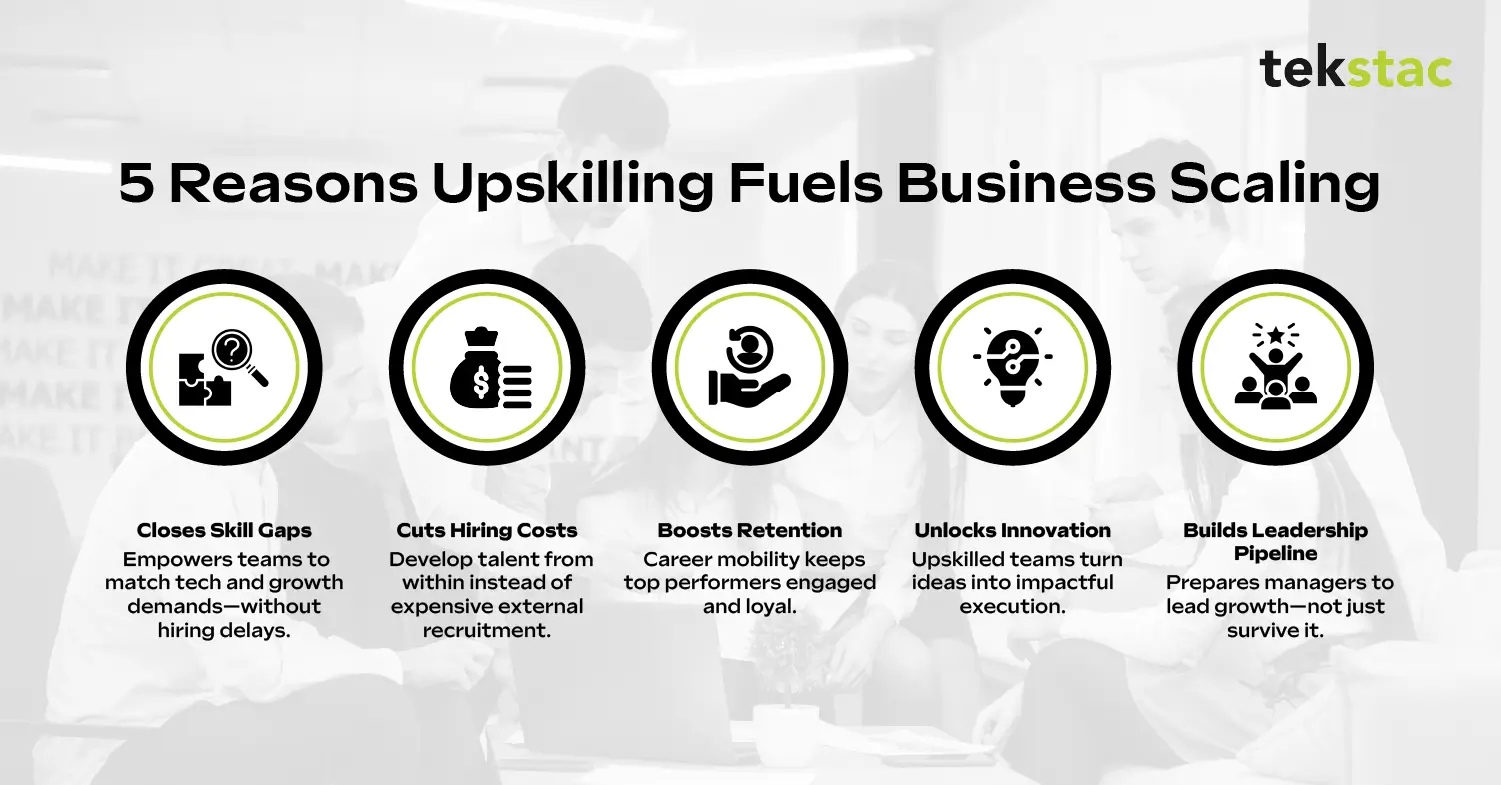
Sometimes, companies may fail to scale as desired because their teams can’t keep pace with the scale they’re chasing. Quick digital transformations, new tools, and changing customer expectations demand new skill sets that the current workforce may not have. Workforce development closes this gap from the inside out. Instead of pausing to hire new talent for every emerging need, which is slower and costlier, companies can level up their existing teams to meet any new challenges.
Business scaling often tempts leaders to throw headcount at a problem. However, aggressive hiring during growth stages can lead to bloated teams, rising overheads, and misaligned talent. Hence, employee upskilling offers a more sustainable path.
When you develop existing employees into higher-impact roles, you retain organizational knowledge and culture, which are two assets that cannot be replaced with new hires. More importantly, it’s cheaper. Recruiting, onboarding, and ramping a new employee to productivity can cost 3 to 4x more than developing one internally.
LinkedIn’s Workplace Learning report found that organizations with solid internal mobility programs see twice as long employee retention than those with low mobility. Hence, upskilling builds from within, so you don’t constantly build from scratch.
Most times, top talent quits because they feel stuck in their roles. LinkedIn reports that 94% of employees would stay longer at a company that invests in employee learning and development. A lack of employee development opportunities is one of the top reasons high performers walk away, especially in growing companies where roles change quickly but careers don’t.
Intentional workforce development provides employees a clear career path forward, showing them that there’s a future in the company beyond their current title. This directly improves retention, stability, and morale, all of which are extremely essential when your business is scaling and cannot afford churn.
The teams closest to your customers, products, and systems often hold the most valuable insights. If they lack the skills to execute new ideas, those insights stay untapped. With proper upskilling, they can turn their knowledge into innovation.
Be it via training a support team in data analytics to find product bugs or coaching marketers on new AI tools to scale campaign testing, such small skill upgrades lead to big business advantages. Hence, it’s important to remember that you don’t always need to hire innovation, most times you just need to unlock it.
Companies can scale faster than their leadership capacity. This means they hire faster than they promote, and grow functions but not managers. And eventually, they hit a wall—not because of market failure—because of management failure. Thorough upskilling prepares mid-level managers to lead at scale.
It provides new leaders with the decision-making, communication, and strategic thinking skills to handle challenges. Without this, business scaling may crumble under pressure. They say they face leadership gaps that directly impact business growth. Scaling may add people, but it must multiply leaders as well.
Scaling a business without a structured employee upskilling strategy can prove to be ineffective. To create a workforce that also grows with your business goals, upskilling must be intentional, tied to business goals, and deeply rooted in the company’s culture.
Let’s see below how you can do it right:
Before rolling out any programs, map your current capabilities against the future needs of the business. Look at two important things:
You can use internal performance data, manager feedback, and tools like skill assessments or 360-degree reviews to find skill gaps in both hard and soft skills. For instance, if your product roadmap is expanding into AI-based features, your customer support and marketing teams may need technical understanding in machine learning concepts, even if they’re not coding themselves.
Upskilling must always directly support business revenue, product, or scaling goals. For example,
When learning programs are clearly tied to business outcomes, leaders buy in faster and employee see the value of upskilling programs.
Everyone learns differently, hence the most effective upskilling programs combine formal and informal methods, such as:
Make development a shared responsibility between the company, manager, and the employee. This means ensuring regular development check-ins, celebrating learning wins, and so on. This transformation starts by changing development from being the sole responsibility of a single department:
To scale sustainability of the learning program, you need to connect learning outcomes. Ask:
These are the signals that tell you whether your employee upskilling strategy is enabling business scale.
Delivering an upskilling strategy at scale across departments, roles, and learning needs is a huge challenge. Organizations may struggle with execution at the time of business scaling because they lack the infrastructure to support personalized learning at speed.
Managing multiple learning paths, tracking progress across teams, ensuring assessment integrity, and keeping programs aligned with business goals require an end-to-end platform, such as Tekstac.
A solution like Tekstac is built specifically for scaling upskilling efforts. It enables you to:
Ready to drive business scaling through employee upskilling? Explore how Tekstac helps global teams grow faster, smarter, and at scale.
1. What does it mean to scale a business?
Scaling a business means growing revenue, customers, or operations without increasing costs at the same rate. Successful business scaling depends on efficient processes, skilled teams, and leadership readiness rather than adding headcount, ensuring growth remains sustainable and controllable over time.
2. How do you plan to scale your business in the next 1-3 years?
Businesses should plan to scale by aligning workforce skills with future growth goals, investing in continuous employee upskilling, and strengthening leadership pipelines. This approach helps teams execute faster, adapt to change, and support expansion without operational strain.
3. What is the biggest challenge in business scaling?
The biggest challenge in business scaling is the skills gap. When employee capabilities and leadership readiness fail to grow alongside business expansion, organizations face slower execution, inefficiencies, and higher attrition that directly limit growth.
4. What skills should L&D prioritize for scaling organizations?
L&D should prioritize skills that directly support business scaling, including digital and data literacy, cross-functional collaboration, agile project management, and leadership readiness. As organizations grow, skills in decision-making, change management, and customer-centric execution become critical to ensure teams can scale efficiently without slowing down operations.
A skills assessment is a structured, data-driven process that measures employee capabilities against role requirements to identify skill gaps and guide targeted upskilling. Organizations that implement regular skills assessments reduce misaligned training spend, improve talent deployment, and build a workforce that adapts to change. This guide covers how to build a skills assessment process, conduct employee skill gap analysis, and choose the right tools.
Roles are frequently assigned based on resumes, past job titles, or assumed experience, not based on validated, current capabilities through a proper Skills Assessment. That’s where the inefficiencies start to creep in. Over time, these assumptions evolve into a quiet but dangerous problem: skill blindness. Our Skills Assessment Guide can help you break this cycle by identifying real skill gaps and aligning talent more effectively.
It is a structured and data-driven method that organizations use to understand the current skills of their employees and compare them with the skills required for their roles. Instead of relying on assumptions, job titles, or intuition, a Skills Assessment provides clear, measurable insights into workforce strengths, skill gaps, and development needs.
A typical Skills Assessment includes:
In simple terms, it removes guesswork and helps companies make smarter decisions about talent alignment, learning investment, and productivity improvement.
To turn this assessment data into meaningful action, organizations rely on skill insights to interpret workforce capabilities, identify patterns, and drive smarter talent decisions.
Without a structured skills assessment strategy in place, organizations end up guessing their way through talent deployment. That guesswork may hold up for a while, but eventually, it snowballs into misaligned responsibilities, inefficiencies, and burnout.
Take this example: A software development team consistently lags behind deadlines.
The assumption is they need more staff. So leadership hires aggressively. Yet the problem persists. The real issue? A misalignment between skill sets and project demands, not the headcount.
Without proper Employee skill gaps analysis, you risk:
This leads to:
Ultimately, you can’t optimize what you can’t measure. And measuring skills is the foundation for building an adaptable, competitive workforce.
According to Deloitte’s Global Human Capital Trends report, only 14% of business executives strongly agree their organization fully leverages workforce skills — a persistent gap that costs organizations in productivity, retention, and competitive readiness.
To eliminate these pitfalls, companies must adopt a structured, repeatable, and data-driven Skills Assessment framework.
A robust Skills Assessment strategy provides:
But it’s not about generic surveys or one-time testing. True Skills Assessments are ongoing, role-specific, and aligned with real-world performance.
Conducting a skills assessment without a structured process leads to the same problem it’s meant to solve — decisions based on assumptions rather than data. Organizations that follow a repeatable framework identify skill gaps 2x faster and allocate training budgets with measurably higher precision than those using ad-hoc evaluation methods. The five steps below form a proven sequence used by enterprise L&D teams to move from scattered intuition to a clear, actionable picture of workforce capability. Each step builds on the last — skipping ahead produces incomplete data and unreliable outputs.
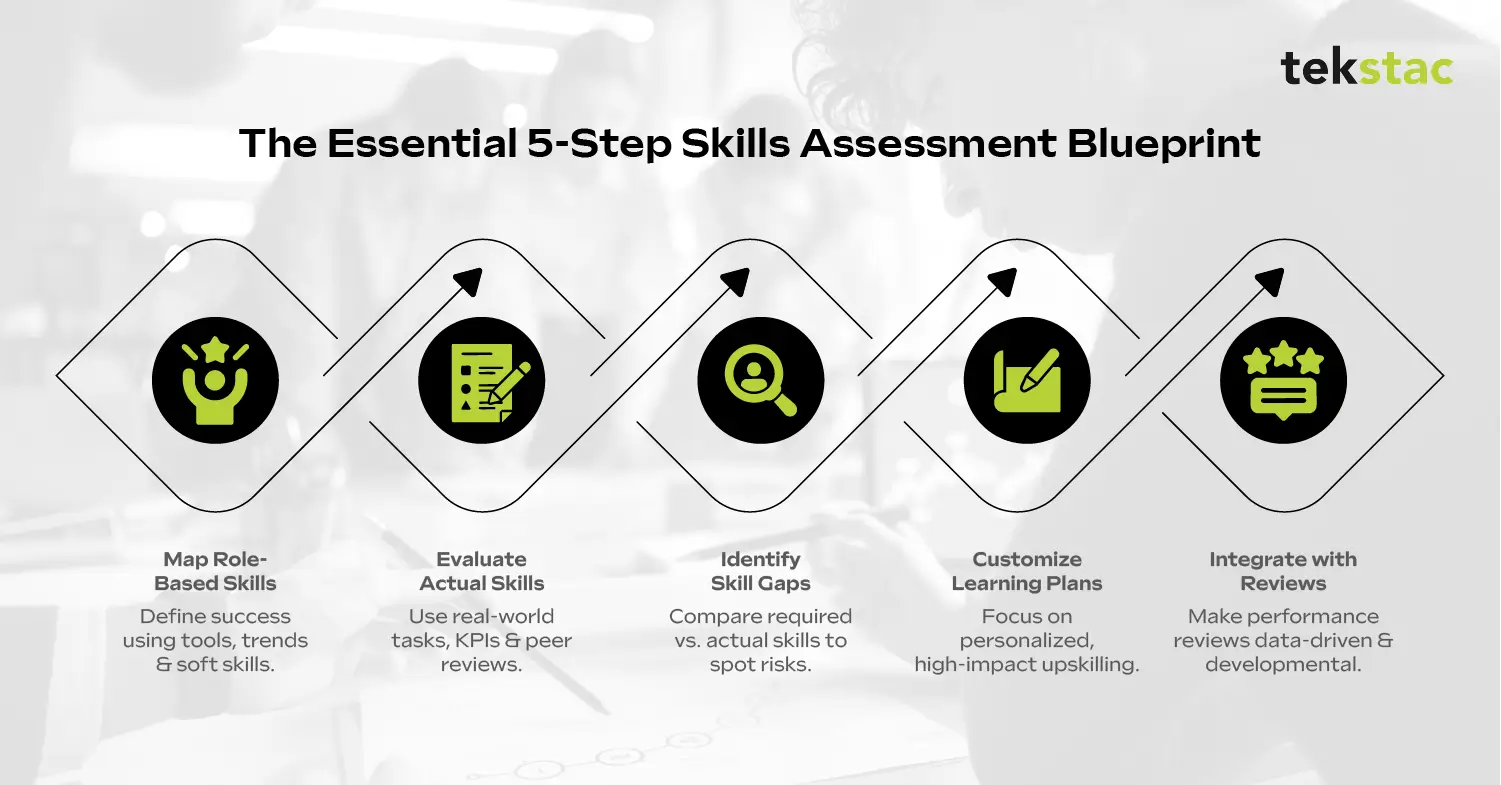
Start by defining what success looks like in each role.
Don’t just rely on generic job descriptions. Factor in:
Core technical competencies tied to business impact
Assessments should be performance-based, not theoretical. Combine:
This holistic view reveals not just what someone knows—but how they apply it.
Once both the “required” and “actual” skill levels are clear, it’s time to identify gaps.
Ask:
Tools like Tekstac offer actionable dashboards that visualize these gaps for informed planning. For organizations looking to improve engagement, modern employee assessment tools now include gamified simulations and interactive challenges. Explore our guide to gamified employee assessments to see how enterprises use game mechanics for skill evaluation.
Use the gap data to design interventions that are:
Avoid generic training modules. Go for high-impact courses, mentorship, job rotations, or AI-driven microlearning.
Instead of treating Employee performance reviews as standalone rituals, integrate updated Skills Assessment data.
This:
A structured employee skill profile gives managers a consolidated view of each individual’s verified competencies, learning progress, and skill gaps — making career path conversations evidence-based rather than subjective.
IBM implements continuous skill assessments across departments. This enables:
The result? A future-ready, agile workforce and improved employee retention.
Google integrates hands-on coding assessments with interviews. This dual approach:
Google’s model highlights how customized role-specific assessments lead to better hires.
Amazon uses data-driven, scalable skill assessments in both tech and non-tech roles. Their success lies in:
This has streamlined their high-volume recruitment while ensuring role alignment.
By now, it’s clear: building a Skills Assessment framework isn’t just about checking boxes, it’s about creating a high-performance learning culture.
The benefits include:
Effective Skills Assessment isn’t just about methodology—it’s about execution. For that, you need the right platform.
An ideal tool should offer:
One platform that delivers across these fronts is Tekstac.
Tekstac provides a comprehensive platform designed specifically for organizations aiming to execute a structured Skills Assessment strategy. Here’s how it maps directly to your needs:
Tekstac aligns its evaluation modules with specific job functions. This means:
This relevance ensures accurate insights, not guesswork.
For technical roles, Tekstac provides live coding environments that simulate real business challenges. This tests:
Using smart algorithms, Tekstac automates evaluations. No more manual checks. The platform also benchmarks individual performance against:
This lets you see exactly where your talent stands competitively.
One of the standout features of Tekstac is its data visualization engine. Leaders get:
Tekstac doesn’t replace your existing systems—it enhances them. It can plug into:
This ensures that Skills Assessment becomes part of your daily workflow, not an isolated event.
Even when leaders understand the value, adoption of a Skills Assessment system is often delayed due to concerns. Let’s tackle them head-on.
Reality: While the initial investment requires time and effort, the return is exponential.
Think of it as building a foundation for everything: learning, staffing, innovation.
Reality: If framed incorrectly, yes. But the key is intentional communication.
You’re building a feedback-rich culture, not a punitive one.
Reality: This is where tools like Tekstac excel.
Their assessment libraries can be updated regularly to reflect:
Additionally, since assessments are data-driven, you can adapt based on live skill evolution.
Reality: With modern APIs, platforms like Tekstac make integration nearly frictionless.
They offer plug-and-play compatibility with popular platforms, ensuring that:
Now that tools and objections are covered, here’s a practical execution roadmap to embed Skills Assessment into your culture.
Choose a single department (e.g., engineering or sales). Use Tekstac to:
Measure outcomes (project success, engagement scores, peer feedback) to validate the ROI.
Connect results directly to upskilling and reskilling strategies. Whether you use internal academies or external platforms, make sure the learning paths solve for actual, identified gaps.
Bring the Skills Assessment data into regular employee performance reviews.
After validating with one unit, roll out across departments.
Best practice: staggered implementation with champions from each team. This improves adoption and reduces pushback.
Once fully embedded, Skills Assessments become part of your company DNA. The long-term benefits include:
You also create a learning culture where development is tied to real business outcomes, not just hours logged in training portals.
In a business environment, the difference between surviving and thriving lies in your workforce adaptability. A structured Skills Assessment framework is not just a tool, it’s your organization’s compass for growth, relevance, and competitive edge.
It enables you to:
Tekstac offers a powerful, customizable engine to help you implement this vision, from employee skill gap analysis to role-specific learning. The time to move from assumptions to action is now.
1. What are the best employee skill assessment tools for enterprise?
The best employee skill assessment tools for enterprises are those that combine AI-driven assessments, real-time analytics, and personalized learning paths. Platforms like Tekstac stand out by offering auto-evaluated assessments, hands-on labs, and skill gap analysis in a single system. These tools help organizations assess capabilities at scale, track progress, and align training with business goals.
2. What is employee skill gap analysis and why does it matter?
Employee skill gap analysis is the process of comparing current employee capabilities with the skills required for their roles or future business needs. It helps organizations identify gaps and prioritize targeted training initiatives. This matters because it enables companies to move from assumptions to data-driven decisions and build a future-ready workforce through continuous upskilling.
3. How does skills benchmarking improve workforce planning?
Skills benchmarking improves workforce planning by providing a clear view of employee proficiency levels across roles, such as beginner, intermediate, or expert. This allows organizations to identify talent strengths, plan reskilling initiatives, and allocate resources effectively. By benchmarking skills, companies can make faster, evidence-based decisions about hiring, promotions, and internal mobility.
4. How is a skills assessment different from a performance review?
A skills assessment evaluates an employee’s actual capabilities through practical tests and real-world tasks, while a performance review focuses on past job performance, behavior, and overall contribution. Skills assessments provide objective, measurable insights into what employees can do, whereas performance reviews are often subjective and retrospective.