Forward Deployed Engineer skills go well beyond programming or AI expertise. An effective FDE combines software engineering, systems integration, applied AI, customer discovery, product thinking, communication, problem-solving and the ability to work through ambiguity. For enterprises, building FDE readiness requires more than an AI learning path or coding assessment. It requires a way to develop and validate whether an engineer can take up a real business problem, build a solution around real-world constraints and move it into production.
In simple terms, a Forward Deployed Engineer is a software engineer who works closely with a customer to build, integrate and deploy a working technical solution in the customer’s environment.
That can mean connecting an AI application to an existing enterprise system, adapting a workflow to a customer’s requirements, debugging an integration that behaves differently in production, or figuring out why a solution that worked perfectly in a prototype is not being adopted by users.
This also explains why FDEs are often confused with adjacent roles such as software engineers, solutions engineers and consultants.
A software engineer may build a product designed for many customers. A solutions engineer may help demonstrate how that product could solve a customer’s problem, particularly during the sales process. An FDE goes further into implementation, working directly with the customer to build and deploy the solution.
The role has become particularly relevant in AI because AI systems are highly dependent on context. An LLM or agent can perform well in a controlled demonstration and still need significant engineering work before it can operate reliably within an enterprise workflow.
The FDE effectively occupies that last-mile space between “the technology can do this” and “the customer can actually use this.” That is also why the role increasingly combines technical execution with customer and product responsibilities.
According to World Economic Forum, 1.3 million new roles like Forward-Deployed Engineers are emerging as AI reshapes the world of work. As organizations focus on AI workforce readiness, it is natural that there is growing curiosity around what this new role entails and the skills needed to succeed in it.
Does an FDE need AI skills? It’s one of the first questions that comes up when we talk about the role today. The strongest Forward Deployed Engineer capabilities can be grouped into four broad areas: engineering depth, systems integration, applied AI and customer-facing problem solving.
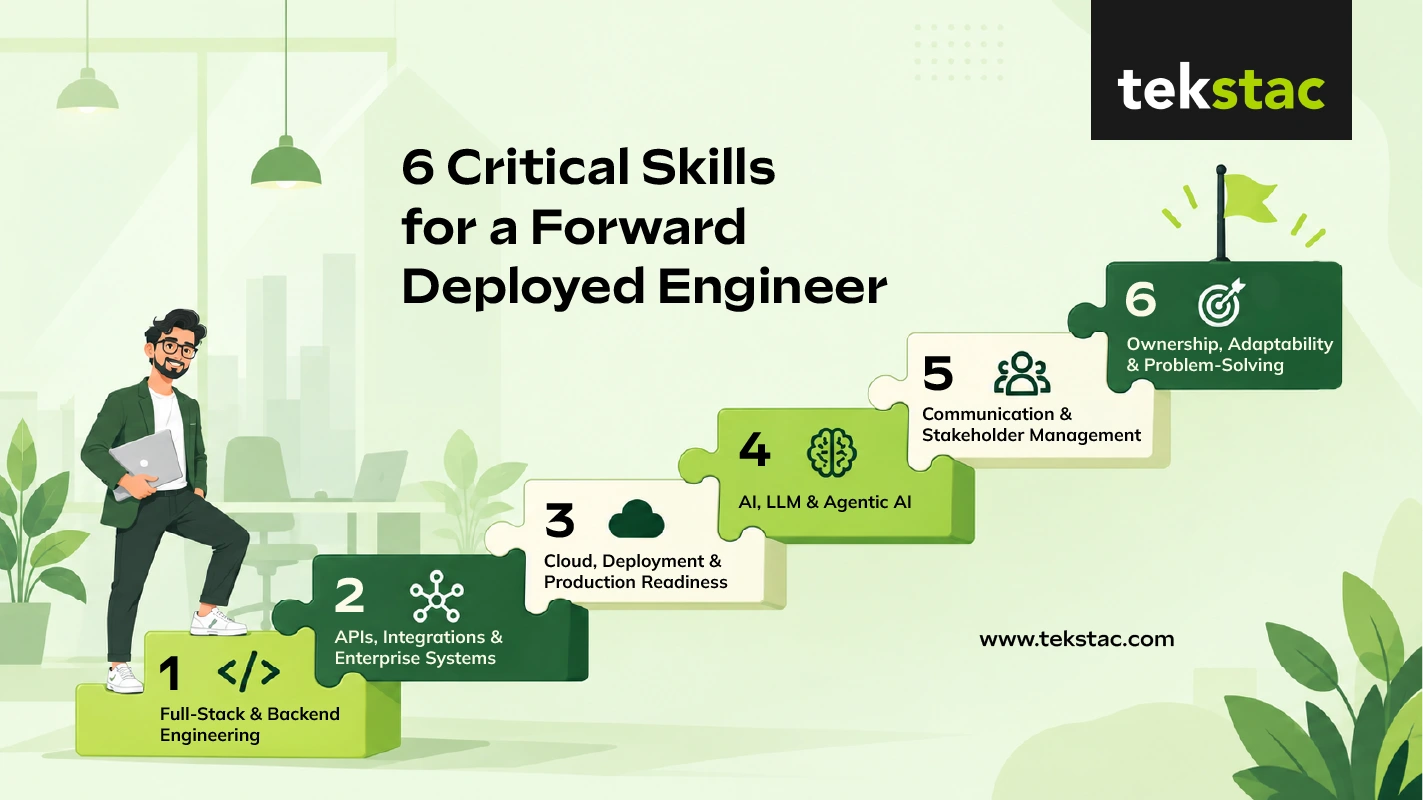
FDEs frequently work across the stack because customer problems rarely arrive neatly packaged for a single engineering team. A solution may require a backend service, a frontend workflow, an API integration and a database change within the same engagement.
Key capabilities include:
This is one of the most important Forward Deployed Engineer competencies.
An FDE may encounter a legacy CRM, an undocumented API, multiple authentication layers, inconsistent data formats and systems that were never designed to work together.
FDEs should be comfortable with:
These are important Forward Deployed Engineer skills because production introduces constraints that a classroom or development environment cannot fully reproduce.
Key skills include:
For AI-native FDE roles, applied AI is increasingly part of the technical foundation.
This can include:
This is where the FDE role starts to separate itself from conventional engineering. FDEs operate across technical and non-technical groups.
A strong FDE can explain:
Finally, FDE work requires a high degree of ownership. An engineer does not become FDE-ready simply because they have completed learning paths covering Python, cloud or GenAI.
They need to demonstrate that they can apply those skills together.
India’s IT services industry alone is planning for thousands of FDE roles. TCS has said it plans to build a team of up to 8,900 FDEs, while Infosys is targeting around 6,000 over the coming years. Hence, a stronger Forward Deployed Engineer skills validation approach must be taken to build its readiness.
For large organizations, the more scalable approach may be to identify adjacent talent and build the missing capabilities.
Before launching an FDE program, define what the role actually requires in your organization.
An FDE deploying enterprise agents will need a different capability profile from an FDE supporting a conventional SaaS implementation. Map the role across technical, AI, customer, product and delivery capabilities.
Learning should move from concept to application through realistic scenarios. A learner might have to build an AI workflow, connect it to enterprise data, evaluate its outputs, troubleshoot failures and present the solution to a simulated stakeholder.
The scenario becomes a learning environment.
Not every engineer needs to become an FDE overnight. A more practical model is to create progressive pathways that build from existing strengths.
For example:
Engineering foundation → Cloud and integration → Applied AI → Customer discovery → Solution delivery → Production deployment → FDE readiness
Tekstac approaches this by bringing technical learning, hands-on practice, assessments and project-based validation into a single capability journey.
Learners can build across the technology layer; from Python, cloud and APIs to GenAI, RAG, agentic AI and application development, while also working through scenarios that require them to apply those skills to realistic problems.
For an FDE pathway, that can mean moving from technical foundations into integration, AI application development, deployment, evaluation and end-to-end project work, with evidence generated along the way.
For L&D and talent leaders, that creates a more useful question than “Who completed the FDE curriculum?”
The rise of the Forward Deployed Engineer reflects a larger change in how technology is being built and deployed.
AI has made it possible to create sophisticated solutions faster. But faster creation does not automatically mean faster adoption. The difficult part often begins when technology encounters real data, existing systems, business processes, security constraints and people.
That is why FDEs need a broader combination of capabilities.
They need to code, integrate, deploy and understand AI. But they also need to ask good questions, understand customer workflows, make trade-offs, communicate clearly and stay accountable when the path from prototype to production gets messy.
For enterprises, that means FDE readiness cannot be reduced to a list of technologies. It has to be demonstrated through skills validation, realistic scenarios and evidence of applied capability.
The organizations that build this capability effectively will not simply have more people who know AI. They will have more people who can make AI work where it matters.
Book a demo to see how Tekstac can help you build and validate FDE capabilities across your workforce.
1. What programming languages do FDEs use?
Python is one of the most common languages for FDEs, particularly for AI, data and automation work. Depending on the customer environment, FDEs may also work with JavaScript/TypeScript, Java, C#, Go or other languages.
2. What AI skills are important for Forward Deployed Engineers?
Important AI skills can include LLMs, prompt engineering, RAG, vector databases, AI APIs, agentic AI, model evaluation and AI application development. The exact depth required depends on the type of solutions the FDE works on.
3. What is the difference between an FDE and a software engineer?
Both roles require strong engineering skills, but their working environments differ. Software engineers often build products within a defined product and engineering roadmap, while FDEs work more directly with customers to adapt and deploy technology for specific real-world problems.