A focused Agentic AI capability roadmap can help enterprises turn Agentic AI learning into capability and capability into deployment readiness. Today, the challenge is no longer simply giving employees access to AI. It is building a workforce that can actually design systems.
That is where many organizations are finding a gap. Teams may have completed GenAI training, experimented with agents, or gained access to the latest frameworks, but leaders still need a clear answer to a practical question: who is ready to work on Agentic AI projects, and who needs more development?
That is why success of enterprise AI adoption depends on how clear a capability roadmap is.
Agentic AI introduces a different kind of skills challenge for enterprises. Employees need to understand how models interact with context, tools, data, memory, and Agentic AI workflows. An enterprise-ready practitioner also needs to understand when an agent is appropriate for a problem, what level of autonomy makes sense, how permissions should be designed, how the system should be monitored, and what happens when an agent fails.
That creates five layers of capability:
This is why a practical learning path must be designed to build agentic AI capability rather than just tutorials. The more durable capability lies in understanding the architecture and principles underneath them.
A structured roadmap can still fail if it is designed around completion rather than capability. According to an IDC report, 56% of organizations are increasing investment in AI skills development for current employees, highlighting the shift from simply delivering learning to building practical, usable AI skills.
Some of the persistent challenges are:
Jumping directly into agent-building tools can produce shallow proficiency. Employees may learn where to click or which library to import without understanding the architecture underneath.
Frameworks can make development faster, but agentic AI readiness is not about learning a set of tools. Tools and frameworks will continue to evolve. What enterprises need to retain is the ability to reason about models, regardless of which framework is being used.
Agentic AI is difficult to learn passively. Reading documentation or completing videos can bring familiarity, but building an agent develops a very different level of proficiency. For enterprise learning, practice needs to be part of the architecture of the learning path, not an optional activity at the end.
The platform brings different components of the journey into a single skilling environment, connecting assessment, Learning Paths, hands-on practice, mentoring, and capability intelligence.
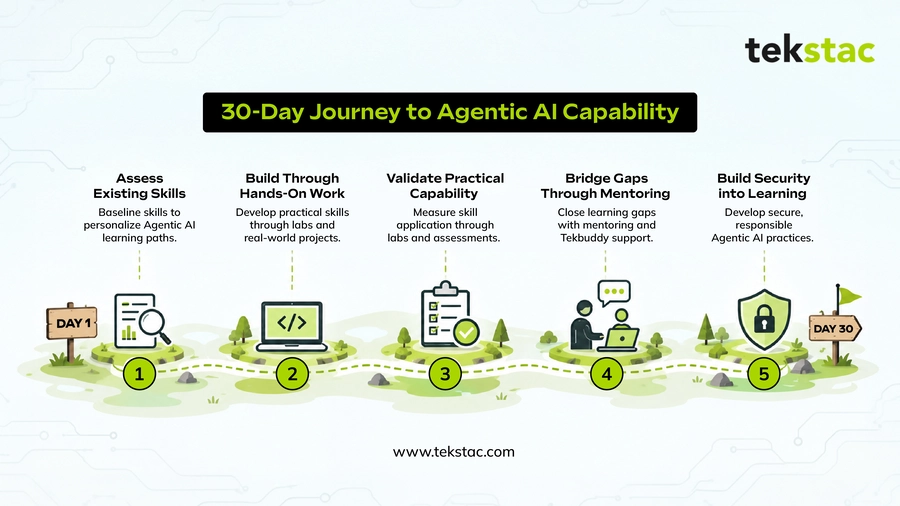
Employees do not enter an Agentic AI journey with the same experience. The platform can establish a skills baseline through assessments and skills validation, helping organizations understand existing proficiency before assigning development paths. This allows the learning journey to be aligned to the learner rather than assuming that every employee needs the same starting point.
The learning experience moves beyond theoretical content through practical labs and real development environments. Learners can work with relevant Agentic AI technologies and build workflows and applications rather than simply consuming instructional content.
One of our biggest strengths in building agentic AI workforce readiness is its ability to measure practical capability, not just learning completion. Its auto-evaluated labs and assessments allow organizations to evaluate how employees apply their skills in real-world scenarios at scale.
When learners get stuck in between their course, we provide mentoring to bridge the gap between understanding a concept and applying it effectively. The platform has embedded an AI assistant called Tekbuddy to solve any real-time doubts.
Our approach also incorporates the trust and security considerations that become important when employees work with agentic systems. That includes areas such as guardrails, safe agent permissions, prompt-injection defense, evaluation, red-teaming, transparency, and responsible AI practices.
The first week should establish technical foundation before employees start building.
Learners work through the concepts that sit underneath modern agentic systems: LLM interaction, prompting and context engineering, APIs and tool calling, retrieval, memory, agent architecture, and orchestration.
By the end of the first week, the enterprise has more than a list of participants. It has an initial view of capability and development needs.
Once the fundamentals are established, employees can move from understanding systems to building Agentic AI solutions. This is where tools and frameworks become useful. Depending on the role and technology environment, learners can work with platforms and frameworks such as n8n, Langflow, Flowise, LangGraph, CrewAI, MCP, A2A, and LangFuse.
This is where the learning journey needs to move beyond technology. During the third week of enterprise agentic AI training, learners can work on a project that requires them to identify a business problem suited to an agentic approach. Additionally, debug failures and improve the solution.
The final week brings together development, evaluation, and enterprise considerations. An agent that works under ideal conditions may still fail when it encounters unexpected inputs, unavailable tools, incorrect information, or unsafe requests. Employees therefore need to test more than functionality.
At the end of the 30 days, the organization can begin distinguishing between employees who are ready for relevant project work, those who are close to readiness, and those who require targeted development.
For enterprise leaders, the final value of an Agentic AI skilling initiative is not simply the number of employees trained. It is the visibility that comes from understanding what the workforce can actually do.
A conventional learning report might show enrollment, completion, assessment scores, or hours spent learning. Those metrics are useful, but they do not necessarily answer the questions technology and business leaders need to make workforce decisions.
This Agentic AI capability roadmap can provide a focused, measurable progression and evaluate the capabilities required for the next stage. With Tekstac, organizations can bring learning paths, hands-on labs, assessments, mentoring, security, and capability intelligence into one structured journey.
Book a demo to get a detailed 30-day Agentic AI capability roadmap with Tekstac.
1. Is 30 days enough to make an employee deployment ready in Agentic AI?
The 30-day roadmap establishes a baseline, develops practical skills, enables project-based application, and validates readiness against defined criteria. Employees who are not yet ready can continue through targeted Learning Paths and mentoring.
2. What should an enterprise include in an Agentic AI Learning Path?
A strong Learning Path should cover AI and LLM foundations, agent development, orchestration, tools and APIs, real-world projects, evaluation, observability, security, and governance. It should also include hands-on practice and assessment so that capability can be demonstrated rather than assumed.
3. How does Tekstac measure Agentic AI readiness?
Tekstac combines skill profiling, hands-on labs, auto-evaluated assessments, project work, and mentoring to generate evidence of capability. Results can then be viewed by role, team, skill, and technology stack to identify employees who are ready, near-ready, or require further development.
4. What is the difference between Agentic AI training and Agentic AI capability building?
Training primarily focuses on what employees learn. Capability building goes further by measuring what they can apply. An Agentic AI capability program combines learning with hands-on development, projects, assessment, mentoring, and evidence that can be connected to specific roles and enterprise requirements.