Agentic AI courses have become one of the most visible ways for organizations to prepare employees for the next stage of AI. They introduce learners to AI agents, autonomous workflows, orchestration, tool use, and the frameworks needed to build intelligent systems.
But there is a growing gap between completing an Agentic AI course and being ready to do Agentic AI work. An employee can finish a learning path, pass an assessment, and receive a certificate without necessarily being able to decide whether an agent is the right solution, build one on the organization’s technology stack, evaluate its behavior, secure it, or take it toward production.
That distinction is becoming important in 2026. As enterprises move from experimenting with generative AI to building more autonomous workflows, this article will shed light on what Agentic AI courses should infer and how Tekstac is doing it differently.
Agentic AI courses are designed to help learners understand how these systems are built, deployed, and applied to real-world use cases. Instead of simply responding to a prompt, an agentic system can plan a task, reason through different steps, use tools and APIs, interact with other systems or agents, and adapt its approach to achieve a defined goal.
This makes Agentic AI courses useful for building a foundation in areas such as agent architectures, reasoning patterns, orchestration, context engineering, tool calling, RAG, evaluation, and multi-agent systems.
The timing matters. Enterprises are increasing their AI investments, while the skills required to build and manage these systems are evolving quickly. In India, 45% of organizations identify AI, digital and data skills as their single largest workforce constraint, according to the SHRM India Skill Intelligence Report. The report also found that only 34% of organizations have formal, systematic measurement of skilling outcomes.
So the enterprise challenge is twofold: build the skills and know whether those skills exist.
This is why Agentic AI courses online are only one part of the answer. The more important question is what the learner can demonstrate after completing them.
A useful way to evaluate an AI learning initiative is to move beyond completion rates and ask 6 practical questions.
1. Can learners build on the required stack?
Can they build RAG applications, AI-assisted software, or agentic workflows using the languages, frameworks, APIs, cloud platforms, and tools relevant to the organization?
Knowing the concept of an agent is different from building one that works in a real environment.
2. Can teams operate what they build?
Production readiness requires more than creating an impressive prototype. Teams need to understand gateways, observability, evaluation pipelines, cost controls, monitoring, and drift.
3. Can learners exercise AI coding judgment?
AI coding assistants can accelerate development, but developers still need to verify generated code, identify hallucinations and errors, test outputs, and understand where AI-generated code should not be trusted.
4. Can they recognize trust and security risks?
Agentic systems can interact with tools, data, APIs, and enterprise systems. Learners therefore need to identify risks such as prompt injection, excessive permissions, unsafe outputs, data exposure, and governance gaps.
5. Can they make sound solution-design decisions?
Not every problem needs an agent.
A capable practitioner should be able to evaluate RAG versus fine-tuning, agents versus conventional automation, build versus buy, and trade-offs involving cost, latency, quality, reliability, and complexity.
6. Can the organization see workforce capability?
Finally, L&D and business leaders need to know where capability exists.
Which employees are ready? Who is close but needs mentoring? Where is the organization’s bench thin? Which roles require deeper development?
These questions turn learning from an attendance metric into a workforce capability conversation.
There is no universal best Agentic AI course. As organizations accelerate their AI investments, the focus is shifting toward building the capabilities needed to put AI into practice. McKinsey’s research found that 92% of companies plan to increase their AI investments over the next three years, yet only 1% of leaders consider their organizations mature in AI deployment. This makes choosing the right learning path even more important.
Here are seven courses and resources that can provide useful exposure to the field:
A technical learning experience combining Python, generative AI concepts, ChatGPT, and project-based work.
Designed for managers and business leaders who want to understand AI agents and their strategic applications.
An introductory option covering agent concepts, NLP, reinforcement learning, and responsible AI.
Focuses on CrewAI and the design of multi-agent systems for task delegation and automation.
A hands-on video series covering agent design, pipelines, and approaches to building and scaling agents.
Introduces AI agent fundamentals through practical enterprise use cases and the Agentforce ecosystem.
A longer-form learning resource covering generative AI development, tools, and production-oriented deployment concepts.
For individuals, these can be useful starting points. Some free Agentic AI courses and video resources can also help learners explore the fundamentals before committing to deeper learning.
For enterprises, however, simply making a list of resources available does not solve the harder problem.
What happens after the learner finishes?
A Gen AI and Agentic AI course certificate tells an organization that someone completed a learning experience. It does not necessarily tell the organization what that person can build.
A learner may know what MCP is without knowing when it should be used. They may be able to create an agent workflow from a tutorial without understanding how to evaluate its output. They may understand multi-agent architecture conceptually without being able to troubleshoot a failing workflow.
This is not a criticism of courses. It is a reminder that courses and capability serve different purposes. The course provides knowledge. Practice develops muscle. Skill assessment provides evidence. Projects reveal application. Mentoring helps learners navigate ambiguity.
Together, these elements create a much stronger picture of readiness.
This is where Tekstac takes a different approach to building Agentic AI capability. Rather than treating Agentic AI as another collection of videos or modules, Tekstac’s approach combines learning content with practice, mentoring, assessment, and real-time visibility. Its platform supports role-aligned learning paths, hands-on AI learning, mentoring, auto-evaluated assessments, and analytics designed to show where learners stand.
Instead of jumping from one new agentic tool to another, learners build their understanding progressively; from foundational AI concepts and context engineering toward agentic application development and protocols such as MCP.
The technology stack also moves from experimentation toward production-oriented agent building. Learners can work across tools and frameworks such as n8n, Langflow, Flowise, LangGraph, CrewAI, MCP and A2A, with observability introduced through tools such as LangFuse.
The objective is not to make someone familiar with a long list of AI tools.
It is to help them understand how to design an agentic system, why a particular approach makes sense, how its components work together, and what needs to be controlled when the system moves beyond a prototype.
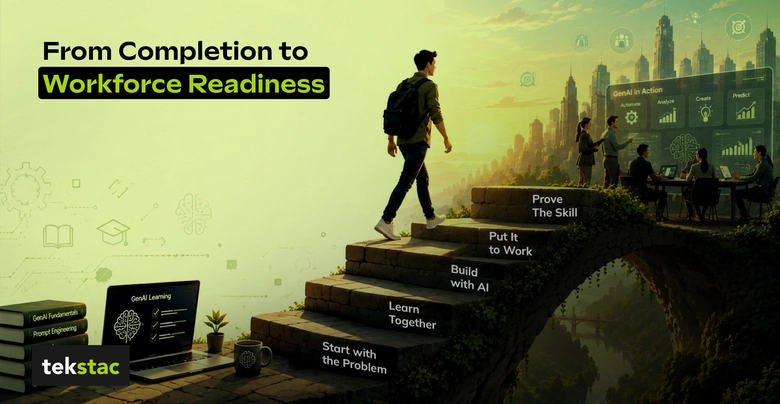
The difference becomes clearer when the learning journey is looked at as a whole.
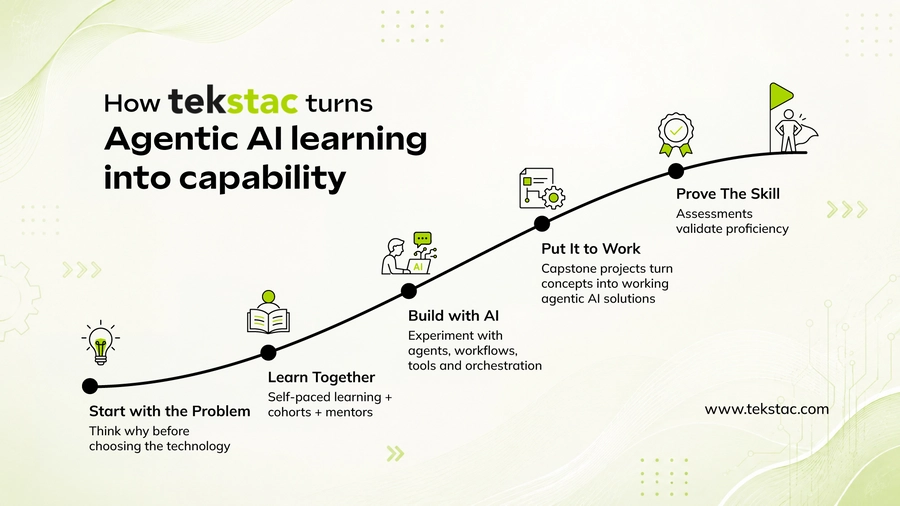
Learners are encouraged to think about the why and the so what before deciding what technology to use. This matters because an impressive agent that does not solve a meaningful problem is still a poor solution.
The approach also helps learners develop the judgment needed to navigate an AI landscape where tools and frameworks are changing constantly.
The learning experience combines self-paced content with cohort interaction and office hours.
That matters particularly for working professionals. Instead of spending synchronous time-consuming lectures, learners can use that time to discuss challenges, ask questions, work through problems, and get feedback from mentors and peers.
Learners do not stop at understanding how an agent works.
They work with agent workflows, tool use, orchestration, and observability. Tekstac’s hands-on labs are designed to provide environments where learners can experiment with technology and receive automated feedback.
A capstone project provides another important layer. Instead of ending with a quiz or certificate, learners bring together their understanding of the problem, architecture, tools, agent workflow, and design decisions into a working prototype.
The value of the capstone is not simply that something gets built. It creates an opportunity to demonstrate the thinking behind the solution; the problem being addressed, why an agentic approach was selected, what changed during iterations, and what the learner would need to consider before taking it further.
Assessment then becomes more than a final checkpoint. Tekstac combines quizzes and auto-evaluated technical assessments with practical labs and role-based learning to provide evidence of proficiency and identify areas that need improvement.
Building job-ready AI skills will remain a key priority for enterprises. They give employees the concepts, frameworks, tools, and vocabulary needed to enter a rapidly evolving field.
As enterprises move toward autonomous workflows and AI-enabled operating models, they will need more than employees who understand Agentic AI. That requires a shift from measuring learning activity to measuring demonstrated capability.
Tekstac approaches this shift by bringing together problem-first Agentic AI learning, hands-on practice, mentoring, capstone projects, skills validation, and readiness mapping. The result is a learning journey designed not simply to answer, “Did the employee complete the course?” but to get closer to the question that matters more in 2026.
Book a demo to know more about our Agentic AI learning paths and how to turn them into workforce decisions.
1. What skills are needed to learn Agentic AI?
A basic understanding of AI, machine learning, or large language models is useful. Depending on the learning path, learners may also benefit from knowledge of Python, APIs, prompt engineering, RAG, cloud platforms, and software development concepts.
2. What is the difference between Generative AI and Agentic AI?
Generative AI primarily focuses on creating content such as text, code, images, or summaries in response to user input. Agentic AI extends these capabilities by enabling AI systems to plan, make decisions, use tools, and execute multi-step tasks toward a goal.
3. Is Agentic AI difficult to learn?
Agentic AI can involve several advanced concepts, but a structured learning path can make it easier to build the required skills progressively. Starting with LLM fundamentals and moving toward tool use, orchestration, and multi-agent systems can provide a practical learning progression. Platforms like Tekstac offer structured Agentic AI Learning Paths that bring together concepts, hands-on labs, assessments, and practical application.