
Most enterprise AI pilots never reach production. Forward deployed engineers (FDEs) are thepeople who close that gap, which is why they are becoming a priority across the globalcapability center India landscape.The gap is not model access. It is the shortage of engineers who can take a model into a messyenterprise environment and make it deliver.This guide is a build framework, not just news. It walks GCC leaders, CHROs and Heads ofEngineering through four capability models, the skill stack, a training blueprint, the operatingmodel and the retention levers that make the capability stick.
Key Takeaways
GCCs have a strategic advantage in FDE development: Their access to enterprise systems, data and business stakeholders creates the right environment for forward deployed engineering.
Internal talent is a largely untapped opportunity: Engineers with 3–8 years of experience can be developed into FDEs through structured upskilling.
FDE capability needs more than technical training: Real-world problem-solving, system integration, customer discovery and deployment experience are equally important.
Building an FDE talent engine requires a long-term approach: The right mix of hiring, internal conversion, hands-on training and mentorship helps GCCs scale sustainably.
Why Forward Deployed Engineering Has Become a GCC Priority
From model access to the last-mile problem of enterprise AI
Every enterprise can now access strong models. That used to be the hard part; it no longer is.The hard part is the last mile, where a promising demo meets legacy systems, patchy data,security reviews and users who must learn to trust the output.FDEs own that last mile. They sit with the business problem, build the solution alongside thepeople who will use it, and stay accountable until it works in production. A pilot that impresses in a boardroom but stalls in production is, in effect, an FDE gap.
1.GCCs as natural FDE engines
GCCs are moving from delivery hubs to product and outcome ownership. Any global capabilitycenter India enterprises run already sits close to the parent company’s data, systems andstakeholders.
That makes deploying AI inside the enterprise forward deployed work in substance, even whenthe job title says something else. The customer is simply internal, and the engineers alreadyknow how the organization really works.
Picture a GCC engineer who takes an AI assistant from a successful pilot and wires it into aglobal finance workflow. She handles access controls, data feeds and a skeptical operationsteam. That is FDE work, whatever her title says.
Demand signals
The market data points the same way:
India accounts for over 50% of global GCC activity, with the market at $64.6B in FY2024 and projected to reach $99–105B by 2030.
India now has 1,900+ GCCs employing about 2.1 million people (ANSR, September 2026).
Postings for forward-deployed and AI-engineering roles grew roughly 1,000% in twelvemonths (ANSR).
Most FDE-style roles cluster in Bengaluru and Hyderabad and are rarely labelled “FDE.”
The lesson for leaders: success is no longer about bigger teams. It is about building scalable talent engines that can attract, develop and deploy talent at speed. As GCCs take on more strategic work, from AI/ML leadership to R&D, that ability becomes a real competitive advantage.
2. The Talent Gap Inside India’s GCCs
Supply vs. demand
Industry estimates put demand at roughly 25,000 FDE-type roles against a ready pool of about2,800 engineers. Even if the exact numbers shift, the direction is clear: demand is running manytimes ahead of supply.
Why hiring alone won’t close it
Hiring is the default response, but it breaks down quickly:
Scarcity: Few proven FDEs are courted by every GCC and startup.
Cost: FDE pay carries a premium of roughly 30–60%.
Retention risk: Hired talent with a market-ready profile is also the easiest to lose.
Mislabeled roles: With no common definition, job titles don’t reveal who is actually an FDE.
The 3–8 years mid-career cohort
Hiring data points to engineers with 3–8 years of experience. They already know productioncode, enterprise systems and the GCC’s own stack.This is the natural conversion pool. Yet few programs are designed around it. A backendengineer, a data engineer, a QA lead and a DevOps specialist bring different strengths, so onegeneric course won’t fit them all.
How leading GCCs Are Building FDE Capability: Four Models & Measuring FDE Capability and ROI
There is no single forward deployed engineering model that fits every GCC. Leaders typicallychoose among these four models.
Hire: Recruit experienced FDEs from the market. Expensive, scarce and a retention risk.
Convert: Reskill internal engineers into FDEs. Usually the fastest route to scale, and where the biggest opportunity sits.
Partner or academy: Outsource training to an external program. Quick to start, but often generic and detached from your stack.
Hybrid: Embedded pods plus structured training. It combines live delivery with capability building.
Comparison at a glance
Factor
Hire
Convert
Partner / Academy
Hybrid
Cost
Highest (30–60% pay premium)
Moderate
Moderate to high
Moderate
Time-to-productivity
Fast on paper, slower once ramp-up on your stack is counted
Fastest to scale, with a structured program
Medium; depends on stack fit
Medium, improves as pods mature
Risk
High: scarcity, attrition, poaching
Low to medium: needs strong assessment and labs
Medium: generic content, weak GCC fit
Low: delivery and learning reinforce each other
Scalability
Low: limited by market pool
High: draws on the existing engineer base
Medium to high
High
Best for
Senior or specialist gaps
Building a bench from 3–8 year engineers
Fast kick-off with little internal capacity
Sustained capability at scale
Designing an FDE Training and Upskilling Program
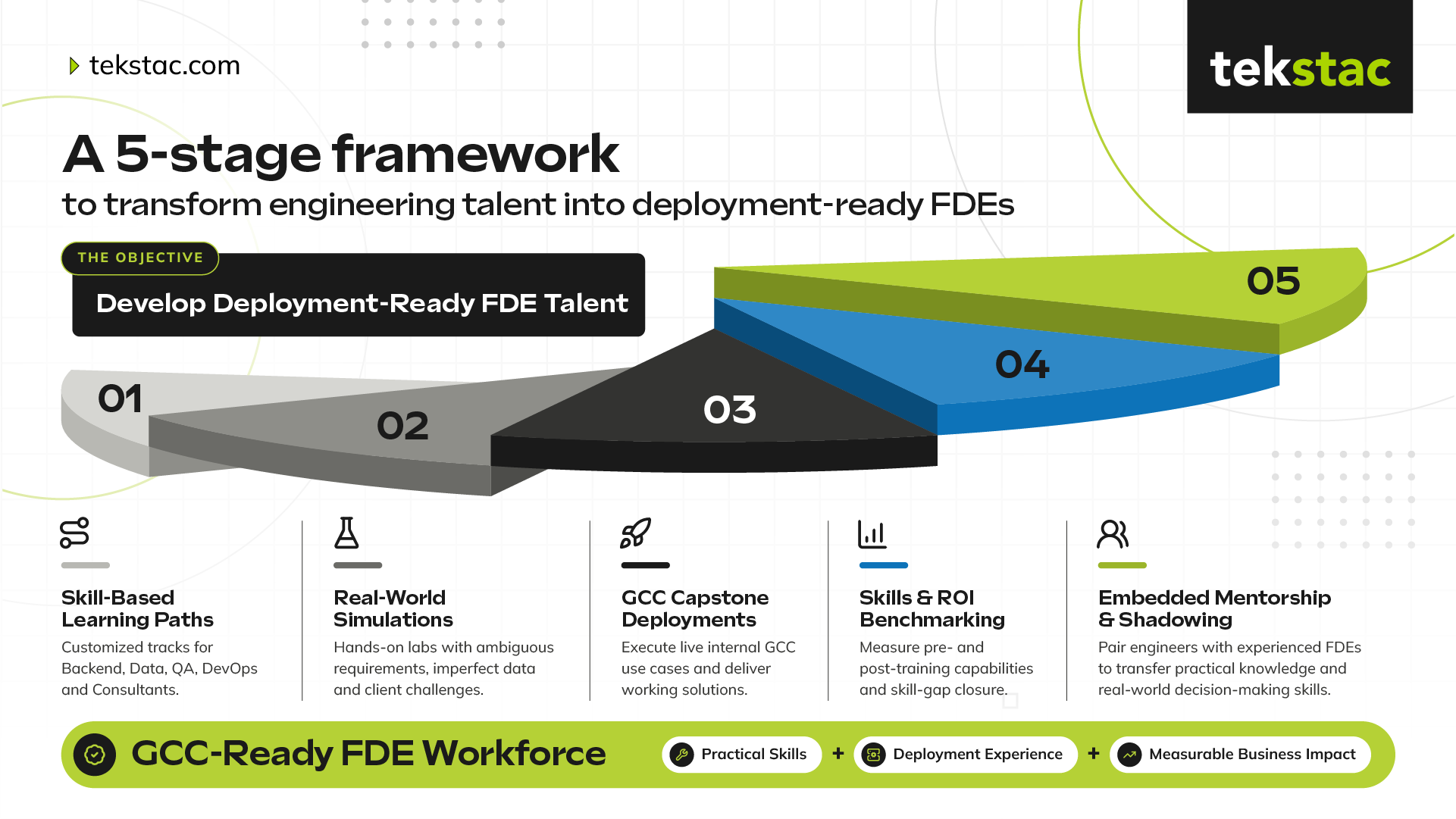
Effective forward deployed engineer training is built around doing the work, not watching it. Five building blocks matter.
Role-based learning paths. Map tracks to the skill stack above and to where engineers start: backend, data, QA, DevOps or consultant. A QA engineer and a data engineer need different on-ramps.
Hands-on labs and simulated client environments. Certificates alone won’t build FDEs. Engineers need labs that mimic real constraints: ambiguous requirements, imperfect data and a stakeholder who changes the brief.
Capstone deployments on real GCC use cases. End each cohort with a capstone on a live internal use case. Training then produces deployment output, not just completion rates.
Assessments and skill benchmarking, before and after. Benchmark every engineer at the start, then again at the end. The delta is your evidence of skill-gap closure, and your input for the ROI case.
Mentorship and shadowing with embedded pods. Pair learners with experienced FDEs on live engagements. Shadowing transfers judgement that no course can.
These are the building blocks behind Tekstac’s role-based programs. In one Agentic AI engagement, 1,200 engineers at a top 5 IT consulting firm ended with a capstone built on CrewAI and LangGraph. The aim is simple: training that ends in something deployable.
How Tekstac Helps GCCs Build FDE Capability
Tekstac helps GCCs run a convert-first approach with:
Role-based FDE competency frameworks and skill-gap assessments
Hands-on labs and capstones built around your own stack and use cases
Pre/post benchmarking with a manager dashboard to show ROI
Pilot cohorts, for example 25–30 engineers over 6–8 weeks, to prove the model first
Conclusion
Forward deployed engineering is fast becoming core to every global capability center Indialeaders run, and hiring alone cannot meet the demand. The smarter path is to convertmid-career engineers, put them through forward deployed engineer training built on labs andreal capstones and measure the outcome.
Start small: define the role, benchmark your engineers and run one pilot cohort on a live usecase. Then scale what works.
FAQs:
Can GCCs reskill existing engineers into FDEs? Yes. Engineers with 3–8 years of experience already have an engineering base. A structured program of role-based paths, labs, a real capstone and benchmarking can close the remaining gap.
FDE in a GCC vs an IT services firm: what’s the difference? In a GCC, the customer is typically internal and the global capability center operating model lets the team own the outcome long term. In an IT services firm, FDEs serve external clients on contract timelines, so context resets between engagements.
Why are hands-on labs for AI deployment training important? Deployment skill comes from solving real constraints, not from certificates. Labs let engineers practice evals, guardrails, integration and stakeholder handling safely, before they touch production.
As Chief Product Officer at Tekstac, Muthuselvan Ayyasamy leads product strategy and innovation for Tekstac’s enterprise skilling platform. His expertise spans learning technology, product innovation, and Generative AI, with a focus on creating personalized and impactful learning experiences. He is passionate about leveraging emerging technologies to transform professional development and help individuals and organizations build the skills needed for the evolving digital economy.